The Tool Desk
Outbyte Driver Updater FREEFix the driver behind crashes, sound loss and screen glitchesFind Drivers →Outbyte PC Repair FREEClear out junk files and repair common Windows errorsFree Scan →To stream portrait video to YouTube Live with FFmpeg, send a correctly composed 9:16 feed to the RTMP or RTMPS ingestion URL and stream key for your YouTube broadcast. A single portrait feed does not automatically create a separate horizontal version. If you need both formats, configure YouTube’s encoder-based vertical workflow and send the appropriate feeds to their corresponding stream keys.
Choose portrait-only or portrait and horizontal
First decide what viewers should receive. For a portrait-only broadcast, produce a 9:16 output and use the selected stream’s ingestion destination and key. Confirm the vertical preview in YouTube Studio before making the stream public.
As an Amazon Associate I earn from qualifying purchases.
If you want horizontal and vertical formats together, YouTube’s Live Control Room can publish both formats. For an encoder-based vertical feed, use the vertical preview’s Auto menu, select Encoder, choose RTMP(S), and select a second stream key for the vertical output. Send each correctly composed format to its corresponding key; do not assume one FFmpeg output will generate both. YouTube may otherwise use a Studio-managed vertical layout, such as a center crop or another layout option. YouTube’s vertical live streaming guidance describes the available workflow.
Quick wins for a faster PC:
Scan for outdated or missing drivers - takes under a minuteDriver Scan →Clear out junk files and repair common Windows errorsFree Scan →Choose based on the intended viewing experience, whether you need separately composed layouts, whether the second stream key is available, and whether your upload connection can sustain both outputs.
#1 Best Overall

- Camera mount tripod stand with zippered storage bag
- Adjustable height from 16.1inch to 50inch with 3-section,lever-lock legs for simple adjustments
- Folds down quickly and made of lightweight aluminum; It weighs only 1.23 lbs,lightweight and portable, easy to carry for travel,hiking,camping,etc
- 3-way head allows for tilt and swivel motion;portrait or landscape options;Built in Bubble Level,fast and accurate positioning
- Quick-release plate helps ensure fast transitions between shots
Get the YouTube ingest URL and protect the key
- Open YouTube Studio and enter Live Control Room. Create or select the scheduled stream you intend to use.
- Copy that stream’s URL and stream key. The endpoint and key are specific to the account and stream. Keep the key secret; never publish a real key in an article, screenshot, command shared publicly, or support post.
- Choose RTMPS where available. YouTube recommends the secure RTMPS protocol. Its setup guidance specifies port 443, and the secure endpoint, scheme, host and path must match the values shown for your stream. See YouTube’s RTMPS guidance.
For FFmpeg, the destination is supplied as an output URL. Depending on the endpoint format and FFmpeg build, the key may be appended to the URL or supplied as part of it. Use the format shown for the selected YouTube stream rather than assuming a universal URL.
Compose the source for a 9:16 frame
A portrait output needs an intentional composition, not just a portrait label. If your source is already 9:16, preserve its framing and encode at portrait dimensions. If it is landscape, decide what should happen to the content outside the narrower portrait frame:
- Crop: fills the portrait frame, but can cut off people, text, or action at the sides.
- Fit or pad: preserves more of the landscape image but may leave unused space around it.
- Designed or stacked layout: rearranges or combines material for portrait viewing rather than relying on a simple center crop.
YouTube’s vertical layout controls describe center crop, fit-to-phone-width and stacked-layout choices. In FFmpeg, the crop filter accepts width, height, x and y coordinates; when coordinates are omitted, the crop is centered. A fixed center crop may fail when a subject moves across the frame, so preview representative footage and adjust the framing deliberately. See the FFmpeg crop filter documentation and YouTube’s vertical layout guidance.
Rank #2

- 【Sturdy Aluminum Alloy Tripod】 This aluminum alloy double tube tripod is sturdy and durable for use in different shooting environments. The 70mm bowl base located at the bottom of the tripod head can be adjusted to keep it stable on most surfaces, meeting the needs of outdoor travel shooting
- 【Adjustable Height & Easy to Carry】 The strong flip locks allow the user to conveniently and easily extend and secure the legs. Use this locking mechanism to adjust the height of the tripod from 34.6"/88cm to 78.7"/200cm. Fold the tripod down to 35.8"/91cm and store away in the included tripod bag for easy storage and transport
- 【Standard 1/4" & 3/8" Screws】The large quick release plate with 1/4" and 3/8" screw is compatible with Canon Nikon Sony and other DSLR cameras and camcorders
- 【Fluid Drag Head】 The fluid head pans 360° horizontally and tilts -70° to 90° vertically, giving you a perfect shooting angle and enhanced shooting experience
- 【Bubble Level & Non Slip Rubber Feet】 Built in bubble level ensures this tall tripod is well balanced and securely set up. The maximum load capacity of the tripod is 17.6lb/8kg and is equipped with rubber pads at the bottom of the feet to increase stability
This filter template center-crops a landscape source to a 9:16 area and scales that result to 720 by 1280:
-vf "crop=ih*9/16:ih:(iw-ih*9/16)/2:0,scale=720:1280"
It is an instructional example, not a universal command. It may crop off-screen content, and the expression should be tested with your source dimensions, pixel format and FFmpeg build. Preview the result before streaming; change the crop position or use a fit or designed layout if the subject is clipped.
Rank #3

- 【75 Inch Tall Tripod Stand】 This tall camera tripod has a height adjustment range of 21.65-75 inches. It can meet the needs of daily work. This compact tripod comes with a carrying bag for outdoor and indoor shooting
- 【Tripod for All Camera and Phone】Standard 1/4" screw mount compatible with all cameras ( Canon, Nikon, Fujifilm, Olympus, Panasonic), DSLR, SLR, and digital cinema cameras, also spotting scopes, projector, binoculars. The 360° phone mount is compatible with iPhone 17 16 15 14 13 12 11 Pro/XS/XR/MAX/8/8 Plus/X/7 Plus/7/6s Plus/6s/6 Plus/6/Samsung Galaxy S22/ S21 Series/ Galaxy Z Flip/ NOTE/ One Plus 1+Series
- 【Professional Fluid Head Tripod】Professional camera tripod stand is equipped with a stable and smooth fluid head, it allows 360° horizontal panoramic shots, 180° up and down shots, and 90° vertical portraits. Non-slip pads provide great grip. You can also hang a backpack on the weight hook for extra stability
- 【Video Tripod for Photography】The video camera tripod is suitable for outdoor and indoor shooting. It can meet the daily shooting needs of video producers, video bloggers, and youtube users. Camera tripods for Photography, food shooting, live streaming, scenery shooting, and portrait shooting, etc
- 【Complete Tripod Units】What You Get: 1X Tripod Stand,1X Tripod Head, 1X Handle, 1X Universal Phone Holder, 1X Remote, 1X Spare QR Plate, 3X Non-slip pads. Please contact us anytime if any questions
Set codec, bitrate and timing for YouTube Live
YouTube’s current encoder guidance supports RTMP/RTMPS and lists H.264, H.265 and AV1 video, up to 60 fps, and AAC or MP3 audio. It recommends constant bitrate (CBR) and a two-second keyframe interval; the interval should not exceed four seconds. Use progressive, square-pixel output where applicable, and choose bitrate for the codec, resolution and frame rate you actually send. The recommendations and table are on YouTube’s encoder settings, bitrates and resolutions page.
Recommended Free Tools
For one example in YouTube’s published table, 1080p at 30 fps with H.264 has a 5 Mbps minimum and 14 Mbps recommended bitrate; at the same resolution and frame rate, AV1 or H.265 has a 4 Mbps minimum and 10 Mbps recommended bitrate. These are YouTube’s technical guidance, not guarantees of picture quality or a substitute for checking your actual upload connection. Select a bitrate that your connection can sustain reliably and run an upload-speed test, as YouTube recommends.
| Setting | What to use |
|---|---|
| Video codec | H.264, H.265 or AV1, provided your FFmpeg build supports the encoder you select |
| Frame rate | Up to 60 fps; match the source and intended output |
| Audio codec | AAC or MP3 |
| Rate control | CBR |
| Keyframe interval | 2 seconds recommended; do not exceed 4 seconds |
| Bitrate | Use YouTube’s table for the selected codec, resolution and frame rate |
FFmpeg’s general command structure and RTMP example are documented in its command-line documentation. YouTube states: “We recommend streaming to YouTube Live with RTMPS, a secure extension to the popular RTMP streaming video protocol.”
Rank #4
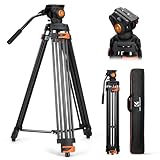
- 【Fluid Head】This fluid head supports 360° horizontal pan and -70°/+90° vertical tilt, enabling diverse shooting angles and providing video creators with stable footage. Also includes detachable handle for a different dominant hand.
- 【Sturdy Aluminum Alloy Tripod】This aluminum alloy is sturdy and durable for use in different shooting environments. Each tripod leg is made of multiple row tubes, with a triangle mid spreader, providing reliable stability with a max load capacity of 17.6lb.
- 【Fast Lock and Installation】Fast and safe camera installation and disassembly in one second, improve work efficiency, suitable for rapid changes in shooting scenes.
- 【Height Adjustment & Easy Portability】3 section telescopic legs and flip locks enable this shooting tripod to extend from 34.6" to 79.5". The tripod can be folded to 36.2" and fit in the carrying bag for easy storage and transportation.
- 【Wide Compatibility】The large quick release plate with 1/4" and 3/8"-16 screw is compatible with Canon Nikon Sony and other DSLR cameras and camcorders. It can also compatible with Camera slider for effortless movement during filming.
Build and test the FFmpeg output
There is no universal copy-and-run command: the input, crop, available encoders, resolution, frame rate and YouTube endpoint/key format vary. Use this schematic to see the output structure, then substitute settings verified for your setup:
ffmpeg [input options] -i INPUT [filter and encode options] -f flv 'RTMP_OR_RTMPS_INGEST_URL/STREAM_KEY'
The placeholder URL is illustrative. Confirm that your installed FFmpeg build supports the selected encoder and protocol, and follow the endpoint’s actual URL/key format. FFmpeg documents an RTMP pattern using -re, libx264, AAC, FLV and a stream URL, but this schematic is not a tested command for every input or YouTube account.
- Prepare the source and composition. Choose portrait input or preview the crop, fit, pad or designed layout you will send.
- Set the encoder options. Choose a supported codec, frame rate, resolution and bitrate; configure CBR and the keyframe interval to match YouTube’s guidance.
- Set the output destination. Use the selected broadcast’s RTMP(S) ingest URL and secret key, with the correct endpoint format. Prefer RTMPS where available.
- Test privately or before going public. Include representative motion and audio. Watch Live Control Room’s preview, stream health and error messages, and correct issues before your intended audience joins.
Troubleshoot portrait streams
| Symptom | Check and fix |
|---|---|
| The stream does not appear in Live Control Room | Confirm FFmpeg is sending data, then verify the exact ingest URL and key. Check the stream’s status and health messages in Studio. YouTube’s liveStream API documentation distinguishes states including active, ready, created, inactive and error; health status reports detected issues. |
| RTMPS will not connect | Verify that you used the secure scheme and the correct ingest host and path, and that the connection uses port 443 as specified by YouTube’s RTMPS guidance. |
| The output is not portrait | Check the encoded width and height and the resulting aspect ratio. Also check whether Studio is using the encoder-based vertical path or a Studio-managed layout. |
| The crop cuts off the subject or text | Change the crop’s x/y position and preview again, or use a fit, pad or designed/stacked composition instead of a centered crop. |
| The picture stutters, drops frames or loses quality | Check whether the upload connection can sustain the selected bitrate. Revisit YouTube’s table for the actual codec, resolution and frame rate, then test a suitable setting with representative footage. |
| FFmpeg rejects an encoder or protocol | Check the installed build’s supported encoders and protocols. Choose an available encoder and confirm the output URL and muxing format are appropriate for the selected RTMP(S) destination. |
Or let it run in the cloud
For a prerecorded video or playlist that should loop as a continuous YouTube stream, StreamNeo keeps the broadcast running from the cloud. Upload the video or build a playlist, add your YouTube stream key once, and go live. Your computer and home connection do not have to stay on. Every slot streams the uploaded file as made, up to 4K 60fps, at one flat price per slot; StreamNeo does not re-encode, and there are no quality tiers. It also attempts automatic recovery if YouTube drops the stream.
The first day is free with no card, once per account. The monthly option is $9.99 per month. The same product is included on every plan; only the billing length changes. StreamNeo is for uploaded video and playlists sent to YouTube, not a live camera input.
Quick Recap
Start your free StreamNeo day.
Product prices and availability are accurate as of the date/time indicated and are subject to change. Any price and availability information displayed on Amazon at the time of purchase will apply.




