To compare smartphone speakers before buying, play the same familiar speech and music on each phone in the same room, with external audio disconnected and volume matched by ear. Listen for clear voices, a balanced tone, useful volume, stereo presentation, and repeatable buzzing or rattling. This is a practical listening check—not a calibrated measurement or a certificate of hardware health.
Set up a fair comparison
- Choose a quiet, familiar setting. Use the same room and the same audio on every phone. Keep your listening distance and phone orientation consistent.
- Disconnect other audio routes. Turn off Bluetooth and disconnect headphones, casting, USB audio, or other connected devices. Confirm that sound is coming from the phone itself.
- Check media volume. Start at a low level, then raise it gradually. Compare phones at roughly similar perceived loudness; a louder phone can seem better even when its sound is not clearer.
Listen for the qualities that matter
Speech clarity
Play a spoken sample or dialogue you know well. Check whether words remain easy to understand and voices sound natural. Raise the volume gradually and listen for clarity that deteriorates, as well as buzzing, crackling, or obvious harshness.
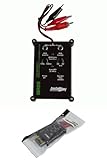
As an Amazon Associate I earn from qualifying purchases.
Music and tonal balance
Use a familiar music passage, not just a synthetic test sound. Notice whether the sound is engaging and balanced to you, or whether parts seem unusually weak or distracting. If a tone sweep is available, listen for repeatable rattles or conspicuous changes as tones rise and fall. A sweep is only a listening aid: variations in loudness across tones can be normal, and hearing them does not measure calibrated frequency response.
Quick wins for a faster PC:
Fix the driver behind crashes, sound loss and screen glitchesFind Drivers →Clear out junk files and repair common Windows errorsFree Scan →Useful volume and artifacts
Increase the level only as far as you would realistically listen. Note the highest level at which the sound remains acceptable to you, and whether buzzing, rattling, crackling, or clipping becomes objectionable. Repeat a concerning sound at a moderate level and with another sample: an artifact that recurs is more meaningful than a single noisy moment.
#1 Best Overall
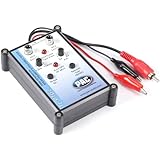
- Tone Generator and Speaker Polarity Tester
- Perfect for safely troubleshooting and testing audio systems
- Output range of 0-8 volts at a variable 13 to 10,000Hz tone
- 9V Speaker popper for visually testing speaker connection polarity
- Includes RCA and alligator clips for connection
Stereo and everyday placement
Listen with the phone held and placed as you expect to use it. Check whether your hand or the surface blocks an output and whether stereo presentation is useful in your usual orientation. Phones can route audio differently, so an unexpected result from a left- or right-channel test does not by itself show that a speaker is broken.
Compare two phones without letting setup decide
For each phone, use the same room, passage, distance, orientation, and roughly matched perceived loudness. These are the most useful listening-comparison axes:
Rank #2

- Perfect for setting system levels, checking crossovers, and verifying connections
- Versatile Tone Generator & Speaker Polarity Tester
- Adjustable 0-8V output with a 13Hz - 10,000Hz range
- RCA and alligator clip connections included
- How intelligible and clear speech sounds.
- Whether speech and familiar music have a tonal character you like.
- How much usable volume you get before artifacts become objectionable.
- Whether a buzz, rattle, crackle, or clipping repeats at ordinary listening levels.
- Whether stereo presentation works for your likely grip and phone orientation.
- Whether the phone sounds acceptable in the positions you will actually use.
If you consult published speaker tests, look beyond a headline score: the method and reported dimensions matter. Formal audio testing can examine frequency response, maximum output, distortion, dynamics, and channel behavior, but its results depend on a defined setup.
What a listening test can—and cannot—establish
A careful store comparison can help you judge personal preference and notice repeatable problems during playback. It cannot give you a calibrated loudness, frequency-response, or distortion measurement, identify which internal component caused an artifact, or prove a phone is healthy. TestingPhone.com puts the distinction plainly: “A result describes what this test observed. It does not automatically diagnose the component inside the phone.” (Phone Speaker and Audio Test; accessed October 7, 2026.)
Rank #3

- Performance: Car speaker tester is used to detect whether the positive and negative poles of the speaker are correctly connected. Car audio speaker test is suitable for door speakers, subwoofers, mini tweeters and other places
- Indicator Lights: Automotive speaker polarity tester comes with 3 color indicator lights. If 3 green and 1 red lights flash, it is correct. If the 3 red and 1 green lights are connected in reverse, yellow indicates low battery
- ABS Material: Auto car audio speaker hom tester phase meter is made of ABS material, which is strong and insulating. Automotive speaker polarity tester is not prone to leakage or breakage, allowing you to use it for a long time
- Convenience: The mini phase meter phasemeter is easy to use with a compact and lightweight design structure. Phase polarity checker detector won't take up space when stored in the car or other places, bringing you convenience
- Specifications: The package includes 1pcs polarity tester and 1pcs test CD, the battery type is 1 9V 6F22 dry batteries (not included). Speaker tester is a professional device for testing and troubleshooting of car audio systems
Professional measurements control the audio stimulus, device position, room or test fixture, and measuring equipment. RTINGS describes using calibrated microphones at a defined distance, adjusting output to a target level with pink noise, and averaging repeated readings for frequency-response results; its methodology also considers soundstage and dynamics (How We Test Speakers: Transforming Data into Comparable Reviews; accessed October 7, 2026). AnandTech’s 2013 smartphone-audio article lists maximum output, THD+N, frequency response, dynamic range, and crosstalk as test dimensions; it is useful for understanding categories, not for guidance on current phone models (Smartphone Audio Quality Testing).
Standards offer further context, but they are not consumer pass/fail rules for a phone’s media speakers. ITU-T Recommendation P.313 (June 2015) sets test methods and requirements for mobile handsets, headsets, and speakerphone sets, including sending and receiving levels, frequency response, noise, sidetone, stability, echo path, and delay (Recommendation P.313). ITU-T’s handset methodology also reports results under a defined reference setup, which should not be treated as a direct forecast of every person’s media-playback experience (Testing Requirements and Methodology; accessed October 7, 2026).
Rank #4
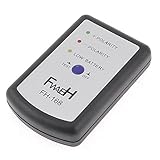
- This phase meter can test all speakers of all car, such as small treble, door speakers, subwoofer, etc.
- Perfect for safely troubleshooting and testing audio systems.Powered By 1 x 9V 6F22 Battery(not included).
- Play section 1 or 2, can check the left/right channel connection is right or not.
- Play section 3 or 4, the sound speaker will produce a fixed frequency signal.
- Then press the 'test' button on the phasemeter, 3 green light flash and 1 red light indicates that the speaker output is in positive phase (correct connection) ; 3 red light flash and 1 green light indicates that the speaker output is in negative phase (reversed connection).
Do not use the phone itself as a precision meter
A phone’s built-in microphone is not suitable for accurate sound-level measurement, according to ITU’s 2024 technical guidance. A validated app paired with a high-quality external microphone may form a system meeting key Class 2 sound-level-meter requirements, but only a tested combination is appropriate when a formal level result matters (ITU technical handbook on sound-level measurement).
Quick Recap
Product prices and availability are accurate as of the date/time indicated and are subject to change. Any price and availability information displayed on Amazon at the time of purchase will apply.




