What’s actually slowing this PC down?
Pick the symptom - the matching free tool is one click away.
Measure the work your cluster finishes, not the benchmark scores of its individual Macs. Run one fixed workload on one node, run the identical workload across the intended nodes, and compare elapsed time, completed work, latency, scaling efficiency, resource pressure, failures and energy per unit of work. A cluster can show high CPU or GPU utilization yet deliver little useful speedup when coordination, data transfers, storage or memory capacity dominates.
The procedure below gives you a repeatable way to answer both practical questions: “How do I measure performance in a Mac mini cluster?” and “Does adding Mac minis make my workload faster?”
As an Amazon Associate I earn from qualifying purchases.
What “performance” means in a Mac mini cluster
A cluster is faster only when it completes the target work sooner, handles more work in the same period, or meets a required response-time target with acceptable cost and energy. A collection of impressive single-node specifications does not establish that result. Distributed execution adds scheduling, synchronization, network transfers, serialization, storage access and failure handling. Those costs can consume the benefit of additional processors.
The Tool Desk
Outbyte PC Repair FREERepair Windows errors before they cause bigger problemsFix Now →Outbyte Driver Updater FREEScan for outdated or missing drivers - takes under a minuteDriver Scan →Choose an outcome that represents useful work for the application you actually intend to run:
#1 Best Overall

- Peak Performance with Thunderbolt 5: Experience superior performance, enabling 80Gbps data transfers and 240W fast charging for powerful multi-display setups.
- Lightning-Fast File Transfers: Move 5GB files in just 1 second with advanced 80Gbps transfer speeds.
- 8K Display Capabilities: Support for dual 8K displays at 60Hz delivers stunning clarity and detail with up to 120Gbps bandwidth.
- 240W USB-C Charging: Charge a 16-inch MacBook Pro (M3 Pro) to 50% in just 26 minutes with ultra-fast 240W USB-C charging.
- What You Get: Anker Prime Thunderbolt 5 Cable (3.3 ft, 80Gbps, 240W), welcome guide, 18-month warranty, and our friendly customer service.
- Completed jobs per hour for batch processing.
- Elapsed time to render a fixed scene.
- Build time for a fixed project and clean checkout.
- For language-model inference, time to first token and sustained generated tokens per second.
- For a service, response-time percentiles (for example, median and tail latency) at a stated request rate.
Record errors, retries, cancelled work and incomplete jobs alongside the headline result. There is no universal Mac mini cluster score; the right metric depends on the workload, runtime and user-facing objective.
How do I measure performance in a Mac mini cluster?
1. Define the workload and success criteria
Write a short test specification before touching the cluster. Identify the application or framework, input data, model or project, software versions, settings, batch size, concurrency and the exact unit of completed work. State whether startup, compilation and cache population are part of the user experience or excluded from steady-state measurements.
Use a fixed input when measuring a fixed job. For throughput tests, define the test duration or number of items and the rule for an item to count as complete. For an inference test, record model name, quantization, context or input length, generation limit, sampling settings, batch size and concurrency. Prompt processing and token generation are different phases; report them separately when the runtime exposes both.
Recommended Free Tools
Make the workload large enough that timing noise is small, but do not silently change batch size or concurrency between the one-node and multi-node runs. Such changes may improve a result, but they are a different experiment and must be labeled as one.
2. Inventory every node and the interconnect
For each Mac mini, record the model identifier, chip, unified-memory capacity, internal storage, macOS version, application and runtime versions, and relevant configuration. Include whether the executable, data and model files are local to each node or read from shared storage.
Record the cluster framework, node count, scheduling method, network topology, link speed and cable type. Note which ports are used and whether a switch, direct connection or another device sits between nodes. Keep this inventory with the benchmark results; two clusters with the same node count can behave very differently because of memory, storage and interconnect differences.
Apple’s August 25, 2026 Mac mini announcement specifically associates clustering with Mac mini systems using M5 Pro and Thunderbolt 5. Port options differ by model, so do not assume that every Mac mini generation has the same links or that a Thunderbolt 5 topology applies to older systems.
3. Establish a one-node baseline
Select one node and run the exact job planned for the cluster. Use the same executable, data, model, settings and output validation. Warm up the application or model if compilation, shader creation or cache population would otherwise affect only the first run. If cold start is part of the real user experience, measure it as a separate scenario rather than mixing it with warm runs.
Rank #2

- 240W Superfast Charging: Empower your devices with Superb 240W PD 3.1, charging a MacBook Pro 16" to 56% in 30 minutes. Backward compatible with 140W/100W/65W devices, ensuring future-proof performance for laptops, phones, and accessories
- Lightning 80Gbps Data Transfer: Transfer a 20GB 4K movie in just 3 seconds with USB4 Gen4's 80Gbps bandwidth, 8x faster than standard USB C cables. Perfect for photographers, developers, or anyone moving massive files between SSDs, NAS, or dual computers
- Industry Leading HD Display: Unlock cinematic visuals with DisplayPort 2.1 mode, supporting up to 16K@60Hz and extending to dual 8K@60Hz or triple 4K@144Hz Display. Ideal for gaming rigs, 3D rendering workstations, or multi screen traders demanding ultra smooth, zero lag visuals
- All-in-One Solution: A single USB C to C cable handles 240W charging, 80Gbps data syncing, and 16K max video output. Seamlessly connect USB C laptops, such as MacBook Pro Air, Dell XPS, phones,such as iPhone 16, Galaxy S24, tablets like iPad Pro, monitors, and accessories. Supports Thunderbolt 4 3, USB4, USB 3.2 3.1 3.0, and more
- Sturdy and long-lasting: Solid and durable nylon braided cable ensures longer service life up to 10,000 bends. Double sided USB C connectors with over molded strain relief are designed for frequent insertions, Aluminum housing, high purity copper wire, and triple shielding will keep long lasting fast charging performance
Capture elapsed wall-clock time, successful work completed, errors and retries. Note the node’s CPU, GPU, memory, disk and network behavior during the run. A baseline must be large enough to measure reliably, but its batch size and concurrency are part of the test definition.
4. Run the multi-node workload
Run the same input and work definition on the intended number of nodes. Keep software versions and settings constant. Repeat each configuration several times and retain every result, not only the fastest run. Report the median and a spread such as minimum and maximum, interquartile range or percentile values. Include node count and the full configuration beside every result.
Separate cold-start and steady-state measurements when users encounter both. For a service, drive a stated request rate and record latency percentiles as well as completed requests. For a fixed batch job, report total completion time and whether all outputs passed validation.
Outdated Drivers Are Slowing You Down
One free scan finds every outdated or missing driver and matches the right update for your exact hardware.Free scan · exact hardware matchPC Slower Than It Used to Be?
A free scan shows the junk files, broken settings and background clutter dragging Windows down - then fixes them in one click.Free scan · Windows 10 & 115. Calculate speedup and scaling efficiency
For comparable runs, calculate:
- Speedup = one-node elapsed time ÷ multi-node elapsed time.
- Scaling efficiency = speedup ÷ number of nodes.
These are analytical definitions, not Apple-published cluster scores. A speedup of 2 on four nodes corresponds to 0.5, or 50%, scaling efficiency. The ratio is meaningful only when the work, input, software, settings and measurement conditions are comparable. If the one-node run fails because the model does not fit in memory, say that explicitly; it is not a valid baseline for a like-for-like speedup claim.
For throughput workloads, report completed units per unit time directly. A cluster can increase throughput while making an individual job’s latency worse, or reduce latency for a large job while offering little gain for small jobs. Publish both measures when both matter.
6. Measure coordination and transfer overhead
Measure the time spent before useful processing begins, during synchronization and moving data between nodes, and after processing while outputs are gathered. Depending on the framework, these phases may appear as queue time, communication time, barrier waits, serialization, file staging or idle gaps.
Compare the amount of data sent over the interconnect with the amount of useful work completed. If nodes repeatedly exchange large activations, model shards or intermediate files, link bandwidth and latency can dominate. If one node waits for the slowest participant, a straggling node or uneven partition can determine total completion time.
Quick wins for a faster PC:
Repair Windows errors before they cause bigger problemsFix Now →Fix the driver behind crashes, sound loss and screen glitchesFind Drivers →Clear out junk files and repair common Windows errorsFree Scan →7. Observe resources during the same run
Use observations to explain the workload result, not to replace it. Collect CPU, GPU, memory, disk and network readings while the benchmark is running. Note when a node is idle, when memory pressure rises, and when transfers or storage activity coincide with low useful throughput.
Rank #3
![Cable Matters [Intel Certified] 80Gbps Thunderbolt 5 Cable, 3.3ft / 1m](https://m.media-amazon.com/images/I/41LqXZjTBYL._SL160_.jpg)
- Unparalleled Speed and Efficiency: Elevate your connectivity with Thunderbolt 5 technology that boasts data transfer rates up to 80 Gbps of bi-directional data transfer and up to 120 Gbps of video bandwidth. The future-proof Thunderbolt cables allow for the rapid synchronization and transfer of large files such as high-resolution videos and complex 3D models, ensuring maximized productivity. Ideal for professionals and enthusiasts who demand the highest data throughput for their workflows.
- Universal Compatibility: Designed for versatility, this Thunderbolt 5 cable seamlessly connects with a wide range of devices, including all Thunderbolt 3, Thunderbolt 4, USB4, and USB-C equipment. Whether you are connecting to the latest laptops, docking stations, or high-resolution displays, this cable ensures you can build a flexible and efficient workspace with widespread compatibility. Performance depends on the capabilities of your host and display/dock.
- Dual 6K or 8K Display Support: Empower your visual experience by connecting dual 6K or dual 8K or triple 4K @144Hz displays, which provide stunning, detailed visuals that are crucial for graphic design, video editing, and other professional applications that require superior display clarity and detail. This cable is optimized for multimedia professionals and content creators who rely on precise color accuracy and sharp image quality for their projects.
- High Power Delivery: With the capability to deliver up to 240W of power and support for PD 3.1, this Thunderbolt 5 cable is a powerhouse for charging high-performance laptops, tablets, and other devices efficiently. Eliminate the clutter and hassle of multiple cables and power adapters in your workspace, as this Thunderbolt cable for Mac provides a high-speed charging solution alongside superior data and video capabilities.
- Thunderbolt 5 Laptop Compatiblity: Fully compatible with newly released Thunderbolt 5 laptops featuring USB-C / Thunderbolt 5 ports, including Acer Predator Helios 16 AI / Helios 18 AI, Alienware 16 / 18 Area-51, MacBook Pro 14 & 16 (M4 Pro / M4 Max), ASUS ROG Strix SCAR 18 G835, Gigabyte AORUS Master 16 AM6H, HP ZBook Fury 18 G1i, Lenovo Legion 9i Gen 10 (18" Intel), MSI Titan 18 HX AI / Raider 18 HX AI / Vector 16 HX AI (A2XW series), and Razer Blade 18.
Interpret utilization in context. High CPU use may indicate serialization or compression rather than productive computation. High GPU use on one node does not prove the cluster is balanced. Conversely, moderate utilization can be normal when a workload is limited by synchronization or memory bandwidth. Correlate each observation with elapsed time, throughput and latency.
8. Measure energy and thermal conditions when relevant
If efficiency is part of the decision, measure wall power for the whole system: every Mac mini and any networking equipment included in the comparison. Calculate energy per completed unit of work, not just instantaneous watts. Record idle power and workload power separately, and state the workload duration.
Apple Support defines its listed power measurements as wall-power readings that include power-supply and system losses. Its “Idle” condition uses Finder open with default power-management settings; “CPU Max” uses a compute-intensive application that maximizes processor use. The visible examples on that support page are older Mac mini generations, so they are not estimates for current Apple silicon nodes.
Free tools Windows power users keep installed
One-click scans. No signup required.
Record room temperature, airflow and sustained-run duration when thermal repeatability matters. Apple describes an airflow path through the Mac mini’s foot, but the cited material does not establish a universal thermal benchmark for clusters.
Metrics to report for a credible comparison
| Metric | How to calculate or collect it | Why it matters |
|---|---|---|
| Completed work | Count validated jobs, items, renders, builds or generated tokens. | Shows whether the system produced useful output rather than activity. |
| Elapsed time | Wall-clock duration for a fixed workload, with cold-start and steady-state cases identified. | Answers how long a user waits for a defined job. |
| Throughput | Completed units divided by elapsed time. | Shows capacity for batch and service workloads. |
| Latency | Report total job time or response-time percentiles at a stated load. | Captures responsiveness and tail behavior. |
| Speedup | One-node elapsed time divided by multi-node elapsed time. | Quantifies improvement relative to the baseline. |
| Scaling efficiency | Speedup divided by node count. | Shows how much of ideal linear scaling was achieved. |
| Variation | Retain all repetitions and report a median plus a spread or distribution. | Reveals jitter, stragglers and unstable scheduling. |
| Resource pressure | CPU, GPU, memory pressure, disk activity and network traffic observed during the run. | Helps identify the limiting subsystem. |
| Operational stability | Count failures, retries, incomplete jobs and setup overhead. | A nominally fast run is not useful if it frequently fails. |
| Energy per unit | Total wall energy divided by validated completed work. | Compares efficiency across node counts and configurations. |
Using Activity Monitor and Instruments on macOS
Activity Monitor: the accessible first pass
Apple’s Activity Monitor User Guide documents views for CPU, GPU, memory, energy, disk and network activity, plus system diagnostics. Open the relevant view during the benchmark and note whether all nodes show similar behavior. Memory pressure is more informative than free-memory numbers alone because it reflects compression and swap activity.
Capture observations at intervals or export them when your workflow permits. A single screenshot can miss a transient transfer spike, a short memory-pressure event or a node that went idle while another continued. Tie each observation to a timestamp in the benchmark log.
Instruments: application-level timelines
Use Instruments when Activity Monitor cannot show which operation is consuming time. Apple’s archived Energy Efficiency Guide for Mac Apps describes activity-monitoring and time-profiling templates. Instruments can reveal application-level waits, expensive functions, file activity and timing relationships across a run.
The same guide documents command-line diagnostics including powermetrics, fs_usage, sample and top. Availability, permissions and output differ by macOS version, so verify the samplers on the system being tested rather than promising a fixed output format. Run diagnostics consistently across the baseline and cluster tests and avoid allowing profiling overhead to change the workload.
Rank #4

- Featuring a black braided design that coils without tangling, this 1-meter cable supports Thunderbolt 5 data transfer up to 120Gb/s;¹ Thunderbolt 3, Thunderbolt 4, and USB 4 data transfer up to 40Gb/s; USB 3 data transfer up to 10Gb/s; DisplayPort 2.1 video output; and charging up to 240W.
- Use this cable to connect a Mac with Thunderbolt 3, 4, or 5 (USB-C) ports to Thunderbolt (USB-C) and USB displays and devices such as Studio Display, Pro Display XDR, docks, and external drives.
- You can also use this cable to connect iPhone and iPad models with USB-C to your Mac.
Does adding Mac minis make your workload faster?
It does when the workload can be divided into sufficiently large independent pieces, the nodes have enough memory, and communication overhead is small relative to computation. It may not when each task is too small, when every step requires synchronization, or when the model and intermediate data move repeatedly across the network.
Signs that additional nodes are helping
- Validated throughput rises as nodes are added.
- Fixed-job completion time falls and the speedup remains meaningful after repeated runs.
- Scaling efficiency stays acceptable for the node counts you can afford.
- Nodes remain busy with similar work rather than one node waiting for another.
- Network and disk activity remain proportional to useful computation.
Signs that coordination is dominating
- Adding nodes produces little or no speedup while transfer and synchronization time grows.
- One node repeatedly finishes early and waits at a barrier.
- Memory pressure or swapping appears on one or more nodes.
- Small jobs become slower because setup and scheduling overhead exceeds compute time.
- Failures and retries increase with node count, reducing completed work.
Test several workload sizes when practical. A configuration that scales for a large batch may be inefficient for interactive requests. Report the boundary you observed instead of presenting one node count as universally optimal.
Independent reader supportYour contribution helps us test, update, and keep practical guides available for everyone.Interconnect and Mac mini model considerations
Document the physical connection as carefully as the chip. Thunderbolt 5, Ethernet and other port configurations have different bandwidth, latency and topology implications. A cable does not provide distributed-compute software and cannot guarantee linear scaling. Confirm that every node supports the intended link, that the topology is valid for the framework, and that cable specifications match the port and distance requirements.
Do these 3 things before closing this tab:
1Fix the driver behind crashes, sound loss and screen glitches2Repair Windows errors before they cause bigger problems3Scan for outdated or missing drivers - takes under a minuteApple’s 2026 announcement states that Thunderbolt 5 allows users to cluster multiple Mac mini systems to run large AI models entirely on device, in the context of Mac mini with M5 Pro. Preserve that model context when describing the capability. Do not generalize it to every Mac mini generation.
Memory is another hard boundary. A cluster can offer more aggregate memory, but the framework must support partitioning or sharding the workload. If a model, dataset or intermediate result must fit on one node, adding other nodes may not solve the capacity problem. Record unified-memory size per node and explain how the runtime places data.
How to interpret Apple’s published benchmark figures
Apple’s August 25, 2026 announcement reports vendor testing conducted in July 2026. It claims up to 13.5× faster LLM prompt processing in LM Studio versus Mac mini with M1 — Apple, 2026, and up to 4.8× versus a Mac mini with M4. The test note identifies the M4 comparison system as a 10-core CPU, 10-core GPU model with 32GB unified memory and a 2TB SSD.
Those are model-to-model, single-system product comparisons under Apple’s stated conditions. They are not independent measurements of a multi-node cluster, and prompt-processing rate is not sustained token-generation speed. Keep the application, model, input, settings and “up to” qualifier attached whenever quoting such a figure. Apple publishes other workload-specific comparisons in the same announcement; each must be identified by its named workload and test condition rather than generalized into a cluster claim.
Apple chief hardware officer Johny Srouji described Mac mini as “our most versatile Mac” and said it can serve as an always-on agentic device. That is a product-use statement, not a measured cluster result.
Best Value
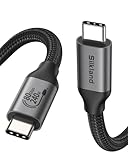
- 80Gbps Data Transfer: Silkland USB 4 Version 2.0 cable delivers a lightning-fast 80Gbps bidirectional data. Backup 6GB files in 1 second – drastically reduce wait times. It is USB-IF certified, meets full USB4 specs (TID:12800, verified by USB-IF official). *Actual speed depends on your device.
- 120Gbps Display Powerhouse: Boast 120Gbps unidirectional bandwidth, 3X the bandwidth of Thunderbolt 4/USB4 (40Gbps). Connect dual 8K/6K or triple 4K@144Hz displays for professional workflows. Enables 16K resolution & 4K@540Hz for ultimate creative/gaming.
- 240W Max Fast Charging: 240W meets power-hungry charging needs(like laptops). Supports PD 3.1 & backward compatible (60W/100W/140W). Equipped with an E-Marker chip for safety, stability, and battery protection.
- Full Thunderbolt 5 Cable Compatible: Future-proof and backward compatible with Thunderbolt 4/3, USB4, and USB 3.2. Works seamlessly with MacBook M4 Pro/Max, iPhone 17/16, Mac Mini, iPad, SSDs, docks, USB C Monitors, etc. Plug and play, OTG supported, and no driver needed.
- Premium Durability & Design: Slim Case-Friendly Shell fits phone cases effortlessly. Aluminum dissipates heat. Tangle-free 48-strand braided nylon ensures worry-free usage. Triple Shielding (EMI tinplate, 28 AWG OFC, stainless connectors) ensures signal integrity.
Troubleshooting disappointing scaling
Check the baseline first
Confirm that the one-node run and cluster run perform identical validated work. Compare software versions, input files, model revisions, batch size, concurrency and cache state. A faster multi-node result that processed fewer items is not a valid speedup.
Find the slowest node
Compare per-node completion counts, memory pressure, disk traffic and network activity. A different Mac mini model, nearly full storage or background process can create a straggler. Repeat with the same node roles and record whether the slow participant changes between runs.
Separate compute from communication
Instrument or timestamp partitioning, transfer, synchronization and final aggregation. If transfer time grows faster than compute time, increase task granularity where the application allows it, reduce unnecessary data movement, keep reusable assets local, or reconsider the topology. Do not claim improvement until the end-to-end workload confirms it.
Test memory and storage pressure
Watch memory pressure, compression and swap activity. Verify that temporary files and model assets are not unintentionally read over a slow shared path. A node that spends time staging data can make the entire cluster appear underutilized.
Account for startup and failures
Measure initialization separately from steady state, then publish both if users experience both. Include retries, failed tasks and recovery time in operational throughput. A cluster that is fast only when every run is perfect may have worse real-world capacity than a slower but stable configuration.
A reporting format readers can reproduce
Publish enough detail that another operator can repeat the comparison:
- Workload: application, model or project, input, output-validation rule and unit of completed work.
- Software: macOS, application, runtime, framework and configuration versions.
- Hardware: Mac mini model and chip, unified memory, storage and node count.
- Interconnect: port, cable, topology, link configuration and any switch or shared storage.
- Procedure: warm-up policy, batch size, concurrency, run duration or item count, and number of repetitions.
- Results: every run value, median, spread, completed work, failures, latency percentiles and cold-versus-warm distinction.
- Analysis: speedup, scaling efficiency, resource observations, coordination time and energy per completed unit when measured.
- Limits: conditions that were not tested, model-specific capabilities and any vendor-supplied benchmark figures kept separate from your measurements.
When the node generation, node count, framework, topology or workload is unspecified, state those choices before presenting a concrete number. Those details determine whether scaling is expected and which bottleneck metrics are relevant.
Bottom-line decision rule
Choose the cluster configuration that delivers the most validated work at the latency, reliability, energy and cost your workload requires. Treat CPU and GPU utilization as diagnostic evidence, not the verdict. A trustworthy result is a repeated, like-for-like comparison of one node and multiple nodes, with coordination overhead, resource pressure, failures, interconnect and measurement conditions visible beside the final throughput or latency.
Quick Recap
Product prices and availability are accurate as of the date/time indicated and are subject to change. Any price and availability information displayed on Amazon at the time of purchase will apply.




