Quick wins for a faster PC:
Fix the driver behind crashes, sound loss and screen glitchesFind Drivers →Clear out junk files and repair common Windows errorsFree Scan →Scan for outdated or missing drivers - takes under a minuteDriver Scan →Measure a concrete supercapacitor by charging and discharging it at a controlled, constant current while recording voltage over time. Calculate capacitance from a stated discharge interval using C = IΔt/ΔV; measure charge time as the elapsed time from a defined starting condition to a defined target voltage. Neither value is meaningful without the cell design, current, voltage window, and calculation basis.
What you are measuring
A “concrete battery” in this context is a cement-based electrochemical cell, often called a carbon–cement supercapacitor—not an ordinary block of concrete that stores energy uniformly. The tested structure may combine carbon–cement electrodes, an electrolyte, an insulating separator, and current collectors. Composition, dimensions, and electrical contact all influence the result. A reviewed cell design uses two electrolyte-saturated electrodes separated by an electrolyte-wetted insulating separator and connected through conductive collectors; it is one design, not a universal construction recipe. The 2024 RSC review surveys electrode and electrolyte configurations.
As an Amazon Associate I earn from qualifying purchases.
Capacitance and energy are different quantities. Capacitance is measured in farads (F); energy is measured in joules (J) or watt-hours (Wh). A cell can have a measurable capacitance without delivering a practically useful amount of energy or power.
What’s actually slowing this PC down?
Pick the symptom - the matching free tool is one click away.
Record the cell and its test conditions
Before testing, document what was assembled. Results cannot be compared fairly if one study reports an electrode value and another reports the complete cell, or if their electrolytes, voltage ranges, or specimen dimensions differ.
#1 Best Overall

- Versatile Digital Multimeter - Accurately measures AC/DC Current, AC/DC Voltage, Capacitance, Frequency, Duty Cycle, Resistance, Diode, Continuity and Temperature.
- Thoughtful Design - Support Data Hold, Large LCD Backlit Screen, Auto Shut-off and Kickstand make the process of measurements easier. Professional level is reflected in some features include Auto-Ranging capability, and True RMS for measuring both AC Current and Voltage.
- Suitable For Many Occasions - This Multimeter is a golden partner to help to troubleshoot a variety of automotive and household electrical problems safely and accurately.
- Ensure Safety - Double ceramic fuse is anti-burn and protects from overloading,and it will be more secure and reliable; F400mA/600V and F10A/600V explosion-proof ceramic fuse tubes can protect the multimeter effectively.
- Additional Tips - Please take off the cap before using the test leads. Check the manual for more usage information.
- Electrode dimensions, thickness, arrangement, and exposed area.
- Cement mix and conductive additive, including the type and proportion of carbon material when known.
- Electrolyte composition and concentration, separator material and geometry, and current-collector arrangement.
- How the cell was held together and how electrical contact or pressure was applied.
- Temperature, conditioning procedure, and cycle number, if controlled or reported.
- The normalization basis for results: active-material mass, electrode mass, whole-cell mass, volume, or area. Say whether a value describes one electrode or the assembled device.
Choose a voltage window for the particular specimen and its protocol. Do not borrow a limit from a different cement mix or assume that a commercial capacitor’s voltage rating applies. Cement-based studies use different compositions and test conditions; report the actual limits used. The 2026 cement-paste study is one example of an experimental investigation with its own mixtures and configuration.
Measure capacitance with galvanostatic charge and discharge
Galvanostatic charge/discharge (GCD) is a direct device-level approach: apply a fixed current, record terminal voltage against time, then discharge at a controlled current over a stated voltage interval. A programmable DC bench supply or another controlled-current source can provide the current, but the setup also needs suitable voltage measurement and time logging. A power supply alone does not guarantee adequate measurement precision or data acquisition. Select equipment for the cell’s voltage and current requirements. A 2025 review of cement-based supercapacitors describes controlled-current charge/discharge methods.
Rank #2

- Important Tips - This CM2K0R clamp meter can not test DC Current. To measure the AC Current you need to clamp the meter around one of the wires and not the whole power cord. Ensure the conductor to betested is in the center of the clamp head. The clamp Jaw is only used to measure current. Do not measure voltage by clamping the conductor being measured.
- Versatile Digital Clamp Meter - Accurately measures AC/DC Voltage, AC Current, Capacitance, Resistance, Diode Continuity and Live Wire Tests. This clamp meter is a really useful tool for solving industrial and household electrical issues.
- Thoughtful Design - Support Data Hold, Max/Min, Auto Shut-off, low battery indicator and continuity buzzer. Includes Convenient features like Audial and Visual Alarm, LCD Backlit Screen and Flashlight make it easy to use. Two 1.5V AAA batteries are included in the package.
- Non-contact Voltage Testing - This Clamp Meter features non-contact voltage testing with sound and light alarm. When the Meter senses a weak AC signal, the green indicator light will come on and the buzzer will emit a slow, audible beep. when the Meter senses a strong AC signal, the red indicator light will come on and the buzzer will emit a quick beep.
- Enhanced Safety - The clamp meter has passed the environmental pollution degree 2 and overvoltage category III 600V safety standards. If you have any questions about the product, feel free to contact us! Our California-based support team will respond within 24 hours.
- Set the current and voltage limits. Use the intended test protocol for the specific cell. Record the current or current density and the upper and lower voltage limits.
- Charge from a defined starting condition. Apply constant current and log voltage over time. If charging begins after a rest period or from a particular residual voltage, record that condition.
- Discharge at controlled current. Record the discharge trace over the stated voltage window. Use the magnitude of the discharge current in the capacitance calculation.
- Select and report the interval. For an approximately linear part of the discharge trace, note the exact voltage change and elapsed time. State whether any initial voltage drop was excluded.
- Repeat and identify the cycle. Report the conditioning and cycle number used for the result rather than presenting one measurement as an unconditional property of the material.
For a constant-current discharge segment, calculate device capacitance as:
C = IΔt/ΔV
Here, I is current in amperes, Δt is the time in seconds for the selected segment, and ΔV is the voltage change in volts. The result is in farads because A·s/V = C/V. For example, if the selected trace segment discharges by 0.5 V at 0.01 A over 20 seconds, the interval capacitance is 0.4 F. This example illustrates the calculation only; it is not a reported result for a concrete specimen.
Rank #3

- 🎁【FULL FUNCTIONS】The T21D electrical multimeter accurately measure Non-contact voltage testing, AC/DC voltage, current, resistance, continuity, frequency, capacitance, diode, temperature, live wire test and battery test.
- 🎁【WIDE APPLICATIONS】This digital multimeter is a useful tool for general electrical testing of power outlets, batteries, charging systems, electrical circuits testing and electronics systems in cars etc. It is a perfect tool for DIYers, homeowners, handymen and electricians.
- 🎁【AUTO-RANGING MEASURE 】Auto-ranging multimeter is a very convenient tool to use as you no longer have to set your dial based on a range. It will automatically detect the range if you are not testing above the maximum voltage. T21D is a user-friendly multimeter designed to make your work easier.
- 🎁【NON-CONTACT VOLTAGE TEST】 The T21D Multimeter is also designed with safety in mind. It features non-contact voltage testing and lives function with sound and light alarms. It works for outlets, sockets, and terminals without touching any wires, making the T21D much safer and more reliable to work with.
- 🎁【6000 COUNTS TRUE RMS ACCURATELY DISPLAY】 Upgraded high accuracy chip and TRUE RMS (root mean square), provide a higher range and more accurate reading, this makes the T21D digital multimeter an excellent tool for electrical testing.
The calculated value depends on the voltage interval and the cell’s response. Report those alongside the result. A 2020 measurement review discusses current–time–voltage interval methods and EN 62391-1; formal compliance work requires consulting the standard itself, since a summary is not a substitute for its full requirements. Read the measurement and reporting review.
Define charge time precisely
Charge time is not a single intrinsic number for a cell. It is the elapsed time for the cell to move from a stated starting condition to a stated target voltage under a stated charging current and voltage window.
Rank #4

- Versatile Multimeter with Capacitance - Accurately measures AC/DC Voltage, DC Current, Resistance, Capacitance (from 200nF to 2000μF), Continuity, and Diode. This Multimeter is a really useful tool for efficiently troubleshooting industrial and routine household electrical issues
- Accurate Capacitance Testing - Specially upgraded with a dedicated capacitance measurement function capable of testing up to 2000μF. It delivers rapid and precise error diagnostics, making it an indispensable tool for home appliance repairs, HVAC maintenance, and DIY electronics.
- Ensures Safety - Double fuse is anti-burn and protects from overloading. The silicone cover can protect the multimeter from failing damage and prevent electric shocks. And low battery indication will be displayed when battery power is low.
- Ease of Use - Support Data Hold, Auto Shutoff and Continuity Buzzer. Includes Convenient feature like LCD Backlit Screen makes it easy to use in dimly light areas. Batteries/Set of Test Leads/User Manual are Included.
- Additional Tips - This Multimeter is designed to troubleshoot a variety of automotive and household electrical problems safely and accurately. It's a suitable tool if you want to do some household or commercial improvements whether DIYers or Hobbyists. (NOTE: This meter can not test AC Current; Ensure your multimeter is set to the correct setting before testing)
Report the start voltage or starting procedure, target voltage, applied current (or current density), and elapsed time. If the protocol includes a constant-voltage hold after constant-current charging, report the hold separately; do not fold it into the constant-current charge time without saying so. Also state whether a rest or stabilization period is included. Changing the current or the selected target changes the measured time, so a figure without these conditions cannot be applied reliably to another specimen.
Calculate stored or delivered energy
For an ideal capacitor, the energy stored at voltage V is E = ½CV², with C in farads and V in volts to give joules. If the cell moves between two nonzero voltages, the idealized energy change is ΔE = ½C(V₂² − V₁²). This estimate assumes the chosen capacitance adequately represents behavior over that voltage range.
Best Value
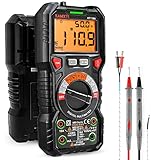
- WIDE APPLICATIONS: KAIWEETS HT118A Multimeter measures up to 1000V DC voltage and 750V AC voltage, 10A AC/DC current and 60 MOhms resistance, electrical tester also tests temperature, capacitance, frequency, duty-cycle, wire on-off, and test diodes and continuity
- EASY OPERATION: Switch the dial to the function you need, and the LED lights on the jacks will shine accordingly. To plug in the leads is easy. Autoranging saves you the hassle of having to know which range of value. Large 2.9” LCD backlight display, easy-to-read digits offer a 6000-count resolution
- MULTI-FUNCTION: Non-contact voltage testing and Live function with sound and light alarm. Flashlight on the back ensures easy use in dimly lit places. Min/Max/Average to record signal fluctuations. Stable kickstand, Pen slot on the back, Low battery prompt, Data retention, Auto power-off
- SAFETY FIRST: IEC Rated CAT III 1000V, CAT IV 600V, CE, RoHS certified. Anti-Burn with double ceramic fuse and thermistor protection circuit. High Voltage Protection is active on all ranges. Double insulated unit. Silicone protective case prevents it from falling damage
- AFTERSALES: KAIWEETS provides a 36-Month after-sale service, lifetime technical support. Please feel free to contact us if you have any concerns. Package includes multimeter, test leads, thermocouple, batteries and user manual. ( Note: Please take off the cap before using the leads)
For measured discharge behavior, calculate delivered energy from the voltage and current trace by integrating power over time: E = ∫V(t)I(t)dt. With voltage in volts, current in amperes, and time in seconds, the result is joules. State the sign convention and whether the reported integral represents energy delivered to the load. This trace-based value reflects the measured discharge interval; do not label it as electrode-only stored energy without making that distinction. The PNAS carbon–cement study presents CV and GCD characterization and energy analysis for its tested cells. See the primary study.
Compare results without mixing unlike measurements
When comparing specimens, hold these factors constant or clearly identify how they differ:
- Electrode formulation and carbon additive.
- Electrolyte and concentration.
- Electrode thickness and area, separator geometry, and cell arrangement.
- Applied current or current density and the voltage window.
- Conditioning and cycle protocol.
- Normalization basis and whether the reported value is for one electrode or the assembled cell.
These details are essential because reported “specific capacitance” can use different denominators, and an electrode value is not interchangeable with full-cell capacitance. The 2026 cement-paste study reports differences among its tested carbon-black mixtures and artificial-seawater configuration, as well as LED illumination from stored charge and longer discharge for its three-layer arrangement. Those are results for that paper’s specimens and setup, not a general optimum or evidence of commercial performance.
Recommended Free Tools
Quick Recap
Product prices and availability are accurate as of the date/time indicated and are subject to change. Any price and availability information displayed on Amazon at the time of purchase will apply.




