Choose the qualified accelerator platform first, then compare the Samsung or SK hynix HBM configuration inside it. HBM is normally mounted in the accelerator package, so it is not a plug-in memory upgrade for a graphics card or server. The practical decision is which complete platform delivers enough usable capacity and workload performance within your power, cooling, supply and support constraints.
Compare Samsung and SK hynix at the same HBM generation, stack height and package configuration. Treat peak bandwidth and efficiency figures as vendor specifications until the accelerator supplier provides controlled results for your model, precision, sequence length and utilization.
As an Amazon Associate I earn from qualifying purchases.
Start with the accelerator, not the memory brand
Unlike ordinary DIMMs, high-bandwidth memory is usually integrated beside the compute die in an accelerator package. The GPU or accelerator manufacturer selects, validates and assembles the stacks, then exposes a fixed memory capacity and interface to the system. A buyer therefore typically chooses an HBM-equipped accelerator, module or server rather than ordering bare Samsung or SK hynix stacks for installation.
Ask the accelerator or system supplier for the exact memory bill of materials, stack count, layer count, total usable capacity and qualification status. Two cards can both advertise HBM3E while differing materially in capacity, bandwidth, firmware support and thermal limits. Those differences affect whether a model fits, how much data must be sharded, and how consistently the system sustains performance.
#1 Best Overall

- Graphics Card Interface: Pci E
Define the workload and constraints
- Model and precision: record the model family, parameter count, activation footprint, context or sequence length, and whether training, fine-tuning or inference is required. State FP32, FP16, BF16, FP8, INT8 or another precision because memory use and arithmetic intensity change with precision.
- Parallelism: specify tensor, pipeline, data and expert parallelism. A model that fits on one accelerator may require sharding across several when redundancy, optimizer state or long context is included.
- Service target: set throughput, latency, concurrency and uptime requirements. Peak tokens per second is not interchangeable with tail latency at production concurrency.
- Infrastructure limits: define rack power, cooling method, inlet temperature, host memory, interconnect topology, network bandwidth and available electrical capacity.
- Deployment window: state the required volume, delivery date, geography, warranty period and spare strategy. A theoretically superior part that cannot be delivered or supported does not meet a production requirement.
What HBM specifications actually mean
HBM bandwidth is built from several variables: signaling rate per pin, the number of I/O channels or interface width, bandwidth per stack and the number of stacks attached to the accelerator. Capacity depends on the density of each die, layer count and stack configuration. Package routing, memory-controller design, software scheduling and thermal limits determine how much of the headline specification an application can sustain.
Use the following rule when comparing quotations: match generation with generation (HBM3E against HBM3E, or HBM4 against HBM4), then match stack height, capacity, stack count and package. A 12-layer stack and an 8-layer stack are not equivalent even if both suppliers call them HBM3E. A per-stack figure also cannot be compared with an accelerator’s aggregate bandwidth unless the measurement level is identical.
Capacity is usable accelerator memory
Model placement is governed by the accelerator’s total usable HBM, not the capacity of one stack in isolation. Reserve space for framework buffers, communication workspaces, activations, key-value caches and, during training, gradients and optimizer states. Request the vendor’s usable-memory figure after firmware reservations and verify whether the quoted capacity is decimal gigabytes or another unit convention.
When capacity is insufficient, software can shard the model across accelerators, offload data to host memory or use compression. Each workaround adds communication, latency or engineering complexity. A platform with slightly lower peak bandwidth but enough local capacity can outperform a faster, smaller-memory option by avoiding excessive sharding.
Bandwidth is not end-to-end throughput
Peak HBM bandwidth describes movement between memory and the accelerator’s memory controllers under the stated interface conditions. AI performance also depends on matrix-engine throughput, kernel efficiency, interconnect traffic, cache behavior, sparsity, batch size and the percentage of time the workload is memory-bound. Use peak bandwidth to screen candidates, not to declare a winner.
For a multi-stack accelerator, ask whether the quoted value is per stack or aggregate. If a supplier gives only per-stack bandwidth, the nominal aggregate is the per-stack value multiplied by the number of active stacks, subject to the package and controller architecture. Require the supplier to state the exact stack count and measurement method rather than calculating an apparently precise number from incomplete specifications.
Public Samsung specifications
Samsung Semiconductor’s current HBM portfolio information, accessed in 2026, lists the following figures. They are Samsung-published product specifications, not an independent comparison with SK hynix.
What’s actually slowing this PC down?
Pick the symptom - the matching free tool is one click away.
Rank #2

- Professional AI & Creator Workstation: AMD Radeon AI PRO R9700 GPU with 32GB GDDR6 is engineered for AI development, professional content creation, and compute-intensive workloads.
- Massive 32GB Memory Capacity: 32GB of GDDR6 memory on a 256-bit bus provides ample bandwidth for large AI models, 8K video editing, and complex 3D rendering.
- Advanced RDNA 4 with AI Accelerators: 64 Compute Units with 3rd Gen Ray Tracing and dedicated 2nd Gen AI Accelerators for groundbreaking AI performance and visual computing.
- Professional Blower Cooling: Efficient single blower design exhausts heat directly out of the chassis, ideal for multi-GPU workstation and server configurations.
- Enterprise-Grade Thermal Solution: Vapor chamber heatsink with industrial Honeywell PTM7950 thermal interface material ensures reliable cooling under sustained professional loads.
| Samsung product | Published capacity and stack | Published signaling and bandwidth | Qualification of the figure |
|---|---|---|---|
| HBM4 | 36 GB; 12-high stacking | Up to 13.0 Gbps and up to 3,300 GB/s | Samsung portfolio maximum; configuration and accelerator must be confirmed |
| HBM3E | 24 GB or 36 GB; 8-high or 12-high | Up to 9.2 Gbps and up to 1,180 GB/s per stack | Samsung portfolio maximum per stack |
Samsung’s HBM4 newsroom announcement says bandwidth per stack rises to a maximum of 3.3 terabytes per second, described by Samsung as 2.7 times its HBM3E figure. The statement is a company comparison; it is not a controlled Samsung-versus-SK hynix test. The same announcement describes 12-layer HBM4 capacities from 24 GB to 36 GB and says 16-layer stacking could expand capacity to 48 GB. Treat 48 GB as a roadmap statement unless the accelerator supplier confirms that the exact configuration is shipping, qualified and available in your region.
Samsung’s HBM4 product information specifies 2,048 I/O pins and 1c DRAM. Samsung claims approximately 40% higher energy efficiency, 10% better vertical thermal resistance and 30% better heat dissipation. These percentages are Samsung’s stated product comparisons, and the cited material does not provide a matched independent test against an SK hynix part. Samsung’s HBM3E information separately claims approximately 12% better power efficiency than its previous generation.
An older Samsung HBM3E FAQ said HBM4 qualification timelines had not been publicly disclosed on that page. That statement should not be treated as a complete, current account of customer-specific qualification. Ask the platform supplier for the status of the precise stack, package revision and accelerator you intend to buy.
Public SK hynix specifications and platform evidence
SK hynix’s official 2025 materials provide useful generation and platform context but do not present a directly matched numeric HBM4 capacity-and-bandwidth table comparable to Samsung’s portfolio page.
| SK hynix material | Published information | What it establishes | What it does not establish |
|---|---|---|---|
| October 2025 OCP Global Summit report | 12-layer HBM4 with 2,048 I/O channels; more than 40% greater power efficiency claimed; 36 GB HBM3E displayed with NVIDIA’s GB300 GPU | SK hynix showed an HBM4 configuration and an HBM3E platform example | A directly comparable HBM4 capacity or bandwidth against Samsung, or an independent efficiency result |
| November 2025 SC25 report | 12-layer HBM4 with 2,048 I/O channels; 12-layer HBM3E product described with NVIDIA’s next-generation GB300 GPU; an AiMX demonstration used four AiMX cards and two NVIDIA H100 GPUs | Additional platform and demonstration context | A controlled Samsung-versus-SK hynix workload benchmark or retail availability |
SK hynix’s report describes more than 40% greater power efficiency for its HBM4. The extracted material does not specify test conditions or the comparison baseline. Do not equate that wording mechanically with Samsung’s approximately 40% energy-efficiency claim; the baselines, workloads and measurement methods may differ.
The 36 GB HBM3E shown with a GB300 GPU demonstrates a platform configuration reported by SK hynix in 2025. It does not prove that every GB300 system has that capacity, that the module is available for independent purchase, or that it is faster than a Samsung-equipped alternative.
Compare the two suppliers on the same decision axes
Generation, layer count and package
Begin with a like-for-like table supplied by the accelerator vendor. Record HBM generation, die density, layer count, stack capacity, number of stacks, interface width, package type and accelerator model. Reject comparisons that combine Samsung HBM4 numbers with an SK hynix HBM3E module, or a single-stack figure with an eight-stack accelerator total.
Rank #3

- NVIDIA Volta GV100 Architecture — 4,608 CUDA Cores, 640 1st-Gen Tensor Cores delivering 14 TFLOPS FP32 and 112 TFLOPS deep learning performance for AI training, inference, HPC, and scientific computing workloads
- 32GB HBM2 ECC Memory — 900 GB/s Bandwidth — High-bandwidth memory on a 4096-bit bus with ECC error correction provides the memory capacity and throughput required for the largest AI models, simulations, and datasets
- PCIe 3.0 x16 Interface — 250W TDP — Standard PCIe Gen3 connectivity with passive cooling designed for enterprise rack server deployment in HPE ProLiant, Dell PowerEdge, and Supermicro platforms with adequate chassis airflow
- NVLink — Scale to 96GB Unified Memory — Connect two V100 GPUs via NVLink at 300 GB/s bi-directional bandwidth to scale GPU memory from 32GB to 96GB for larger AI training and HPC workloads
- Multi-Precision Computing — Supports FP64 (7 TFLOPS), FP32 (14 TFLOPS), FP16 (112 TFLOPS) and INT8 precision modes for flexible deployment across training, inference, and scientific simulation workloads
Capacity and scaling behavior
Measure the memory required by the complete workload, including runtime overhead. Then compare total usable HBM per accelerator and the number of accelerators required for the target model. Fewer devices can reduce interconnect traffic, host overhead and software complexity, even if each device has a lower theoretical bandwidth.
Outdated Drivers Are Slowing You Down
One free scan finds every outdated or missing driver and matches the right update for your exact hardware.Free scan · exact hardware matchWindows Errors? Fix Them Before They Spread
Repair common Windows errors and clear accumulated junk for a smoother, more stable PC - no reinstall needed.Free scan · no reinstallBandwidth and sustained utilization
Request sustained read, write and mixed-access measurements on the target accelerator. Ask for the precision, tensor dimensions, batch or sequence length, firmware version, number of stacks used and whether the result is per stack or aggregate. A synthetic memory test can reveal hardware limits, but a model-level benchmark shows whether your kernels can approach them.
Power and thermal envelope
Obtain memory power, total board power, package temperature, cooling requirements and performance at the intended inlet temperature. A memory efficiency claim does not by itself predict rack-level energy use because the accelerator’s compute engines, voltage settings and cooling fans may dominate. Verify sustained performance after thermal steady state, not only during a short burst.
Qualification, reliability and support
Qualification should cover the exact memory revision, package, accelerator board, firmware and software stack. Ask about error detection and correction behavior, remapping or retirement procedures, failure-rate reporting, replacement policy, warranty and field-service response. A supplier’s public product page cannot substitute for a current customer-specific qualification letter or support commitment.
Supply and commercial terms
Compare allocation, lead time, minimum order, delivery schedule, geographic support, warranty, spare units and end-of-life notice. Include the complete system cost: accelerator, host, interconnect, power distribution, cooling, software support and operations. A small difference in peak memory specification may be irrelevant if one configuration has unpredictable delivery or requires a more expensive cooling design.
Recommended Free Tools
A procurement process that produces an answer
- Freeze the workload definition. Supply the model, dataset or prompt mix, precision, sequence length, batch or concurrency target, training or inference phase and success metrics.
- Specify the minimum memory envelope. Calculate model weights, activations, optimizer state, communication buffers and safety margin. State the required usable HBM per accelerator and total system capacity.
- Choose candidate accelerator platforms. For each, record the accelerator model, HBM generation, stack capacity, stack count, layer count, aggregate bandwidth, board power, cooling method and interconnect.
- Request the memory source and qualification. Ask whether the platform uses Samsung, SK hynix or another supplier, which exact revision is installed, and whether the configuration is production-qualified for the intended software release.
- Normalize the specifications. Put per-pin rate, interface width, per-stack bandwidth and aggregate bandwidth in separate columns. Mark vendor maximums, roadmap statements and measured sustained values distinctly.
- Run controlled workload tests. Keep model version, kernels, compiler, drivers, firmware, precision, batch, sequence length and power limits constant. Record throughput, latency percentiles, memory utilization, power and temperature after the system reaches steady state.
- Test failure and recovery behavior. Confirm how memory errors are reported, whether workloads restart cleanly, how a failed accelerator is replaced, and how many spare units are required to meet availability targets.
- Price the deployed system. Include hardware, software, networking, cooling, electricity, support, spares, shipping and expected utilization. Compare cost per completed training step, token or inference request rather than memory price alone.
- Lock the delivery configuration. Put the HBM supplier, capacity, stack configuration, accelerator revision, firmware baseline and substitution rules in the purchase agreement. Require notice and requalification for a memory change.
How different priorities change the choice
When the model barely fits
Prioritize usable capacity and software headroom. A nominal 24 GB, 36 GB or future 48 GB figure matters only if the matching accelerator exposes that capacity to your framework and can be delivered as a qualified product. Confirm the actual memory map before selecting a stack advertised for a roadmap configuration.
When the workload is strongly memory-bound
Prioritize sustained application bandwidth and access efficiency, then check power at that operating point. Samsung publishes up to 3,300 GB/s for HBM4 and up to 1,180 GB/s per HBM3E stack, but those figures do not prove higher model throughput than an SK hynix-equipped platform. Require same-accelerator measurements.
Rank #4
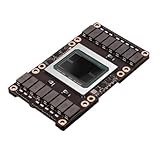
- Robust Design:Constructed to withstand high temperatures, the V100 16GB SXM2 card operates efficiently up to 105℃.
- Advanced Connectivity:Features a SXM2 connector for seamless integration with a wide range of systems, ensuring compatibility.
When rack power or cooling is the bottleneck
Compare complete-node energy per useful result, not an isolated memory-efficiency percentage. Include thermal throttling, fan or liquid-cooling overhead, inlet-temperature range and the number of nodes needed to meet the service target.
When delivery certainty dominates
Select the configuration with a documented allocation, production qualification, support path and acceptable substitution policy. A published specification without a committed delivery schedule cannot satisfy a deployment date.
Do these 3 things before closing this tab:
1Fix the driver behind crashes, sound loss and screen glitches2Repair Windows errors before they cause bigger problems3Scan for outdated or missing drivers - takes under a minuteWhen evaluating an early HBM4 platform
Separate announced, sampled and generally shipping configurations. Ask for production dates, customer qualification, firmware support and benchmark access. Do not treat Samsung’s 16-layer, 48 GB statement as an immediately purchasable capacity, and do not infer SK hynix’s complete HBM4 specification from its 2025 demonstration reports.
Common mistakes and how to correct them
- Declaring a brand winner from one bandwidth number: replace the claim with a same-platform benchmark using your workload.
- Mixing HBM generations: compare HBM3E with HBM3E or HBM4 with HBM4 before discussing suppliers.
- Confusing per-stack and aggregate bandwidth: label the measurement level and stack count in every quotation.
- Using capacity from a roadmap as installed memory: require a shipping part number and qualification confirmation.
- Comparing efficiency percentages as if they share a test method: request baseline, workload, temperature and power-measurement details.
- Assuming HBM can be upgraded later: treat it as part of the accelerator package and verify the replacement path with the system vendor.
- Ignoring software and interconnect effects: measure model throughput, communication time and tail latency, not only a memory microbenchmark.
- Leaving substitutions undefined: contractually specify whether a supplier or stack revision may change and what requalification is required.
Decision checklist
Before approving a purchase, ensure you can answer each question with a document or measurement:
- Which accelerator model and software stack will run the workload?
- What HBM generation, supplier, layer count, stack count and capacity are installed?
- How much memory is usable after firmware and runtime reservations?
- Is every bandwidth figure per pin, per stack or aggregate, and under what conditions?
- What sustained throughput and latency were measured on the intended model and precision?
- What are board power, memory power, thermal limits and cooling requirements at steady state?
- Has the exact memory-and-package configuration been qualified for production?
- What error handling, warranty, replacement and field-support commitments apply?
- Can the supplier meet the required volume and delivery window, and what substitutions are allowed?
- What is the total cost per useful training step or inference request after infrastructure and operations?
Bottom line: choose the validated platform
Public information does not establish that Samsung or SK hynix is universally better for AI. Samsung publishes higher headline figures for its listed HBM4 and HBM3E products, while SK hynix’s 2025 reports provide specific HBM4 channel information and HBM3E platform examples but not a directly matched numeric HBM4 table. Those facts are useful for screening, not for ranking complete systems.
The defensible choice is the accelerator platform whose exact HBM configuration meets your usable-capacity requirement, delivers measured workload performance, stays within the power and cooling budget, has current qualification and support, and can be supplied at the required volume. If suppliers cannot provide a controlled same-platform comparison, the public evidence does not resolve a winner; select on validated system results and delivery risk instead.
Quick Recap
Product prices and availability are accurate as of the date/time indicated and are subject to change. Any price and availability information displayed on Amazon at the time of purchase will apply.

