The Tool Desk
Outbyte PC Repair FREERepair Windows errors before they cause bigger problemsFix Now →Outbyte Driver Updater FREEScan for outdated or missing drivers - takes under a minuteDriver Scan →Start with where the item is sold, then verify the exact product. Pokémon Center describes itself as the official online source for licensed Pokémon merchandise, while marketplace listings are only seller claims. For Pokémon Trading Card Game products, Pokémon Support recommends comparing official product images, checking whether a card can be seen through under bright light, questioning unusually low booster-pack prices, and asking a specialist card shop when you are unsure. For Nintendo-licensed accessories, the Official Nintendo Licensed Product seal is important evidence, but seller identity, packaging and regional licensing still matter.
Use the sales channel as your first authenticity check
A genuine-looking product can still be counterfeit, and a legitimate product can look unfamiliar because it was made for another country or licensed partner. The seller and distribution route therefore provide the first layer of evidence.
As an Amazon Associate I earn from qualifying purchases.
Pokémon Center and other documented channels
Pokémon Center’s current FAQ calls Pokémon Center the official source for licensed Pokémon products online. Its support information identifies Pokémon Center merchandise, Pokémon automated retail vending machines and limited-time arrangements with major retailers such as Target and GameStop as licensed channels. Pokémon Trading Card Game products are also distributed through established mass-market partnerships. Availability and authorization can differ by country, product category and promotion, so confirm that the retailer is recognized for your region rather than relying on a seller’s use of the word “official.”
What’s actually slowing this PC down?
Pick the symptom - the matching free tool is one click away.
Why a marketplace listing is not proof
A marketplace may host independent sellers, mix inventory from different sources or use a stock photograph that does not show the item you will receive. A high rating, a “licensed” description, a holographic sticker or a familiar product title does not replace evidence of provenance. Treat the listing as an assertion to verify, not as certification.
#1 Best Overall

- Collect Them All | Grow your collection.
- Latest & Greatest | All of your packs will be from the Sword & Shield era OR NEWER! This means you have a chance to get the latest & greatest cards.
- 100% Authentic | Coming from verified vendors, these packs are 100% authentic from The Pokemon Company. No need to worry about fake cards or resealed packs!
- Online Code Card | Each booster pack comes with one Pokemon Trading Card Game Online (Live) Code Card!
- Pokemon Trading Card Game Online (Live) | Free to download, free to play, online version of the Pokémon Trading Card Game. An easy way to learn how to play the Pokemon Trading Card Game!
| Purchase route | What it establishes | What you still need to check |
|---|---|---|
| Pokémon Center regional store | Strongest first-party benchmark for products listed there | Regional availability, the exact listing and the condition of the shipped item |
| Documented partner retailer | May be an authorized route for a particular product or promotion | Whether the authorization applies in your country and to that product category |
| Specialist card shop | Seller may have expertise and established supply relationships | Shop reputation, return terms and the sealed product’s condition |
| Marketplace individual seller | Only the seller’s claim and the platform’s transaction protections | Seller identity, photos, provenance, price, product match and return policy |
| Flea market or informal sale | No built-in licensing assurance | Every other check, plus an independent inspection before paying |
Match the item to an official product listing
Find the closest official product page or catalog entry before you buy. Compare the product name, set or collection, character artwork, package format, included accessories, language, dimensions and any product or collection code shown by the manufacturer. An official image is a reference, not a guarantee that a seller’s stock is genuine, so compare the physical item after delivery as well.
Compare packaging systematically
- Check that logos, character names, set names and legal text are spelled correctly.
- Compare the placement and proportions of artwork, barcodes, warnings, age ratings and manufacturer information.
- Look for differences in print sharpness, color balance, alignment, foil pattern, stitching, seams and material texture.
- Confirm that the number and type of contents match the official description; a missing insert or an altered accessory can indicate tampering.
- Check that the language and regional markings make sense for the market in which the item was sold.
A mismatch is a warning sign, not automatic proof of fraud. Products can be revised, reissued or licensed by different partners. If the item cannot be reconciled with any official listing, pause the purchase or return it rather than trying to explain away every discrepancy.
How to check Pokémon Trading Card Game cards
Pokémon Support provides the clearest published tests for counterfeit cards. Use several checks together; no single visual feature proves authenticity for every card set, printing era or country.
1. Compare the card and sealed product with official images
Use the official Pokémon website to compare the card’s set symbol, collector number, rarity treatment, typography, attack text, energy symbols, copyright line and artwork. For sealed products, compare the booster-pack wrapper, box layout, shrink-wrap style and the stated number of packs or promotional cards. Look at the same language and regional edition whenever possible. A card that combines elements from different sets or uses an incorrect font deserves a second opinion.
2. Use the bright-light transparency test
Hold the card up to a bright light. Pokémon Support says, “Counterfeit cards are often easy to see through if you hold them up to a bright light, so this is a good way to identify a fake.” Genuine cards generally have an opaque core that limits visibility. A card that appears unusually transparent is a strong warning sign, although lighting, card wear and different print constructions can affect what you see. Do not bend, crease or damage a valuable card to perform a test.
Rank #2
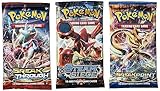
- 3 Pokemon booster packs from various sets
3. Treat a dramatically low booster-pack price as a major warning
Pokémon Support states, “As a general rule, if the price of a pack seems too good to be true, it probably is.” Compare the asking price with current prices from established retailers for the same set, language and condition. A discount can be legitimate during a clearance sale or when a set is old, but a large unexplained gap—especially for supposedly current, scarce or sealed stock—raises the likelihood of counterfeit or tampered packs. Factor in shipping, taxes and whether the seller is offering loose packs rather than a sealed display.
4. Be cautious at flea markets and informal events
Pokémon Support reports many counterfeit sales from flea markets. Informal venues make it harder to verify invoices, return an item or compare a seller’s entire inventory. If you cannot inspect the cards carefully and obtain a written receipt with the seller’s identity, consider the purchase unverified. A low price is not compensation for losing the ability to recover your money.
5. Ask a specialist card shop
When the light test, packaging comparison and seller evidence do not agree, take the card or sealed product to a shop that specializes in trading cards. Ask whether the shop can compare it with a known genuine copy and whether it charges for authentication. A specialist can also identify resealing, altered contents or a legitimate regional printing that is unfamiliar to you. Keep the item in its original condition until you have decided whether to return it.
Check Nintendo-licensed accessories and hardware-related merchandise
For products that use Nintendo licensing—such as some controllers, cases, cables, apparel or accessories—look for the applicable “Official Nintendo Licensed Product” seal. Nintendo Support describes the official seal as assurance that the product has been evaluated and licensed by Nintendo. Nintendo also says products without one of its listed seals are likely unlicensed and have not gone through its testing and evaluation process.
The seal is useful evidence, not a universal Pokémon authenticity certificate. Pokémon merchandise can be licensed through partners and regions with different markings, and counterfeiters can copy a logo. Confirm the seal’s wording and placement against Nintendo’s current guidance, then verify the seller, packaging, product match and regional compatibility. Do not reject a legitimate Pokémon item solely because it lacks a Nintendo seal when the product is not a Nintendo-licensed category; do not accept a Nintendo-looking mark as conclusive without the other checks.
Rank #3

- PACK CONTENTS: Contains 10 random Pokemon trading cards from the Scarlet & Violet Prismatic Evolutions expansion set per booster pack
- ARTWORK VARIETY: Each booster pack features randomly selected pack artwork from the available designs in this expansion
- CARD POTENTIAL: Possibility to pull rare, ultra-rare, and special variant cards featuring Pokemon from the Scarlet & Violet series
- GAME COMPATIBILITY: All cards are tournament-legal and can be used in official Pokemon Trading Card Game matches
- COLLECTION VALUE: Perfect for collectors and players alike, with cards featuring stunning illustrations and powerful game mechanics
Inspect physical quality without relying on one “tell”
Plush toys
Compare the character’s proportions, embroidery, fabric pile, eye placement, seams, stuffing density and hang tags with an official product image. Uneven stitching, misspelled tags, rough edges, strong chemical odors or a different fabric can indicate a counterfeit, but manufacturing tolerances vary. Check the tag for the named licensee, country of manufacture and care instructions, and compare those details with a known genuine example from the same market.
Free tools Windows power users keep installed
One-click scans. No signup required.
Apparel and bags
Check print registration, color, wash-label text, fiber content, seam finishing, zipper hardware and size information. A design that is slightly different from the official image may be a regional or seasonal release; a misspelled character name, blurry screen print or label that conflicts with the packaging is harder to explain. Verify that the seller’s photos show the actual front, back, labels and any licensed marks rather than only a stock image.
Figures, toys and collectibles
Look for clean molding, consistent paint, stable joints, complete accessories and packaging that matches the documented release. Compare logos, copyright lines, manufacturer names, safety warnings and age ratings. Missing safety information, crude paint boundaries or an accessory from a different release should prompt a pause. A country-of-origin label alone does not prove authenticity because licensed products are manufactured in multiple countries.
Stationery, electronics and small accessories
Check connector fit, button labeling, print alignment, material quality and included instructions. For electrical products, confirm that the plug, voltage, safety marks and regional model number are appropriate for your country. Do not use an unverified charger, battery or cable with valuable equipment simply because it carries a Pokémon character; licensing and electrical safety are separate questions.
Evaluate the seller, listing and provenance
- Identity: Prefer a business that states its legal or trading name, physical contact details and a clear returns address.
- Photos: Require sharp images of the actual item, seals, labels, set codes and all sides of the package. Stock photography hides defects and substitutions.
- History: Ask when and where the seller obtained the product. An invoice, distributor record or dated store receipt is stronger than a statement that it came from a “warehouse.”
- Condition: For cards, distinguish factory-sealed product from loose packs, repacked bundles and boxes with damaged or replaced shrink-wrap.
- Returns: Read the deadline, restocking terms and exclusions for opened collectibles. Pay through a method that records the transaction and offers a dispute process.
- Consistency: Multiple unrelated products, identical descriptions across accounts or pressure to pay outside the platform are reasons to stop.
Do not treat a tag, hologram, country-of-origin label or single logo as conclusive. Those features can be genuine, copied, changed between production runs or unrelated to the licensing route for your region.
Rank #4

- 1 box contains 10 packs
- 1 pack: Includes 10 cards
Account for regional and partner licensing
“Official” is not a single global appearance. A Pokémon product may be licensed for one market, printed in another language, sold through a regional distributor or made by a partner whose name does not appear on a different country’s version. Pokémon Center’s own support information distinguishes its merchandise channels from the mass-market partnerships used for Pokémon TCG distribution. Before comparing labels, establish the intended country, language, edition and release period.
If a seller claims that an unfamiliar package is an import, ask for the product’s market and a receipt or distributor explanation. An imported genuine item may have different warning text, barcodes or licensee details; that explains a documented difference but does not excuse blurry printing, incorrect card data or suspicious resealing.
A practical decision workflow before you pay
- Identify the exact item. Record the product name, set or collection, language, edition, condition and any model or collector number.
- Check the route. Determine whether the seller is Pokémon Center, a documented partner, a specialist shop or an individual marketplace seller.
- Open the official reference. Compare the seller’s photos and description with an official Pokémon or Nintendo listing appropriate to the product category and region.
- Inspect the evidence. Review print, color, alignment, seams, labels, seals, contents and licensing marks. For cards, add the bright-light test without damaging the card.
- Test the price and provenance. Explain any unusually low price, request actual-item photos and ask where the stock came from.
- Protect the transaction. Confirm return rights, keep messages and receipts, and avoid irreversible payment methods when authenticity is uncertain.
- Escalate uncertainty. Ask a specialist card shop to inspect TCG products or decline the purchase until the seller supplies credible documentation.
What to do when an item may be counterfeit
Stop using or reselling the item while you investigate. Photograph the package, labels, seals, card fronts and backs, and save the listing, seller messages, payment record and delivery packaging. Contact the seller promptly through the platform and request a return or refund under the stated policy. Do not send the item back without tracking or proof of postage.
For suspected counterfeit cards, a specialist shop can provide a written assessment if available. Report the listing through the marketplace’s counterfeit or intellectual-property process, and contact the relevant Pokémon or Nintendo support channel when the product falls within its guidance. If an electrical accessory appears unsafe, disconnect it and follow your local consumer-safety reporting route. Do not sell the item to another collector merely because you cannot prove the problem.
Common mistakes that create false confidence
- “It has a hologram, so it is real.” Holographic labels can be copied and are not used identically across products.
- “The seller has thousands of reviews.” Reviews may cover unrelated goods, and counterfeit stock can be mixed with genuine inventory.
- “The country on the tag proves it.” Licensed Pokémon products are manufactured in several countries, while counterfeiters can print any origin.
- “The seal looks intact.” Resealing and replacement packaging can preserve a convincing appearance; compare film, seams and contents with an official example.
- “A single difference proves a fake.” Regional editions and production changes exist. Seek a matching official listing or specialist opinion before making a definitive accusation.
How much evidence is enough?
For a low-value item from a documented retailer, an official product match, plausible price and intact packaging may be sufficient. For an expensive collectible, a sealed TCG box, a rare card or an item from an informal seller, require a stronger chain: actual-item photographs, a credible purchase record, a price that fits the market, consistent packaging and an independent inspection when needed.
No first-party source publishes one universal visual checklist covering every Pokémon merchandise category, country and production era. That limitation is why the safest conclusion is sometimes “unverified,” not “genuine” or “fake.” If the seller will not provide evidence or a return option, walk away.
Quick Recap
Product prices and availability are accurate as of the date/time indicated and are subject to change. Any price and availability information displayed on Amazon at the time of purchase will apply.

