The Tool Desk
Outbyte Driver Updater FREEFix the driver behind crashes, sound loss and screen glitchesFind Drivers →Outbyte PC Repair FREERepair Windows errors before they cause bigger problemsFix Now →A phone thermal camera’s “calibration” button usually performs an internal detector correction called non-uniformity correction (NUC); it does not certify that the temperature shown for an object is accurate. For more reliable readings, let the attachment stabilize, use its calibration control as directed, set the target’s emissivity and reflected temperature when available, and keep the measurement setup consistent.
What “calibration” means on a phone thermal camera
The word refers to two different things. In many phone attachments, calibration is an internal shutter event that helps correct detector non-uniformity and make the image more even. FLIR’s FLIR ONE manual says its internal mechanical shutter activates during calibration and makes a clicking sound; the app can also initiate calibration manually. FLIR ONE user manual.
As an Amazon Associate I earn from qualifying purchases.
This internal correction is not formal instrument calibration. FLIR reproduces the International Bureau of Weights and Measures’ definition of calibration as an operation that relates indications to measurement standards under specified conditions, with associated measurement uncertainties, and uses that relation to obtain a measurement result. FLIR: What is calibration? A shutter click does not establish traceable accuracy or guarantee that a displayed surface temperature is correct.
Outdated Drivers Are Slowing You Down
One free scan finds every outdated or missing driver and matches the right update for your exact hardware.Free scan · exact hardware matchWindows Errors? Fix Them Before They Spread
Repair common Windows errors and clear accumulated junk for a smoother, more stable PC - no reinstall needed.Free scan · no reinstallHow to get a more reliable reading
- Check the exact attachment manual. Controls and labels differ by model. Confirm whether the app offers manual calibration/NUC, emissivity, reflected temperature, distance, and any window or atmospheric compensation.
- Let the camera stabilize as its manual directs. Avoid taking a critical reading before the manufacturer’s stated warm-up or stabilization period, if one is specified.
- Run the internal correction when appropriate. Use the app’s calibration control when prompted by the camera or manual, or before a recording if the manufacturer recommends it. Keep the camera pointed at the scene if the instructions call for that. Treat the shutter action as detector correction, not as a substitute for instrument calibration.
- Set emissivity for the surface. Emissivity describes how effectively a surface emits infrared energy compared with an ideal emitter. FLIR identifies emissivity as a key measurement parameter; choose a value appropriate to the target when the app allows it. FLIR measurement manual.
- Consider reflected apparent temperature. The camera receives infrared energy from both the target and its surroundings. This matters especially for shiny, low-emissivity surfaces, which can reflect nearby objects or people rather than simply reporting their own temperature. Set the reflected-temperature parameter when available and when you can reasonably determine it.
- Keep geometry consistent. Use a close, repeatable distance and similar viewing angle, and make sure the measured area fills enough of the camera’s measurement spot. For longer paths, atmospheric conditions and distance can increasingly affect readings; use supported compensation controls where appropriate.
- Account for barriers. Ordinary glass is not transparent to long-wave infrared in the way visible light is. Do not treat a reading through a window as the temperature behind it. If measuring through a purpose-built thermal window or barrier, use temperature and transmission compensation only if the camera supports it and you can configure it correctly.
- Repeat with the same setup. For a temperature trend, measure the same spot using the same distance, angle, target parameters, and surrounding conditions. Report the conditions and avoid implying more precision than the instrument supports.
Why readings can seem wrong
Shiny or reflective targets
Bare polished metal and other reflective, low-emissivity surfaces can show reflected surroundings strongly. A reading that changes when a person or warm object moves nearby may reflect scene energy rather than a change in the target itself. A high-emissivity reference patch can help compare a surface only when it is appropriate for the job, firmly attached, and at the same temperature as the target. FLIR describes a controlled method for estimating emissivity; this is not a universal household shortcut. FLIR measurement manual.
#1 Best Overall

- COMPATIBILITY: Infrared camera plugs directly into phone charging port and connects with iphones with USB-C (iphone 15 and newer)
- SUPER RESOLUTION: Vivid IR technology upscales the image to 240x180 from 80x60 for greater detail and clarity. Flir MSX technology merges thermal and visual images to enhance details in real time.
- THERMAL INSPECTION GUIDES: Within the Flir One app is a step-by-step inspection guide to help you address typical faults easily and perform accurate home inspections. Find air leaks, moisture buildup, and more
- ACCURACY: Measures temperature within ±3°C or ±5% when the unit is within 15 °C – 35 °C and the scene is within 5 °C – 120 °C
- JOBSITE TOUGH: Built to take the abuse that working on a jobsite dishes out every day, rated to take a drop from 1.5 meters and is built to last
Wrong target or scene settings
Emissivity and reflected apparent temperature are important inputs, and the camera’s displayed number is an estimate based on those inputs and the scene. If the app provides distance, atmospheric temperature, humidity, or window compensation, incorrect settings can also affect results—particularly over longer paths or through a thermal barrier.
Insufficient target coverage or inconsistent positioning
A camera measures infrared energy over a field of view, not an infinitely small point. If the target occupies too little of that area, nearby surfaces can influence the result. Changing the distance, angle, or measured spot between readings also makes comparisons less meaningful.
Rank #2

- iOS and Android Compatibility: The P1 thermal imager supports all USB-C smartphones and computers, including iOS, Android, and Windows. For iPhones with a Lightning port, a Type-C to Lightning adapter is required (sold separately). App name: Thermal Master.
- 320×240 X³ IR Resolution: Equipped with advanced X³ IR technology, P1 thermal camera upgrades its IR resolution from 160×120 to 320×240, delivering sharper and clearer images. With a 25Hz refresh rate and the ability to detect temperature differences as small as 0.04°C, it delivers smooth visuals and precise thermal detection, helping prevent potential safety risks.
- Wide Temperature Range: The P1 supports a temperature range from -4℉ to 1112℉ (-20℃ to 600℃) with an accuracy of ±3.6℉. Equipped with the high-sensitivity Thermal Master sensor, it offers a reliable thermal imaging solution for home insulation inspections, HVAC system diagnostics, electrical panel inspections, industrial equipment maintenance, and automotive troubleshooting.
- More Accurate and Efficient: P1 thermal imaging camera features 15× digital zoom, high and low temperature alarms, and an isotherm mode. These functions help you quickly detect hot or cold spots and examine key details with clarity. Adjustable emissivity, ambient temperature, and distance settings reduce environmental interference and improve temperature accuracy.
- Compact and Long-Lasting: Use the Thermal Master App for seamless device control. With low power consumption of just 0.32W, the P1 supports 5–8 hours of continuous operation. Compact and lightweight, it measures 2.32×1.06×0.68 inches (59×27×17.2mm) and weighs only 0.62oz (17g), making it easy to carry in a shirt pocket. The package includes the P1 thermal camera, a zipper case, a 50cm extension cable, and a quick start guide.
Should you use default settings?
When a user is unsure, a FLIR general camera manual lists recommended starting values: emissivity 0.95, reflected temperature 20°C (69°F), object distance 1.0 m (3.3 ft.), atmospheric temperature 20°C (69°F), and relative humidity 50%. These are defaults for the documented FLIR camera family, not a universal calibration recipe for every phone attachment. Replace them with known or better-estimated target and scene values when possible. FLIR general camera manual.
Can you trust the temperature number?
Use it as a surface-temperature estimate whose reliability depends on the instrument, target emissivity, reflected surroundings, distance, and measurement setup—not as universal ground truth. If the number will guide a safety-critical, medical, legal, or other consequential decision, follow the relevant procedure and use an appropriately specified and calibrated instrument or qualified provider. The materials cited here do not establish one accuracy tolerance that applies to all phone thermal attachments.
Rank #3
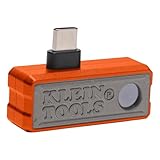
- 19,200-PIXEL RESOLUTION: High-quality thermal imaging camera delivers excellent resolution for troubleshooting hot and cold spots in electrical and HVAC applications
- USB-C COMPATIBILITY: Works with iOS and Android devices and fits phone cases up to 1/5-Inch thick for convenient use
- CAPTURE AND SHARE: Easily store thermal images and video including time-lapse video feature for comprehensive documentation and reporting
- MULTIPLE TEMPERATURE MODES: Touch screen displays spot temperature, high/low temperatures, and differential temperature readout
- WIDE TEMPERATURE RANGE: Measures -4 to 752-Degree Fahrenheit (-20 to 400-Degree Celsius) with three color palettes (ironbow, rainbow, grayscale) for optimal visualization
If you are choosing an attachment, compare the exact model’s manual for temperature range and stated accuracy, supported phone and connector, whether the app exposes NUC and target parameters, and whether the intended task needs a broad thermal map or a calibrated reference measurement. FLIR asks buyers to check phone model and connector compatibility for FLIR ONE. FLIR ONE product page. Compatibility and app features vary by model; buying an attachment does not itself improve calibration.
Quick Recap
Best Value
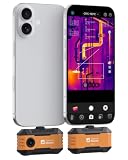
- USB-C Phone Compatibility: Plug the P1 thermal camera into USB-C iPhone, Android, tablets, or Windows devices and use the Thermal Master app for quick field checks; Lightning iPhones require a Type-C to Lightning adapter sold separately.
- Clear Real-Time Thermal Imaging: Razor-Sharp X³ technology enhancement upgrades the native 160 x 120 sensor to 320 x 240 IR detail, while 25Hz refresh and 0.04°C (0.1℉) sensitivity help you spot subtle hot and cold differences with smoother live viewing.
- Wide Range for Real Jobs: Measure surface temperatures from -4°F to 1112°F with ±3.6°F accuracy for home insulation checks, HVAC diagnostics, electrical panels, PCB troubleshooting, automotive repair, and equipment maintenance.
- Find Issues Faster: Use 15x digital zoom, hot/cold spot alarms, isotherm mode, and adjustable emissivity, distance, and ambient settings to narrow in on leaks, overheating parts, drafts, and temperature patterns with more confidence.
- Pocket-Size, No Charging Needed: Powered by your phone at only 0.32W for about 5-8 hours of use, this compact IR camera includes a zipper case, 50cm extension cable, and quick start guide for safer angles and easier inspections.
Rank #4

- UNIVERSAL USB-C COMPATIBILITY: As an upgraded version of TC002C, the TOPDON TC002C Duo now works seamlessly with all USB-C smartphones and tablets (iOS, Android & Windows), ensuring compatibility with the latest Apple & Android devices. Note: Not compatible with Mac device or Android 16 device temporarily
- SUPER RESOLUTION (TISR): The TOPDON TC002C Duo thermal camera enhanced 256×192 thermal imaging to reveal sharper details at 512×384 with TISR(TOPDON Image Super Resolution). It complemented by a 25Hz refresh rate and a high heat sensitivity of 40mK, ensure smooth, real-time heat tracking, perfect for dynamic environments
- EXTENSIVE TEMPERATURE RANGE: The thermal camera can read temperatures ranging from -4 ℉ to 1022 ℉ with a maximum of ±2℃ or 2% for error, catering to diverse applications. You can view real-time temperature variations by waveform change and customize temperature limits with colorful displays for ultimate convenience. Plus, it supports photo & video recording
- WIDE APPLICATIONS: The TC002C Duo thermal camera allows you to measure temperature differences from a safe distance of up to 16.4ft (5m), making it an ideal tool for home inspectors, HVAC technicians, electricians, automotive technicians, etc. Beside, it is a perfect gift for family event like hide-and-seek, playing with you pet
- COMPACT DESIGN: The thermal camera is lightweight and portable for on-the-go use, measuring 2.8” x 1.7” x 0.55” (71x42x14mm) and weighing 1.1 oz (30g). Use the TopInfrared App for seamless control of your device. Plus, enjoying 24/7 US-based customer service for your convenience
Product prices and availability are accurate as of the date/time indicated and are subject to change. Any price and availability information displayed on Amazon at the time of purchase will apply.




