Data-center backup batteries do not have one universal test or replacement date. Set the schedule by battery chemistry, UPS design, manufacturer instructions, operating conditions and measured performance. In practice, separate three activities: routine inspections, capacity or discharge tests, and replacement decisions. A useful framework summarized by Vertiv uses monthly, quarterly and annual inspections; capacity testing at installation and at intervals no longer than 25% of expected service life; and annual capacity tests once degradation appears or a battery reaches 85% of expected service life. For lead-acid systems, the same summary attributes replacement guidance to IEEE practices when measured capacity falls below 80% of the manufacturer rating.
What the testing schedule is actually measuring
A battery program is easier to manage when each activity has a distinct purpose. An inspection looks for developing problems and verifies operating measurements. A capacity test checks how much usable energy the battery can deliver under a controlled discharge. Replacement is a decision based on capacity, condition, safety and the risk the UPS must carry; it is not an automatic consequence of reaching a particular birthday.
As an Amazon Associate I earn from qualifying purchases.
- Inspection: recurring visual, environmental and electrical checks used to find abnormal conditions and establish trends.
- Capacity or discharge test: a controlled test that measures delivered capacity against the battery manufacturer’s rating.
- Replacement: removal of a battery, cell or string when measured performance, physical condition, safety or manufacturer instructions make continued service unacceptable.
Do not treat a monthly inspection as proof that a battery can support its rated runtime. Conversely, a capacity test does not replace routine checks for swelling, leakage, loose connections, overheating or abnormal charging.
Quick wins for a faster PC:
Clear out junk files and repair common Windows errorsFree Scan →Scan for outdated or missing drivers - takes under a minuteDriver Scan →A practical inspection rhythm for a UPS battery room
Vertiv’s UPS Battery Maintenance Solutions summary associates battery measurements such as string or cell voltage and float-charging current with monthly, quarterly and annual inspections. It also notes that more frequent inspection and testing can improve performance trending. The exact checklist should come from the UPS and battery manufacturers, the site’s electrical-safety program and the applicable standard.
#1 Best Overall
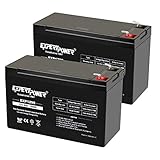
- Universal Compatibility: Ideal 12V lead acid battery for kids electric car or to use as APC battery replacement, alarm battery, 12V 8Ah -12V 9Ah battery, mobility scooter battery replacement or electric bike battery with (+ -) polarity.
- Long-Lasting Performance: Provides reliable power, maintenance-free construction, spill-proof design. Delivers consistent 12 volt output as UPS replacement battery.
- Easy Installation: Simple replacement for your existing 12V 9Ah battery. Features F2 terminals, no special tools required. Check compatibility before purchase. Dimensions: 5.94" x 2.56" x 3.70" (total height: 3.94")
- Versatile Applications: AGM battery for ADT alarm system, UPS, medical devices, small solar storage, wheelchairs, or as 12 V kids car battery, fish finder battery, exit sign battery, emergency light battery or gate opener battery.
- Premium Construction: The advanced valve regulated AGM design offers long shelf life and reliable standby performance. Its rugged ABS case help resist vibration.
| Activity | Interval or trigger in Vertiv’s summary | Purpose |
|---|---|---|
| Routine inspection | Monthly, quarterly and annual inspection tiers | Check condition and operating measurements, then compare results with previous readings and manufacturer limits. |
| Capacity test at commissioning | At installation | Establish a verified baseline for the new battery or string. |
| Periodic capacity test | At intervals no greater than 25% of expected service life | Measure delivered capacity before the battery approaches the end of its expected service period. |
| Condition-based annual capacity test | Annually after signs of degradation appear or when the battery reaches 85% of expected service life | Increase test frequency as the battery enters a higher-risk portion of its life. |
| Lead-acid replacement review | When measured capacity is below 80% of the manufacturer rating | Plan replacement; Vertiv’s summary attributes a maximum one-year replacement period to IEEE 450 and IEEE 1188 guidance. |
The figures in this table are a manufacturer’s summary of standards, not a substitute for the current IEEE text or your battery maker’s procedure. “Expected service life” is the life specified for that battery in its installation and operating conditions, not a universal number of years.
What to record during inspections
Use the same measurement points and instruments each time so that trends are meaningful. Record the inspection date, UPS and battery identifiers, ambient conditions, charger or float state, string and cell readings where applicable, float-charging current, alarms, physical observations and corrective actions. A single unusual reading deserves investigation; a steadily worsening trend is often more useful than an isolated value.
When and how to perform capacity testing
Capacity testing places a controlled load on the battery and measures how long it can sustain that load or how much energy it delivers before reaching the test endpoint. It can interrupt redundancy, create heat and expose a weak cell, so it belongs in an approved maintenance window with a documented contingency plan. Only personnel qualified for the UPS, battery chemistry and site electrical hazards should perform it.
What’s actually slowing this PC down?
Pick the symptom - the matching free tool is one click away.
Establish the baseline
Perform a capacity test at installation, after the system is commissioned and the battery is fully charged according to the manufacturer’s instructions. Preserve the test conditions, load level, endpoint, temperature and instrumentation in the record. Future results are comparable only when the test method is materially consistent.
Rank #2

- ML9-12 SLA is a 12V 9AH Sealed Lead Acid (SLA) rechargeable maintenance free battery - UL Certified
- Dimensions: 5.94 inches x 2.56 inches x 4.02 inches. Terminal: F2. Listing is for the Battery only. No wire harness or mounting accessories included.
- SLA / AGM spill proof battery has a characteristic of high discharge rate, wide operating temperatures and long service life.
- Rechargeable battery that can be mounted in any position, resists shocks and vibration. Long lasting high performance in high and low temperatures.
- Full One Year Warranty
Use the service-life fraction as a maximum interval
Vertiv summarizes a periodic interval of no more than 25% of expected service life between capacity tests. This is a ceiling, not a reason to postpone a test when the battery is showing warning signs. A site with severe heat, frequent discharge events, unstable charging or a critical availability requirement may need a shorter interval.
Increase testing when degradation appears
The same summary calls for annual capacity tests when degradation is evident or when a battery reaches 85% of expected service life. It identifies degradation as either a capacity decline greater than 10% from the previous capacity test or capacity below 90% of the manufacturer rating. For VRLA batteries, a significant change in internal ohmic values between readings or physical changes are additional triggers for investigation and testing. These indicators are warning thresholds, not automatic permission to continue operating indefinitely.
Apply chemistry-specific timing
For vented lead-acid (VLA) batteries, Vertiv’s summary specifies a capacity or discharge test within the first two years of service, in addition to the installation baseline and subsequent periodic testing. For valve-regulated lead-acid (VRLA), internal-ohmic trends and physical changes are emphasized as triggers. Confirm the exact method, discharge rate and endpoint with the battery manufacturer; a test designed for one battery construction may be unsuitable for another.
The Tool Desk
Outbyte PC Repair FREEClear out junk files and repair common Windows errorsFree Scan →Outbyte Driver Updater FREEScan for outdated or missing drivers - takes under a minuteDriver Scan →When should a UPS battery be replaced?
For lead-acid systems, Vertiv summarizes IEEE 450 and IEEE 1188 guidance as replacement when capacity falls below 80% of the manufacturer-rated capacity, with replacement within a maximum one-year period. Treat that as a capacity-based replacement trigger, not an age cutoff. A battery can fail earlier because of heat, overcharging, repeated deep discharges, manufacturing defects or mechanical damage, while another can remain above the threshold longer under favorable conditions.
Rank #3

- ML7-12 SLA is a 12V 7.2AH Sealed Lead Acid (SLA) rechargeable maintenance free battery - UL Certified
- Dimensions: 5.94 inches x 2.56 inches x 4.02 inches. Terminal: F1. Listing is for the Battery only. No wire harness or mounting accessories included.
- SLA / AGM spill proof battery has a characteristic of high discharge rate, wide operating temperatures, long service life and deep discharge recover.
- Rechargeable battery that can be mounted in any position, resists shocks and vibration. Long lasting high performance in high and low temperatures.
- Full One Year Warranty
Physical and operational signs that require action
- Swelling, cracking, leakage, corrosion or a damaged case.
- Abnormal temperature, odor, noise or visible venting.
- Loose, discolored or overheated terminals and interconnects.
- Repeated UPS alarms, charger abnormalities or a cell/string voltage that departs from the manufacturer’s limits.
- A capacity result below the replacement threshold or a rapid decline between tests.
Remove a battery from service promptly when it presents a safety hazard. Do not wait for the next scheduled capacity test, and do not mix a questionable replacement into a string without the UPS and battery manufacturer’s approval.
Why age alone is an unreliable rule
Standby battery life depends on chemistry, temperature, float-voltage control, discharge history, ventilation, installation quality and maintenance. The available guidance does not establish a universal lifetime for every data-center battery. Use the manufacturer’s expected-life figure to calculate the 25% and 85% milestones, then adjust for actual condition and the consequence of failure.
How chemistry changes the schedule
VRLA
IEEE 1188-2025 is listed as the active practice for stationary VRLA battery maintenance, testing and replacement, superseding IEEE 1188-2005. VRLA strings are often monitored through voltage, charging current, temperature and internal-ohmic measurements. A significant change in ohmic values, physical deterioration, a capacity drop greater than 10% from the previous test or capacity below 90% of the manufacturer rating should move the battery into a more intensive testing and replacement review.
Vented lead-acid
IEEE 450-2020 is listed as the active practice for stationary vented lead-acid batteries. These systems require attention to ventilation, electrolyte-related hazards, connections and the site’s procedures for working around exposed electrolyte. Vertiv’s summary calls for a capacity or discharge test within the first two years and attributes the 80%-of-rating replacement threshold to IEEE 450 and IEEE 1188.
Rank #4

- GENUINE APC UPS BATTERY REPLACEMENT: For optimal performance, use APC-branded replacement battery cartridges with your APC Back-UPS and Smart-UPS, and check the product you receive to confirm it is APC-branded
- TESTED AND CERTIFIED RBC CARTRIDGE: Each APC Replacement Battery Cartridge (RBC) is tested and certified for compatibility to restore your APC UPS performance to original factory specifications
- MODEL-SPECIFIC COMPATIBILITY: APCRBC124 is compatible with APC Back-UPS models BX1500M, BR1500G, and Smart-UPS model SMC1000-2UC (verify compatibility before ordering)
- BACKED BY APC WARRANTY: Genuine APC replacement batteries are backed by a 2-year manufacturer warranty
Lithium-ion
IEEE 2962-2025 is the current active practice identified for stationary lithium-ion batteries. Its scope includes system design, storage, installation, ventilation, instrumentation, operation, maintenance, capacity testing, replacement and worker safety. Do not transfer the lead-acid 80%, 90%, 10%, 25% or 85% figures to lithium-ion systems without written confirmation from the battery and UPS manufacturers. The public IEEE listing does not establish one universal lithium-ion test interval. Lithium-ion battery-management-system alarms, thermal controls and manufacturer diagnostics may be central to the maintenance plan.
Broader UPS guidance
IEEE 1184-2022 is listed as an active guide for batteries used in UPS systems more broadly. Use it alongside the chemistry-specific practice and the equipment manufacturer’s instructions rather than treating it as a replacement for either.
Independent reader supportYour contribution helps us test, update, and keep practical guides available for everyone.Current standards to identify in your maintenance plan
| Reference | Application | Status or publication detail | Coverage identified in the public listing |
|---|---|---|---|
| IEEE 1188-2025 | Stationary VRLA batteries | Active; board-approved 2025-12-10; supersedes IEEE 1188-2005 | Maintenance, testing and replacement practice |
| IEEE 450-2020 | Stationary vented lead-acid batteries | Active; published 2021-03-05 | Maintenance, testing and replacement practice |
| IEEE 2962-2025 | Stationary lithium-ion batteries | Published 2026-03-25 | Design, storage, installation, ventilation, instrumentation, operation, maintenance, capacity testing, replacement and worker safety |
| IEEE 1184-2022 | Stationary standby batteries used in UPS systems | Active; published 2022-05-16 | Guide for UPS battery systems |
Public IEEE pages identify scope and status, while the full standards require purchase or subscription. A maintenance document should name the edition being used and preserve the manufacturer’s instructions that govern the installed model.
Crashes, No Sound, or Screen Glitches?
Random freezes, missing sound and display glitches usually trace back to one bad driver. Find and replace yours safely.Free scan · under a minuteWindows Errors? Fix Them Before They Spread
Repair common Windows errors and clear accumulated junk for a smoother, more stable PC - no reinstall needed.Free scan · no reinstallA step-by-step program for data-center operators
- Inventory every string. Record the UPS model, battery model, chemistry, string voltage and configuration, installation date, expected service life and manufacturer limits.
- Assign the applicable standard. Use the current chemistry-specific IEEE practice together with the broader UPS guidance where relevant.
- Write the inspection checklist. Define monthly, quarterly and annual tasks, responsible personnel, instruments, alarm review, environmental checks and escalation limits.
- Capture the commissioning baseline. Perform and document the installation capacity test under an approved procedure.
- Calculate future test dates. Place periodic capacity tests no more than 25% of expected service life apart, then schedule annual tests at the 85% milestone or sooner when degradation appears.
- Trend results. Compare capacity, voltage, current, temperature and internal-ohmic data with prior readings, not just with a pass/fail label.
- Escalate deterioration. Investigate a capacity decline greater than 10%, capacity below 90% of rating, significant ohmic change, physical damage or repeated alarms.
- Plan replacement logistics. Verify the exact replacement battery or string, delivery lead time, lifting and handling requirements, outage or bypass plan, disposal route and post-installation test.
Procurement and compatibility checks
The correct purchase category is a model-matched UPS replacement battery or battery string. Compatibility depends on more than nominal voltage: verify chemistry, string voltage and configuration, connector and interconnect requirements, charging limits, physical dimensions, monitoring interfaces and the UPS manufacturer’s approved parts. The available guidance does not validate a generic battery or a particular listing. Obtain written confirmation from the UPS or battery manufacturer before ordering.
For critical facilities, contract support should cover inspection, capacity testing, replacement and documentation. Specify the test method, deliverables, safety responsibilities, acceptance criteria and how failed or removed batteries will be handled. A service provider’s ability to work on the installed UPS and chemistry matters more than a generic claim to service batteries.
Common scheduling mistakes and corrections
- Mistake: replacing every battery on a fixed age date. Correction: use expected life for planning, but let measured capacity, physical condition and manufacturer limits drive the decision.
- Mistake: calling a visual inspection a capacity test. Correction: schedule controlled discharge testing separately and record its endpoint and delivered capacity.
- Mistake: applying lead-acid thresholds to lithium-ion. Correction: follow IEEE 2962-2025 and the lithium-ion system manufacturer’s diagnostics and limits.
- Mistake: testing without an availability plan. Correction: confirm redundancy, bypass or alternate power arrangements and recovery actions before placing a UPS battery under load.
- Mistake: buying by voltage alone. Correction: match the exact UPS, battery model, chemistry and string configuration, then verify with the manufacturer.
- Mistake: ignoring trend data. Correction: retain consistent readings so a gradual decline can trigger a planned replacement instead of an emergency outage.
Bottom line
Inspect UPS batteries on a monthly, quarterly and annual cadence defined for the installation. Test capacity at commissioning, at intervals no greater than 25% of expected service life, and annually once degradation appears or the battery reaches 85% of expected life. For lead-acid batteries, treat capacity below 80% of the manufacturer rating as a replacement trigger and plan replacement within the one-year period summarized by Vertiv’s guidance. Use chemistry-specific IEEE practices, current manufacturer instructions and qualified personnel; lithium-ion batteries require their own documented limits rather than borrowed lead-acid thresholds.
Quick Recap
Product prices and availability are accurate as of the date/time indicated and are subject to change. Any price and availability information displayed on Amazon at the time of purchase will apply.
Recommended Free Tools

