Free tools Windows power users keep installed
One-click scans. No signup required.
An AI planner that excels at chess or Go cannot simply be moved to poker, Stratego, Bridge, or Liar’s Dice. In a perfect-information game, every legal position is visible and a search algorithm can evaluate continuations from one known state. In an imperfect-information game, the same public moves may fit many hidden states, and opponents act on private information you cannot observe. A useful planner must therefore maintain uncertainty, reason about what other players may believe, and sometimes choose an action because of how often it is played rather than because it is best in isolation.
That changes the planning problem from “Which move wins from this position?” to “Which strategy performs well across the states and beliefs consistent with what everyone has seen?” Different systems answer that question with different combinations of belief modeling, game-theoretic solving, sampling, search, and reinforcement learning; no single method works equally well for every game.
As an Amazon Associate I earn from qualifying purchases.
Perfect information and imperfect information are different planning problems
Chess and Go expose the complete board state. Once the move history is known, a planner can reconstruct the exact position: every piece, legal move, and captured stone is public. A search tree therefore branches from a known node. AlphaZero-style systems can use self-play and lookahead to estimate which actions lead to better outcomes from that state.
Quick wins for a faster PC:
Clear out junk files and repair common Windows errorsFree Scan →Scan for outdated or missing drivers - takes under a minuteDriver Scan →Repair Windows errors before they cause bigger problemsFix Now →Hidden-information games expose only an observation. A poker player sees community cards and betting, but not opponents’ hole cards. In Stratego, players see board locations and revealed combat outcomes while most piece identities remain concealed. In Bridge, each player knows a different hand. The observation history can correspond to many underlying states, often called an information set. Planning from one guessed state risks making a move that is disastrous in the true state.
#1 Best Overall
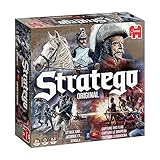
- Stratego is the strategic game where you challenge your opponents in the heat of battle
- Your task is to capture your opponent’s flag while defending your own
- Lead your men into battle, every move is crucial
- Includes 2 x 40 pre-printed playing pieces, Game board, Screen and 2 sorting trays for the pieces
- Suitable for 2 players, aged 8+
The distinction is formal rather than cosmetic. A perfect-information search evaluates a node; an imperfect-information planner must evaluate a set or distribution of possible nodes and account for the information available to each participant. Google DeepMind’s Stratego explainer summarizes the practical consequence: “The machine learning approaches that work so well on perfect information games, such as DeepMind’s AlphaZero, are not easily transferred to Stratego.”
Why hidden states make lookahead unreliable
One history can hide many realities
Suppose a poker player raises. The same raise is compatible with a strong hand, a drawing hand, or a bluff. A planner that silently chooses one hidden hand and searches as though it were known can overfit to an imagined world. The correct calculation weights the possible hands by the information available and updates those weights after every action.
In Stratego, the uncertainty is persistent. Players arrange their pieces secretly, then reveal identities only when pieces meet. A move that appears safe against one possible arrangement may expose a valuable piece to another. The planner must preserve uncertainty about dozens of pieces while the board changes over a long sequence of turns.
Other players have beliefs too
It is not enough to estimate the true hidden state. An opponent also has a belief about your cards, pieces, or intentions, and you may need to reason about that belief. Your action can change what the opponent infers, which changes the response you should expect. This nested reasoning is why an information set is often augmented with a public-belief state: a representation of what the public history implies about possible private states and their probabilities.
Rank #2
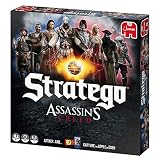
- Test your skill with Stratego, a classic game of battlefield strategy
- Let battle commence between Assassins and Templars in this ‘Stratego Assassins Creed’ special edition
- Attack and be the first to capture your opponent’s Apple of Eden Play three exciting variations of the game: Classic, Duel, and Special
- Includes 30 red playing pieces, 30 blue playing pieces, game board, screen, and sticker sheet
- Suitable for 2 players, aged 8+
Action value depends on frequency
In a perfect-information position, the strongest move can often be selected deterministically. In an imperfect-information game, a move’s value can depend on how frequently it is chosen. If a player bluffs every time a draw misses, opponents can fold profitably; if the player never bluffs, opponents can call only with strong hands. A balanced strategy mixes actions so that the opponent cannot exploit a predictable pattern.
ReBeL’s analysis makes this point with a modified Rock-Paper-Scissors example: the strategic value of an action depends on the opponent’s response and on the probability assigned to each action, not merely on the action’s payoff in a single sampled state. A one-ply search that picks the locally highest-valued move can therefore miss an equilibrium strategy.
How planners represent uncertainty
Belief-state planning
A belief-state planner stores the possible hidden states compatible with public observations, together with probabilities or strategic weights. After an action or reveal, it updates that distribution and searches over the resulting public state. This is conceptually faithful to the game, but the number of possible states can grow rapidly, and beliefs about several players can be difficult to represent compactly.
Outdated Drivers Are Slowing You Down
One free scan finds every outdated or missing driver and matches the right update for your exact hardware.Free scan · exact hardware matchPC Slower Than It Used to Be?
A free scan shows the junk files, broken settings and background clutter dragging Windows down - then fixes them in one click.Free scan · Windows 10 & 11Determinization and Perfect Information Monte Carlo
A simpler approach samples a complete hidden state, runs a perfect-information search on that sample, and repeats the process. The resulting actions are aggregated across samples. Perfect Information Monte Carlo variants used by AlphaZe (an AlphaZero-like 2023 baseline) illustrate why this adaptation can be useful for board games: existing learning and search machinery remains available while uncertainty is approximated through sampling.
Rank #3
- The classic game of battlefield strategy!
- It's a light strategy game for two players
- Command your Army, devise plans using strategic attacks and clever deception!
- Be the first player to capture the other Army's flag to win!
- For ages 8 and up
Determinization has a fundamental weakness. Each sampled world is treated as if its hidden facts were known to the acting player, so the search can exploit information the real player does not possess. Correlated samples can also produce inconsistent strategies, and performance may depend heavily on the sampling scheme and on how the opponent is modeled. The classic discussion in “A theoretical and empirical investigation of search in imperfect information games” describes why methods designed for visible states do not automatically retain their guarantees after hidden information is filled in.
Game-theoretic solving
Game-theoretic methods seek strategies that remain sound against a range of opponents, often by approximating an equilibrium. For two-player zero-sum games, exploitability can be a meaningful target: how much an ideal opponent could gain by deviating against the strategy. These guarantees are not universal. A result proved for two-player zero-sum play should not be extended to multiplayer or general-sum games without additional analysis.
Model-free learning
Deep reinforcement learning can learn policies directly from self-play without explicitly searching every hidden state during a match. This can avoid an intractable tree, but the policy must still discover how to randomize, infer information from action histories, and cope with opponents whose behavior changes. Learning can be stable in one game and brittle when rules, player counts, or information patterns change.
What major systems do differently
| System | Planning idea | What it demonstrates | Main trade-off |
|---|---|---|---|
| Libratus | Builds an abstract-game blueprint, repeatedly solves more detailed subgames during play, and improves the blueprint over time. | Offline computation can be combined with real-time refinement in heads-up no-limit Texas Hold’em. | Strong decomposition and online solving, but the design is tied to poker’s structure and benchmark. |
| ReBeL | Represents a public belief state and combines self-play reinforcement learning with search. | Beliefs about possible private states become part of the planning state; results were reported in poker and Liar’s Dice. | Its stated convergence guarantee is for two-player zero-sum games, not arbitrary settings. |
| AlphaZe (2023 baseline) | Adapts AlphaZero-style learning and search with Perfect Information Monte Carlo variants. | Sampling can make familiar model-based methods useful in imperfect-information board games. | Results are sensitive to sampling and opponent modeling, and do not establish a universal solution. |
| DeepNash | Uses game theory and model-free deep reinforcement learning for Stratego instead of explicitly modeling an opponent’s private state during play. | Long horizons and enormous hidden-state spaces can make direct tree search impractical. | Policy learning scales to the game but does not provide a general recipe for every information structure. |
Libratus showed the value of abstraction plus repeated subgame solving in heads-up no-limit poker. ReBeL combined public-belief-state learning and search, with results in poker and Liar’s Dice. The Frontiers in Artificial Intelligence study of AlphaZe found a strong baseline on Stratego and DarkHex, while also identifying sampling and opponent modeling as paths for improvement. These systems should be compared by what uncertainty they represent, when search runs, what theoretical properties are claimed, and the scale and player structure of the game—not by a single leaderboard number.
Rank #4
- Strategy Board Game
- Players: 2
- Age: 8 and up
Why Stratego is especially difficult
Stratego combines hidden identities, a long horizon, and a huge configuration space. As the official DeepMind description puts it: “Both players start by arranging their 40 playing pieces in whatever starting formation they like, initially hidden from one another as the game begins.” Identities are generally revealed only when pieces meet, so every engagement updates beliefs about pieces elsewhere.
- A typical game lasts approximately 1,000 turns, according to Google DeepMind’s 2022 explanation.
- The game has about 1066 starting configurations.
- Its game-tree complexity is described as about 10535.
At that scale, ordinary Monte Carlo tree search cannot expand enough of the tree to provide useful coverage during play. DeepNash instead learned a game-theoretic policy through model-free deep reinforcement learning. The approach avoids pretending that a single sampled arrangement is known, but it also illustrates a limitation: a policy that works for Stratego does not automatically transfer to poker, Bridge, or a multiplayer game with different incentives.
A 2026 Nature article’s indexed search description refers to more than 1033 possible Stratego piece configurations. That quantity may use a different counting convention from the starting-configuration and game-tree figures above; the full article page was not accessible for verification, so the numbers should not be combined as though they measured the same object.
Do these 3 things before closing this tab:
1Fix the driver behind crashes, sound loss and screen glitches2Repair Windows errors before they cause bigger problems3Scan for outdated or missing drivers - takes under a minutePoker makes strategic mixing unavoidable
Poker exposes the planning problem in a compact form. Hidden cards determine the true state, but betting also communicates information. A strategy that always bets with strong hands is readable; a strategy that sometimes bets with weak hands can prevent opponents from calling only when they are ahead. The planner must select both the action and an appropriate frequency.
Best Value

- Brand New in box. The product ships with all relevant accessories
- Includes gameboard, armies with 4 Infantry, 12 Cavalry, and 8 Artillery each, deck of 56 Risk cards, 1 card box, 5 dice, 5 cardboard war crates, and game guide.
- PLAY USING ALEXA SKILL: Players have the option of playing this Risk game using Alexa. (Alexa device sold separately. ) Note: sound comes from paired Echo device.
- DRAGON TOKEN: This Risk game includes a dragon token. Players must destroy the dragon before it destroys their troops. A lucky roll can subdue the dragon and get it out of a player's territory
That requirement changes evaluation. A move cannot be judged only by its expected payoff against one fixed opponent response. The planner must ask how the move changes the opponent’s belief, how the opponent could exploit a predictable frequency, and whether the resulting strategy remains effective against alternative responses. Libratus’s blueprint and subgame-solving architecture addresses this by computing broad strategic structure in advance and refining local decisions as a hand unfolds.
Independent reader supportYour contribution helps us test, update, and keep practical guides available for everyone.Why AlphaZero does not work unchanged
AlphaZero’s core assumptions fit games where the current state is visible and a move can be evaluated by self-play from that state. Poker or Stratego violates each assumption:
- The state is not fully observed. A search node corresponds to several possible private states.
- Information is asymmetric. Each player may know facts the others do not, so there is no single common state to place at the root.
- Randomization is strategic. The correct policy may intentionally mix actions, while deterministic selection can be exploitable.
- Search can leak information. Determinizing hidden facts gives the simulated player knowledge unavailable in the real game.
- Scale changes the engineering choice. Stratego’s roughly 1,000-turn horizon and enormous tree make exhaustive or ordinary Monte Carlo search impractical.
AlphaZero-like methods can still contribute representation learning, policy/value networks, and self-play infrastructure. They need an uncertainty treatment—such as belief-state search, carefully designed sampling, or a policy-learning method that learns equilibrium behavior—before they can address hidden information responsibly.
A practical design checklist for an imperfect-information planner
- Define the information structure. Record what each player observes, what remains private, when random events occur, and whether observations are publicly shared.
- Choose the uncertainty representation. Use explicit public beliefs when the state space permits; use sampling when exact beliefs are too large; or learn a policy directly when online search is infeasible.
- Prevent information leakage. Ensure training and evaluation never give the acting policy hidden facts that a real player would not have.
- Model action frequencies. Evaluate whether opponents can exploit deterministic or overly predictable choices.
- Match the solver to the game. Decomposition suits poker subgames; belief-state search suits some compact two-player games; model-free learning may suit very long, huge games such as Stratego.
- State guarantees narrowly. Report exploitability or convergence claims with their player-count and payoff assumptions.
- Test robustness. Evaluate against varied opponents, rule changes, altered information patterns, and different random seeds rather than relying on one benchmark.
How to interpret benchmark results
A win rate or headline victory is conditional evidence. It applies to the specified game, rules, opponent pool, hardware and evaluation protocol. AlphaZe’s strong Stratego and DarkHex baseline does not equal DeepNash’s stronger reported Stratego results, and neither result proves that the same algorithm dominates poker or Bridge. The relevant questions are whether the system was tested against adaptive opponents, how hidden states were sampled or represented, whether search occurred before play or during play, and what failure modes appear when the opponent changes strategy.
For readers comparing papers, keep five axes separate: the uncertainty representation; equilibrium or exploitability properties; timing of computation; game scale, horizon and number of players; and robustness to changed rules or information patterns. This prevents a method optimized for one benchmark from being mistaken for a universal planner.
Where the field is heading
Research is expanding imperfect-information benchmarks beyond compact poker variants and short board games. The 2026 Nature publication “Scalable decision-making for games of imperfect information” is a recent signal of that direction; only indexed details were available, so its reported metrics should be read as preliminary until the full article and definitions are examined. The broader trend is clear: progress depends on combining scalable learning with representations that respect what each player can actually know.
Imperfect-information planning is therefore not a missing feature that can be switched on in a perfect-information engine. It is a different problem class. Successful systems either maintain beliefs, solve strategically mixed subgames, learn policies that encode uncertainty, or combine several of those ideas while accepting game-specific trade-offs.
Quick Recap
Product prices and availability are accurate as of the date/time indicated and are subject to change. Any price and availability information displayed on Amazon at the time of purchase will apply.

