Quick wins for a faster PC:
Repair Windows errors before they cause bigger problemsFix Now →Scan for outdated or missing drivers - takes under a minuteDriver Scan →Data centers use natural gas in two ways: indirectly, by buying electricity from grids where gas-fired plants are part of the generation mix, and directly, by operating gas engines, turbines, microturbines or fuel cells on or near the campus. LNG (liquefied natural gas) is the same fuel in cryogenic liquid form. A facility stores LNG, vaporizes it and sends the resulting gas to generating equipment when pipeline supply is unavailable, constrained or insufficiently redundant.
The distinction matters. Saying that a data center “runs on gas” does not necessarily mean it burns gas onsite. In the United States, natural gas produced 43% of all electricity in 2023, according to the U.S. Energy Information Administration (EIA). The International Energy Agency (IEA) estimates that gas supplied more than 40% of the electricity physically consumed by U.S. data centers in 2025, counting both onsite generation and the local grid mix. Globally, gas supplied 26% of data-center electricity in 2024.
As an Amazon Associate I earn from qualifying purchases.
Where natural gas enters a data center’s power system
Electricity purchased from the grid
Most facilities receive medium- or high-voltage service from a utility. The electricity may come from a regional mix of gas, coal, nuclear, hydroelectric, wind and solar resources. Gas-fired combined-cycle plants are common because they can run for long periods at relatively high efficiency while adjusting output to balance changing demand and variable renewable generation. EIA describes these units as flexible resources that support transmission reliability.
A grid-connected data center therefore has an indirect gas footprint even when its site contains no combustion equipment. The relevant gas share is the physical generation mix serving the facility, not a national average or a renewable-energy certificate claim. That distinction becomes important when estimating emissions or evaluating whether a campus can operate through a grid outage.
#1 Best Overall
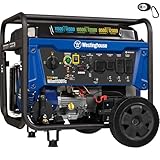
- Automatic Home Backup Made Portable: Pair with the Westinghouse WATS200 Automatic Transfer Switch for automatic backup power. This revolutionary, first-of-its-kind technology combines standby convenience with portable versatility. Exclusive to Westinghouse. Switch sold separately.
- Built for Longer Engine Life: The powerful 550cc engine features a pressure lubrication system that delivers oil to critical components, reducing friction and wear. A reusable oil screen captures abrasive particles and contaminants for cleaner oil and long-lasting engine performance.
- Power for sensitive electronics: Less than 5% THD delivers cleaner power for phones, computers and TVs. Copper windings help it run cooler and last longer. Up to 19 hours at 25% load on a 9.5-gallon gas tank, with push-button and remote start.
- Fuel flexibility: Choose gasoline, propane or natural gas. Delivers 11,500 running/14,500 peak watts on gasoline. 50A and 30A outlets pair well with an interlock kit, manual transfer switch or Westinghouse WATS200 ATS system for home backup (sold separately).
- Built-in safety and support: Automatic low-oil shutdown helps protect the engine, while the CO sensor shuts down the generator when elevated carbon monoxide is detected. Backed by a 3-year limited residential warranty and lifetime technical support.
Onsite prime, bridge and standby generation
When transmission upgrades or utility interconnections cannot be completed on a required construction schedule, developers may install generation at the campus or on adjacent land. Gas units can provide temporary “bridge” power until the grid connection is ready, continuous prime power, or dispatchable support alongside utility service.
Common choices include aeroderivative gas turbines, large reciprocating engines, smaller engines, microturbines and fuel cells. Aeroderivative turbines and reciprocating engines are attractive for large, rapidly changing loads because they start quickly, ramp rapidly, can be installed in modules and provide high power density. EPA’s distributed-generation guidance also identifies gas engines, microturbines and fuel cells for standby, continuous prime-power and combined-heat-and-power applications.
Fuel cells supplied with natural gas
A fuel cell makes electricity electrochemically instead of burning fuel in a cylinder or turbine. A natural-gas system first reforms the gas into hydrogen-rich fuel, then produces electricity in the cell stack. It still has upstream fuel and emissions considerations, and it should not be called zero-emission unless the fuel source and accounting boundary genuinely support that description.
Do these 3 things before closing this tab:
1Clear out junk files and repair common Windows errors2Scan for outdated or missing drivers - takes under a minute3Repair Windows errors before they cause bigger problemsA U.S. Department of Energy demonstration with Microsoft used a 1.5-megawatt fuel-cell generator together with cooling equipment, an inverter, transformer and switchgear. That configuration illustrates the balance-of-plant equipment needed beyond the cell stack itself.
Rank #2

- 12500 Peak Watts, 9500 Running Watts (Gasoline); 11200 Peak Watts, 8500 Running Watts (Propane); 9500 Peak Watts, 7500 Running Watts (Natural Gas); Remote Start with Included Key Fob, Electric and Recoil Start; Up to 12 Hours of Run Time on a 6. 6 Gallon Fuel Tank with Fuel Gauge
- Features Two GFCI 120V 5–20R Standard Household Receptacle, One Transfer Switch Ready 120V L14-30R, and One RV Ready 120/240V 14–50R; All Outlets Have Rubber Covers for Added Safety
- Powered by a Heavy Duty 457cc Westinghouse 4-Stroke OHV Engine Featuring a Long-Lasting Cast Iron Sleeve with Automatic Low Oil and Carbon Monoxide (CO) Shutdown, and Digital Hour Meter
- Plug-and-Play: Comes with a Remote Start Key Fob, 12V Battery Charger, Oil, and Oil Funnel, a Tool Kit, and a User’s Manual to Get You Started Right Out of the Box (Minimal Assembly Required)
- All Westinghouse Portable Generators are Functionally Tested in the Factory and May Contain Minimum Residual Oil and/or Fuel Odor; EPA Compliant; Backed By 3-Year Limited Service, Labor, and Parts Coverage and Nationwide Customer Service Network
What LNG changes compared with pipeline gas
LNG is not a separate molecule or a special type of generator fuel. It is natural gas cooled to about −260°F (−162°C), where it becomes a liquid and occupies roughly 1/600th of its gaseous volume. The volume reduction allows gas to be moved by tanker or ISO container and stored onsite when a pipeline connection is unavailable or lacks adequate delivery capacity.
The LNG-to-electricity sequence
- Delivery: A tanker truck, trailer or other approved transport vessel unloads LNG through a dedicated connection.
- Cryogenic storage: Double-wall tanks hold the liquid at very low temperature. The site must control pressure and account for heat entering the tank.
- Boil-off management: A small portion of LNG naturally warms and becomes gas. Operators route boil-off gas to the fuel system, reliquefaction equipment or an approved disposal or combustion system, depending on the design.
- Vaporization: Vaporizers add heat so LNG becomes gaseous natural gas at the pressure required by the engines, turbines or fuel processors.
- Gas conditioning: Regulators, filtration and gas-quality controls protect the generating equipment and keep the fuel within the manufacturer’s specification.
- Generation and distribution: The gas is burned in engines or turbines, or processed in a fuel cell. Transformers and switchgear then connect the output to the data-center electrical bus.
Some power plants make and store LNG onsite for high-demand periods or when pipeline-delivery capacity is constrained. A data-center project using LNG must add unloading equipment, cryogenic tanks, vaporizers, pressure regulation, gas detection, fire protection and emergency procedures to the generator plant. There is no universal LNG storage duration or cost: the answer depends on the IT load, generator efficiency, tank size, delivery contract, climate, local codes and permit conditions.
Pipeline gas versus LNG
| Consideration | Pipeline natural gas | LNG |
|---|---|---|
| Fuel state at the generator | Gas delivered continuously through a utility or dedicated pipeline | Liquid is stored, then vaporized into gas before use |
| Infrastructure | Metering, pressure regulation, filtration and redundant pipeline feeds where available | Cryogenic tanks, unloading connections, vaporizers, boil-off management, gas controls and truck or marine logistics |
| Supply risk | Depends on pipeline capacity, pressure, upstream interruptions and priority rules during extreme weather | Depends on inventory, delivery access, liquefaction and shipping availability, and the ability to vaporize the stored fuel |
| Best-fit problem | Continuous fuel for a site with a dependable, adequately sized connection | Fuel resilience or temporary supply where pipeline service is delayed, constrained or unavailable |
| Universal cost or duration | Not stated; site-specific | Not stated; site-specific |
Why AI data centers are considering gas turbines
AI training and inference clusters concentrate very large electrical loads in a small geographic area. They also bring schedules that may be shorter than the time required to build transmission lines, substations and utility interconnections. Onsite gas generation can be deployed in stages while grid work proceeds, allowing servers to be energized earlier.
What’s actually slowing this PC down?
Pick the symptom - the matching free tool is one click away.
Fast ramping is another reason. A turbine or reciprocating engine can adjust output as accelerators, cooling systems and other variable loads change. The generator is not expected to replace every element of the electrical architecture: batteries and uninterruptible power supplies handle millisecond-scale ride-through, switchgear transfers sources, and engines or turbines provide sustained energy.
Rank #3

- With 13,000 watts of power, the XP13000HXT Tri Fuel generator will keep your whole home running during a storm or power outage, while protecting your family from harmful fumes with CO Alert
- Run your generator on gasoline, propane, or natural gas. With Tri Fuel, we offer the ultimate freedom and flexibility of fuel choice
- Powerful 500cc OHV Engine: At the heart of this generator resides a robust DuroMax engine designed to provide you with the most power.
- The XP13000HXT comes with a push button start, a front facing interface that allows you to change your fuel type in seconds, and a wide variety of outlets including a transfer switch-ready 50 amp outlet
- Push Button Start and Remote Start: Turn on your generator with a simple push of a button, or use the remote to conveniently start your generator from a distance.
Reliability requires more capacity than the instantaneous IT demand. The IEA’s 2026 analysis says dependable onsite gas-fired electricity may require 30% to 70% more onsite generation capacity than the critical and variable load. That overbuild covers maintenance outages, generator failures, heat-rate changes, peak conditions and uncertainty in the workload. It is an infrastructure-planning range, not a rule that every campus must apply identically.
The U.S. EIA reported that developers planned 18.7 gigawatts of new combined-cycle capacity by 2028, including 4.3 gigawatts already under construction, reflecting broader expectations for gas-fired electricity as demand grows. Those plants may serve data centers through the grid rather than sit at a campus.
How much gas-related electricity data centers may need
The IEA projects electricity generation serving data centers worldwide to rise from 460 terawatt-hours in 2024 to more than 1,000 terawatt-hours in 2030 in its base case. The projection covers all generation sources, not just gas. Applying the 26% global gas share observed for 2024 would be an illustration, not a forecast: actual shares will vary by country, grid expansion, renewable deployment, nuclear availability, fuel prices and the amount of onsite generation.
For a specific campus, fuel demand must be calculated from the electrical load profile and the selected equipment’s heat rate. Engineers model the critical load, noncritical and variable load, expected utilization, ambient conditions, maintenance schedule, black-start requirements and the efficiency of each generator. A nameplate megawatt figure alone cannot determine annual gas consumption.
Rank #4

- INVERTER BENEFITS, HOME BACKUP POWER: The Westinghouse iGen8200TFc is a tri fuel generator with all the benefits of an inverter, but also with home backup power and a 50A outlet; Gasoline: 6600 running/8200 peak watts, Propane: 5940 running/7380 peak watts, Natural Gas: 5280 running/6560 peak watts
- SAVE FUEL, SAVE MONEY, LESS NOISE: Inverter technology adjusts engine speed to meet power demand, significantly cutting fuel use compared to traditional generators. That's less refills and fuel runs–saving time, money, and hassle. It's also much quieter than open frames, around 60 dBA at 25% load
- TRANSFER SWITCH OR INTERLOCK KIT READY: One 120/240V 14–50R 50A outlet for home backup can run your air conditioner, refrigerator, sump pump, and more–all at once; One RV ready 120V TT-30R 30A outlet; One GFCI 120V 5–20R 20A standard duplex outlet
- LOW THD AND COPPER WINDINGS: With less than 3% THD, it's safe to power electronics like phones, computers and TVs to stay connected during outages, or on jobsites and campsites. Copper windings help the unit make cleaner power, run cooler and last longer
- DURABLE ENGINE WITH SAFETY BUILT-IN: Powered by a heavy duty 298 cc Westinghouse 4-stroke OHV engine with a cast iron sleeve; up to 17 hours of run time on a 3.9 gallon fuel tank at 25% load with automatic low oil shutdown and carbon monoxide (CO) sensor
Reliability architecture around gas generation
Redundant generator blocks
Data centers commonly divide generation into independent blocks so a single failure does not remove the entire supply. N+1 means one additional unit beyond the number needed for the design load; N+2 provides two spares. The appropriate arrangement depends on the facility’s uptime objective, maintenance strategy and utility reliability.
Fuel-train redundancy
A reliable plant needs more than multiple engines. Designers may provide dual pipeline feeds, separate LNG tanks or unloading paths, parallel vaporizers, independent gas pressure-control trains and isolation valves. Controls should prevent one fuel-system fault from disabling every generator.
Black start and electrical coordination
Black-start capability allows generators to start without an energized grid. Automatic transfer switches, medium-voltage switchgear, protective relays, transformers, UPS systems and batteries must be coordinated so engines or turbines do not trip when large motors and cooling equipment start. Testing should include loss of utility power, generator failure, fuel-system interruption and restoration to normal service.
PC Slower Than It Used to Be?
A free scan shows the junk files, broken settings and background clutter dragging Windows down - then fixes them in one click.Free scan · Windows 10 & 11Outdated Drivers Are Slowing You Down
One free scan finds every outdated or missing driver and matches the right update for your exact hardware.Free scan · exact hardware matchAre natural-gas generators cleaner than diesel backup generators?
Natural-gas combustion produces carbon dioxide and criteria pollutants. Its climate impact also includes methane released during production, gathering, processing, transmission, liquefaction, shipping, storage and regasification. LNG adds energy use and emissions from liquefaction and transport. A gas system therefore cannot be labeled “clean” without stating whether the comparison includes upstream methane and LNG logistics.
Best Value

- Automatic Home Backup Made Portable: Pair with the Westinghouse WATS200 Automatic Transfer Switch for automatic backup power. This revolutionary, first-of-its-kind technology combines standby convenience with portable versatility. Exclusive to Westinghouse. Switch sold separately.
- Built for Longer Engine Life: The powerful 500cc engine features a pressure lubrication system that delivers oil to critical components, reducing friction and wear. A reusable oil screen captures abrasive particles and contaminants for cleaner oil and long-lasting engine performance.
- Less refueling, easy starting: Runs up to 19 hours at 25% load on a 9.5-gallon gasoline tank. Start with the push of a button or the included remote key fob; backup recoil starting adds flexibility. A built-in fuel gauge makes fuel checks easy.
- Fuel flexibility: Choose gasoline, propane or natural gas. Delivers 10,500 running/13,500 peak watts on gasoline. 50A and 30A outlets pair well with an interlock kit, manual transfer switch or Westinghouse WATS200 ATS system for home backup (sold separately).
- Built-in safety and support: Automatic low-oil shutdown helps protect the engine, while the CO sensor shuts down the generator when elevated carbon monoxide is detected. Backed by a 3-year limited residential warranty and lifetime technical support.
Compared with diesel engines, gas equipment often has lower particulate emissions and can have lower nitrogen-oxide or sulfur emissions when designed with appropriate combustion controls and exhaust treatment. The result depends on engine type, operating load, maintenance, methane slip, permit limits and the specific diesel baseline. EPA’s distributed-generation report gives an example in which a fuel cell has lower carbon-dioxide emissions than a diesel generator, but that example uses particular technologies and operating assumptions; it is not a universal result for every natural-gas installation.
What must be counted
- Scope 1: Carbon dioxide and other pollutants emitted at the site by engines, turbines, boilers or fuel processors.
- Upstream methane: Leakage and venting before the fuel reaches the campus.
- LNG chain: Electricity and fuel used for liquefaction, shipping, storage and vaporization.
- Grid displacement: Emissions avoided or added when onsite generation changes how much electricity the campus draws from the regional grid.
- Reporting obligations: Air permits and greenhouse-gas rules may apply to stationary combustion, LNG storage, pipelines and fuel suppliers. EPA’s eGRID database provides U.S. generation, emissions, emission rates, heat input and resource-mix data, while the Greenhouse Gas Reporting Program covers relevant large sources and fuel-supply categories.
Local constraints that can decide the design
Air permits and construction timing
Gas turbines and engines need air permits that address nitrogen oxides, carbon monoxide, volatile organic compounds, greenhouse gases and, where applicable, particulate matter. Permit reviews, environmental analysis, emissions-control equipment and interconnection studies can affect the schedule as much as equipment manufacturing.
Noise and community impact
Large engines, turbines, compressors, pumps and cooling equipment produce low-frequency and tonal noise. Acoustic enclosures, silencers, barriers and operating restrictions may be necessary. Fuel cells can be considered where noise or local-air-pollution limits make combustion equipment difficult, although their fuel-processing and balance-of-plant requirements remain.
Water, heat and combined heat and power
Cooling design affects both efficiency and permitting. Some equipment rejects heat through air systems; other designs use water-based cooling. Where a nearby industrial or district-heating customer exists, combined heat and power can use otherwise wasted thermal energy, but it adds piping, controls and a dependable heat load.
A practical checklist for evaluating an LNG or gas-powered campus
- Define the load: Separate critical IT load, variable accelerator load, cooling, pumps, lighting and support systems.
- Map the utility path: Confirm interconnection date, transmission constraints, voltage level, protection requirements and outage history.
- Select an operating role: Decide whether gas generation is standby, bridge power, continuous prime power, peak support or a combination.
- Compare technologies: Evaluate turbines, reciprocating engines, microturbines and fuel cells for ramp rate, efficiency, modularity, emissions, noise and maintenance.
- Choose fuel logistics: Verify pipeline pressure and redundancy. If using LNG, size tanks and vaporizers for the required autonomy and delivery schedule rather than assuming a generic storage period.
- Design redundancy: Coordinate N+1 or N+2 generation with UPS batteries, switchgear, black-start equipment and independent fuel trains.
- Model environmental performance: Include onsite combustion, methane leakage, LNG energy use, water, heat rejection and displaced-grid emissions.
- Secure permits and emergency plans: Address air quality, fire protection, hazardous-material handling, traffic, noise, spill response, gas detection and community reporting.
- Test under realistic conditions: Demonstrate black start, step-load response, island operation, fuel interruption, generator maintenance and return to utility service.
The bottom line for operators and communities
Natural gas is becoming a practical way to add firm electricity near data centers while utilities build longer-term grid capacity. Pipeline gas is simpler when a large, redundant connection exists; LNG adds storage and transport flexibility but also cryogenic equipment, deliveries and additional emissions sources. Gas generation can improve schedule and resilience, yet it requires overbuilt capacity, careful electrical coordination, air permits and a fuel plan that survives interruptions. The most defensible assessment compares the complete system—grid supply, onsite equipment, fuel chain, batteries, cooling, reliability and emissions—rather than treating “natural gas” or “LNG” as a single technology.
Quick Recap
Product prices and availability are accurate as of the date/time indicated and are subject to change. Any price and availability information displayed on Amazon at the time of purchase will apply.

