Climate models simulate winds, pressure, ocean circulation, ice and other changing parts of the Earth system. Researchers can use those simulated fields to estimate how mass and momentum shifts affect Earth’s rotation—but many climate models do not let the changing rotation rate feed back into the simulation itself. The distinction matters: a model can help calculate a rotation response without dynamically changing the planet’s spin inside the model.
How changes in mass and motion affect Earth’s rotation
Two related physical effects connect climate to Earth’s rotation. One is the redistribution of mass; the other is the exchange of angular momentum between the atmosphere and solid Earth. They can influence different rotation measurements, so polar motion and length of day (LOD) should not be treated as interchangeable.
As an Amazon Associate I earn from qualifying purchases.
Mass redistribution can move the spin axis
Moving ice, groundwater, ocean water or other mass changes Earth’s distribution of mass, and therefore its inertia tensor. This can shift the rotation axis relative to the crust, a motion called polar motion. NASA’s polar-motion visualization depicts contributions from surface mass changes, such as ice melt and sea-level change, as well as internal processes including glacial rebound and mantle convection. The visualization exaggerates the displayed signals to make them easier to see.
Quick wins for a faster PC:
Repair Windows errors before they cause bigger problemsFix Now →Scan for outdated or missing drivers - takes under a minuteDriver Scan →Angular-momentum exchange can change the length of day
The atmosphere carries angular momentum in its winds and in its mass distribution. NASA’s Earth-rotation service distinguishes the motion component of atmospheric angular momentum (AAM), associated with winds relative to Earth, from the mass component, associated with atmospheric mass distribution. To a close approximation, when angular momentum is conserved, a change in atmospheric angular momentum is balanced by an opposite change in the solid Earth’s angular momentum. That exchange can alter spin rate, commonly expressed as a change in LOD.
#1 Best Overall

- [Color LCD Screen Weather Station] Newentor temperature & humidity monitor with a large color LCD display shows essential home weather information at a glance: indoor/outdoor temperature & humidity, daily high/low records, customizable alerts, time/date, alarm clock & snooze, weather forecast, moon phase, and barometric pressure.
- [Two Power Modes & Adjustable Backlight] To enjoy a 24/7 continuous always-on vibrant display, simply connect this home weather station to a wall outlet using the included DC power adapter. When operating on battery power only (batteries not included), the digital thermometer automatically enters an eco-energy-saving mode, where the screen lights up for a quick 15-second glance before dimming. It is the perfect bedside or living room clock designed to fit your power preference.
- [3-channel Home Weather Stations Wireless Indoor Outdoor] Wireless temperature forecast station supports up to 3 remote sensors to monitor inside outside temperature & humidity of multiple locations. Package contains one remote sensor.
- [Wireless Forecast Station] The weather forecast station calculates the weather forecast for the next 12-24 hours, 7 to 10 days calibration ensures an accurate personal forecast for your location.
- [Wireless Weather Station with Atomic Time&Date] Atomic alarm clock weather station can be used not only as a wireless indoor outdoor thermometer but also as an atomic clock with dual alarms.
In practical terms, climate output supplies changing winds and pressure fields; a rotation calculation then applies angular-momentum conservation to estimate the associated response. The effect is real but small, and its estimated size depends on the reservoirs, time scales and external torques included.
What climate models simulate—and what they may leave fixed
Climate models represent interacting components and enforce physical conservation laws. NASA’s climate-model explainer describes simulations of atmosphere, ocean and land processes that follow conservation of mass, momentum and energy. NASA’s GEOS-5 description gives a coupled-system example in which atmosphere, ocean, land and sea ice exchange momentum, heat and freshwater.
Rank #2

- Comprehensive Weather Information: One of the best weather stations, receive over 55 data points that allow you to monitor historical data, the heat index, dew point, feels like temperature, pressure trends with trend arrow, and more
- Real-Time Weather Conditions: Look no further for the perfect indoor and outdoor weather station! Wirelessly receive readings for indoor/outdoor temperature and humidity, wind speed/direction, barometric pressure, and rainfall directly to your home weather station
- Easiest Setup on the Market: Just install batteries, attach the wireless outdoor sensor to a pole or post using the included mounting bracket, and you’re ready to be the neighborhood weather expert
- Weather Clock: The indoor weather station display is a large, color LCD Display with the current time, date, and an adjustable dimmer, making it convenient to read and easily view indoor and outdoor data, time, and conditions
- Weather Forecast: The outdoor weather station collects elevation data and combines it with barometric pressure data from the indoor weather station to provide a personalized weather forecast 12 hours from your current conditions
That does not mean every model dynamically updates Earth’s rotation rate. The treatment depends on the model and research question. A HadGEM3 study, for example, used simulated atmospheric angular-momentum fluctuations to examine LOD variability while explicitly noting: “This model knows nothing of the fluctuations in Earth’s rotation rate.” The authors’ point was that AAM can still be useful for predicting or assessing rotation variability even when rotation itself is not a changing model state.
Free tools Windows power users keep installed
One-click scans. No signup required.
Other researchers calculate rotation effects after a climate simulation. A 2026 study in npj Climate and Atmospheric Science analyzed large ensembles from three climate models, deriving motion AAM from zonal winds and mass AAM from surface pressure. It translated changes in total AAM into LOD anomalies using angular-momentum conservation, and applied an inverted-barometer approximation for the ocean’s response to atmospheric pressure loading. This is a diagnostic workflow: the climate-model output is used to estimate the rotation response, rather than establishing that the model simulated rotation feedback internally.
Rank #3

- Simple Setup and Use: Install 2 AA batteries (not included) in the outdoor weather station sensor and easily hang on a post or tree branch using the integrated hanger to begin receiving your weather forecast and hyperlocal conditions
- Real-Time Weather Conditions: This indoor outdoor weather station has an indoor temperature gauge and an outdoor temperature thermometer for indoor and outdoor temperature, humidity, and barometric pressure trends from an outdoor temperature sensor
- Weather Forecast and Forecasting Technology: The outside temperature thermometer wirelessly relays data to provide a hyperlocal, personalized weather forecast 12 hours from your current conditions, so you can plan your la crosse or other sports game!
- Illuminated LCD Color Display: Easy-to-view digital indoor outdoor thermometer display has an adjustable dimmer to make for the perfect addition to your home technology and allows easy placement anywhere in the house, office, or as an RV weather station
- Dynamic Forecast Icons and Moon Phase: With multiple thermometers & weather instruments data, this digital indoor outdoor thermometer display has trend arrows and provides the current moon phase to further impact your weather monitoring capabilities
How researchers connect models with observations
Mass-redistribution estimates combine observations and models because no single measurement describes every reservoir and period. NASA’s JPL visualization uses GRACE measurements of continental mass change, alongside model-based solutions for associated ocean redistribution, for 2003–2015. For 1900–2000, it assembles modeled mass transport involving ice sheets, glaciers, reservoir impoundment, groundwater depletion, glacial rebound and mantle convection.
NASA’s 2024 account of studies on polar motion and LOD reports that the spin axis meandered about 30 feet (10 meters) over the preceding 120 years. It also summarizes a machine-learning study attributing 90% of recurring polar-motion fluctuations from 1900 to 2018 to groundwater, ice sheets, glaciers and sea level, with most of the remainder associated with Earth-interior dynamics. That percentage is an attribution reported for those recurring fluctuations and that study period, not a universal explanation for all polar motion.
Rank #4
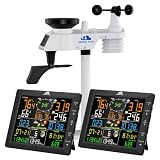
- ⛅️ [High-precision Swiss temperature and humidity sensor] Temperature measurement range: -40°F~140°F, accuracy ±2°F/1°C; humidity 10%~99%, accuracy ±5%. Supports wind chill index and dew point analysis, issues alerts when perceived temperature drops below actual temperature, safeguarding outdoor activity safety for children and the elderly at home.
- ⛅️ [8.5-inch large-screen weather display] Equipped with an 8.5-inch color LCD screen with adjustable brightness, it displays wind speed and direction, future weather trends, indoor/outdoor temperature and humidity, and barometric pressure changes all on one screen, generating personalized weather references tailored to your home location.
- ⛅️ [Multi-function wireless weather station] Deployable both indoors and outdoors, it wirelessly transmits multi-dimensional data including temperature and humidity, rainfall, wind speed and direction, moon phase, UV index, wind chill index, dew point, and barometric pressure to the host unit, enabling round-the-clock real-time monitoring.
- ⛅️ [Research-grade environmental monitoring] Equipped with professional-grade rain gauge, anemometer, and high-precision temperature and humidity sensors, it collects reliable hydro-meteorological data that can meet both environmental monitoring and research needs, as well as serve as a tool for children's meteorological education.
- ⛅️ [328 ft ultra-long-range transmission] The outdoor sensor provides a wireless signal coverage radius of up to 328 ft/100 meters, eliminating the hassle of wiring with stable and smooth transmission, performing reliably in both home and professional settings.
The same NASA account reports that ice and groundwater movement was attributed to an LOD increase of 1.33 milliseconds per century during 2000–2018. For earlier periods of the prior century, the summarized estimates ranged from 0.3 to 1.0 milliseconds per century. These are study-derived rates for specified periods, not a single constant applied to every climate era.
What projections say—and what they do not
NASA’s 2024 summary describes a high-emissions estimate of up to 2.62 milliseconds per century of climate-related LOD increase under continued high emissions, compared with an average 2.4 milliseconds per century from lunar tidal friction. The 2.62 figure is a scenario-dependent projection, not an observation or a guaranteed outcome. Separately, the 2026 AAM study examined the SSP3-7.0 scenario using 100 CESM2-LE, 40 ACCESS-ESM-1.5 and 50 MIROC6 simulations; its ensemble design and focus on atmospheric angular momentum are not directly interchangeable with estimates of ice- and groundwater-driven mass redistribution.
Best Value

- Excellent Visual Experience: This home weather station offers an amazing visual experience with its 7.5-inch HD screen. The display interface is carefully optimized to ensure high contrast and a comfortable viewing experience. Clear categorization of information and soft colors make it easy to read key details such as temperature, humidity, weather forecasts, time, and date. It is designed to be suitable for all ages, making it an indispensable companion for every household.
- Atomic Clock & DST Function: The weather station supports multiple time zones (HAT, AKT, PST, MST, CST, EST, AST) and features an atomic clock that automatically syncs daily with signals for accurate timekeeping. Before enabling the atomic clock function, please ensure that the time zone settings are correct to prevent any synchronization errors. You can also set it manually if the signal around your house is weak.
- Weather Forecast: In addition to basic temperature and humidity information, this wireless weather station also allows you to plan your day with a more comprehensive weather forecast for your area. It calculates the forecast for an 8- to 12-mile radius around your home based on barometric pressure trends. However, barometric pressure calibration requires 7 to 10 days to ensure an accurate forecast for your location.
- Multi-location Weather Monitoring: With the latest quick connection technology, the host can connect to up to three sensors, allowing for a wireless transmission distance of up to 328 feet, making it easy to achieve multi-point weather monitoring throughout the house.
- Two Power Supply Modes: When powered by batteries, the device will not stay constantly lit to conserve power. Touching the top button will turn on the screen, which will automatically turn off after 15 seconds. When powered by the adapter, the device will stay constantly lit except during the signal search period. It is recommended to use a power adapter for daily operation and insert batteries as a backup to preserve settings in case of accidental power loss.
When comparing results, check which quantity is reported—polar motion, LOD or both—and whether the analysis concerns atmospheric AAM or mass shifts in ice and water. Also note the period and time scale, the use of observations, reanalysis or climate-model output, and the emissions scenario and ensemble design. Those choices shape what a result means and how broadly it can be applied.
The practical takeaway
Climate models provide important information about changing winds, pressure and mass flows. Researchers use these fields, observations and geophysical calculations to estimate how those changes affect Earth’s rotation. In many cases the rotation response is diagnosed outside the climate simulation, so it would be inaccurate to assume that a standard climate model automatically changes its rotation rate as climate evolves. This is a common workflow, not a claim that no specialized model can ever couple rotation back into climate.
Quick Recap
Product prices and availability are accurate as of the date/time indicated and are subject to change. Any price and availability information displayed on Amazon at the time of purchase will apply.
Do these 3 things before closing this tab:
1Repair Windows errors before they cause bigger problems2Fix the driver behind crashes, sound loss and screen glitches3Clear out junk files and repair common Windows errors



