The Tool Desk
Outbyte PC Repair FREERepair Windows errors before they cause bigger problemsFix Now →Outbyte Driver Updater FREEFix the driver behind crashes, sound loss and screen glitchesFind Drivers →A stronger ringgit increases Malaysians’ purchasing power against the US dollar, euro, yen and other currencies. Importers need fewer ringgit to pay the same foreign-currency invoice, so imported fuel-linked materials, components, food ingredients, medicines, machinery and finished products can become cheaper in ringgit terms. Exporters receive fewer ringgit when they convert foreign-currency sales, while foreign customers may see Malaysian goods become more expensive.
The effect is distributed unevenly and arrives at different speeds. A company that imports most of its components and sells locally may gain quickly. A manufacturer paid in US dollars but paying Malaysian wages and rent may face pressure. A household may eventually pay less for an imported phone or overseas tuition, but local freight, taxes, wages, subsidies, old inventory and retailer margins can delay or absorb the saving.


As an Amazon Associate I earn from qualifying purchases.
Bank Negara Malaysia summarises the trade-off this way: “A stronger ringgit: is good if your business needs a lot of imports, or you are shopping or travelling abroad; is bad if your business depends on exports, or for tourists coming to Malaysia.”
What a stronger ringgit actually changes
Exchange rates express how many ringgit are needed to buy a unit of foreign currency. When the ringgit strengthens, that number falls. For example, if a US-dollar invoice is converted at RM4.40 per US dollar, a US$1,000 purchase costs RM4,400. At RM4.06 per US dollar, the same invoice costs RM4,060 before bank charges, taxes and other fees. The illustration shows the arithmetic; it is not a claim that every importer moved between those exact rates.
#1 Best Overall
The relevant rate for a particular transaction may differ from a headline market rate. Banks add spreads, companies may have fixed-price contracts, and importers often buy currency in advance. A business that hedged its dollar requirement may not receive the full benefit immediately, just as a business that failed to hedge can be exposed to a sudden reversal.
Economists also distinguish the ringgit’s bilateral rate against one currency from its nominal effective exchange rate (NEER), which measures it against a basket of trading partners. A ringgit can strengthen against the US dollar while moving less against the currencies of suppliers and competitors.
How appreciation reaches import prices
Imported inputs become less expensive in ringgit
Manufacturers, food processors and retailers often buy foreign fuel, chemicals, semiconductors, packaging, machinery or ingredients. A stronger ringgit lowers the local-currency cost of those invoices, assuming the foreign-currency price itself is unchanged. Bank Negara Malaysia’s Economic and Monetary Review 2025 said the relatively strong ringgit “helped contain import costs for raw materials.”
Do these 3 things before closing this tab:
1Clear out junk files and repair common Windows errors2Fix the driver behind crashes, sound loss and screen glitches3Repair Windows errors before they cause bigger problemsThe saving can improve a producer’s margin, allow a lower selling price, or fund investment. Which outcome occurs depends on competition and the firm’s pricing policy. A supplier with little competition may retain much of the saving; a business competing for price-sensitive customers is more likely to pass some of it through.
Finished imports can also fall in price
Electronics, vehicles, medicines, appliances, software subscriptions billed abroad and some packaged foods are priced partly or wholly in foreign currency. Importers can pay less in ringgit for a new shipment. The retail effect is clearest when inventory turns quickly and the product has a transparent international price.
Rank #2

- A New York Times and Wall Street Journal Bestseller.
- Finalist for the Financial Times and Goldman Sachs Business Book of the Year
- One of the best books of the year, picked by Washington Post, The Economist, Bloomberg
Malaysia’s external trade gives this channel substantial scope. The Malaysia External Trade Development Corporation recorded RM117.44 billion of consumption-goods imports in 2024, equal to 8.6% of total imports and up 12.8% from the previous year. The increase was driven mainly by processed food and beverages for household consumption. A stronger ringgit can reduce the currency component of those purchases, although it cannot eliminate domestic distribution and selling costs.
Why the shop price may not change immediately
Currency conversion is only one part of a final price. A shipment bought before appreciation may remain in a warehouse at its old cost. Importers may have fixed contracts, forward contracts or price lists that are reviewed monthly or quarterly. Freight, insurance, port charges, rent, electricity, wages, advertising, taxes and local delivery are ringgit costs that do not automatically decline.
Quick wins for a faster PC:
Fix the driver behind crashes, sound loss and screen glitchesFind Drivers →Repair Windows errors before they cause bigger problemsFix Now →Retailers may also preserve a margin rather than reprice every item after a small exchange-rate move. Products with weak competition, regulated prices or long shelf lives generally show slower pass-through. Conversely, a highly competitive market with frequent replenishment can transmit a currency saving relatively quickly. If the ringgit later weakens, retailers may raise prices faster than they reduced them because replacement inventory must be bought at the new rate.
What exporters lose—and why exports can still grow
The conversion effect on revenue
An exporter invoicing US$1 million receives fewer ringgit when the ringgit appreciates. At RM4.40 per US dollar, the conversion is RM4.4 million; at RM4.06, it is RM4.06 million, before fees and hedging. If the exporter’s wages, utilities and local suppliers are paid in ringgit, the reported margin can narrow even when the dollar selling price is unchanged.
Foreign buyers can also face a higher price for Malaysian goods when the ringgit strengthens and competing currencies do not. That can reduce demand or force the exporter to accept a lower foreign-currency price. The pressure is greatest for standardized products with many international substitutes and little ability to differentiate.
Imported content provides a partial offset
Many exporters are also importers. A factory buying foreign machinery, fuel-linked materials or components receives a cost saving that offsets some of the smaller ringgit value of its sales. The net result depends on the share of foreign-currency costs, the share of foreign-currency revenue and the currency in which each contract is settled.
Hedging changes the timing and size of the impact. Forward contracts and other risk-management arrangements can lock in an exchange rate, protecting a budget but also preventing a company from immediately enjoying a favorable move. Malaysia’s Ministry of Finance reported that gross exports grew 6.5% in 2025, compared with 5.8% in 2024, and said leading exporters commonly hedge currency exposure. Export growth therefore does not prove that appreciation is harmless; it shows that volume, demand, product mix, pricing and hedging can outweigh the conversion pressure.
Commodity exporters have another buffer
Commodity exporters may offset a currency effect when global commodity prices or shipment volumes rise. If a product’s US-dollar price increases enough, the exporter can receive more foreign currency even while each dollar converts into fewer ringgit. Bank Negara Malaysia’s 2026 outlook also noted that Malaysia’s position as a net energy exporter can partly mitigate the effect on export competitiveness. This is a sector-specific cushion, not a guarantee for every producer.
Sector-by-sector exposure
The same ringgit move can help one firm and hurt another. The most useful tests are the foreign-currency share of costs and revenue, import intensity, hedge coverage, pricing power, contract and inventory lags, and dependence on foreign demand.
| Business or household exposure | Likely first effect of a stronger ringgit | What determines the final result |
|---|---|---|
| Import-intensive manufacturer selling in Malaysia | Lower ringgit cost for components, machinery or fuel-linked materials | How quickly contracts reset, how much competition forces price cuts, and whether imported inputs dominate total cost |
| Exporter with mostly ringgit costs | Fewer ringgit per foreign-currency sale and possible loss of price competitiveness | Hedging, ability to raise foreign prices, product differentiation and foreign demand |
| Exporter that imports many inputs | Foreign-input savings partly offset weaker converted revenue | Import content compared with export content and the currencies used in contracts |
| Tourism business serving overseas visitors | Malaysia becomes more expensive in visitors’ currencies | Visitor origin, hotel and attraction pricing, and whether the ringgit move is shared by competing destinations |
| Malaysian traveller or student abroad | Lower ringgit cost for foreign hotels, tuition and daily spending | Destination currency, payment timing, card fees and the length of the trip or study programme |
| Household buying imported goods | Potentially lower prices or slower price increases | Retail competition, stock age, taxes, freight, local wages and retailer margins |
What households may notice in everyday costs
Food and household goods
Imported ingredients and processed foods can become cheaper at the importer’s purchasing stage. The benefit is larger for products with a high foreign-content share and frequent restocking. Fresh local produce may respond little because farm labour, land, transport and wholesale costs are predominantly domestic. Even an imported product can remain expensive if packaging, refrigeration, delivery and shop costs account for much of its shelf price.
Windows Errors? Fix Them Before They Spread
Repair common Windows errors and clear accumulated junk for a smoother, more stable PC - no reinstall needed.Free scan · no reinstallCrashes, No Sound, or Screen Glitches?
Random freezes, missing sound and display glitches usually trace back to one bad driver. Find and replace yours safely.Free scan · under a minuteElectronics, vehicles and medicines
Phones, computers, cameras, spare parts and some medicines often have internationally priced components. A stronger ringgit can reduce the ringgit cost of a new shipment or a manufacturer’s imported parts. Dealers may still sell older stock at the previous cost, and taxes, warranties, distribution agreements and service costs can dominate the final price. A currency gain is therefore a reason to watch prices, not a promise of an immediate discount.
Travel, education and online services
Malaysians paying hotels, tuition, rent or living expenses abroad gain directly when the ringgit buys more foreign currency. The same applies to subscriptions or cloud services billed in dollars or euros, subject to the provider’s pricing and card-conversion fees. The advantage is strongest for payments made after appreciation; a prepaid booking or a hedged institutional payment may use an earlier rate.
Energy and transport
Many energy-related inputs are traded internationally, so a stronger ringgit can reduce the currency component of fuel and transport costs. Pump prices and utility bills also reflect taxes, subsidies, regulated formulas, global commodity prices, refining, storage and distribution. Government price policy can therefore delay, amplify or prevent a direct exchange-rate pass-through.
Does a stronger ringgit lower inflation?
It can reduce imported inflation, but exchange-rate appreciation is not a complete explanation for the cost of living. Lower import costs put downward pressure on some prices; domestic wages, rents, electricity, food supply, taxes, subsidies, freight and retailer margins can move in the opposite direction.
Bank Negara Malaysia reported that 42.1% of Consumer Price Index items recorded monthly price increases in 2025, compared with 43.0% in 2024 and a 45.6% average during 2011–19. These figures indicate that the breadth of monthly price increases eased. They do not establish that ringgit appreciation alone caused the change, nor do they show that every household’s basket became cheaper. A household buying mostly local services can experience a different result from one purchasing imported electronics, overseas travel or foreign-currency education.
Best Value
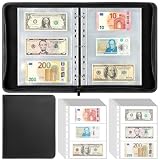
- Premium Leather Construction: The Uncle Paul money binder is crafted from high-quality artificial leather, offering durability and a sophisticated, professional look for your currency collection.
- Ample Storage Capacity: Comes with 40 sheets Currency Pages(240 pockets) to neatly organize and store a large number of paper money bills, banknotes, and coupons, keeping them safe and easily accessible.
- Double-Sided Design: Each page features a double-sided insert with 3 rows and 6 pockets, maximizing storage space and allowing for efficient categorization and display of your paper money collection.
- Secure Zipper Closure: The currency holder album is equipped with a reliable zipper closure, ensuring that your valuable currency collection remains protected from dust, moisture, and accidental spills.
- Sturdy and Well-Structured: Its robust build and well-thought-out design provide excellent support for the pages, preventing sagging or bending, and ensuring your collection stays in pristine condition over time.
There is also a distinction between a lower inflation rate and lower prices. If prices rise more slowly, the cost level may still be higher than before. Appreciation can slow the pace of increases in import-sensitive categories without reversing earlier increases.
Independent reader supportYour contribution helps us test, update, and keep practical guides available for everyone.Malaysia’s recent exchange-rate context
Recent official figures show why the direction of the ringgit matters, while also showing why no single number predicts every price.
| Period | Reported movement or level | How to interpret it |
|---|---|---|
| 2024 | NEER appreciated 7.5% against major trading partners | A broad, trade-weighted appreciation rather than a single bilateral rate |
| Second quarter of 2025 | NEER appreciated 1.5% | A quarterly movement that may affect contracts and prices with a lag |
| Fourth quarter of 2025 | Ringgit appreciated 3.6% | A quarter-specific change, not a full-year pass-through estimate |
| 2025 year to date | Appreciated 10.1%; ended the year at RM4.06 per US dollar | A reported annual movement and year-end level, not a guaranteed rate for every transaction |
Exchange rates move with interest-rate differentials, global risk appetite, terms of trade, capital flows and expectations for Malaysia’s economy. The figures above are context, not a forecast. A later reversal can erase an importer’s saving or restore an exporter’s converted revenue pressure.
Who gains and who bears the pressure?
Likely beneficiaries
- Manufacturers with substantial imported components, machinery or energy inputs.
- Retailers and households buying imported food, electronics, vehicles or medicines after prices reset.
- Malaysians travelling, studying or paying recurring bills abroad.
- Businesses with ringgit revenue and foreign-currency costs.
Likely under pressure
- Exporters paid in foreign currency while most costs are in ringgit.
- Firms competing with lower-cost foreign producers.
- Tourism operators dependent on overseas visitors, because Malaysia may appear more expensive in visitors’ currencies.
- Households whose income depends on export-oriented industries.
These are tendencies, not fixed outcomes. A company’s hedge book, contracts, inventory, imported content and pricing power can reverse the apparent advantage. An exporter with strong demand may maintain volumes and margins, while an importer with weak competition may keep the currency saving instead of lowering prices.
How to judge the effect on a specific product or business
- Identify the currency exposure. Check whether the invoice, selling price, loan, wage or supplier contract is denominated in ringgit, US dollars, euros, yen or another currency.
- Separate imported and domestic costs. Estimate the share represented by foreign materials, freight, insurance and machinery versus Malaysian labour, rent, utilities, taxes and distribution.
- Check timing. Look for inventory already paid for, fixed-price contracts, forward hedges and the next price-review date.
- Assess pricing power. A product with many substitutes is more likely to pass a cost saving to customers; a differentiated or regulated product may not.
- Consider demand and competitors. Exporters need to know whether foreign buyers can switch suppliers and whether competing currencies moved in the same direction.
- Watch the replacement cost. The relevant question for a retailer is often what the next shipment will cost, not what the current shelf stock cost months earlier.
What the available evidence cannot prove
There is no single authoritative percentage showing how much a given ringgit appreciation lowers a representative Malaysian household’s complete cost-of-living basket. The pass-through differs by product, contract, market structure and government policy. Import statistics, exchange-rate measures and CPI breadth describe important channels, but they cannot be turned into a universal household saving without assumptions that would vary from family to family.
The practical conclusion is a distributional one: appreciation shifts purchasing power toward importers and consumers buying foreign goods, while it reduces the ringgit value or price advantage of many export sales. The size and speed of the shift depend on foreign-currency exposure, imported-input content, hedging, inventories, contracts, domestic costs, competition and commodity prices.
Quick Recap
Product prices and availability are accurate as of the date/time indicated and are subject to change. Any price and availability information displayed on Amazon at the time of purchase will apply.

