Do these 3 things before closing this tab:
1Clear out junk files and repair common Windows errors2Fix the driver behind crashes, sound loss and screen glitches3Repair Windows errors before they cause bigger problemsLate X-ray flares from GRB 220706A suggest its central engine was still active 27.25 days after the burst in the burst’s own rest frame. The flares were observed as late as about 51 days after the event from Earth. The authors describe this as the latest reported central-engine activity in a gamma-ray burst, about 20.6 rest-frame days later than the previous comparison event, GRB 210204A. It does not mean the initial gamma-ray flash lasted a month.
How long did GRB 220706A’s engine stay active?
In a 2026 arXiv preprint, Gompertz and co-authors report X-ray flaring from GRB 220706A at an epoch about 51 days after its July 6, 2022 trigger, measured in time as observed from Earth. Using the burst’s measured redshift of 0.8577, they infer that the final flare occurred 27.25 days after the trigger in the burst’s rest frame. They interpret that late flare as evidence that the central engine remained active at least that long.
As an Amazon Associate I earn from qualifying purchases.
The timing supports a record claim with a specific scope: the authors call it the latest observed central-engine activity in a gamma-ray burst, and compare it with GRB 210204A, whose reported late activity was about 20.6 rest-frame days earlier. This is a claim about the timing of late flares, not a general record for the duration of every part of a gamma-ray burst.
Did the gamma-ray burst itself last a month?
No. A burst’s initial gamma-ray emission and later activity inferred from X-ray flares are different measurements. The study reports a Swift/BAT prompt-emission t90 of 87 ± 18 seconds for GRB 220706A. The much later X-ray flare is what points to an engine that continued producing activity long after the prompt flash.
#1 Best Overall

- 【Nuclear radiation detector】GQ GMC-800 is the latest upgraded model of USA GQ Electronics Geiger Counters. Portable, personal & group use. Detect ionizing nuclear radiation Beta, Garma, X-ray. Quick, sensitive, precise & Easy-to-use. Simply power-on, reading instantly shows at screen. One press shortcut key transit among four function screens. Readable under the sun, suitable indoor & outdoor.
- 【Multifunctional】Traditional Geiger counter function to find the instantaneous radiation flux on a location/spot; Real-time & timeframe measuring function to display radiation data; Dosimeter function to obtain the real-time & accumulated radiation on human body; Radiation monitoring function to monitor radiation over time at a location.
- 【The measurement accuracy】is ensured via compliant design meets USA national standard (NIST & NRC). The calibration is done to further strengthen the accuracy and data quality. Easy access rechargeable & replaceable battery. Type C data transfer & charging cable. Light, thin & anti-drop. Handheld, stand on both sides, or lay down at the surface.
- 【Five types of radiation alarms】Visual LED, Audio, Vibration, Voice. Four alarm types provide everyone including vision-impaired & hearing-impaired users. The alarm level threshold can be set by users. Exclusive Advanced Features are integrated in. Built-in Clock, Memory for data storage up to 10 years. Free data processing software & firmware updates & open protocol & online data storage & history data preview. Navigate menu & submenu to explore.
- 【User Friendly Interface UI】Shorten learning curve, easy- to-navigate. The larger clear TFT color LCD display. Fast speed, immediate reading. Main screen simultaneously show reading in dosimeter units. User selectable color change scheme, customized light/dark mode for user preferences & visual comfort; Graphic, large font mode.
Redshift also matters when comparing the timing. Because the host galaxy’s measured redshift is 0.8577 ± 0.0005, time intervals observed from Earth are stretched relative to intervals in the burst’s rest frame. The roughly 51-day observed span and the 27.25-day rest-frame epoch describe the same late activity using different reference frames.
What do the study’s different duration measures mean?
The paper reports several measures that answer different questions. Its ranking of GRB 220706A among long bursts uses tburst, not the time until the last late X-ray flare.
Rank #2

- Real-time data logging every second into internal memory.
- History data can be downloaded to computer
- Rechargeable battery last longer
- Free data Viewer PC software
- Dosimeter mode, CPM count mode, Graph mode
| Measure | What it describes | GRB 220706A result reported by Gompertz et al. |
|---|---|---|
| Prompt-emission t90 | The duration containing 90% of the detected prompt gamma-ray emission, as measured by Swift/BAT. | 87 ± 18 seconds. |
| tburst | The paper’s duration measure, based on whichever is later: the last point in the steep-decay phase or the gamma-ray t90. | 104.75 seconds; eighth-longest among 550 analyzed GRBs, including this event and 549 comparison events that passed the authors’ data-quality cuts. |
| Time to the final late flare | The epoch of late X-ray activity measured from Earth. | About 51 days after the event. |
| Final-flare epoch in the burst’s rest frame | The late-flare epoch corrected for the host galaxy’s redshift; this underpins the engine-activity claim. | 27.25 days after trigger. |
These figures should not be collapsed into one “burst duration.” In particular, the eighth-place tburst ranking is separate from the claim about the latest observed late-flare activity. The first uses a defined duration measure and a selected sample; the second concerns how late the engine appears to have remained active.
What observations support the late-activity finding?
Swift/XRT, NICER and Chandra observed the X-ray emission, while optical and infrared observations and radio/millimeter follow-up added coverage at other wavelengths. The late X-ray flaring is the key evidence for the engine-timing inference; the multiwavelength observations also help characterize the afterglow and possible source environment.
Rank #3

- Nuclear Radiation Detector: Portable design suitable for both individual and group use. Equipped with built-in precision sensors, it can detect gamma rays, beta rays, and X-rays. The device is characterized by rapid response, high sensitivity, accurate measurements, and ease of use. Readings appear immediately upon startup and are displayed in real time on the screen. The display remains clear and easy to read even in direct sunlight, making it suitable for a variety of indoor and outdoor environments
- Smart Alarms: This Geiger counter offers three alarm modes-light, vibration, and sound. Alarm thresholds can be set separately for both instantaneous and cumulative dose rates. Whether you are sleeping or active, the detector will immediately sound an alarm when radiation levels exceed the set threshold
- Measurement Accuracy: Calibration enhances accuracy and data quality. Equipped with an easily replaceable rechargeable battery. Includes a Type-C data transfer and charging cable. Designed to be slim, lightweight, and drop-resistant. This handheld radiation meter features a clear interface and simple operation, supporting dual measurement alarm modes and logging functions
- Multifunctional: Traditional Geiger counter radiation detection functions measure instantaneous radiation flux at specific locations or points; Real-time and timed measurement functions display radiation data; the dosimeter function records an individual's real-time and cumulative radiation exposure; the radiation monitoring function enables long-term tracking of radiation changes at designated locations
- Applications: Widely applicable in environments with ionizing radiation, including radiation detection during home renovations, geological exploration, steel inspection, vehicle inspection, nuclear power plants, industrial production, radiology departments, and radiation laboratories
The optical afterglow was unusually faint relative to the X-rays, meeting the study’s criterion for a “dark burst.” Dust in the host galaxy is one likely explanation, though the authors note other possibilities. The host-galaxy redshift, 0.8577 ± 0.0005, is measured from the event’s environment and is the basis for translating the late-flare timing into the burst’s rest frame.
Was a supernova found with this burst?
Optical light emerged around 17 days after the trigger, and the authors find that it is consistent with a supernova component. That is evidence for a possible associated supernova, not an unambiguous determination of its luminosity or type.
Rank #4
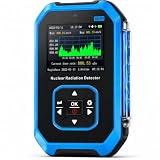
- 【Nuclear Radiation Detector】FNIRSI GC-01 Geiger counter nuclear radiation detector with built-in GM sensor, able to detect Gamma, Beta and X-rays. Cumulative dose equivalent: 0.00 uSv-500.0 mSv. Energy range: 48 KeV-1.5 MeV ≤ plus/minus 30%(for 137 Csγ)
- 【Smart Alarm】3 modes of Light/Vibration/Sound. Geiger counter can set current dose alarm value and cumulative dose alarm value. Whether in sleep or active state, the radiation monitor will alarm if the detected radiation dose exceeds the alarm threshold
- 【Multifunctional Geiger Counter】Our the geiger counter has other various setting, such as alarm setting, system clock setting and unit setting & language change,you can operate in English (default) or Chinese. Easy one-handed operation
- 【Working Principle】FNIRSI GC-01 radiation meter uses a trachea or small room as a probe to detect ionizing radiation gamma/Beta/X-ray. Radiation ionization generates ion pairs, ions are enlarged and converted into electrical pulse counts to measure
- 【Application Areas】Widely applied in the environment where existing ionize radiation. Such as home improvement radiation, uranium glass, geological survey, iron, Inspection vehicles, nuclear power plants, industry, radiology, radiology laboratories
The inferred extinction from dust spans 0.9–3.6 magnitudes. Because the correction is uncertain across that range, the authors say the supernova could meet superluminous thresholds under some assumptions, but the evidence does not establish that conclusion independently of the dust correction. They also note that continuing X-ray flaring could complicate the interpretation of the optical light.
The Tool Desk
Outbyte Driver Updater FREEFix the driver behind crashes, sound loss and screen glitchesFind Drivers →Outbyte PC Repair FREERepair Windows errors before they cause bigger problemsFix Now →What could keep the engine active so late?
The preprint discusses three broad possibilities, but does not identify a mechanism that cleanly explains all the observations:
Best Value

- 【Nuclear radiation detector】GQ GMC-800 is the latest upgraded model of USA GQ Electronics Geiger Counters. Portable, personal & group use. Detect ionizing nuclear radiation Beta, Garma, X-ray. Quick, sensitive, precise & Easy-to-use. Simply power-on, reading instantly shows at screen. One press shortcut key transit among four function screens. Readable under the sun, suitable indoor & outdoor.
- 【Multifunctional】Traditional Geiger counter function to find the instantaneous radiation flux on a location/spot; Real-time & timeframe measuring function to display radiation data; Dosimeter function to obtain the real-time & accumulated radiation on human body; Radiation monitoring function to monitor radiation over time at a location.
- 【The measurement accuracy】is ensured via compliant design meets USA national standard (NIST & NRC). The calibration is done to further strengthen the accuracy and data quality. Easy access rechargeable & replaceable battery. Type C data transfer & charging cable. Light, thin & anti-drop. Handheld, stand on both sides, or lay down at the surface.
- 【Five types of radiation alarms】Visual LED, Audio, Vibration, Voice. Four alarm types provide everyone including vision-impaired & hearing-impaired users. The alarm level threshold can be set by users. Exclusive Advanced Features are integrated in. Built-in Clock, Memory for data storage up to 10 years. Free data processing software & firmware updates & open protocol & online data storage & history data preview. Navigate menu & submenu to explore.
- 【User Friendly Interface UI】Shorten learning curve, easy- to-navigate. The larger clear TFT color LCD display. Fast speed, immediate reading. Main screen simultaneously show reading in dosimeter units. User selectable color change scheme, customized light/dark mode for user preferences & visual comfort; Graphic, large font mode.
- Accretion onto a black hole from an extended massive star: continued infall could power activity after the initial burst. The authors favor a stellar-collapse explanation by analogy with the possible supernova, but the unusually late flares remain a challenge to explain.
- A magnetar: a highly magnetized neutron star could provide an ongoing energy source. The paper considers this possibility but does not show that it accounts for every observed feature.
- A tidal disruption event: the disruption of a star by a compact object could produce prolonged activity. This is also discussed as a possibility rather than established as the cause.
The late flares establish an unusually delayed episode of activity; they do not, by themselves, reveal which engine powered it. The proposed stellar-collapse and supernova connection remains an interpretation, with the source mechanism unsettled.
How certain is the record claim?
The finding is reported in a preprint submitted to arXiv on September 18, 2026. Its record language should be read as the authors’ comparison of reported late central-engine activity, not as proof that no burst could ever have had later activity. The comparison event named in the paper is GRB 210204A, and the study’s 550-event sample ranking uses a different measure, tburst.
Quick Recap
Product prices and availability are accurate as of the date/time indicated and are subject to change. Any price and availability information displayed on Amazon at the time of purchase will apply.




