Free tools Windows power users keep installed
One-click scans. No signup required.
To improve a PCB’s chances of passing EMI compliance testing, plan placement and grounding while reviewing the schematic—not after routing begins. Identify nodes that must remain physically small, circuits that need to be close, and sensitive references that could be affected by return-current voltage drops. Then choose a grounding architecture based on the board’s current paths, operating frequencies, and measurement needs. A ground plane and a ground tree each address different trade-offs; neither guarantees a first-pass compliance result.
How the schematic can guide placement before routing
A schematic is more than a connection list: it can expose physical constraints before the board layout starts. As Analog Devices field applications engineer James Niemann writes in “Passing EMI Compliance Testing the First Time—Part 3,” published June 23, 2026: “The schematic always comes first, and the designer should understand everything about the schematic and how the circuit works from the inside out.”
As an Amazon Associate I earn from qualifying purchases.
During schematic review, mark the physical relationships the layout must preserve. In particular, identify nodes that should occupy little physical area, circuits whose connections should be short, and distances that matter to timing, RF behavior, or precision analog performance. These constraints help guide placement and reduce the risk of discovering an interference problem only after traces have been routed.
The Tool Desk
Outbyte Driver Updater FREEScan for outdated or missing drivers - takes under a minuteDriver Scan →Outbyte PC Repair FREERepair Windows errors before they cause bigger problemsFix Now →- Keep sensitive or high-frequency nodes physically compact. Flag the nodes whose geometry could affect RF behavior, coupling, or other application-specific constraints.
- Identify components that belong close together. Mark functional groups and connections where distance matters, including supply decoupling around the devices it serves.
- Preserve critical spacing. Note where timing, precision, safety, heat flow, current capacity, or sensitivity requires more than the smallest possible footprint.
Generic PCB area estimators can offer a rough starting point, but they do not account for all of these constraints. Treat their results as estimates rather than authoritative board-size requirements.
#1 Best Overall

- Industrial Grade Material : Faraday Cloth Tape Two sided conductive material made up of conductive glue and conductive cloth,two sided conductive material made up of conductive glue and conductive cloth, this allows any overlapping seams of tape to be electrically continuous.Suitable for all kinds of electronic products and appliances.Applications with Faraday Conductive Tapes,metallized surface nickel, copper form excellent electrical conductivity,which not only provides stable electrical conductivity, but also has excellent shielding effect against electromagnetic interference.
- Farewell Interference: Faraday Fabric Tape, metallized surface nickel, copper form excellent electrical conductivity, used for shield electromagnetic signals and radio waves, it will reflect, absorb or penetrate according to the nature of the object, providing excellent shielding effect. It has high shielding, electrically conductive, anti-interference, radiation protection, antistatic, anti-aging, flexibility, abrasion resistance, and other properties.High Shielding Conductive Tape, suitable for a variety of surface applications, such as metals, aluminum, plastics, glass, copper / brass, and more, strong practicability, wide range of applications.
- Widely Used: Multi-purpose cloth adhesive tapes can be used for circuit connections, electrical repairs, wire interference shielding, automotive wiring harness wrap, cable fixing, creating paper circuits, PCB heat dissipation, electric guitar noise eliminate, display repair, RFID signal blocking, making conductive foam strips, electrostatic grounding, building Faraday cage and boxes, make credit card wallets, DIY projects and more.
- Wide range application: Suitable for laptop, mobilephone, lcd, pop cable, speaker, microphone, remoter, keyboard repair. EMI Shielding. Guitar interference shielding. ESD Grounding, sealing, Waterproof material. Fasten joint of pipes of airconditioner, refrigerator, packing or wraping of the data cables etc. Also can be used as circuit sticker.
- Package Included: The whole roll of conductive fabric tape is wide 2 inch/5.08cm by long 59 feet/18m. It's easy to use and residue-free, and you can cut it into round, square, bar, sheet, or other shapes to suit your needs, making it easy to apply to a wide range of sensitive parts without the need for complex tools or skills.
How much physical area does the layout need?
There is no reliable board-area figure in the source guidance that applies across designs. Required area depends not only on the number of parts and pins, but also on whether the layout can meet its electrical, thermal, current-handling, safety-spacing, and sensitivity requirements.
Use the schematic to identify space-consuming relationships early, then assess whether the proposed footprint leaves enough room to preserve them. A compact board is not a success if meeting its outline forces critical nodes, components, or clearances into unsuitable geometry.
Rank #2

- Strong Adhesive - Kirecoo copper tape [2inch, 33FT], The copper foil tape conductive adhesive is super sticky and is protected with an easy peel backing which make it can be used on most surfaces & is able to withstand all weather conditions.
- Highly Conductive - Our copper foil uses a highly conductive material with low resistance, has dual conductivity so current will flow through both sides and the adhesive. No need to worry that the copper tape conductive adhesive will reduce the effectiveness between components, making our emi shielding foil a excellent option for electrical projects, repairs and even paper circuits. Excellent alternative to conductive paints.
- EMI & RFI Shielding - This copper foil tape with conductive adhesive Shielding electric guitar to avoid interference, shield the pickup and control cavities of a guitar. Prevent radiating and interfering, making it an ideal guitar shielding tape option. Perfect for any guitar builder/ luthier.
- Good helper for gardening - This copper tape can for slugs. You can wrap copper tape around the base of small plants Works for keeping slugs & snail away! Seedlings to protect plants. This was the perfect eco friendly solution!
- Creative Decoration - Our copper tape is a desirable choice for decorating your home, making personalized wall vinyl’s, jewellery, stainless glass & more that will come in handy for various DIY & Creative projects. Also perfect for solder, birthday light card, paper circuit or repair such as LCD monitor mobile phone.
When does differential signaling make sense?
Differential signaling is a technique to evaluate when coupled noise or ground fidelity is a concern, not an automatic remedy. It can reduce susceptibility to common-mode coupled noise when both signals in the pair experience similar interference. The source article also presents it as an option for preserving ground fidelity along longer PCB paths or through sensitive analog sections.
Its usefulness depends on the circuit and the physical implementation. Consider whether the signals will experience sufficiently similar interference and whether the differential route addresses the actual problem; do not treat the signaling method alone as a substitute for sound placement and grounding.
Rank #3

- Product structure : Faraday Fabric Tape is constructed of high-strength polyester fiber and acrylic adhesive.Nickel is first coated on polyester fiber by chemical deposition or physical metal transfer, then covered with a high-conductivity copper layer, and finally electroplated with anti-oxidation and anti-corrosion nickel.The copper-nickel composite layer provides outstanding conductivity and excellent EMI shielding effec.
- Product performance: Faraday fabric tape offers strong initial adhesion and double-sided conductivity, providing reliable circuit connection for non-weldable electronic components.It also features anti-interference, anti-static, high temperature resistance and high tensile strength.Stable and long-lasting performance even under extreme temperature conditions.
- Military-grade : high-density shielding strongly blocks EMI/RFI interference, eliminates electromagnetic leakage and signal crosstalk, and ensures long-term stable operation of equipment.
- Multi-functional for wide applications, ideal for internal shielding repair, conductive connection, electrical circuit maintenance, static grounding, cable electromagnetic shielding, paper circuit making, RFID signal shielding, PCB motherboard heat dissipation, EMP electromagnetic protection, electric guitar noise elimination, automotive wiring harness wrapping, and Faraday cage sealing & construction. It meets various needs of equipment repair, modification and DIY projects.
- Package Included: Easy hand tear design, The full-roll conductive sticky tape measures 1.2inch x 66Feet in length. It securely adheres to various surfaces including metal, plastic, foam, and glass, and more, while leaving no residue after removal.
Ground plane or ground tree: which architecture fits?
The choice depends on return-current behavior and what the circuit measures. A solid ground plane supports low-impedance, high-frequency decoupling and field containment. A ground tree may help prevent low-frequency resistive drops from noisy return currents from shifting sensitive measurement references. The latter requires more attention to field containment, so it is not a universal preference for mixed-signal designs.
| Design consideration | Solid ground plane | Ground tree |
|---|---|---|
| Important return-current behavior | Useful for high-frequency decoupling and continuous field containment; high-frequency return current tends to follow the signal path beneath a trace over the plane. | May suit designs where low-frequency or DC return-current drops could disturb sensitive measurement references. |
| Ground-voltage concern | Provides a broad conductive reference, but the architecture still needs to be evaluated against the circuit’s measurement requirements. | Branches can be arranged so the noisiest or highest currents return first and measurement grounds are added later, reducing exposure to those current drops. |
| Field containment and decoupling | Supports field containment and low-impedance high-frequency decoupling. | Field containment needs additional attention; ground fill may be used to lower supply impedance without abandoning the branching approach. |
| Routing and design effort | Requires careful placement and geometry to support intended return paths. | Requires deliberate branch planning and extra work to contain fields. |
Why frequency changes the grounding decision
At high frequencies, return current tends to flow beneath the signal path when a ground plane is available. At DC and lower frequencies, current uses available copper according to resistance, and the resulting voltage drops can matter if a sensitive circuit uses that ground as its measurement reference. That difference is why the architecture should follow the expected current paths and measurement needs, rather than a blanket rule to split or join grounds.
Rank #4
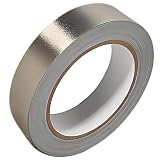
- Professional Grade: Conductive cloth tape is made of high-strength polyester fiber fabric and acrylic adhesive with a copper-nickel conductive layer formed by a special electroplating process. It ensures reliable electrical conductivity and superior electromagnetic interference shielding.
- Excellent Features: Faraday tape has good initial adhesion, with its double-sided conductive properties enabling reliable circuit connections for non-solderable electronic components. The tape also features anti-interference, anti-static, high temp resistance, and tensile strength that ensure durable performance in extreme temperatures.
- Farewell Interference: Military-grade shielding effectively blocks and suppresses external signal interference, protecting precision components from EMI and RFI. It resolves electromagnetic leakage and signal crosstalk issues, ensuring long-term stable operation of equipment.
- Multiple of Uses: Ideal for repairing internal shielded layers in devices, conduct electricity, electric repairs, electrostatic grounding, cable shield, creating paper circuits, RFID blocking, PCB heat dissipation, EMP proof, guitar noise elimination, car wire harnesses wrap, and sealing Faraday cages.
- Package Included: The full-roll conductive sticky tape measures 1" in wide × 50 Feet in length. It securely adheres to various surfaces including metal, plastic, foam, and glass, and more, while leaving no residue after removal.
When to consider a ground tree
Consider the branching approach when low-frequency or DC return currents could create resistive drops that affect measurement references. The source article describes starting with the noisiest or highest-current returns and adding measurement grounds later in the branch structure. Because a tree makes field containment more work, the layout must also address that requirement; ground fill is discussed as a way to lower supply impedance while retaining the branching method.
What’s actually slowing this PC down?
Pick the symptom - the matching free tool is one click away.
When a solid plane is appropriate
A solid plane is a strong option where low-impedance high-frequency decoupling and field containment are important. An Analog Devices application note for the AD4116 EMC board illustrates one specific implementation: it separates analog and digital areas, uses a solid ground plane for the converter, and places small ceramic decoupling capacitors close to supply pins. This is an example for that design, not a universal layout prescription.
Best Value

- ADEQUATE COPPER FOIL TAPE - Each roll is 50mm x 10m; Wide copper foil tape can wrap the cable, machine component, connection, fan, extendable antenna, computer component fully.
- ADHESIVE TAPE WITH GOOD FLEXIBILITY - The dual conductive tape can be twisted, bent, tore easily, enable you to use them by hand, no need to apply with other tool, one fit most of cables.
- COPPER FOIL TAPE - The copper tape can EMI shielding in electric machine to protect your electronics devices from electromagnetic interference.
- ARTS & CRAFTS- Copper conductive adhesive tape can be applied to stained glass, outdoor garden and home interior decorations.Copper foil tape also can paper circuits, electrical repairs, soldering, grounding.
- ARTS & CRAFTS- Copper conductive adhesive tape can be applied to craft, stained glass, outdoor garden and home interior decorations.Copper foil tape also can paper circuits, electrical repairs, soldering, grounding.
Use placement examples as design-specific guidance
Analog Devices’ AN-2020, based on the AD7606B, provides another design example, focused on signal-flow placement and input filtering and protection in an EMC-oriented board. Its component choices and layout illustrate an approach for that circuit; they should not be treated as requirements for unrelated boards. The same care applies to broader layout advice: translate an example into your design’s signal paths, operating conditions, and constraints rather than copying geometry without context.
A practical sequence from schematic review to layout
- Review how each circuit works. Trace signal and return paths, distinguish high-frequency behavior from DC and low-frequency behavior, and identify sensitive measurement references.
- Mark placement constraints on the schematic. Call out compact nodes, groups that should stay close, and distances that matter for RF, timing, or precision.
- Estimate area with the real constraints in view. Use component and pin counts only as a rough aid; account for heat flow, current capacity, safety spacing, and extra room for sensitive circuitry.
- Choose the grounding architecture from current paths. Evaluate whether high-frequency decoupling and field containment favor a solid plane, or whether low-frequency ground drops at measurement references make a tree worth considering.
- Check that placement and grounding work together. Confirm that the proposed geometry supports the intended returns, keeps critical nodes compact, and provides the required decoupling and field containment.
- Carry the decisions into power routing and stack-up planning. Placement and grounding shape those later choices; the series’ Part 4 covers power routing and stack-up planning.
What this approach can—and cannot—establish
Planning from the schematic helps surface placement and return-current issues before routing, but the article does not establish that following these steps guarantees an EMI compliance pass on the first attempt. It supplies no quantified first-pass success rate. Treat the process as a way to make informed layout decisions, not as a compliance guarantee.
Quick Recap
Product prices and availability are accurate as of the date/time indicated and are subject to change. Any price and availability information displayed on Amazon at the time of purchase will apply.
Quick wins for a faster PC:
Scan for outdated or missing drivers - takes under a minuteDriver Scan →Clear out junk files and repair common Windows errorsFree Scan →



