Yes, conductive patterns can be made on paper with desktop-scale equipment, but “printed paper electronics” covers different processes. One research route uses commodity inkjet printers and conductive ink; another builds paper-and-adhesive channels and fills them with liquid metal. The latter is not a circuit printed by an ordinary office printer.
What does “desktop-printed paper electronics” mean?
It is an umbrella term for ways to prototype electronic patterns or components on paper and other flexible materials. The key distinction is how the conductor is made: an inkjet deposits conductive ink, while a liquid-metal channel process assembles patterned layers and injects metal into them. These methods have different equipment, materials, and limits, so results from one should not be assumed to apply to the other.
As an Amazon Associate I earn from qualifying purchases.
How does inkjet printing make a circuit?
The 2013 Instant Inkjet Circuits work demonstrated conductive traces and patterns on flexible substrates, including paper and plastic film, using commodity inkjet printers and commercially available ink. Microsoft Research says conductivity emerged within seconds, without special equipment, and reports prototypes including sensors and antennas. The authors—Yoshihiro Kawahara, Steve Hodges, Benjamin S. Cook, Cheng Zhang, and Gregory D. Abowd—estimated an initial investment of around US$300 at the time of publication. That is a 2013 estimate, not a current equipment or materials quote. Microsoft Research: Instant Inkjet Circuits.
Do these 3 things before closing this tab:
1Clear out junk files and repair common Windows errors2Fix the driver behind crashes, sound loss and screen glitches3Repair Windows errors before they cause bigger problemsA later research project, Soft Inkjet Circuits (2019), explored combining conductive and insulating inks. Saarland University’s HCI Lab shows examples on materials such as temporary tattoo paper, textiles, and thermoplastic, including stretchable devices, e-textiles, and body-based or reshapeable interfaces. These examples demonstrate research possibilities; the project page does not establish that the process or materials are currently sold as a consumer product. Saarland University HCI Lab: Soft Inkjet Circuits.
#1 Best Overall

- Safe & Simple Circuit Kit: Our paper circuit kit is designed with children's safety in mind. The electric circuit kit for kids uses copper tape to create circuits, and the button battery is securely housed in a screw-fixed battery box, preventing accidental swallowing. With low voltage and current, this circuit kit ensures a high level of safety, making it a great STEM toy for young explorers
- Real-Life Themed Circuits: This circuit kit contain 3 themed circuits: Table Fan, Alarm Clock & Traffic Signal. Just like real engineers, children can unlock the secrets of how circuits power daily life from these hands-on projects. Our paper circuit experiment kit encourages critical thinking, problem-solving, and logical reasoning while learning a joyful electric circuit
- Dual Circuit Design: Start with basic circuits to grasp fundamental circuit concepts. Level up to real-world projects (like spinning fans) with themed circuit diagrams, bridging theory and practice. Dual-level learning is suitable for beginners, as well as the advanced to explore more difficult experiments. Spark curiosity with relatable, hands-on science experiments
- All-In-One Exploration Kit: No soldering or tools needed! Includes circuit cards, LED diodes, copper foil tape, button coin cell battery holders, button switches, motors, buzzer & propeller. Simply use copper tape to create conductive pathways, install the LED bulbs to bring the circuit to life, and then connect the circuit to the wires of the battery case. Sparks curiosity in DIY engineering projects and science experiments for kids
- Educational Gift for Kids 8-12: This electric circuit kit is design for the kids who want to explore deeper science or engineer knowledge, follow our instructions, children can easy get the STEM skills. It’s a great gift for Easter, birthday, or back to school day. You can play in home, classrooms, or family bonding, making science fun now
How does the liquid-metal paper method differ?
In the 2015 Liquid on Paper study, researchers formed microchannels by layering printing paper and double-sided adhesive, then injected liquid metal into the channels. Their prototype used laser patterning; the authors also noted that manual knife cutting had been possible in earlier work. Copper conducting tape served as electrodes at channel openings. This is a separate fabrication workflow, not a matter of loading liquid metal into a standard inkjet printer. Scientific Reports: Liquid on Paper.
The researchers reported approximately 200 μm minimum line width and spacing, and fabrication in 30 minutes on the lab bench. Demonstrations included an LED circuit, a multilayer button-battery-and-LED assembly, a liquid-displacement transducer, and a pressure-sensor concept. Those figures and demonstrations apply to the study’s particular paper-channel construction, not to inkjet traces in general.
Rank #2
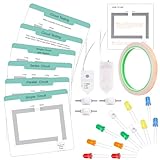
- Safe & Simple Circuit Kit: Our paper circuit kit is designed with children's safety in mind. The electric circuit kit for kids uses copper tape to create circuits, and the button battery is securely housed in a screw-fixed battery box, preventing accidental swallowing. With low voltage and current, this circuit kit ensures a high level of safety, making it a great STEM toy for young explorers
- All-In-One Exploration Kit: No soldering or tools needed! Includes circuit cards, LED diodes, copper foil tape, button coin cell battery holders and button switches. Simply use copper tape to create conductive pathways, install the LED bulbs to bring the circuit to life, and then connect the circuit to the wires of the battery case. Sparks curiosity in DIY engineering projects and science experiments for kids
- Science Learning Through Play: Make learning a joyful experience! Each card in the kit features a different circuit concept, from series and parallel circuits to switches. Come with clear instructions and engaging questions, great for kids aged 8 and above science learning beginners to explore electronic components and to understand the fundamental electrical principles
- Encourage STEM Skills: STEM is most important for each kids. Our paper circuit experiment kit encourages critical thinking, problem-solving, and logical reasoning. It's an excellent tool for homeschooling, classroom activities, or simply quality family time, fostering kids’ STEM skills
- Educational Gift for Kids 8-12: This electric circuit kit is design for the kids starter who want to explore the science or engineer, follow our instructions, children can easy get the STEM skills. It’s a great gift for Easter, birthday, or back to school day. You can play in home, classroom, or family bonding, making science fun now!
For the tested conductors, the authors reported retained conductivity while bending through angles from 0 to 180 degrees. After 1,000 bend-and-release cycles at 90 degrees, they observed no significant irreversible increase in resistance. As the paper’s authors put it, “Leveraging the high electric conductivity and good flowability of liquid metal and metallophobic property of paper, it is possible to keep electric and mechanical functionality of the electric circuit even after a thousand cycles of deformation.” This result concerns their specific liquid-metal microchannel prototype; it is not a durability rating for paper circuits as a whole.
What the different approaches demonstrate
| Approach | Equipment and materials | Substrates or construction | Reported demonstrations and limits |
|---|---|---|---|
| Commodity inkjet circuits | Commodity inkjet printer and commercially available conductive ink; the 2013 authors gave a historical initial-investment estimate of around US$300. | Flexible substrates including paper and plastic film. | Conductive patterns, sensors, and antennas; conductivity reported within seconds. Compatibility depends on the particular ink, printer, and substrate. |
| Soft inkjet circuits | Research work combining conductive and insulating inks. | Examples include temporary tattoo paper, textiles, and thermoplastic. | Stretchable devices, e-textiles, and body-based or reshapeable interfaces. The project page does not establish current consumer availability. |
| Liquid-metal paper channels | Patterned paper and double-sided adhesive assembled into channels, injected liquid metal, and copper conducting tape at channel openings; the reported prototype used laser patterning. | Layered paper-and-adhesive microchannels. | Approximately 200 μm minimum line width and spacing; 30-minute lab-bench fabrication; LED and sensor-related demonstrations. Durability results apply to the tested channel conductors. |
| Desktop dispenser liquid-metal traces | A desktop dispenser, liquid metal, coated paper, and silicone rubber for insulation or encapsulation. | Coated paper and silicone rubber. | A separate research prototype described in 2013; its authors identified metal surface tension and adhesion as challenges. It does not show that ordinary office inkjet printers accept liquid-metal ink. |
The studies do not provide a controlled, head-to-head comparison. They establish particular research workflows and prototypes, not universal compatibility, broad reliability, or an off-the-shelf home-printer recipe.
Rank #3

- BUILD BREADBOARD CIRCUITS AND MINI PROJECTS - Create LED indicators, button inputs, traffic-light sequences, light-activated circuits, RGB effects and buzzer alarms for electronics practice, classroom demonstrations and maker projects
- 235 PARTS FOR REPEATABLE EXPERIMENTS - Includes a 400-tie-point solderless breadboard, power module, jumper wires, Dupont wires, potentiometer, buttons, LEDs, resistors, capacitors, diodes, transistors, buzzers and light-sensitive components
- LEARN HOW CORE COMPONENTS WORK - Use the 74HC595 to expand outputs, the 4N35 optocoupler to explore signal isolation, PN2222 transistors to switch loads and 1N4007 diodes for polarity protection and rectification experiments
- POWER AND REWIRE PROJECTS QUICKLY - Use the breadboard power module for selectable 3.3 V or 5 V rails, while rigid jumpers and female-to-male leads simplify connections; use a suitable 6.5–9 V DC input and do not exceed 9 V
- COMPONENT KIT WITH CLEAR EXPECTATIONS - A controller board, programming cable and wall power adapter are not included; use a compatible microcontroller for coded projects and follow the current tutorial, datasheets and wiring guidance
What can you realistically try?
For a simple educational paper circuit, copper conducting tape can serve as a supporting connection or electrode material, and an LED with a button or coin-cell battery can form a basic demonstration. These are examples of components used or supported by the cited work, not a standardized bill of materials. Copper tape is not the conductive ink in an inkjet process or the liquid metal inside a channel.
If your goal is to reproduce one of the research methods, first identify the exact printer, ink, substrate, or channel-building process used by that method. The published demonstrations do not establish that arbitrary conductive inks work in arbitrary printers, or that liquid-metal channels can be made without their patterned paper-and-adhesive assembly. For a beginner activity, a conventional paper circuit using tape and discrete components is more distinct—and less equipment-dependent—than either research printing workflow.
Quick Recap
Best Value

- Complete Electronics Combo Kit: this comprehensive kit includes 200 pieces of bright 5mm LED diodes in 10 popular colors (20 pieces per color) and 1 roll of double-sided conductive copper foil tape (5/16 inch wide x 22 yards long); It's the ultimate starter pack for a wide range of electronics and creative projects
- High-brightness Multi-color LED Assortment: our LEDs offer superior luminosity; White LEDs shine at 12000-14000 mcd, Warm White at 14000-16000 mcd, and Blue/Pink at 7000-8000 mcd; With voltages clearly grouped (2.0-2.2V for Red/Yellow/Green/Orange; 3.0-3.4V for others), they are ideal for indicator lights, Arduino projects, and DIY PCB circuits; Each has a 25° viewing angle for focused light
- Double-sided Conductive Copper Tape: this 8mm (5/16”) wide copper foil tape is conductive on both sides and features strong adhesive, making it ideal for soldering, creating paper circuits, and electrical grounding; Its malleability allows it to conform to various surfaces for reliable EMI/RFI shielding in small electronics
- Versatile for Education, Repair Creative Arts: ideal for students, hobbyists, and professionals; Use the LEDs and tape together for educational kits, and prototyping on breadboards; The tape is also excellent for stained glass work, model detailing, and quick electronic device repairs; Endless possibilities for learning and creation
- Reliable Quality Practical Packaging: all components are securely packaged for easy storage and access; The LEDs are well-organized by color, and the tape roll comes with easy-peel backing; We are confident in the quality and functionality of this combo kit; If you have any questions, our customer support is ready to assist
Rank #4

- 【LED CIRCUIT STICKERS】This fantastic kit allows you to make multiple light-up projects! Includes 30 LED stickers( 10 Red, 10 Blue, 10 Green) , 30Pcs/Sets White LED (40 Pcs/Sheet Conductive Double-side Stickers), 1 Roll Conductive Fabric Tape ( 5mm(W) x 32ft/10m(L) / Roll), 3 Sheets Adhesive Foam Strips (93 Strips in total) that enable you to add light to your projects. It's fun and easy to learn circuitry and bring your paper crafts to life.
- 【CONDUCTIVE FABRIC TAPE】This tape is soft and flexible yet sturdy with a nice conductive adhesive.It will help you place all the parts needed to create your own LED stickers.This roll of tape measures 10 meters or 32 feet long. 5mm wide.
- 【EASY TO USE】LED lights are a great way to explore basic circuits, Design connections with conductive tape,add led circuit stickers,and a battery(not included),Craft over your circuit. Possibilities are endless!
- 【POWER NOT INCLUDED】To light up these LED stickers you will also need conductive tape and a power source, Batteries are NOT included! You need to prepare a coin cell battery (3V) by yourself!
- 【LIGHT UP YOUR PROJECT】 Our LED stickers enable you to add light to your projects using simple craft techniques like stickers and tape! It's fun and easy to learn circuitry and bring your paper crafts to life.
Which approach should you choose?
- Choose inkjet research as the relevant reference if you want deposited conductive patterns on flexible substrates and have access to compatible printer-and-ink materials.
- Choose the liquid-metal channel study as the relevant reference if the feature of interest is a deformable conductor formed inside a deliberately assembled paper structure.
- Choose a simple tape-and-component paper circuit for a basic educational demonstration rather than treating either research process as a universal consumer recipe.
Product prices and availability are accurate as of the date/time indicated and are subject to change. Any price and availability information displayed on Amazon at the time of purchase will apply.
The Tool Desk
Outbyte Driver Updater FREEFix the driver behind crashes, sound loss and screen glitchesFind Drivers →Outbyte PC Repair FREERepair Windows errors before they cause bigger problemsFix Now →



