There is no universal winner. A tested granular activated carbon (GAC) removed more chromium per gram than a South African coal char in one direct comparison, while specially made or iron-modified biochars performed strongly in other experiments. The useful choice depends on whether you need to lower Cr(VI), lower dissolved total chromium, or merely convert Cr(VI) to Cr(III), plus the feedstock, pH, salinity, competing ions, dose, contact time and flow configuration.
First decide what “chromium removal” means
Chromium in water is not one analytical target. Hexavalent chromium, written Cr(VI), is generally the species of concern in the experiments discussed here. Trivalent chromium, Cr(III), behaves differently and can be less mobile, but changing Cr(VI) into Cr(III) is not automatically the same as removing chromium from the water.
As an Amazon Associate I earn from qualifying purchases.
- Cr(VI) removal: the measured concentration of hexavalent chromium falls. This can happen through adsorption, chemical reduction, or both.
- Total-chromium removal: dissolved chromium of all measured valence states falls, usually because chromium has been transferred to a solid that is then separated.
- Speciation change: Cr(VI) is reduced to Cr(III), but some Cr(III) may remain dissolved. A Cr(VI)-only result can therefore make treatment look more complete than a total-chromium result would.
Before comparing media, identify the laboratory endpoint and the water sample. A claim such as “84% removal” is incomplete unless it says which chromium species was measured, the starting concentration, pH, dose, contact time and whether the test was a stirred batch or a flowing column.
What the direct activated-carbon comparison found
Di Natale, Lancia, Molino and Musmarra tested a granular activated carbon and a char produced from South African coal. In that experiment, the EPA HERO record reports a maximum capacity of approximately 7 mg of chromium per gram for the GAC near neutral pH and low salinity, compared with approximately 0.3 mg/g for the tested coal char. Those values describe the two experimental materials, not all activated carbons and all biochars. The study is documented at the EPA HERO record for the 2007 Journal of Hazardous Materials paper.
#1 Best Overall

- [Replacement filters] Need filters for PT-07? Search for PF-01A or ASIN B086ZPR3WM on Amazon. Choose genuine Waterdrop filters for a precise fit and reliable performance. Please confirm your model before ordering
- [NSF certified filtration performance] The Waterdrop Lucid filtered water pitcher with lid has passed NSF/ANSI 42 and 372 certifications. Tested by a third-party lab, it helps reduce PFOA/PFOS, odor, iron, mercury, copper, and other metal ions. Note: This system DOES NOT lower TDS value. If you prefer a low TDS value, please choose the Waterdrop TDS Reduction Pitcher by searching PT-13W on Amazon
- [Quality daily water choice] The Waterdrop Lucid water filter pitcher with lid is designed for efficient daily filtration, making it a practical choice for apartments, kitchens, living rooms, dorms, and offices. It helps provide better-tasting drinking water for everyday use
- [Exceptional quality] This pitcher features a hands-free lid for automatic water dispensing without opening the lid, helping prevent dust accumulation for convenient and hygienic use. Its compact body is designed to fit most refrigerators. Product dimensions: 10" x 5" x 10.1"; please verify your fridge dimensions before ordering
- [5x longer lifespan & indicator] The filtered water pitcher has a filter lifespan of up to 200 gallons or 3 months, helping support longer daily use with efficient water flow. The LED indicator lets you check the filter usage status and reminds you when it is time to replace the filter
The authors found that GAC performance depended strongly on pH and salinity. The coal char had the lower capacity and declined slightly as pH and salinity increased. Much of the coal-char uptake was attributed to reduction of Cr(VI), followed by sorption of Cr(III). Similar behavior was reported for GAC below pH 3. Above pH 7, competition among Cr(VI), hydroxide and chloride becomes important, so a result from acidic, low-salt water cannot be transferred directly to neutral tap water.
How activated carbon removes Cr(VI)
The U.S. EPA report Activated Carbon Process for Treatment of Wastewaters Containing Hexavalent Chromium examined adsorption and reduction in batch and continuous-flow packed-column laboratory systems. It varied chromium concentration, pH, carbon dose, mixing and regeneration. For the carbon tested, maximum Cr(VI) adsorption occurred at pH 2.5, and adsorption capacity fell rapidly between pH 2.5 and 7.1. Below pH 2.5, rapid reduction and the resulting cationic Cr(III) changed the observed behavior. The report is available from the EPA at EPA/600/2-79/130.
The report summarizes the mechanism this way: “Two removal mechanisms were observed: hexavalent chromium species were removed by adsorption onto the interior carbon surface and/or through reduction to the trivalent state at the external carbon surface.” Reduction at an outer surface can lower a Cr(VI) measurement even when the resulting Cr(III) has not been physically separated from the water.
Recommended Free Tools
Rank #2
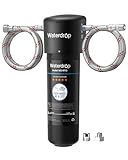
- Less than $25.99 per replacement filter WD-RF10(Search " B085G66JTZ "on Amazon), save over 50% of cost on subsequent use.
- [After Sales Assistance] Waterdrop Backs the WD-10UA's high-end technical performance with a comprehensive prorated performance service; should a quality issue arise with the filter, you can contact us. It is specifically designed for municipal tap water and can only be used with cold water sources. It is not suitable for well water or hot water.
- [Innovative Design] Only a cold-water source should be used to power the filter. Its twist-and-lock construction and push-to-connect fittings enable installation in three minutes, three second replacement, and safety-assuring integration. This filter comes with a 3/8" line that connects directly to US sinks' standard 3/8" feed water valves. The system is connected to 1/2" and 3/8" cold water pipes and faucets with the use of the 3/8"-1/2" convertor fitting.
- [Solve Clogging Problem] By upgrading the filtration area, our filter now provides a 20X increase in dirt adhesion area, enhancing filtration capability while minimizing the risk of clogging.
- [Filter Replacement and Long Lifespan] This system may be upgraded with a UF or a MZ filter to meet your water needs. It is compatible with several filters with various functions. Each system has a maximum service life of 12 months when used with municipal water, which is sufficient to cover the needs of an entire household. Before going on vacation, please Put the filters in separate sealed plastic bags, and store the bags in your refrigerator (NOT the freezer) to keep it fresh in 30 days.
The acidic pH values in this work are process conditions for a laboratory wastewater treatment investigation, not a ready-made household filter recipe. Operating at pH 2.5 would require acid addition, corrosion control, neutralization and verification that the finished water is safe and chemically stable.
What the biochar experiments found
Eucalyptus-bark biochar
Choudhary, Paul, Singh and Gupta made eucalyptus-bark biochar by pyrolysis at 500 °C under oxygen-free conditions. In batch tests, aqueous Cr(VI) removal was complete at pH 1–2, but the chromium did not behave the same way at both pH values. At pH 1, sorption was negligible. At pH 2, about 55% of total chromium was sorbed on the biochar surface. X-ray photoelectron spectroscopy of the sorbed fraction reported approximately 82% Cr(III) and 18% Cr(VI). The material, acidic solution and analytical endpoint are described in the EPA HERO record for the 2017 study.
The proposed chemistry involved carboxylic groups in sorption and phenolic groups in reduction. Dissolved organic matter released from the biochar also helped reduce Cr(VI) in solution. Thus, “complete Cr(VI) removal” in this experiment included a chemical transformation, while only about half of total chromium was reported as sorbed at pH 2.
Rank #3

- ❄️【Authoritative Certifications】 - The filter is certified against NSF/ANSI 42 by IAPMO, filtering out 99% Chlorine, odor and improve water taste significantly. It also certified by European , Canadian CSA, BPA Free and Australian Water Mark. Only select products with authoritative certifications for your loved ones.
- ❄️️【HIGH CAPACITY】 The CTO carbon filter can filter up to 13000 gallons depending on water quality. Suggest to replace it every 3- 6 months for the average household for optimal performance depending on the use. Let it bring a wonderful cleaner water experience to your loved ones.
- ❄️️【COMPATIBLE FILTERS】 - The filter can be used in any standard 10” x2.5” RO Unit whole house filtration system and compatible with standard 10 inch X 2.5 inch filter models of DuPont WFPFC8002, WFPFC9001, SCWH-5, Whirlpool WHCF-WHWC, Pentek CBC-10, GE FXWTC, FX12P, GXWH20F, Culligan D-10A & D-10, Aquaboon CTO, Ace Hardware 84608, Apex IR-40, Cornelius COR10B1, COR10B5, Dupont DWC30001, PFC8002, WFDWC30001, WFPFC8002, WFPFC9001, 46942, EcoLab 9320-1002, Everpure CG5-10, DEV9108-15, Flotec TO1, ICEPURE CTO10.
- ❄️️【 HIGHER QUALITY FILTRATION】 - Carbon is well known for its unique absorbing ability, a pound of carbon is able to provide up 125 acres of filtering surface area. Our RO carbon filter is made of 100% coconut shell activated carbon block to filter most sediments, Sintering Technology ensures high absorbing capacity offers a much finer filtration of suspended particles and dirt.
- ❄️️【STRICT QUALITY CONTROL】 - All water filter home cartridge are produced under the ISO9001 standard and inspected under strict quality control. Each filter is produced through 34 production processes, 400PSI pressure test, 10,000 water hammer tests, and 6 independent tests.
Magnetic rice-husk biochar
A separate experiment compared unmodified rice-husk biochar with a magnetic composite made from the same general feedstock. The magnetic material achieved 84.3% Cr(VI) removal and an equilibrium capacity of 8.35 mg/g. The unmodified rice-husk biochar achieved 26.5% removal and 2.63 mg/g in that study. The authors linked the improvement mainly to iron oxide and reactive carbon features. These are within-study comparisons; they do not prove that magnetic biochar generally outperforms activated carbon. The indexed record is available through EPA HERO.
PC Slower Than It Used to Be?
A free scan shows the junk files, broken settings and background clutter dragging Windows down - then fixes them in one click.Free scan · Windows 10 & 11Crashes, No Sound, or Screen Glitches?
Random freezes, missing sound and display glitches usually trace back to one bad driver. Find and replace yours safely.Free scan · under a minuteOak-wood biochar
A 2019 oak-wood biochar experiment started with approximately 50 mg/L Cr(VI). After one day at initial pH 2, aqueous Cr(VI) fell below 0.02 mg/L. The result belongs to that raw oak-wood material, concentration, one-day contact time and strongly acidic starting pH; it is not a general performance estimate for wood biochar or a neutral-water filter. The PubMed record is linked here.
Why pH and water chemistry can reverse the ranking
Chromium speciation, the electrical charge of the media surface and the availability of competing ions all change with pH. In the direct GAC-versus-coal-char comparison, increasing pH and salinity affected the materials differently. The EPA activated-carbon work found the highest adsorption at pH 2.5 and a rapid decline toward neutral pH. The eucalyptus experiment found Cr(VI) reduction at pH 1–2 but little sorption at pH 1. These results are not contradictory: they measured different materials and pathways under different chemical conditions.
Rank #4
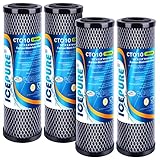
- [NSF/ANSI 42 Certified] This filter has passed the IAMPO NSF/ANSI 42, ensuring it effectively reduces chlorine taste and odor from your drinking water. Enjoy cleaner, fresher water with every sip, thanks to this trusted filtration standard
- [Superior Material] Most ICEPURE water filters meet European EC1935-2004 Regulations, Australian Water Mark, and BPA FREE. This kind of filter is recommended for tap water filtration. If your water source is well water, this filter may not achieve the filtering effect that you expect, because well water contains large particles such as mud and sand, which may clog the filter in a shorter time. If you need to treat well water, please search our other products: B08H7Z5VZ2, to achieve effective purification
- [Compatible Models] This filter can be used in any standard 10” x 2.5” RO Unit whole house filtration system, and is compatible with DuPont WFPFC8002, WFPFC9001, SCWH-5, DWC30001, PFC8002, WFDWC30001, 46942, Whirlpool WHCF-WHWC, Pentek CBC-10, GE FXWTC, FX12P, GXWH20F, Culligan D-10A & D-10, Aquaboon CTO, Ace Hardware 84608, Apex IR-40, Cornelius COR10B1, COR10B5, EcoLab 9320-1002, CG5-10, DEV9108-15, Flotec TO1, PUREPLUS CTO10. ICEPURE is an independent brand
- [Why ICEPURE] Trusted by 300M+ families globally, ICEPURE brings 26 years of expertise and 200+ patents to your home. Our advanced filtration technology ensures every drop is clean, fresh, and high-quality. Make the smart choice for your family's water safety—choose ICEPURE
- [Efficient Filtration] This filter is made with innovative Sintering Technology, which helps to remove 99% of chlorine, taste, and odor. This filter can remove finer particles and sediment. Delivering cleaner water that tastes great, and providing a wonderful drinking experience for your whole family. This filter has a life span of up to 13000 gallons, depending on your water quality. For optimum performance, we recommend you change the filter every 6 months based on water quality
Salinity adds another variable. Chloride and other dissolved ions can compete for sites or alter chromium’s interactions with the surface. Hydroxide competition becomes relevant above pH 7. Natural organic matter can block sites, donate electrons or change chromium’s apparent mobility. A media ranking obtained in deionized water may not survive in groundwater, industrial wastewater or chlorinated municipal water.
Comparison of the reported materials
| Material | Reported result | Key conditions and endpoint | What the number does not prove |
|---|---|---|---|
| Granular activated carbon | Approximately 7 mg/g maximum capacity | Di Natale et al. experiment; near-neutral pH, low salinity; chromium adsorption capacity | Not the capacity of every GAC product or proof of household drinking-water performance |
| South African coal char | Approximately 0.3 mg/g maximum capacity | Same direct comparison; capacity declined slightly as pH and salinity increased | Not representative of every biochar feedstock or modification |
| Eucalyptus-bark biochar | Complete aqueous Cr(VI) removal at pH 1–2; about 55% of total chromium sorbed at pH 2 | 500 °C oxygen-free pyrolysis; XPS of sorbed chromium: about 82% Cr(III), 18% Cr(VI) | Cr(VI) reduction did not by itself establish complete total-chromium removal |
| Magnetic rice-husk biochar | 84.3% Cr(VI) removal; 8.35 mg/g equilibrium capacity | Iron-containing composite in the 2018 experiment | Not evidence that magnetic biochar generally beats GAC |
| Unmodified rice-husk biochar | 26.5% Cr(VI) removal; 2.63 mg/g equilibrium capacity | Compared with the magnetic composite in the same study | Cannot be generalized to all unmodified rice-husk products |
| Raw oak-wood biochar | Cr(VI) decreased from approximately 50 mg/L to below 0.02 mg/L | One day; initial pH 2 | Not a neutral-water or certified point-of-use performance claim |
Use these seven axes when choosing or comparing media
- Species measured: Require separate Cr(VI) and total-chromium results when the treatment objective is actual chromium removal.
- Feedstock and modification: Record the wood, bark, crop residue or coal source, pyrolysis temperature and any activation, iron loading or magnetic treatment. “Biochar” is a category, not one standardized material.
- Water chemistry: Compare pH, salinity, chloride, alkalinity, dissolved organic matter and other competing ions with the water you will treat.
- Dose and contact time: A high dose or a 24-hour batch contact can produce a result that a small, fast-flowing cartridge cannot reproduce.
- Configuration: Distinguish a stirred batch test from a packed column. Columns introduce empty-bed contact time, pressure drop, channeling and breakthrough.
- Chromium destination: Determine whether chromium is firmly sorbed, reduced but still dissolved as Cr(III), or present in a detachable precipitate.
- Spent-media plan: Ask how chromium-loaded carbon or biochar will be contained, regenerated, tested and disposed of before selecting a medium.
A practical test plan for a real water sample
If chromium treatment matters in an actual installation, use a staged test rather than selecting a medium from a single capacity number.
- Characterize the feed water. Measure Cr(VI), dissolved total chromium, pH, conductivity or salinity, chloride, alkalinity, hardness and organic matter. Preserve samples according to the laboratory’s instructions.
- Define the endpoint. Decide whether compliance or risk management requires a Cr(VI) limit, a total-chromium limit, or both. State the reporting limits before the test begins.
- Screen candidate media in batch tests. Use the same water, solids dose, particle size and contact times for each carbon or biochar. Include an untreated control and measure both chromium species after separation of the solids.
- Check pH sensitivity. Run the relevant pH range rather than testing only a strongly acidic sample. Record whether pH drifts during contact, because biochar ash and dissolved organic matter can change it.
- Move the best candidate to a column test. Use the intended flow rate and bed depth. Track empty-bed contact time and collect samples through the run to identify breakthrough instead of relying on equilibrium capacity alone.
- Verify the finished water independently. Test Cr(VI), total chromium, pH and any treatment chemicals or metals released by the media. Repeat testing after the system has operated long enough to represent normal use.
- Document the exhausted-media procedure. Keep chromium-bearing solids contained and obtain waste-handling advice appropriate to the local jurisdiction and the chromium concentration.
How to interpret capacity, percentage removal and “complete” removal
Capacity in mg/g describes how much chromium a gram of a particular medium held under a specified test condition. It is not the same as a guaranteed cartridge life. Cartridge life also depends on influent concentration, flow, bed volume, particle size, competing contaminants and the breakthrough criterion.
Best Value

- ❄️ Recognized Certification - Food Grade Material Meets European EC1935-2004 Regulations, Australia Water Mark, REACH, BPA FREE Certified. The filter reduces up to 99% of Chlorine, sand, rust, sediment, color. This kind of filter is recommended for tap water filtration. ❄️If your water source is well water, this filter may not achieve the filtering effect you expect. Check out our another product. Search “B01N9024NF” for well water filtration.
- ❄️ Multi-Layer Density Tech - The whole house water filter is designed with density three PP layers and Coconut Shell Activated Carbon Layer to remove most contaminants and deliver great fresh water. The multi-layer density tech can capture impurities targetedly and have 30% longer service life than the other common type.
- ❄️ High Capacity - The filter can filter up to 30000 gallons depending on water quality. Suggest to replace it every 3- 6 months for the average household for optimal performance depending on the use. Let it bring a wonderful cleaner water experience to your loved ones.
- ❄️ Compatible Models - PUREPLUS whole house carbon water filter is premium replacement for any standard 10inch X 4.5inch pre-filtration filter models including GXWH35F, WRC25HD, GXWH40L, GXWH30C, GXWH38F, GNQH38S, GE FXHTC WRC25HD,WHKF-WHPCBB, RFC-BB and RFC-BB, WFHD13001, 4WH-HDGR-F01. The ge whole house water filter is compatible with any standard 10" x 4.5" heavy duty filter housing and most systems with 9.75" x 4.5" filters.
- ❄️ Why PUREPLUS - PUREPLUS has 20 years of expertise and 200 patents in the water filtration industry. Every year it provides filtration solutions to more than 200 million American households, our filters use advanced filtration technology to ensure high quality water. Trust us, make PUREPLUS your solution.
Percentage removal depends on the starting concentration. A test that drops 50 mg/L to 0.02 mg/L has a different operational meaning from one that drops 0.05 mg/L to 0.02 mg/L, even if both are described with a percentage. Contact time matters just as much: the oak-biochar result used one day, while a household filter may provide seconds or minutes.
Finally, “complete Cr(VI) removal” should be read as complete removal below that experiment’s analytical detection or reporting threshold, not as proof that no chromium remains in any form. Ask for total chromium and a mass balance whenever reduction to Cr(III) is part of the proposed mechanism.
Can either material be recommended for household drinking water?
The cited experiments do not validate an ordinary retail carbon or generic garden biochar for drinking-water treatment. None of the supplied evidence identifies a current consumer product, demonstrates certification, or establishes safe performance in a household plumbing configuration. A real recommendation would need product-specific test data using the relevant chromium species and the actual source-water chemistry, followed by finished-water monitoring.
Quick wins for a faster PC:
Scan for outdated or missing drivers - takes under a minuteDriver Scan →Repair Windows errors before they cause bigger problemsFix Now →Generic biochar should not be treated as equivalent to a characterized research adsorbent. Feedstock contaminants, ash, particle shedding, pH effects and variable surface chemistry can all matter. Activated carbon is a defined media category, but products still differ in pore structure, activation process, particle size and manufacturing quality.
What happens to chromium-loaded media?
Once carbon or biochar captures chromium, the contaminant has not disappeared; it has been transferred to a solid. Handling the exhausted medium therefore becomes part of the treatment design. The EPA activated-carbon report investigated thermal and chemical regeneration, showing that reuse is a process-engineering question rather than an assumption that spent media is harmless. The report does not establish one universal regeneration or disposal method for every carbon, biochar or chromium concentration.
Keep spent media sealed, prevent dust and leaching, and obtain a waste classification and disposal route from the responsible environmental authority or qualified waste contractor. Do not place chromium-loaded media in ordinary compost, soil amendments or an unapproved drain-disposal route.
Quick Recap
Which option makes sense in common scenarios?
- Comparing a characterized GAC with an unmodified, unknown biochar: GAC is the more defensible starting benchmark because the direct study measured a higher capacity for its GAC, while the biochar’s properties are unknown.
- Working with acidic industrial wastewater: Either activated carbon or a purpose-designed biochar may be effective, but test Cr(VI), total chromium and the reduction-versus-sorption pathway at the actual pH and salinity.
- Considering iron-modified or magnetic biochar: Treat it as a distinct engineered composite. The 84.3% and 8.35 mg/g results apply to the reported rice-husk composite, not to biochar in general.
- Trying to protect household drinking water: Do not infer safety from batch studies. Obtain product-specific evidence, use an appropriate treatment design and verify finished water with a qualified laboratory.
Source records
- Di Natale, Lancia, Molino and Musmarra, “Removal of chromium ions from aqueous solutions by adsorption on activated carbon and char,” Journal of Hazardous Materials (2007): EPA HERO record.
- Huang and Bowers, Activated Carbon Process for Treatment of Wastewaters Containing Hexavalent Chromium, U.S. EPA report EPA/600/2-79/130 (1979): EPA report page and report text.
- Choudhary, Paul, Singh and Gupta, “Removal of hexavalent chromium upon interaction with biochar under acidic conditions,” (2017): EPA HERO record.
- “Mechanistic insights into adsorption and reduction of hexavalent chromium from water using magnetic biochar composite” (2018): EPA HERO record.
- “Characterization of chromium species and distribution during Cr(VI) removal by biochar…” (2019): PubMed record.
Product prices and availability are accurate as of the date/time indicated and are subject to change. Any price and availability information displayed on Amazon at the time of purchase will apply.
What’s actually slowing this PC down?
Pick the symptom - the matching free tool is one click away.

