Quick wins for a faster PC:
Clear out junk files and repair common Windows errorsFree Scan →Fix the driver behind crashes, sound loss and screen glitchesFind Drivers →Choose the squat that best fits your current goal and that you can perform comfortably and consistently. If you want to improve your back squat, practice the back squat; if you prefer the front-rack position or want a complementary variation, the front squat is a valid choice. Neither is a universal winner, and you can program both.
How to choose between the back squat and front squat
- Choose the back squat when back-squat practice is the priority. Training adaptations are partly specific to the movement being trained.
- Choose the front squat if its bar position suits you better or you want a different squat pattern in your program.
- Use both if they serve different purposes in your training and you can perform each with control. There is no requirement to make a permanent either-or choice.
In practice, the best option is one you can repeat and progress while maintaining the range of motion and technique you intend to train. Bar position affects how the lifts feel and the demands they place on the body, but the available comparisons do not establish one variation as best for everyone.
As an Amazon Associate I earn from qualifying purchases.
What changes when the bar moves
Back squats place the bar on the back; front squats hold it in front of the body. Those positions change the movement’s mechanics. The resulting comparison depends partly on how the exercises are matched: equal weight on the bar is not the same as equal relative effort.
Hip and knee demands vary with the comparison
In a study of 11 NCAA Division I athletes, back squats produced greater hip-extensor net joint moments than front squats at some matched absolute loads. At high relative loads, the researchers predicted comparable knee moments. Those findings do not support a simple rule that one lift always emphasizes the hips or the knees more.
#1 Best Overall
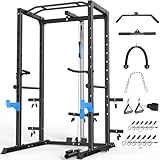
- STRONG AND STURDY:ULTRA FUEGO power cage with pulley system has been built with precise laser cutting and powder coated finish, features 1.5mm thick steel, 50mm x 50mm uprights, extra reinforcing tab, Wide and heavy steel bases distribute weight and resist tipping during intense workouts. 1.14inch holes with 4in hole spacing comes as standard which enables endless possibilities for attachments.
- ENDLESS TRAINING POSSIBILITIES:No home or garage gym should be without a Power Rack. You can make 10-level height adjustment for the j-hooks and safety bar, 5-level height adjustment for the dip handles, and you can also adjust the dip handles to the bottom hole for push up training. when you training whith the pulley system, you can increase or decrease the weights according to your plan. You can train your full-body with just one device.
- VERSATILE AND ACCESSORIES COMPLETE:This UF-896 is the most versatile, heavy duty power rack system on the market. Attachments included Tricep rope, Ankle strap, T-bar, lat pull-down bar, a pair of cable handles/J-Hooks/Dip bars/Safety bars, 6 weight plate storage pegs, 360 degree landmine attachment, a pulley system and 4 band pegs. With 1002 pound capacity, this power cage gives you the flexibility for various strength training workout, within a safe & compact space.
- ONE CAGE, YOUR ENTIRE GYM: This power cage squat rack is designed with a large walk-in space, providing easy side-to-side movement. Power cage with lat pull down attachment outside size - 63’’(depth) x 47’’(width) x 82.8’’(height). Combine it with other fitness equipment such as barbell, weight bench, resistence bands, bring even more exercise into your daily life, because your training no opening hours, no route, no stress train, better at home than at gym.
- 2-YEAR WARRANTY:The Power cage rack with lat pulldown offers 2-Year Warranty and high quality customer service. Everything we do is to ensure you have a memorable shopping experience.
A separate 2009 study of 15 healthy trained people found greater knee compressive forces and knee-extensor moments in the back squat under its test conditions. Overall muscle recruitment was similar between variations. These are acute biomechanical measurements from a small study, not evidence that one lift causes more or fewer knee injuries.
Comfort and setup matter
The front-rack position can feel unfamiliar or uncomfortable, while the back-squat position suits some lifters better. Individual comfort and ability to maintain controlled technique are useful selection criteria; the cited evidence does not establish that any particular accessory is required to make either lift appropriate.
Rank #2

- 【Build with gym Quality】- Sportsroyals power cages are made of 50 X 50mm steel square frame with a thickness of 1.5mm, past thousands of weight tests, we make sure our machines are safe to support 1200 lbs. The power rack weighs 150lbs with 2 reinforcing tabs which increase its stability during training. Solid and durable for years of workout.
- 【Precision & Durable Pulley System】- Sportsroyals home gym rack equipped with an upper and lower pull-down pulley system. Precision bearing pulleys and fully electroplated telescopic poles provide a smooth movement experience. Upgraded PU-Coated steel cable can hold up to 500 pounds, convenient for you to do any weight workout. Great for your home gym.
- 【Train all your muscles with one machine】- Sportsroyals power cage combines a squat rack, lat pull-down machine, power tower, dip bar, 14 adjustable height levels, and other free Accessories.It supports a wide range of exercises, including wide and narrow lat pull-downs, landmine work, seated cable rows, bench presses, squats, deadlifts, pull-ups, chin-ups and dips. Train all your muscles with one machine.
- 【Fully Equipped & Versatile】 Everything you need for a complete power cage home gym: Rowing Bar ×1, Weight Plate Storage ×4, Band Peg ×6, Safety Arm ×2, Lat Pull Down Bar ×1, Safety Bar ×2, J-Hooks ×2, Dip Stands ×2, Tricep Rope ×1, Ankle Strap ×1, 1" & 2" Barbell Clamps ×6, Cable Handles ×2, Wide & Narrow Pull-Up Frame ×1, 360° Landmine ×1, and Foot Board ×1. Weight Plate Storage fits 2" Olympic and 1" standard plates.
- 【Practical Using Feature】Say goodbye to a cluttered floor. Sportsroyals power rack for home gym is built with 1 barbell bar storage holder, 6 weight storage racks, and 6 handle storage hooks, it can perfectly organize all your gym accessories and weight plates. In addition, the rubber pads on the safety bar and safety arm can provide good cushioning, and ensure the safety of workouts.
What the evidence says about strength and muscle growth
A 12-week trial trained 24 recreationally trained females twice a week using squat variations. Both groups increased measured lateral-thigh muscle thickness, with no significant between-group difference in that measure. The back-squat group improved more on a 45-degree leg-press strength test, but the leg press is not a test of squat-specific strength. The trial’s size, population, duration, and outcomes limit how broadly its results can be applied.
For a goal such as improving a particular squat, practice that squat rather than assuming another variation will transfer completely. For muscle growth, this trial found similar changes in one measured thigh site, but it does not show that the variations produce identical results for every muscle, population, or program.
Rank #3
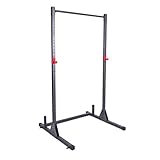
- SPECS – Assembled dimensions are 46" wide x 50" deep x 85" high
- CONSTRUCTION – The 11- and 12- gauge steel tubing allows this bench to handle heavy weight securely, without compromise. Tested based on ASTM standards to hold up to 750 lbs. Recommended maximum weight capacity of 500 lbs.
- MULTIPLE FEATURES – Built-in bar and weight storage. Double gusseted uprights provide exceptional stability and security. J-cup catches to safely hold barbell
- RELIABLE PERFORMANCE – Durable powder coat finish and industrial zinc hardware provide exceptional maintenance-free durability
- TRUST – Trust experience. CAP has been a pioneer in fitness for over 30 years and has locations worldwide. Chances are if you have EVER worked out, you have used a CAP product
Do front squats protect your knees or back?
No. The lower knee-force measurements for front squats in one small acute study do not establish a lower injury rate or prove that front squats are safer for a particular person. The studies compare exercise mechanics and training outcomes; they do not show that either variation prevents knee or back injuries.
A 2021 study of 10 healthy men observed greater lumbar lordosis during the front squat than the back squat under its protocol. It did not measure injury incidence, and it does not establish that front squats are generally worse for the back. It does mean that a blanket claim that front squats always reduce spinal loading is not supported.
Quick Recap
A practical decision process
- Name the training goal. For back-squat performance, make back squats the specific practice. For a complementary squat or a preferred front-rack position, consider front squats.
- Compare the setups you can control. Use a variation in which you can perform your intended range of motion with stable, repeatable technique.
- Adjust if a setup is uncomfortable. You can try the alternative variation, but do not treat it as a guaranteed fix for pain or an injury.
- Get individualized help when needed. If pain persists, you have a diagnosed condition, or you are uncertain how to train safely, seek advice from a qualified clinician or coach who can assess your situation.
Evidence at a glance
| Question | What the cited evidence found | What it does not establish |
|---|---|---|
| Hip and knee mechanics | Results differed by load comparison: the 2020 study found greater hip-extensor moments for back squats at some matched absolute loads and comparable predicted knee moments at high relative loads. | A universal hip- or knee-emphasis winner. |
| Acute knee loading | The 2009 study found greater knee compressive forces and extensor moments in back squats under its test conditions, with similar overall muscle recruitment. | Injury rates or which variation is appropriate for an individual knee condition. |
| Thigh growth and strength | In a 12-week trial of 24 recreationally trained females, lateral-thigh thickness increased in both groups without a between-group difference; the back-squat group improved more on the leg press. | Results for all populations, all muscles, or squat-specific strength. |
| Lumbar posture | A 2021 study of 10 healthy men observed greater lumbar lordosis in the front-squat condition under its protocol. | Spinal injury risk or a general safety ranking. |
Sources
- Gullett JC et al., “A biomechanical comparison of back and front squats in healthy trained individuals,” Journal of Strength and Conditioning Research (2009). PubMed.
- Krzyszkowski J, Kipp K., “Load-dependent mechanical demands of the lower extremity during the back and front squat,” Journal of Sports Sciences (2020). PubMed.
- “The effects of squat variations on strength and quadriceps hypertrophy adaptations in recreationally trained females,” Journal of Functional Morphology and Kinesiology (2024). Full text.
- Ulm R., “Stability and the Squat: Front-Loaded versus Back-Loaded Squatting—Part 4,” NSCA Coach (2017). NSCA.
- “Front Squat Increases Lumbar Lordosis Compared to Back Squat without Changing Lower Limb and Trunk Muscles Activity at the Same Absolute Barbell Weight,” International Journal of Sport and Health Science (2021). Journal article.
Product prices and availability are accurate as of the date/time indicated and are subject to change. Any price and availability information displayed on Amazon at the time of purchase will apply.




