PC Slower Than It Used to Be?
A free scan shows the junk files, broken settings and background clutter dragging Windows down - then fixes them in one click.Free scan · Windows 10 & 11Outdated Drivers Are Slowing You Down
One free scan finds every outdated or missing driver and matches the right update for your exact hardware.Free scan · exact hardware matchSometimes—but only when GPU hotspot temperature is the constraint that is limiting a workload. Diamond-enhanced cold plates can spread heat faster and place cooling capacity over localized hotspots. That may create more sustained accelerator power, fewer thermal throttling events, or better output per watt. However, public information does not establish a universal payback case: suppliers have not published a standard diamond premium, and the largest performance figures are vendor claims rather than independently audited fleet results.
The practical answer is therefore conditional. Treat a diamond plate as a system-level engineering option, not a guaranteed percentage improvement from a material datasheet. Measure the complete cooling loop, the actual AI workload and the installed cost at matched operating conditions before committing to a fleet rollout.
As an Amazon Associate I earn from qualifying purchases.
What “diamond-enhanced cold plate” actually describes
The phrase covers more than one technology. Confusing these designs can lead to an invalid comparison or an overstated business case.
Diamond as a heat-path material
Some designs put diamond directly in the thermal path above a chip hotspot. Frore Systems describes its LiquidJet DIAMOND as a copper cold plate with diamond embedded in the bottom surface above GPU hotspots, combined with a short-loop, multi-stage liquid-flow architecture. The company’s product page states: “Diamond is embedded in the bottom surface of the coldplate, placed directly above the hotspots.” See the LiquidJet DIAMOND product page for the manufacturer’s description.
#1 Best Overall

- ★ Water cooling block size: 40 x 80 x 12mm; Material: aluminum alloy.
- ★ The surface of the water cooling block is polished, the inner flow channel is extruded into an M-shaped flow channel, brazing parts into a whole.
- ★ The pagoda nozzle has a minimum outer diameter of 7mm and can be connected to an inner diameter of 7-8mm Water pipe.
- ★ This water cooling block applicable to computer CPU, graphics gpu heat, motherboard, xbox consoles cpu, graphics, semiconductor cooling piece, industrial inverter driver, laser head cooling and industrial control cabinet cooling.
- ★ Package Content: 2 x Aluminum Water Cooling Block.
Cu-diamond composites are another approach. Element Six presents the material as a heat spreader or insert for lids and cold plates. It claims thermal conductivity of more than twice that of copper and a coefficient-of-thermal-expansion match closer to common semiconductor materials. Those are supplier material and application claims, not an independently measured, deployment-level comparison against a complete conventional cold plate. Its positioning is described on the Element Six thermal-management page.
A package-level design can also combine a single-crystal-diamond substrate with direct jet cooling. Diamond Foundry’s Advanced Cooling page illustrates that “diamond cooling” is not one interchangeable product category; substrate construction, jet geometry, interfaces and the rest of the loop still determine the result.
Diamond-shaped fins are a different claim
A 2026 paper in the International Journal of Heat and Mass Transfer uses “diamond-shaped” to describe the geometry of pin fins in copper and copper-tungsten cold plates. The fins are shaped like diamonds; they are not evidence of a diamond-material insert. The paper reports approximately 15% lower thermal resistance than a conventional straight-fin microchannel in its tested designs. That result is useful for fin geometry, but it cannot be cited as proof that a diamond slab or Cu-diamond composite delivers the same benefit. Read the paper at ScienceDirect.
The Tool Desk
Outbyte PC Repair FREEClear out junk files and repair common Windows errorsFree Scan →Outbyte Driver Updater FREEFix the driver behind crashes, sound loss and screen glitchesFind Drivers →What the available performance evidence says
The figures below are not equivalent measurements. They come from different sources, test conditions and evidence levels, so use them as questions to investigate rather than as a single expected improvement.
Rank #2

- High-Efficiency Cooling Design: Precision-engineered M-shaped flow channel maximizes heat exchange area, paired with vacuum aluminum brazing for leak-proof durability. Ideal for rapid heat dissipation in demanding applications.
- Universal Compatibility: Designed for CPUs, GPUs, motherboards, Xbox consoles, semiconductor refrigeration sheets, industrial inverters, and control cabinets. Perfect for gaming rigs or industrial setups.
- Robust Aluminum Construction: 40x40x12mm lightweight aluminum alloy block with polished contact surface for optimal heat absorption. Resists rust, corrosion, and wear for long-lasting performance.
- Easy Installation: Includes 10mm pagoda nozzles compatible with standard 7-9mm inner diameter tubing. Pre-drilled mounting holes simplify integration into existing cooling systems.
- Value-Packed Bundle: Includes 2 water cooling blocks. Ready to upgrade dual systems or keep a backup for maintenance.
| Claim or result | What was measured or described | Evidence status |
|---|---|---|
| About 15% lower thermal resistance | Diamond-shaped pin-fin designs compared with a straight-fin microchannel in a 2026 peer-reviewed study. | Peer-reviewed geometry study; not a test of diamond material. |
| 6.9 K/kW | Best reported copper plate in that study at a 1 kW heat load and 9.0 kPa inlet-to-outlet pressure drop, using water. | Study-specific result; copper-tungsten’s corresponding reported value was 9.0 K/kW. |
| 16–22°C cooler GPU temperatures | Frore’s comparison of LiquidJet DIAMOND with multi-inlet skived plates. | Manufacturer claim; the product page does not provide an independent protocol or raw comparative dataset. |
| 30–35% more AI tokens per watt | Frore’s stated comparison with multi-inlet skived plates. | Manufacturer claim; workload, duration, sample size and uncertainty are not fully published on the reviewed page. |
| 770 W/cm² hotspot density | Frore’s October 2026 announcement describing a LiquidJet DIAMOND demonstration. | Company announcement, not an independently audited deployment result. |
| Up to 35% AI-factory profitability improvement | Frore’s comparison with traditional skived plates in the same announcement. | Company claim; purchase prices and independently verified profitability are not disclosed. |
The announcement also describes LiquidJet cooling a 2,300 W NVIDIA Rubin and LiquidJet DIAMOND at 770 W/cm² hotspot density. Those are demonstrations described by the supplier, not a promise that every Rubin or other accelerator will operate at those conditions. The announcement is available at Frore’s October 7, 2026 release.
Why the cost question is still unanswered publicly
No public source reviewed here lists a purchase price for a diamond-enhanced plate, its integration premium or a customer’s measured payback period. Without those numbers, a claim such as “35% more profitable” cannot be converted into a return-on-investment calculation.
IDTechEx estimates ordinary cold plates at roughly US$300–500 each and puts representative rack-level thermal content near US$56,880. Those are analyst estimates from December 2025, not quotations for diamond hardware. The rack figure includes more than the plate: hoses, fittings, quick disconnects, manifolds and coolant distribution are part of the thermal system. The cost discussion appears in IDTechEx’s analysis.
For a real decision, calculate the incremental installed cost rather than the plate invoice alone:
Rank #3

- ★ Water cooling block size: 40 x 80 x 12mm; Material: aluminum alloy.
- ★ The surface of the water cooling block is polished, the inner flow channel is extruded into an M-shaped flow channel, brazing parts into a whole.
- ★ The pagoda nozzle has a minimum outer diameter of 7mm and can be connected to an inner diameter of 7-8mm Water pipe.
- ★ This water cooling block applicable to computer CPU, graphics gpu heat, motherboard, xbox consoles cpu, graphics, semiconductor cooling piece, industrial inverter driver, laser head cooling and industrial control cabinet cooling.
- ★ Package Content: 1 x Aluminum Water Cooling Block.
Incremental cost = diamond plate and spreader premium
                 + new manifolds, fittings or pumps
                 + engineering and qualification
                 + service inventory and training
                 + downtime or migration cost
Then compare it with annual value that is actually enabled:
Annual value = additional useful AI output
             + avoided accelerator or server purchases
             + cooling-energy savings
             + avoided thermal-throttling losses
             − added pump, maintenance and service costs
A shorter payback requires both a meaningful workload benefit and high utilization. A plate that improves a synthetic hotspot test but does not raise sustained production throughput has little economic value.
When a diamond enhancement is a plausible upgrade
Start with the bottleneck, not the material. The upgrade deserves a pilot when several of these conditions are true:
Free tools Windows power users keep installed
One-click scans. No signup required.
- Telemetry shows localized GPU hotspot temperature is the limit on sustained clocks or power.
- Coolant entering the server is already within its target range, so lowering facility-water temperature is impractical or inefficient.
- Flow distribution and pump capacity are adequate, and a better spreader would not simply expose a manifold or pump limitation.
- The thermal interface material, package lid, mechanical contact pressure and mounting flatness are characterized and not the dominant resistance.
- Higher sustained accelerator power or fewer throttling events have measurable value for the production workload.
- The server, manifold, coolant chemistry, seals and service procedures can accept the proposed plate without invalidating warranties or certifications.
Conversely, a diamond plate is unlikely to fix a facility-level coolant problem, an undersized pump, a blocked filter, poor flow balancing or a degraded thermal interface. Solve those causes first; otherwise the new plate may be an expensive component downstream of the real constraint.
Rank #4

- ★ Water cooling block size: 40 x 160 x 12mm; Material: aluminum alloy.
- ★ The surface of the water cooling block is polished, the inner flow channel is extruded into an M-shaped flow channel, brazing parts into a whole.
- ★ The pagoda nozzle has a minimum outer diameter of 7mm and can be connected to an inner diameter of 7-8mm Water pipe.
- ★ This water cooling block applicable to computer CPU, graphics gpu heat, motherboard, xbox consoles cpu, graphics, semiconductor cooling piece, industrial inverter driver, laser head cooling and industrial control cabinet cooling.
- ★ Package Content: 1 x Aluminum Water Cooling Block.
How to run a fair evaluation
Require a matched comparison. Changing the GPU, firmware, power map and coolant conditions at the same time makes the result impossible to attribute.
- Define the baseline. Record the exact accelerator and package, cold-plate model, interface material and thickness, mounting torque, manifold layout, coolant type, inlet temperature, flow rate, pressure drop, ambient conditions and firmware power limits.
- Instrument hotspot behavior. Capture peak and spatially localized temperature, chip-to-coolant thermal resistance, clock frequency, power, throttling reasons and coolant temperature at the inlet and outlet. Log enough channels to distinguish a hotspot from a generally warm plate.
- Match hydraulic conditions. Compare plates at equal heat load and either equal flow or an explicitly modeled pump-power budget. A lower temperature obtained by consuming substantially more pumping power may not reduce total energy per token.
- Use a sustained production-like workload. Run representative training, inference or serving jobs long enough to reach steady state and expose throttling. Record tokens per second, tokens per joule, job completion time and utilization; do not rely on a short thermal demo.
- Repeat and quantify uncertainty. Use multiple samples or repeated runs, report duration and variance, and retain raw temperature, flow and power logs. Ask the supplier for baseline configuration, sample size, ambient and coolant conditions, test duration and uncertainty behind every headline percentage.
- Check integration and reliability. Inspect seals, quick disconnects, manifolds, corrosion controls, contamination tolerance, service access and mechanical fit. Include pressure cycling, thermal cycling and leak checks appropriate to the platform.
- Build the total-cost model. Insert the measured throughput and energy deltas into the incremental-cost equation. Model the actual utilization profile, electricity price, pump power, maintenance interval and the value of avoided capacity.
Metrics that matter more than a temperature headline
Thermal resistance and hotspot margin
Chip-to-coolant thermal resistance and maximum hotspot temperature show whether the plate is removing heat where the silicon needs it. A lower average temperature can hide a damaging local peak. Define the allowable hotspot margin at the intended power map and workload.
Pressure drop and pump energy
Measure inlet-to-outlet pressure drop at the same heat load. A microstructure that improves heat transfer but sharply raises pressure drop may require larger pumps or reduce flow elsewhere in the rack. Include pump electrical power in any tokens-per-watt calculation.
Sustained output
Temperature is an intermediate metric. The business outcome is sustained useful work: tokens per second, tokens per watt, training progress per hour or jobs completed per day. Keep batch size, precision, model, sequence length and software stack fixed when comparing results.
Best Value
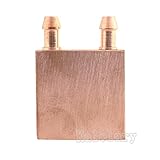
- √Processing: Pure copper
- √Internal flow channel extrusion forming,brazing parts into a whole
- √Internal fin thickness 0.5MM,Leak rate of less than 5X10⁻⁶ mbar.l/s parts
- √Surface treatment: double side processing were smooth
- √Applicable to computer CPU water, industrial inverter driver, laser head cooling, industrial control cabinet cooling
System availability and serviceability
Leaks, clogged channels, difficult cold-plate replacement and long lead times can erase the value of extra thermal headroom. Price spares, inspection labor, coolant handling and the cost of taking a server out of service.
Integration issues that can erase the benefit
- Package and mechanical fit: A customized plate may not fit the accelerator carrier, retention hardware or neighboring components. Frore lists 104.6 mm × 62 mm × 20.4 mm for a customized NVIDIA GB300 configuration; that dimension is not a universal form factor.
- Interface resistance: Diamond cannot compensate for a poorly applied or aging thermal interface material. Verify bond-line thickness, contact pressure and flatness.
- Flow distribution: A hotspot-focused jet or short loop must receive the intended flow. Manifold imbalance can starve the very region the enhancement targets.
- Coolant compatibility: Confirm chemistry, electrical properties, corrosion control, seals and filtration with the entire loop—not just the plate supplier.
- Warranty and qualification: A custom cold plate can affect GPU, server and facility warranties. Obtain written compatibility and service requirements before deployment.
- Manufacturing consistency: Ask how diamond placement, bond quality, channel dimensions and leak testing are controlled across production lots.
A practical decision matrix
| Observed situation | Recommended action | Reason |
|---|---|---|
| Hotspots throttle the accelerator while coolant temperature and flow are healthy | Run a diamond-enhanced pilot with matched workload and pump-power measurements. | This is the condition in which extra local spreading or jet cooling can create usable headroom. |
| Facility coolant is too warm or undersized | Address facility heat rejection, distribution or flow first. | A plate change does not remove heat that the secondary loop cannot carry away. |
| Thermal-interface resistance is unknown | Characterize and standardize the interface before comparing plates. | An uncontrolled interface can dominate the measured result. |
| Only a vendor temperature demo is available | Request raw conditions and run an independent workload test. | Temperature alone does not establish tokens-per-watt or payback. |
| Custom integration cost is close to the value of avoided capacity | Keep the conventional plate or target only the hottest, highest-value nodes. | Selective deployment can preserve optionality when fleet-wide economics are weak. |
Bottom line for AI operators
Diamond-enhanced cold plates can be worth their cost when localized accelerator hotspots are demonstrably limiting sustained production output and the resulting headroom has a measurable financial value. The peer-reviewed evidence for diamond-shaped pin-fin geometry is encouraging, but it is not evidence for a diamond-material insert. The largest GPU-temperature, tokens-per-watt and profitability numbers currently available are supplier claims, and public sources do not disclose the diamond premium or an independently verified fleet payback.
Make the purchase decision only after a matched pilot reports hotspot temperature, chip-to-coolant resistance, pressure drop, pump power, sustained workload output, reliability findings and total installed cost. If those measurements do not show a system-level gain, higher conductivity on its own is not a reason to pay for the upgrade.
Quick Recap
Product prices and availability are accurate as of the date/time indicated and are subject to change. Any price and availability information displayed on Amazon at the time of purchase will apply.

