Freedom251 › AI Detection Software
ZeroTrue
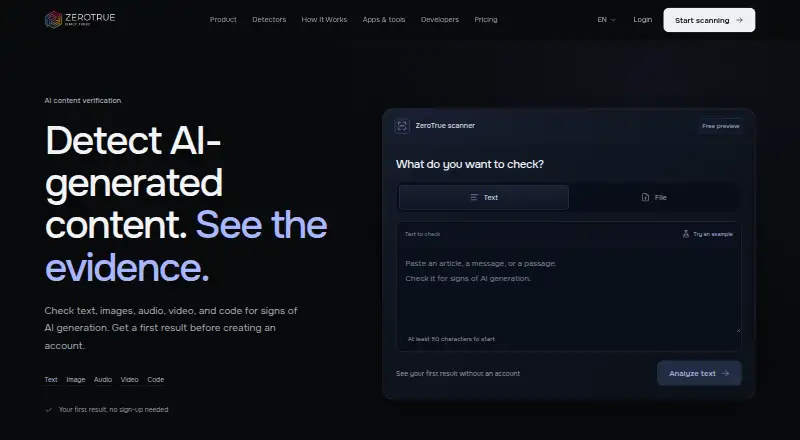
What ZeroTrue is
ZeroTrue checks text, images, audio, video, and code for signs that they may be AI-generated. It offers a web checker and an API, with results that combine an overall probability and supporting details such as highlighted regions or timestamps. These are probabilistic signals for review, not proof of who created content or why. The API uses one request pattern across the listed media types; batch processing and asynchronous webhooks are listed capabilities. Python, TypeScript, and Go SDKs are available, alongside Android and iOS apps, a Telegram bot and Mini App, MCP connectivity, and an agent skill. ZeroTrue lists enterprise review, journalism and OSINT, platform integrity, and developer products as fit areas. Detection confidence can be reduced by short samples, edits, compression, translation, re-recording, mixed human and AI content, and new generators. The free plan includes 100 detections per month, API access, a web dashboard, and community support. Paid image, audio, and video rates are listed separately. The free web image checker accepts JPG and PNG files up to 10 MB.
Who it suits
It may suit teams handling enterprise review, journalism or OSINT, platform integrity, and developer products. People making high-impact decisions should use human review rather than relying on detector output alone.
What it does well
- Checks text, images, audio, video, and code
- API supports batch processing and asynchronous webhooks
- Python, TypeScript, and Go SDKs are listed
- Free plan includes 100 detections per month
What to know first
- Short or edited samples can reduce confidence
- Free image uploads are limited to JPG and PNG
- Free web image checker caps files at 10 MB
- Developer modality rates vary by content type
Limits
The Free plan includes 100 detections per month. Its web image checker accepts JPG and PNG files up to 10 MB. Developer pricing is billed pay-as-you-go per modality, with listed rates of $0.01 per image, $0.05 per audio minute, and $0.10 per video minute.
Plans
| Plan | Billed and limits | Price |
|---|---|---|
| Free | $0 · 100 detections/month · API access · web dashboard · community support | Free |
| Developer | Pay-as-you-go per modality · Unlimited detections · $0.01/image · $0.05/audio minute · $0.10/video minute · priority support | On request |
| Enterprise | Custom · SSO and SAML · on-premise deployment · custom SLA · dedicated account manager | On request |
| Growth | Volume pricing · Volume discounts · batch-processing API · asynchronous webhooks · dedicated Slack channel | On request |
As zerotrue.app lists them, read 21 Oct 2026. The maker's own page has the final word.
Getting started
- Visit https://zerotrue.app/.
- Use the web dashboard or choose a listed Android, iOS, or Telegram option.
- For API access, use the API or one of the listed Python, TypeScript, or Go SDKs.
- Choose the Free plan for 100 detections per month, or review the listed Developer, Growth, and Enterprise plan options.
ZeroTrue is a detector for AI-generated text, images, audio, video, and code, with web and API access. It suits teams that need to triage several media types and can have people review the signals; it is not a sound choice when a score must settle authorship or intent.
Overview
Its central advantage is the range of formats handled by one service. Results pair an overall probability with supporting details, such as highlighted regions or timestamps, giving reviewers leads to investigate rather than a definitive answer. That distinction matters: detection is probabilistic evidence, not proof.
Key features
Signals and limitations
Review cues can help focus attention, but confidence may fall with short samples, editing, compression, translation, re-recording, mixed human and AI content, or newer generators. Multilingual coverage helps broaden screening, not remove those constraints. ZeroTrue cautions against using detector output alone for high-impact decisions, so organizations need a human review step.
API and integrations
One API request pattern covers all five media types, avoiding separate modality-specific interfaces. Batch processing and asynchronous webhooks suit workflows handling groups of items or results that need not return immediately. Python, TypeScript, and Go SDKs add developer options; Android and iOS apps, a Telegram bot and Mini App, MCP connectivity, and an agent skill provide additional access points.
Security and deployment
The public website and application endpoints use HTTPS, but that does not establish whether a particular deployment meets an organization’s data requirements. Confirm data location, retention, deletion, access controls, and deployment needs before production use. Enterprise offers on-premise deployment, SSO and SAML, a custom SLA, and a dedicated account manager for organizations needing those arrangements.
The free web image checker accepts JPG and PNG files up to 10 MB, a useful but bounded route for occasional image checks.
Pricing
The Free plan costs nothing and includes 100 detections per month, API access, a web dashboard, and community support. That is a meaningful starting allowance for evaluation or light use, but the monthly cap makes it unsuitable for sustained high-volume screening.
Developer is billed pay-as-you-go per modality, with unlimited detections, Priority Support, and rates of $0.01 / image, $0.05 / audio min, and $0.10 / video min. The per-unit rates make costs easier to relate to usage, though audio and video volume can accumulate; no price is given for text or code. Growth uses custom pricing billed by volume, adding volume discounts, batch processing API, asynchronous webhooks, and a dedicated Slack channel. It is a better fit for substantial throughput than the capped Free plan, but requires custom pricing.
Enterprise is billed custom and adds SSO and SAML, on-premise deployment, a custom SLA, and a dedicated account manager. Those are organizational controls and support rather than a necessary upgrade for every individual reviewer. Growth and Enterprise have no published fixed price, so buyers need a quote to compare their costs.
Platforms
ZeroTrue supports Android, iOS, web, API, and self-hosted use. That mix can accommodate both direct checking and integration into products or organizational deployments, while the security and data questions still need to be resolved for production.
Who it's for
Journalists and OSINT researchers can use the signals to prioritize material for verification; platform-integrity teams can screen across varied media; and developers can build checks into products through the shared API and SDKs. It is a poor fit for anyone seeking an authorship verdict without human assessment, or for organizations unwilling to resolve data-handling requirements before deployment.
Pros and cons
- Broad media coverage: one service checks text, images, audio, video, and code, useful for mixed-format review.
- Actionable review cues: probabilities plus highlighted regions or timestamps offer more direction than a bare score, while remaining inconclusive.
- Developer options: a common API pattern, SDKs, batch processing, and webhooks support product and larger-scale workflows.
- Material confidence limits: common transformations and mixed-origin content can weaken results, requiring human review.
- Free usage is capped: 100 monthly detections may be too little for teams with regular screening needs.
- Production diligence remains necessary: HTTPS does not answer data location, retention, deletion, access, or deployment questions.
Alternatives
Choose Trinka if its broader platform range or freemium option better matches your workflow. Grammarly is an alternative with a free plan and an allowance of 100 AI prompts per month on its Free plan. Sapling offers a free plan with 2,000 AI detector characters per check, five detector files per batch, and 20 snippets, which may suit bounded text checks.
SlopProx is another alternative. AI Detect may suit users seeking a free, local-use option with no usage limits and no API key. AI Detector Pro offers a free plan with three AI scans per month. Detecto is another freemium alternative. GPTZero offers a free plan with 10,000 words per month and 50,000 characters, making it worth considering for a text-focused allowance.
Verdict
ZeroTrue is a strong fit for teams that need to screen multiple media types through one API or a range of apps and can treat results as prompts for investigation. Its breadth and review signals are the main reasons to choose it; confidence limitations and unresolved production data requirements are reasons to look elsewhere when a conclusive, low-friction decision process is essential.
Verdict
ZeroTrue offers checks across five media types, with review signals, API access, and a free plan. Its results are probabilistic, and the listed sample conditions can reduce confidence, so human review matters.
Questions
Does ZeroTrue have a free plan?
Yes. The Free plan costs nothing and includes 100 detections per month, API access, a web dashboard, and community support.
What content can ZeroTrue check?
It checks text, images, audio, video, and code for signs of AI generation.
Which platforms and integrations are listed?
Platforms include Android, iOS, self-hosted, web, and API. The site also describes a Telegram bot and Mini App, MCP connectivity, an agent skill, and SDKs.
What does the API offer?
It uses one request pattern across the listed content types. Batch processing and asynchronous webhooks are listed capabilities.
What does Enterprise include?
The Enterprise plan lists on-premise deployment, SSO and SAML, a custom SLA, and a dedicated account manager.
Are detection results proof of authorship?
No. Results provide probabilistic evidence and supporting signals, not proof of authorship or intent. The site calls for human review and cautions against relying on detector output alone for high-impact decisions.
Facts from ZeroTrue's own pages
- API
- The API uses one request pattern across text, images, audio, video, and code, with batch processing and asynchronous webhooks listed as capabilities. · zerotrue.app, 4 Oct 2026
- API endpoint
- The documented check endpoint is POST /api/v1/check and accepts private-scan, deep-scan and idempotency options. · zerotrue.app, 21 Oct 2026
- Async processing
- The API documentation describes polling and webhook delivery for long-running media checks. · zerotrue.app, 21 Oct 2026
- Audio detection
- The audio detector examines voice-cloning and synthetic-speech signals including timing, spectral and speaker-consistency evidence. · zerotrue.app, 21 Oct 2026
- Batch processing
- Batch detection is listed as an API capability for processing multiple files in one operation. · zerotrue.app, 21 Oct 2026
- Beta status
- The terms describe the service as early beta and warn that features may be incomplete, unstable or changed without notice. · zerotrue.app, 21 Oct 2026
- Code detection
- The code detector looks for patterns associated with output from coding assistants and large language models. · zerotrue.app, 21 Oct 2026
- Company
- The site identifies the company as ZeroTrue Inc. · zerotrue.app, 4 Oct 2026
- Company facts
- The official site footer identifies the operating entity as ZeroTrue Inc.; no headquarters or founding year is stated on the reviewed pages. · zerotrue.app, 21 Oct 2026
- Company project date
- The Uberwow portfolio lists ZeroTrue as a 2025 multimodal AI-content and deepfake-detection project. · uberwow.me, 21 Oct 2026
- Data retention
- Terms say uploaded source files and submitted content are generally retained for no longer than 180 days, subject to stated exceptions. · zerotrue.app, 21 Oct 2026
- Detection limitation
- ZeroTrue states that scores are probabilistic evidence and cannot prove authorship or intent. · zerotrue.app, 21 Oct 2026
- Detection limits
- Short samples, editing, compression, translation, re-recording, mixed human and AI content, and new generators can reduce confidence. · zerotrue.app, 4 Oct 2026
- Detection weakness
- Short samples, editing, compression, translation, re-recording, mixed authorship and newer generators can reduce confidence. · zerotrue.app, 21 Oct 2026
- Documentation depth
- Public documentation includes API examples, response fields, methodology, model-evaluation guidance and modality-specific guides. · zerotrue.app, 21 Oct 2026
- Enterprise deployment
- The Enterprise plan lists on-premise deployment, SSO and SAML, a custom SLA, and a dedicated account manager. · zerotrue.app, 4 Oct 2026
- Evidence
- Results provide probabilistic evidence and supporting signals, not proof of authorship or intent. · zerotrue.app, 4 Oct 2026
- Explainable results
- Results can include probability scores, confidence bands, highlighted regions, timestamps, forensic indicators and provenance notes. · zerotrue.app, 21 Oct 2026
- Image detection
- The image detector checks diffusion artifacts, GAN output, face swaps, metadata and other manipulation indicators. · zerotrue.app, 21 Oct 2026
- Image upload limit
- The free web image checker accepts JPG and PNG files up to 10 MB. · zerotrue.app, 4 Oct 2026
- Independent description
- Parse describes ZeroTrue as a multimodal detector with explainable confidence scores and a unified API for enterprise privacy and security workflows. · parse.gl, 21 Oct 2026
- Independent visibility metric
- Parse assigns ZeroTrue a Parse Score of 47.3 based on its AI-answer tracking dataset. · parse.gl, 21 Oct 2026
- Integrations
- The product site advertises Android and iOS apps, a Telegram bot and Mini App, MCP connectivity, an agent skill and SDK integrations. · zerotrue.app, 21 Oct 2026
- Intended users
- ZeroTrue identifies enterprise review, journalism and OSINT, platform integrity, and developer products as fit areas. · zerotrue.app, 4 Oct 2026
Where ZeroTrue stands on Freedom251
- AI Detection Software#23 of 30