Freedom251 › AI Content Detection Software
AI Detect
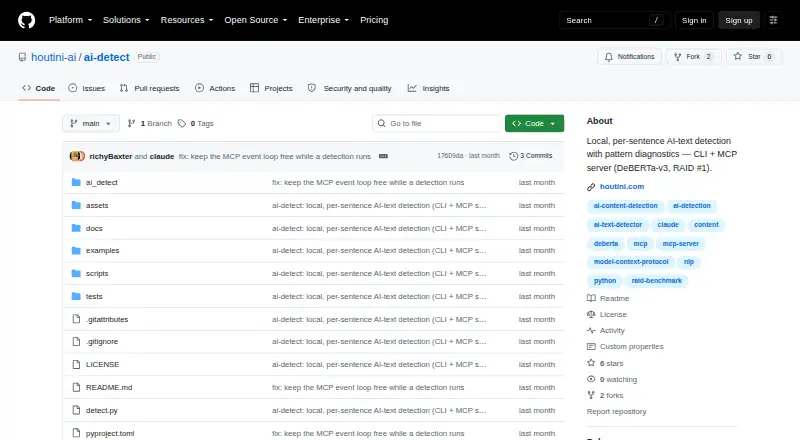
What AI Detect is
AI Detect is an open-source tool for assessing writing sentence by sentence for signs of likely AI-generated text. It is intended for local checks of commissioned or unpublished copy, including batches of writing. The default model is DeBERTa-v3-large with 304 million parameters and a download of about 1.7 GB; a 126 MB RoBERTa ONNX model is also available for faster triage. The tool can flag patterns such as missing contractions, formal verbs, and formal transitions, then offer plain-English rewrite suggestions. It is distributed as a command-line tool, a Python package, and an MCP server. The MCP server can be used with Claude Desktop, Claude Code, or another MCP client. Text inference runs on the user's hardware. After the model is downloaded and cached, AI Detect can run offline; its only network call is the initial model download. CPU is the default, while CUDA is used automatically when available. Sentences shorter than five words are skipped. The maker describes the project as beta and recommends viewing scores across a batch as a signal rather than treating an individual sentence score as a verdict. AI Detect is free under an MIT license, with file uploads, batch scanning, and basic report exports.
Who it suits
AI Detect suits people who want to check commissioned or unpublished writing locally, especially when reviewing batches. It may also suit users who want a command-line, Python, or MCP interface and can work without a support contract or polished dashboard.
What it does well
- Runs text inference on the user's own hardware.
- Can work offline after the model is cached.
- Offers a lighter 126 MB model option.
- Available as a CLI, Python package, and MCP server.
- Supports file uploads and batch scanning.
- Free and MIT-licensed.
What to know first
- The default model download is about 1.7 GB.
- Sentences shorter than five words are skipped.
- The maker describes the software as beta.
- The local tool has no support contract or polished dashboard.
Limits
Sentences shorter than five words are skipped rather than scored. The maker recommends interpreting scores across a batch as a signal, not as a verdict on an individual sentence.
Plans
| Plan | Billed and limits | Price |
|---|---|---|
| Free | no API key · no usage limits · local inference · offline after model download | Free |
As github.com lists them, read 15 Oct 2026. The maker's own page has the final word.
Getting started
- Open the project website on GitHub.
- Choose the command-line tool, Python package, or MCP server interface.
- Download and cache the default model or the lighter RoBERTa ONNX model.
- Run it locally on CPU, or use CUDA if available.
- For MCP use, connect the server with Claude Desktop, Claude Code, or another MCP client.
AI Detect is a free, open-source detector that scores writing sentence by sentence on your own hardware. It suits writers and editors reviewing batches of unpublished or commissioned copy, especially when offline use matters. Its flexible local tools come with a clear trade-off: beta scores are prompts for review, not judgments about individual sentences.
Overview
Text stays on your hardware during inference, and the repository says the only network call is the initial model download. Once the model is cached, AI Detect runs offline. That is a practical advantage for private drafts, while users who need a hosted service will need another tool.
The MIT license and command-line, Python package, and MCP server distributions give technical users several ways to fit AI Detect into a local workflow. The project is in beta, and its maker says users give up a support contract and polished dashboard. That makes it a poor fit for teams that need formal support or a ready-made visual workspace.
Key features
Sentence scoring and editing cues
AI Detect scores text sentence by sentence and flags patterns such as missing contractions, formal verbs, and formal transitions. It also offers plain-English rewrite suggestions, which can help editors focus attention on passages that may need a closer read. These cues do not establish authorship: the maker recommends looking at patterns across a batch rather than treating a single sentence score as a verdict.
Two model sizes
The default DeBERTa-v3-large model has 304 million parameters and takes about 1.7 GB to download. For faster triage, a 126 MB RoBERTa ONNX option uses much less storage. The smaller download lowers the barrier for machines with limited space, though the published facts do not establish how its results compare with the default model.
Local compute and batch work
A GPU is optional: CPU is the default, and CUDA is used automatically when available. Batch scanning and file uploads suit users checking multiple documents, and basic report exports provide a way to carry results out of a scan. Sentences shorter than five words are skipped, so very short text will not receive scores.
MCP connections
The MCP server can connect with Claude Desktop, Claude Code, or another MCP client. That gives users of those tools a way to incorporate local scoring into their workflow; people who do not use an MCP client can choose the command-line or Python interfaces instead.
Pricing
The Free plan costs nothing. It requires no API key, has no usage limits, and runs locally. There is no free trial because the product is free. The plan also supports file uploads, batch scanning, and basic report exports, making it a useful option for sustained review without per-scan caps. In return, users take on the local setup and work without a support contract or polished dashboard.
Platforms
AI Detect supports Linux, macOS, and Windows, as well as self-hosted use. Combined with CPU support and offline operation after the model download, this suits users who can run software on their own machines and do not need a browser-based service.
Who it's for
AI Detect is best for technically comfortable writers, editors, and organizations checking commissioned or unpublished copy in batches while keeping inference on their own hardware. It is less suitable for anyone who expects a managed dashboard, contracted support, or definitive authorship decisions from sentence scores.
Pros and cons
- Private, offline-capable inference: text is processed locally, and scans work offline after the model is cached.
- No usage caps or API key: the free plan supports repeated local batch review without a scan allowance.
- Flexible interfaces: CLI, Python, and MCP options accommodate different technical workflows.
- Substantial default download: the 1.7 GB model may be inconvenient on machines with limited storage, though the 126 MB option reduces that burden.
- Beta results need restraint: scores can guide attention across a batch but should not decide whether an individual sentence was AI-generated.
- No support contract or polished dashboard: users who need either should choose a more managed option.
Alternatives
TrustOriginality.ai is a better fit for someone who prefers a hosted service and a defined monthly allowance: its free plan includes one text analysis per month, while Quick Check costs €4.99 a month for three multimodal verifications and three API calls. Corrector.app suits readers who want free grammar and spelling checks without account registration, with a 15,000-character input limit shown on its checker.
SlopTotal is another free option with no account, credit card, or scan limits. Trinka is an alternative with a free plan and a freemium model. Readers comparing more tools can browse AI Content Detection Software or AI Detection Software.
Verdict
Choose AI Detect if you can manage a local tool and want unlimited, offline-capable sentence scoring for private drafts and batch review. Its strongest case is the combination of local processing, multiple interfaces, and a free MIT-licensed plan. Look elsewhere if you need support, a polished dashboard, or scores that can serve as definitive judgments about individual sentences.
Verdict
Choose AI Detect if local, offline-capable sentence scoring and batch review fit your workflow. Its free MIT-licensed distribution and multiple interfaces are useful for that purpose. Look elsewhere if you need a support contract or polished dashboard, or if you need scores treated as definitive judgments on individual sentences.
Questions
How much does AI Detect cost?
It is free, with a Free plan listed as free. There are no usage limits listed for that plan.
Does AI Detect have a free trial?
No. It is listed as free, and there is no free trial.
Which platforms does it support?
The listed platforms are Linux, macOS, Windows, and self-hosted use.
Is AI Detect open source?
Yes. The project is open source and MIT-licensed.
Can it work with Claude?
Its MCP server can be used with Claude Desktop, Claude Code, or another MCP client.
What does the free plan include?
The plan lists no API key, no usage limits, and local use. File uploads and batch scanning are supported, with basic report exports.
Facts from AI Detect's own pages
- Accuracy caveat
- The guide reports that short factual human sentences can be falsely flagged while long conversational sentences often pass. · houtini.com, 15 Oct 2026
- Audience
- The maker positions it for people checking commissioned or unpublished copy locally, including users handling batches of writing. · github.com, 7 Oct 2026
- Benchmark claim
- Houtini says the DeBERTa detector ranked first on the RAID detection benchmark. · github.com, 15 Oct 2026
- Business classification
- Companies House classifies HOUTINI LIMITED under SIC 62090, other information technology service activities. · find-and-update.company-information.service.gov.uk, 15 Oct 2026
- Caveat
- The maker describes the software as beta and recommends treating its scores as a signal across a batch rather than a verdict on an individual sentence. · github.com, 7 Oct 2026
- Command-line interface
- The CLI accepts text or files, compares two versions, emits JSON, and lets users choose model and device. · github.com, 15 Oct 2026
- Company founding
- LinkedIn lists Houtini as founded in 2025. · linkedin.com, 15 Oct 2026
- Company headquarters
- LinkedIn lists Houtini’s headquarters as London. · linkedin.com, 15 Oct 2026
- Company size
- LinkedIn lists Houtini as having 2–10 employees. · linkedin.com, 15 Oct 2026
- Default model download
- The default model downloads about 1.7 GB from Hugging Face on first use and is then cached locally. · github.com, 15 Oct 2026
- Detection model
- The default detector uses desklib/ai-text-detector-v1.01, based on a 304-million-parameter DeBERTa-v3-large model. · github.com, 15 Oct 2026
- Diagnostics
- It flags writing patterns such as missing contractions, formal verbs, and formal transitions, and provides plain-English rewrite suggestions. · github.com, 7 Oct 2026
- Hardware
- A GPU is optional: the default is CPU, with CUDA used automatically when available. · github.com, 7 Oct 2026
- Hardware support
- CPU execution is the default, while CUDA is used automatically when an available GPU is detected. · github.com, 15 Oct 2026
- Independent deployment status
- Glama states that this MCP server cannot be deployed through its platform. · glama.ai, 15 Oct 2026
- Independent documentation assessment
- Glama’s page reproduces instructions for CLI commands, MCP configuration, model downloads and the five exposed tools. · glama.ai, 15 Oct 2026
- Independent listing
- Glama lists AI Detect as a Python, local MCP server for AI text detection. · glama.ai, 15 Oct 2026
- Input limit
- Sentences shorter than five words are skipped rather than scored. · github.com, 7 Oct 2026
- Installation requirement
- The accompanying setup guide lists Python 3.9 or newer, pip and roughly 3 GB of disk space for the first download. · houtini.com, 15 Oct 2026
- Integrations
- The MCP server can be used with Claude Desktop, Claude Code, or another MCP client. · github.com, 7 Oct 2026
- Interfaces
- It is distributed as a command-line tool, Python package, and MCP server. · github.com, 7 Oct 2026
- Legal entity
- UK Companies House lists the maker as HOUTINI LIMITED, company number 16683235, an active private limited company incorporated on 31 August 2025. · find-and-update.company-information.service.gov.uk, 15 Oct 2026
- License
- The project is released under the MIT license. · github.com, 15 Oct 2026
- Light model
- An optional RoBERTa-base int8 ONNX model is provided for smaller and faster scans and is about 126 MB. · github.com, 15 Oct 2026
Where AI Detect stands on Freedom251
- AI Content Detection Software#1 of 45
- AI Detection Software#1 of 29