Freedom251 › Game Anti-Cheat Software
UltimateAntiCheat
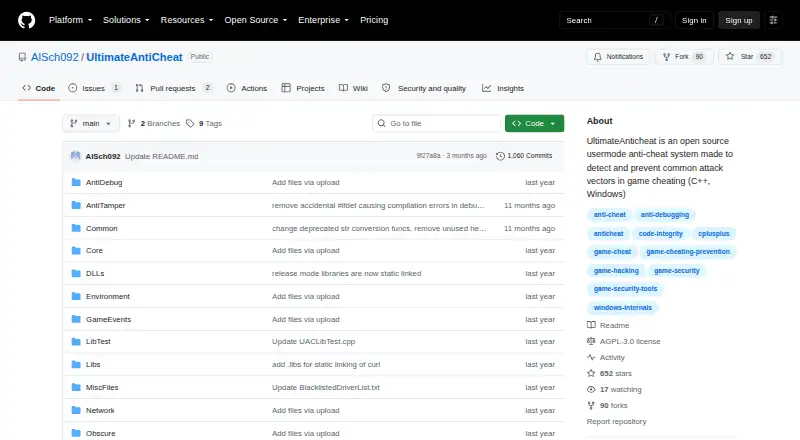
What UltimateAntiCheat is
UltimateAntiCheat is an open-source educational anti-cheat system for Windows, intended as a reference rather than commercial software. Its listed checks cover memory integrity, manually mapped and unsigned modules, debugger activity, process creation, and handles opened to the protected process. Prevention options include remapping protected sections, restricting certain new threads, hiding threads from debuggers, and applying mitigation policies. The project is written in C++ and supports CMake; its README recommends integrating it as source code or a static library rather than using a standalone DLL. A hybrid kernelmode and usermode option is available, but users must provide or make their own driver. Networking is optional and can send clients a simple heartbeat every minute. Settings are compiled into the program and can be changed in main.cpp or Common/Settings.hpp. Windows targeting is configurable, with some features requiring newer Windows versions. The project uses AGPL-3.0, and the README says projects using its code must also be open source. The maker cautions against checking process window names and text in live use because of false-positive risk.
Who it suits
UltimateAntiCheat suits developers seeking an educational Windows anti-cheat reference that they can integrate into software as source code or a static library. Its license and the requirement to provide a driver for the hybrid option should be considered before use.
What it does well
- Open-source educational project with no listed price.
- Checks several memory, module, debugger, and process conditions.
- Networking can be enabled or disabled.
- Supports CMake and configurable Windows targeting.
What to know first
- The maker positions it as educational, not commercial software.
- Hybrid kernelmode use requires a user-provided or user-made driver.
- The README says projects using its code must also be open source.
- Window-name and text checks carry a large false-positive risk.
Limits
The free AGPL-3.0 project requires projects using its code to also be open source. Kernelmode use requires a user-supplied or user-made driver; some features require newer Windows versions.
Plans
| Plan | Billed and limits | Price |
|---|---|---|
| UltimateAntiCheat | Open-source educational project · AGPL-3.0 · commercial reuse requires the project to also be open source | Free |
As github.com lists them, read 8 Oct 2026. The maker's own page has the final word.
Getting started
- Open the project's GitHub website.
- Build the C++ project with CMake for Windows.
- Integrate it into a game or software as source code or a static library.
- Adjust compiled settings in main.cpp or Common/Settings.hpp.
- If enabling the hybrid kernelmode approach, provide or make a driver.
UltimateAntiCheat is a Windows usermode anti-cheat project for developers studying or adapting detection code. It is most suitable for open-source projects that can work with its licensing terms. Its range of process checks is useful as a reference, but it is not a turnkey commercial service.
Overview
The project focuses on common game-hacking vectors inside processes, with configurable checks and prevention options. Its maker positions it as educational rather than commercial software, and recommends integrating it into a game or application as source code or a static library—not as a standalone DLL. That makes it a better fit for developers prepared to inspect and adapt C++ code than for studios seeking a packaged anti-cheat deployment.
Its stated privacy approach avoids file-system scanning: it checks byte patterns in processes already open or created while the anti-cheat is running. That is a meaningful boundary, but not a guarantee of error-free detection. The maker specifically cautions against checking process window names and text in live use because of false-positive risk.
Key features
- Process and memory detection: Checks cover memory integrity, manually mapped and unsigned modules, debugger activity, process creation, and handles opened to the protected process. This gives developers several common attack vectors to study, but it does not provide server-side detection.
- Prevention controls: Options include remapping protected sections, blocking certain new threads, hiding threads from debuggers, and applying mitigation policies. These controls let integrators choose measures for their software; they do not make the project a complete hosted protection service.
- Optional heartbeat: A client-server mechanism can send clients a simple heartbeat every minute, and networking can be switched off in settings. This is a narrow networking function, not server-side cheat detection.
- Optional kernel approach: Settings support a hybrid kernelmode and usermode design, but users must supply or build their own driver. That adds substantial responsibility and makes the option unsuitable for teams expecting a bundled kernel client.
- Build and configuration: The C++ project supports CMake, with an LLVM/clang-cl option on a branch the maker warns may lag or contain errors. Settings are compiled into the program and edited in main.cpp or Common/Settings.hpp, so changing configuration requires source-level work and a rebuild rather than an external settings file.
Pricing
The UltimateAntiCheat plan costs nothing. It is an open-source educational project under AGPL-3.0, with no free trial. The zero price suits developers who can work with the source and its terms; it does not buy a commercial license or a managed service. The maker says projects using the code must also be open source, so closed-source commercial games should look elsewhere.
Platforms
UltimateAntiCheat is self-hosted and targets Windows PCs. Windows targeting is configurable at compile time; the README gives Windows 10 and Windows 7 or later as examples, while noting that some features need newer Windows versions. The project is not a kernel-level client by itself, and its hybrid option requires a separately provided driver.
Who it's for
This is best for developers learning about usermode anti-cheat techniques or adapting code for an open-source Windows game or application. It is less appropriate for teams that need a developer SDK, server-side detection, hardware bans, or a ready-to-deploy kernel client: those are not part of the stated offering. Teams should also be comfortable evaluating false-positive risks and maintaining source-level configuration.
Pros and cons
- Pro: A broad set of process and memory checks provides a concrete educational reference for common attack vectors.
- Pro: Optional prevention controls and configurable networking give integrators choices about what to enable.
- Pro: Avoiding file-system scanning may suit projects seeking a process-focused approach.
- Con: AGPL-3.0 terms require projects using the code to remain open source, ruling it out for many closed-source commercial integrations.
- Con: No SDK, server-side detection, hardware bans, or bundled kernel client limits its role as a complete production anti-cheat solution.
- Con: Compiled-in settings and the warning about false positives from window-name and text checks demand care from integrators.
Alternatives
Choose Easy Anti-Cheat if you want a freemium option with a free plan for studios of any size and broader listed platform support, including mobile, Linux, macOS, and web; its Core plan uses custom pricing.
Epic Online Services is a free-to-use alternative across several platforms, with no royalty or hosting fees, though service usage restrictions may apply. For single-player or offline games, AGINUZ Anti-Cheat Infrastructure offers a free Protected plan with per-player unique binaries and struct-field shuffling; its stated scope makes it a more focused choice for that use.
RoSentry has a free-forever web plan capped at 100 concurrent players and one active game, with community support and no moderation dashboard. Anybrain, GuardingPear Anti-Cheat, Byteria Game Anti-Cheat, and BattlEye are other options to compare; their listed platform and pricing models differ, but the stated facts do not support a more specific fit comparison.
For more options, browse Game Anti-Cheat Software.
Verdict
Choose UltimateAntiCheat if you want a free, source-level Windows reference for usermode checks and can keep your project open source under AGPL-3.0. Its educational scope, configurable controls, and process-focused approach are the main reasons to consider it. Look elsewhere if you need closed-source commercial integration, server-side detection, a supplied kernel client, or a packaged service.
Verdict
UltimateAntiCheat provides a configurable set of usermode detection and prevention options for Windows software. It is an educational reference, and its AGPL-3.0 terms and stated false-positive caution matter for developers considering integration.
Questions
How much does UltimateAntiCheat cost?
The listed plan is free.
Is UltimateAntiCheat open source?
Yes. It uses the GNU Affero General Public License, and the README says projects using its code must also be open source.
Which platforms does it support?
It is a Windows C++ project, listed for self-hosted deployment and PC. Windows targeting is configurable; some features require newer versions.
Does it use a kernel-level client?
No kernel-level client is listed. A hybrid kernelmode and usermode approach is available through settings, but requires a driver made or supplied by the user.
Does it include server-side detection or a developer SDK?
Neither server-side detection nor a developer SDK is listed.
How should developers integrate it?
The README recommends using it as source code or a static library within a game or other software rather than as a standalone DLL.
Facts from UltimateAntiCheat's own pages
- Configuration
- Settings are compiled into the program rather than stored in an external file, and can be changed in main.cpp or Common/Settings.hpp. · github.com, 8 Oct 2026
- Detection coverage
- Its listed checks include memory integrity, manually mapped modules, debugger activity, unsigned modules, process creation, and handles opened to the protected process. · github.com, 8 Oct 2026
- Integration
- The README recommends integrating the project into a game or software as source code or a static library instead of using a standalone DLL. · github.com, 8 Oct 2026
- Intended use
- The maker describes it as a generic reference for educational purposes rather than commercial software. · github.com, 8 Oct 2026
- Kernel option
- A hybrid kernelmode and usermode approach is available through settings, but users must make or provide their own driver. · github.com, 8 Oct 2026
- Known limitation
- The detections page says checking process window names and text is not recommended in live use because of a large false-positive risk. · github.com, 8 Oct 2026
- License
- The repository uses the GNU Affero General Public License, and its README says projects using its code must also be open source. · github.com, 8 Oct 2026
- Networking
- An optional client-server mechanism sends a simple heartbeat to clients every minute, and networking can be enabled or disabled in settings. · github.com, 8 Oct 2026
- Platform and build
- The project is written in C++ for Windows and supports CMake; an LLVM/clang-cl option is available on a branch that the maker cautions may lag or contain errors. · github.com, 8 Oct 2026
- Prevention features
- Listed preventions include remapping protected sections, blocking certain new threads, hiding threads from debuggers, and applying mitigation policies. · github.com, 8 Oct 2026
- Privacy
- The maker says the project avoids privacy-invasive techniques and does not rely on file-system scanning; it scans byte patterns in processes already open or created while the anti-cheat runs. · github.com, 8 Oct 2026
- Purpose
- UltimateAntiCheat is an open-source, educational usermode anti-cheat system designed to detect and prevent common game-hacking attack vectors. · github.com, 8 Oct 2026
- Windows versions
- Windows targeting is configurable at compile time, and the README gives Windows 10 and Windows 7 or later as examples; some features require newer Windows versions. · github.com, 8 Oct 2026
Where UltimateAntiCheat stands on Freedom251
- Game Anti-Cheat Software#8 of 22