Freedom251 › Procure-to-Pay Software
Tradeshift
by Tradeshift
What Tradeshift is
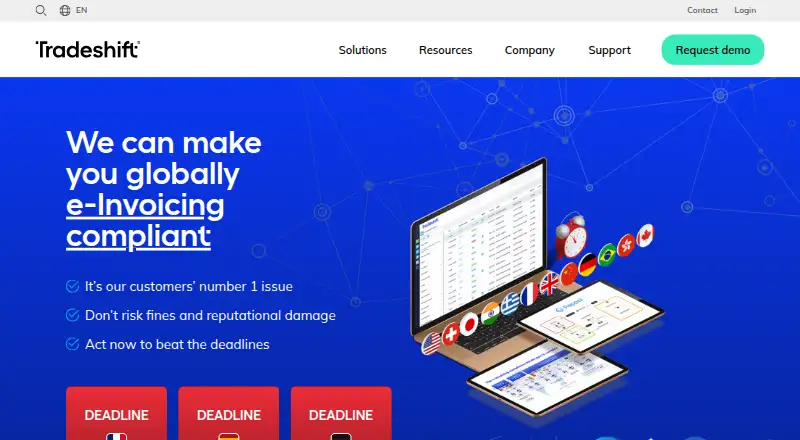
Tradeshift is a cloud platform for accounts payable, e-invoicing, compliance and clearance for buyers and suppliers. Its accounts payable tools digitize invoices, extract and validate data, match purchase orders, route approvals and provide dashboards. The modular Procure to Pay platform supports purchasing workflows and connections with suppliers and customers; listed functions also include purchase orders, supplier management and catalog-based request intake with punchout support. Configurable AI can automate invoice coding, workflow management and purchase order matching. For integrations, the AP solution offers a REST API and standard connectors for SAP ECC 6.0, SAP S4/HANA, Oracle eBusiness Suite and Oracle Fusion. Tradeshift lists ISO 27001, SOC 1 Type II, SOC 2 Type II and ISAE 3402 accreditations. Its described security practices include least-privilege access, secure code review and scanning, vulnerability testing, incident response and daily backups. The company says it serves large and mid-sized companies and covers e-invoicing compliance in 70 countries. AP customers can access Tradeshift University and 365-day support after setup. Sellers receive customer support without extra charges for heavy support use. Pricing varies by seller transaction volume; the first 30 invoices per quarter are free, with paid tiers above that threshold.
Who it suits
Tradeshift suits large and mid-sized companies seeking accounts payable automation, e-invoicing compliance or connected purchasing and supplier workflows. Sellers should consider the quarterly invoice tiers when estimating costs.
What it does well
- Automates invoice validation, purchase-order matching and approvals.
- Configurable AI supports invoice coding and workflow management.
- Lists connectors for SAP and Oracle products.
- Sellers receive support without extra charges for heavy use.
What to know first
- Seller tiers become paid above 30 invoices per quarter.
- Custom pricing applies above 15,000 quarterly transactions.
- AP support is described as available after setup.
Limits
The free seller tier covers up to 30 invoices per quarter; invoices and credit notes count, while purchase orders do not. Tier 2 covers 31–300 quarterly transactions on request, calculated quarterly and billed quarterly in arrears; the first 30 invoices per quarter remain free. Tier 3 is priced on request for 301–3,000 quarterly transactions, and Tier 4 is priced on request for 3,001–15,000; Tier 5 has custom pricing above 15,000.
Plans
| Plan | Billed and limits | Price |
|---|---|---|
| Free | Freemium plan; paid packages depend on invoice volume | Free |
| Free tier | No charge for up to 30 invoices per quarter; first 30 invoices are free in every tier. · 0–30 invoices per quarter · invoices and credit notes count; purchase orders do not | Free |
| Tier 4 | Per transaction, calculated quarterly and billed quarterly in arrears; first 30 invoices per quarter are free. · 3,001–15,000 quarterly transactions | $0.30 |
| Tier 3 | Per transaction, calculated quarterly and billed quarterly in arrears; first 30 invoices per quarter are free. · 301–3,000 quarterly transactions | $0.60 |
| Tier 2 | Per transaction, calculated quarterly and billed quarterly in arrears; first 30 invoices per quarter are free. · 31–300 quarterly transactions | $0.80 |
| Tier 5 | Custom pricing; charges are calculated quarterly and billed quarterly in arrears. · More than 15,001 quarterly transactions | On request |
| Paid packages | Pricing depends on invoice load; vendor quote required | On request |
As tradeshift.com lists them, read 15 Oct 2026. The maker's own page has the final word.
Getting started
- Visit https://tradeshift.com/.
- Use the web platform or connect through its API.
- Ask Tradeshift for pricing for the paid offering.
- For seller pricing, identify quarterly invoices and credit notes across Tradeshift buyers; the first 30 are free in every tier.
Overview
Tradeshift brings invoice processing, e-invoicing compliance and purchasing workflows together in a cloud platform for buyers and suppliers. It is most relevant to mid-sized and large companies coordinating substantial supplier activity. Its broad workflow is an advantage when AP and procurement need to connect, but sellers should account for quarterly transaction charges.
Key features
For accounts payable teams, Tradeshift digitizes invoices, extracts and validates data, matches purchase orders, routes approvals and presents activity in dashboards. That end-to-end sequence can make it a stronger fit than a tool focused only on invoice capture when a company also needs matching and approval workflows. Configurable AI can automate invoice coding, workflow management and purchase-order matching; the practical benefit will depend on how those configurable steps align with existing processes.
The modular, app-based Procure to Pay platform extends the offer into purchasing and supplier connections. Purchase orders, supplier management, punchout catalogs and catalog-based request intake make it relevant to procurement teams, not just AP. A REST API and standard connectors for SAP ECC 6.0, SAP S4/HANA, Oracle eBusiness Suite and Oracle Fusion are useful for organizations on those systems, while teams using other platforms should assess integration fit before committing.
Tradeshift says its e-invoicing compliance coverage spans 70 countries, which matters for companies operating across borders. Security accreditations include ISO 27001, SOC 1 Type II, SOC 2 Type II and ISAE 3402. The company also describes least-privilege access, secure code review and scanning, vulnerability testing, incident response and daily backups. AP customers can access Tradeshift University and 365-day support after setup; sellers receive customer support without extra charges for heavy support use.
Pricing
Seller pricing starts with a free allowance of up to 30 invoices per quarter. The allowance applies in every tier; invoices and credit notes count toward the thresholds, while purchase orders do not. Sellers transacting 31 or more invoices per quarter across their Tradeshift buyers move into paid tiers, so the model is worth tracking if volumes fluctuate.
| Plan | Price and billing | Quarterly volume | Best fit |
|---|---|---|---|
| Free tier | free; no charge | 0–30 invoices per quarter | Sellers staying within the free invoice allowance. |
| Tier 2 | price on request; per transaction, calculated quarterly and billed quarterly in arrears | 31–300 quarterly transactions | Lower-volume sellers exceeding the free tier. |
| Tier 3 | price on request; per transaction, calculated quarterly and billed quarterly in arrears | 301–3,000 quarterly transactions | Sellers with sustained mid-range transaction volume. |
| Tier 4 | price on request; per transaction, calculated quarterly and billed quarterly in arrears | 3,001–15,000 quarterly transactions | Higher-volume sellers within the published range. |
| Tier 5 | Custom pricing; calculated quarterly and billed quarterly in arrears | More than 15,001 quarterly transactions | Sellers above the Tier 4 range. |
These are seller transaction tiers, not a complete price for buyer-side AP or Procure to Pay use: Tradeshift’s overall pricing is on request, so companies evaluating the buyer platform need a quote. The lower seller tiers trade the free allowance for per-transaction charges; at higher volumes, the published per-contact rate falls, but billing remains quarterly in arrears.
Platforms
Tradeshift is available on web and through an API. That supports browser-based use and integration work, but organizations needing a listed mobile app should compare other options.
Who it's for
Tradeshift suits mid-sized and large companies that want to link invoice capture, purchase-order matching, approvals and purchasing workflows, particularly those using its named SAP or Oracle connectors or operating across multiple e-invoicing jurisdictions. It is less compelling for a seller with little quarterly invoice activity if paid transaction charges would outweigh the value of joining buyers on the network, or for a buyer seeking a published platform price before engaging sales.
Pros and cons
- Pros: AP automation covers capture through approval, while procurement tools add purchase orders, supplier management and catalog workflows in the same platform.
- Pros: Named SAP and Oracle connectors, broad compliance coverage and published security accreditations give larger organizations concrete points to assess for fit.
- Pros: Sellers receive support without extra charges for heavy support use, and the first 30 invoices per quarter are free in every tier.
- Cons: Sellers crossing 30 invoices per quarter enter a paid tier, with invoices and credit notes counting toward the limit.
- Cons: Buyer-side pricing is on request, making cost comparison harder without a sales conversation.
- Cons: Web and API are the listed platforms, so buyers who need native mobile apps may prefer another product.
Alternatives
For a broad procurement shortlist, compare Procure-to-Pay Software, Procurement Software, Supplier Portal Software, AI Invoice Processing Software, Accounts Payable Software and Electronic Invoicing Software to compare tools by the part of the workflow that matters most.
Onventis is worth considering when suppliers need a free network profile and customer-relationship management; its Source-to-Pay product has custom pricing. Choose Coupa Accounts Payable as another paid AP option if you want to compare platforms that include Android and iOS alongside web and API access. Esker Source-to-Pay is another paid, mobile-capable option, with pricing handled through a demo rather than a public price. For contract management, GEP SMART Contract Management and Ivalua Contract Management are alternatives; Ivalua’s enterprise CLM pricing is by request. WHIZCargo, Corcentric Source-to-Pay and Folio are additional paid alternatives with no public price stated.
Verdict
Choose Tradeshift if your mid-sized or large organization needs AP automation tied to purchasing and supplier workflows, and its compliance coverage and named ERP connectors match your operating footprint. Its main case is breadth across the invoice and procurement cycle; look elsewhere if you need clear buyer-side pricing up front, native mobile apps, or a seller model without quarterly transaction charges.
Verdict
Tradeshift combines accounts payable automation with purchasing, supplier and compliance capabilities. Seller pricing is free for the first 30 invoices per quarter, then rises by transaction tier, so volume matters.
Questions
Does Tradeshift have a free plan?
Yes. The seller Free tier has no charge for up to 30 invoices per quarter. Invoices and credit notes count toward the limit, while purchase orders do not.
How much do the seller tiers cost?
Tier 2 is priced on request for 31–300 quarterly transactions; Tier 3 is priced on request for 301–3,000; Tier 4 is priced on request for 3,001–15,000. The first 30 invoices per quarter are free in every tier, and Tier 5 uses custom pricing above 15,000 transactions.
Which platforms does Tradeshift support?
The listed platforms are web and API.
What systems does its accounts payable solution connect to?
It offers a REST API and standard connectors for SAP ECC 6.0, SAP S4/HANA, Oracle eBusiness Suite, and Oracle Fusion.
What security accreditations does Tradeshift list?
They include ISO 27001, SOC 1 Type II, SOC 2 Type II, and ISAE 3402.
Who makes Tradeshift?
Tradeshift is made by Tradeshift, which was founded in 2010.
Facts from Tradeshift's own pages
- AI tools
- Tradeshift says configurable AI can automate invoice coding, workflow management, and purchase order matching. · tradeshift.com, 8 Oct 2026
- Analytics
- Generative-AI dashboards provide real-time visibility into approvals, payments, spending and compliance. · tradeshift.com, 15 Oct 2026
- AP automation
- The platform captures invoices from e-invoicing, PDF, OCR and purchase-order-flip sources, then extracts, validates and routes them. · tradeshift.com, 15 Oct 2026
- API authentication
- The developer guide instructs integrators to create OAuth 1.0 credentials through the API Access to Own Account app. · developers.tradeshift.com, 15 Oct 2026
- Approval workflows
- Invoices can be automatically routed through predefined approval rules, including mobile and fast-track approval options. · tradeshift.com, 15 Oct 2026
- Business Firewall
- Business Firewall applies static and dynamic, user-defined validation rules to incoming and outgoing documents. · tradeshift.com, 15 Oct 2026
- Collaboration
- Transaction-level chat lets buyers and suppliers discuss invoice issues, with conversations and attachments retained in the audit trail. · tradeshift.com, 15 Oct 2026
- Company founded
- LinkedIn lists Tradeshift as founded in 2009. · linkedin.com, 15 Oct 2026
- Company headquarters
- LinkedIn lists headquarters at San Francisco, California. · linkedin.com, 15 Oct 2026
- Company legal name
- Crunchbase lists the legal name as Tradeshift Holdings, Inc. · crunchbase.com, 15 Oct 2026
- Company size
- LinkedIn lists 501–1,000 employees. · linkedin.com, 15 Oct 2026
- Compliance certifications
- The company lists SOC 1 Type II, SOC 2 Type II, ISAE 3402 Type II, PCI-DSS Level 1 and ISO 27001 in its compliance program. · tradeshift.com, 15 Oct 2026
- Core features
- Its AP automation captures and digitizes invoices, extracts and validates data, matches purchase orders, routes approvals, and provides dashboards. · tradeshift.com, 8 Oct 2026
- Data formats
- The platform supports exchange formats including EDI, XML, PDF and Tradeshift UBL. · tradeshift.com, 15 Oct 2026
- Document support
- Supported transaction types include RFQs, quotes, requisitions, purchase orders, receipts, invoices, credit notes, remittance advice and shipment notices. · tradeshift.com, 15 Oct 2026
- Extensibility
- The App Store contains connectors and functions such as recurring invoices and dynamic validation; customers can build their own apps. · support.tradeshift.com, 15 Oct 2026
- Founded
- 2010 · tradeshift.com, 28 Sept 2026
- Founding
- Tradeshift says it was founded in 2010 to address European e-invoicing compliance. · tradeshift.com, 8 Oct 2026
- Global compliance
- The company says its e-invoicing compliance coverage spans 70 countries and clearance coverage spans 12 countries. · tradeshift.com, 15 Oct 2026
- Historical open source
- Tradeshift says its predecessor project EasyTrade was an open-source trade platform, while Tradeshift itself was launched later as a commercial platform. · tradeshift.com, 15 Oct 2026
- Hosting
- Tradeshift states that its platform is hosted on AWS. · tradeshift.com, 15 Oct 2026
- Integrations
- Prebuilt connectors are listed for SAP ECC, SAP S/4HANA, Oracle E-Business Suite, Oracle Fusion and NetSuite. · tradeshift.com, 15 Oct 2026
- Invoice matching
- AI and multi-way matching can match invoices against purchase orders, goods receipts or contracts. · tradeshift.com, 15 Oct 2026
- Licence
- The Tradeshift platform is presented as proprietary SaaS; no public open-source licence is stated on the cited official product, API or security pages. · tradeshift.com, 15 Oct 2026
Where Tradeshift stands on Freedom251
- Procure-to-Pay Software#1 of 24
- Working Capital Management Software#2 of 25
- Purchasing Software#2 of 23
- Procurement Software#3 of 32
- Accounts Payable Software#10 of 97
- AI Invoice Processing Software#4 of 30
- e-Invoicing Software#3 of 22
- Supplier Portal Software#3 of 22
- AP Automation#3 of 21
- Electronic Invoicing Software#9 of 33