Freedom251 › Threat Intelligence Platforms
ThreatForge
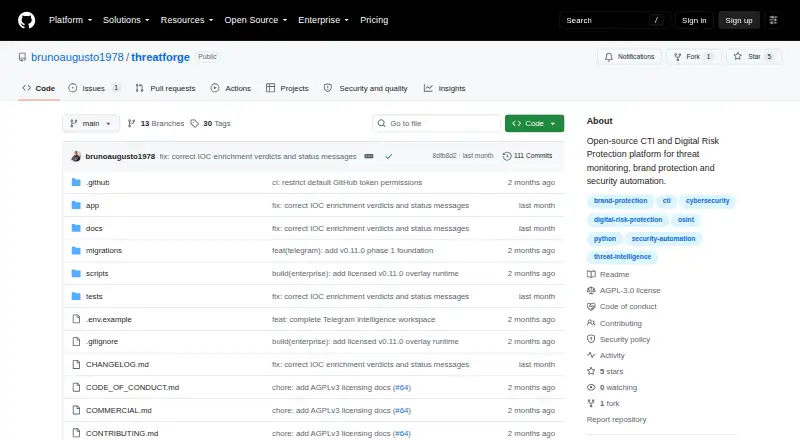
What ThreatForge is
ThreatForge is a free, open-source CTI and Digital Risk Protection platform for threat monitoring, brand protection, and digital risk investigation. Security analysts, SOC teams, fraud teams, and researchers can use it to organize indicators, enrich observables, and assess risk. It accepts IPs, domains, URLs, hashes, e-mails, and CVEs, then draws on public sources, assigns explainable scores from 0 to 100, and creates Markdown reports. Community connectors include CISA KEV, URLhaus/abuse.ch, MITRE ATT&CK, and EPSS/FIRST. Brand monitoring can generate typosquatting variants, discover certificates, enrich DNS, MX, RDAP, and certificate-age data, and score abuse. Alerts can go through Telegram, webhooks, or SMTP, each on a best-effort basis. The platform supports tenant isolation, roles, scoped API keys, and audit logs. It can be deployed with Docker Compose, with a web UI served by the API. Community Edition is free under AGPL-3.0-or-later; Enterprise has a 90-day trial, but no price is listed. Community v0.11.1 is a preview release, and the project says its schema, API, and interface may change before 1.0.
Who it suits
It suits security and fraud teams or researchers who need to investigate indicators and monitor brand abuse. Community users should account for its preview status and the features reserved for Enterprise.
What it does well
- Accepts six types of indicators, including CVEs.
- Provides explainable risk scores from 0 to 100.
- Brand monitoring includes typosquatting variation generation.
- Supports tenant isolation, roles, and audit logs.
- Free Community Edition under AGPL-3.0-or-later.
What to know first
- Community email observables are intake-only in the MVP.
- Community does not perform automatic takedowns.
- PDF export and premium enrichment require Enterprise.
- Community release remains a preview before stable 1.0.
Limits
Community email observables are intake-only in the MVP. Community locks PDF export, premium enrichment and inbound Telegram Intelligence; requests for these features return HTTP 402. The Enterprise Edition has a 90-day trial.
Plans
| Plan | Billed and limits | Price |
|---|---|---|
| Community Edition | Open source · AGPL-3.0-or-later | Free |
| Enterprise Edition | Commercial license · 90-day trial · commercial support and SLAs per agreement | On request |
As github.com lists them, read 2 Oct 2026. The maker's own page has the final word.
Getting started
- Open the ThreatForge GitHub website.
- Deploy using the documented Docker Compose setup.
- Use the web UI served by the API or the interactive API documentation.
- Start with the free Community Edition, or use the Enterprise Edition's 90-day trial.
ThreatForge is an open-source platform for threat intelligence and digital risk investigation, combining observable enrichment with brand-abuse monitoring. It is best suited to security analysts, SOC and fraud teams, and researchers who need a self-hosted way to organize and prioritize investigations. Its Community edition spans a useful set of core tasks, but the preview release and Enterprise gates call for care before relying on it operationally.
Overview
The platform brings indicator investigation, brand monitoring, reporting and workflow automation together, with API and web access and a self-hosted deployment option. Docker Compose deployment is documented, and the API serves the web UI and interactive API documentation. That makes it a practical candidate for teams able to manage their own deployment; readers seeking a hosted service should look elsewhere.
Community is open source under AGPL-3.0-or-later and costs nothing. The repository identifies version 0.11.1 as a preview, with schema, API and UI subject to change before stable 1.0. That is a meaningful trade-off for teams integrating it into durable production workflows.
Key features
ThreatForge accepts IPs, domains, URLs, hashes, email addresses and CVEs, enriching observables from public sources and assigning explainable risk scores from 0 to 100. Markdown reports help preserve and share findings, while community connectors include CISA KEV, URLhaus/abuse.ch, MITRE ATT&CK and EPSS/FIRST. Community email observables are intake-only in the MVP, so teams should not treat email submissions as receiving the same analysis as other indicator types.
Brand monitoring generates typosquatting variations and combines Certificate Transparency discovery with DNS, MX, RDAP and certificate-age enrichment to support abuse scoring. This is useful for identifying suspicious lookalike domains, but ThreatForge does not carry out automatic takedowns; remediation remains the team's responsibility.
Telegram, webhook and SMTP outbound alerts can feed existing channels, but each operates independently on a best-effort basis. They can assist a workflow, not serve as a guaranteed notification mechanism. Multi-tenant isolation, tenant and platform roles, tenant-scoped API keys and audit logs for sensitive actions provide useful separation and accountability. The web UI also uses JWT sessions in httpOnly and SameSite=Strict cookies, Argon2id password handling when available, security headers and login rate limiting.
MISP, OpenCTI and generic integrations appear as catalog entries and stubs in Community; Enterprise enables them. Community also locks PDF export, premium enrichment and inbound Telegram Intelligence behind an active Enterprise license, and locked requests return HTTP 402. Those gates make the free edition a capable starting point, but not a substitute for the paid capabilities if those functions are central to a team's process.
Pricing
Community Edition
Community costs nothing and is open source under AGPL-3.0-or-later. It includes indicator enrichment, report management, workflow automation and case management, with community support. Its practical limits include intake-only email observables in the MVP, stubbed rather than enabled integrations, and Enterprise-locked PDF export, premium enrichment and inbound Telegram Intelligence.
Enterprise Edition
Enterprise has custom pricing and a 90-day trial. Its commercial license enables the gated capabilities and typically includes commercial support, SLAs and indemnification per agreement. It is the relevant option for organizations requiring those integrations or premium functions, but buyers should confirm the specific terms and license scope in their agreement.
Platforms
ThreatForge supports API, web and self-hosted use. Docker Compose is documented for deployment; the web interface is served by the API, which also provides interactive API documentation.
Who it's for
ThreatForge fits teams that want to enrich varied indicators, track potential brand abuse and organize investigations in a self-managed platform. Its explainable scoring, reports and access controls are useful for analyst workflows and separated tenants. It is a weaker fit for teams that need guaranteed alerts, automatic takedowns, full Community email analysis, or stable integrations and premium enrichment without an Enterprise license.
Pros and cons
- Pros: Free, open-source Community edition covers enrichment, reporting, workflow automation and case management.
- Pros: Explainable scoring and public-source connectors help analysts prioritize and contextualize indicators.
- Pros: Brand monitoring combines typosquatting generation and several discovery and enrichment methods.
- Cons: The 0.11.1 preview status means the schema, API and UI may change before 1.0.
- Cons: Alerts are best-effort, and automatic takedowns are not part of the platform.
- Cons: Several important functions, including integrations, PDF export and premium enrichment, require Enterprise.
Alternatives
For a broader comparison, browse Threat Intelligence Platforms. Choose OpenAEV instead when on-premise attack simulation and tabletop exercises are the priority. Choose IBM X-Force Exchange for limited access to its portal, but its free tier does not include X-Force API access. Security Vision TIP is a paid option with custom pricing.
SOCRadar Extended Threat Intelligence Platform may suit teams seeking paid domain monitoring plans, starting with its $600 a month Essential plan for 1 domain and 1 seat. ThreatQ is a paid platform requiring a license, with additional modules requiring license updates. Anomali Platform, Flashpoint Ignite and Intel 471 Verity471 are also alternatives with pricing by request or contact-sales terms.
Verdict
ThreatForge is a strong free starting point for security teams that want self-hosted indicator enrichment, explainable prioritization and brand-abuse investigation in one platform. Choose Community if its preview status and feature gates are acceptable; look elsewhere or evaluate Enterprise if dependable alerts, automatic remediation or stable, enabled integrations are essential.
Verdict
ThreatForge combines indicator enrichment, brand monitoring, and access controls in a free Community edition. Check its preview status and edition limits, and note that outbound alerts are best-effort and automatic takedowns are not included.
Questions
Is ThreatForge free?
Community Edition is listed as free and is open source under AGPL-3.0-or-later.
Is there a free trial?
Yes. The Enterprise Edition lists a 90-day trial.
Which platforms does ThreatForge support?
The listed platforms are API, self-hosted and web. The README documents Docker Compose deployment and a web UI served by the API.
Does ThreatForge integrate with MISP and OpenCTI?
MISP, OpenCTI and generic integrations appear as catalog entries and stubs in Community. The Enterprise edition enables them.
Does ThreatForge take down abusive domains automatically?
No. ThreatForge does not perform automatic takedowns.
What support comes with Enterprise?
The commercial license typically includes commercial support, SLAs and indemnification per agreement. Community support is community support.
Facts from ThreatForge's own pages
- Access controls
- The platform supports multi-tenant isolation, tenant and platform roles, tenant-scoped API keys and audit logs for sensitive actions. · github.com, 2 Oct 2026
- Alerts
- Outbound alerts can use Telegram, webhooks or SMTP, and each channel operates independently on a best-effort basis. · github.com, 2 Oct 2026
- Brand protection
- Brand monitoring includes typosquatting variation generation, Certificate Transparency discovery, DNS/MX/RDAP and certificate-age enrichment, and abuse scoring. · github.com, 2 Oct 2026
- Deployment
- The README documents Docker Compose deployment, a web UI served by the API and interactive API documentation. · github.com, 2 Oct 2026
- Enterprise limits
- Community locks PDF export, premium enrichment and inbound Telegram Intelligence behind an active Enterprise license; locked requests return HTTP 402. · github.com, 2 Oct 2026
- Integrations
- MISP, OpenCTI and generic integrations are listed as catalog entries and stubs in Community, while the Enterprise edition enables them. · github.com, 2 Oct 2026
- Intended users
- It is described as helping security analysts, SOC teams, fraud teams and researchers organize indicators, enrich observables, monitor brand abuse and prioritize risk. · github.com, 2 Oct 2026
- IOC features
- It accepts IPs, domains, URLs, hashes, e-mails and CVEs, enriches observables from public sources, calculates explainable risk scores from 0 to 100 and generates Markdown reports. · github.com, 2 Oct 2026
- Notable limits
- Community email observables are intake-only in the MVP, and ThreatForge does not perform automatic takedowns. · github.com, 2 Oct 2026
- Public connectors
- Community connectors include CISA KEV, URLhaus/abuse.ch, MITRE ATT&CK and EPSS/FIRST. · github.com, 2 Oct 2026
- Purpose
- ThreatForge is an open-source CTI and Digital Risk Protection platform for threat monitoring, brand protection and digital risk investigation. · github.com, 2 Oct 2026
- Release status
- The repository identifies Community v0.11.1 as a preview release and says its schema, API and UI may evolve before a stable 1.0. · github.com, 2 Oct 2026
- Security
- The web UI uses JWT sessions in httpOnly and SameSite=Strict cookies, Argon2id password handling when available, and web security headers and login rate limiting. · github.com, 2 Oct 2026
- Support
- The commercial license typically includes commercial support, SLAs and indemnification per agreement; the comparison describes Community support as community support. · github.com, 2 Oct 2026
Where ThreatForge stands on Freedom251
- Threat Intelligence Platforms#6 of 32