Freedom251 › Threat Intelligence Platforms
IntelOwl
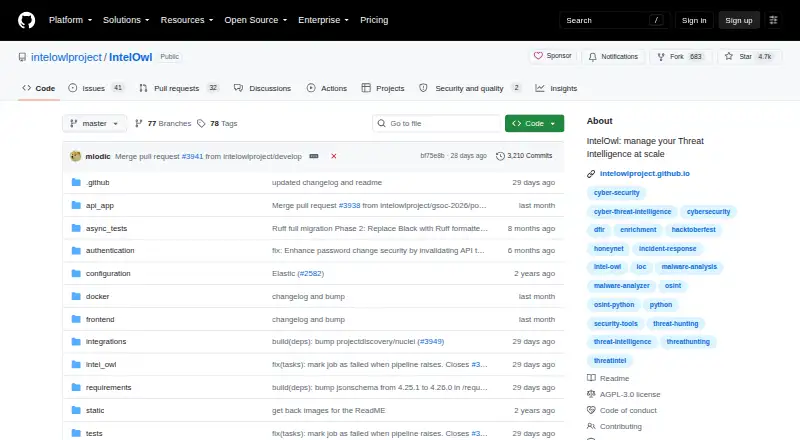
What IntelOwl is
IntelOwl is a self-hosted threat intelligence platform for enriching files and observables from multiple sources through one API. Its use cases include threat hunting, SOC operations, incident response, threat intelligence, and vulnerability management. A web interface provides dashboards, analysis visualizations, and forms for requesting analyses. Users can also work through its REST API or official Python and Go clients, including from the command line. The plugin framework supports analyzers, connectors, pivots, visualizers, ingestors, and playbooks. Listed integrations include VirusTotal, AbuseIPDB, YARA, Oletools, ClamAV, and URLscan; connectors can share results with MISP, OpenCTI, YETI, and Slack. Installation uses Docker Compose, with Debian-based Linux distributions, especially Ubuntu, documented as supported environments. The project recommends 2 CPUs, 4 GB RAM, and 20 GB disk for a basic VM deployment. IntelOwl is free and open source, under the AGPL-3.0 license.
Who it suits
IntelOwl suits security teams handling threat hunting, incident response, SOC operations, or vulnerability management who can run a self-hosted Linux deployment. It also fits teams that want API, client, and plugin options for analysis and sharing.
What it does well
- Free, open-source software under AGPL-3.0
- REST API and official Python and Go clients
- Includes analysis integrations such as YARA and ClamAV
- Connectors can share results with MISP and OpenCTI
What to know first
- Windows is not officially supported
- macOS requires a newer Bash for the startup script
- Deployment requires Docker Compose
- Basic VM guidance recommends 4 GB RAM and 20 GB disk
Limits
The free IntelOwl plan is an open-source, self-hosted deployment. Its documented basic VM recommendation is 2 CPUs, 4 GB RAM, and 20 GB disk; intensive use calls for 8 CPUs, 16 GB RAM, and 80 GB disk.
Plans
| Plan | Billed and limits | Price |
|---|---|---|
| IntelOwl | Open-source solution; self-hosted deployment | Free |
As github.com lists them, read 9 Oct 2026. The maker's own page has the final word.
Getting started
- Visit the IntelOwl GitHub project.
- Prepare a Debian-based Linux environment, especially Ubuntu.
- For a basic VM deployment, plan for 2 CPUs, 4 GB RAM, and 20 GB disk.
- Install using Docker Compose.
- Set per-plugin maximum TLP settings to control which analyzers and connectors can run.
Overview
IntelOwl is a threat-intelligence platform for teams that want to investigate files and observables across multiple sources in a common workflow. It is strongest for security operations that need configurable enrichment and can take responsibility for self-hosting.
The project brings threat hunting, SOC operations, incident response, threat intelligence, and vulnerability management into one platform. Its open-source AGPL-3.0 license avoids a software fee, but the Docker-based deployment and supporting services make operational capacity a real part of the decision. Management has been fully in Certego’s hands since version 6.8.0.
Key features
Enrichment and extensibility
IntelOwl enriches files and observables from multiple sources through a single API. Integrations include VirusTotal, AbuseIPDB, YARA, Oletools, ClamAV, and URLscan. That range gives analysts a shared place to request different kinds of checks; the customizable plugin framework—analyzers, connectors, pivots, visualizers, ingestors, and playbooks—also lets teams shape workflows around their needs. The trade-off is that realizing this flexibility requires someone to configure and maintain the platform.
Interfaces and workflow
The web interface provides dashboards, analysis visualizations, and forms for requesting analyses. A REST API and official Python and Go clients, which can also run from the command line, suit teams that want to integrate enrichment into existing processes rather than work only in a browser. Indicator enrichment, report management, workflow automation, and case management are included in the offering.
Sharing and data controls
Pre-built connectors can send results to MISP, OpenCTI, YETI, and Slack. Per-plugin maximum TLP settings govern which analyzers and connectors may run, and RED prevents the use of external services. Those controls matter when an investigation has restrictions on where data may go; teams still need to select settings appropriate to each plugin and analysis.
Pricing
IntelOwl is free: the IntelOwl plan costs nothing and is an open-source, self-hosted solution. There is no software charge, but teams must provide and operate the deployment. The project documents paid consultancy and mentorship from maintainers for deployment help; it does not change the self-hosting requirement.
Platforms
IntelOwl supports API, Linux, self-hosted, and web use. Installation uses Docker Compose, with Debian-based Linux distributions—especially Ubuntu—documented as supported environments. The basic VM recommendation is 2 CPUs, 4 GB RAM, and 20 GB of disk; intensive use calls for 8 CPUs, 16 GB of RAM, and 80 GB of disk. The deployment includes a React frontend, Django backend, PostgreSQL, Redis, Celery, and Nginx, so this is not a lightweight hosted service.
Windows may run IntelOwl but is not officially supported. On macOS, the bundled Bash must be upgraded to a version newer than 4 to run the startup script. Teams wanting a supported, straightforward desktop installation should look elsewhere.
Who it's for
IntelOwl fits security teams with Linux and Docker operations capacity that need multi-source enrichment, API or command-line access, configurable analysis workflows, and controlled sharing. It is less suitable for individuals or teams seeking a managed service, a simple workstation install, or an officially supported Windows deployment.
Pros and cons
- Pros: Free, open-source self-hosting gives teams access to enrichment, reporting, workflow automation, and case management without a software fee.
- Pros: A broad plugin framework, API, clients, and pre-built sharing connectors support both customized analysis and integration with other security tools.
- Pros: Per-plugin TLP controls, including the restriction on external services at RED, give teams a way to limit analysis choices for sensitive data.
- Cons: Docker Compose and a multi-service architecture require infrastructure and ongoing operational ownership.
- Cons: Windows is not officially supported, and macOS requires a Bash upgrade for the startup script.
- Cons: Even the basic VM recommendation calls for 4 GB of RAM and 20 GB of disk, which may be excessive for small, occasional investigations.
Alternatives
For another free, self-hosted option, Pulse Intelligence is worth comparing if its Node.js 20.9+, PostgreSQL 17, and Redis-compatible server requirements better suit your environment; it also supports macOS and Windows. Choose OpenAEV instead if on-premise attack simulation and tabletop exercises with community support are a closer fit than IntelOwl’s enrichment workflow.
IBM X-Force Exchange offers a freemium portal, but its free plan has limited portal access and no X-Force API access. Kaspersky Threat Intelligence Portal may suit readers seeking curated features, though its free access limits features and the number of suspicious files and URLs for Cloud Sandbox.
Choose MISP if you want open-source threat-intelligence software under AGPL and are comparing support options, including a yearly support contract. ThreatForge is another free, self-hosted AGPL-3.0-or-later option. Threat Intelligence Platform has a free subscription with 100 credits after sign-up, where web analysis costs 10 credits per request and API requests cost 1–3 credits each. Security Vision TIP is a paid alternative with pricing calculated individually through sales.
Browse more options in Threat Intelligence Platforms.
Verdict
Choose IntelOwl if your security team wants free, configurable enrichment across multiple sources and has the Linux and Docker capacity to operate it. Its strongest reason to choose is the combination of plugins, interfaces, workflow tools, and sharing controls in a self-hosted platform. Look elsewhere if you need a managed service or a supported Windows deployment.
Verdict
IntelOwl combines file and observable enrichment with a web interface, API, clients, and extensible plugins. It is a practical fit when self-hosting on a documented Linux environment suits your team.
Questions
Is IntelOwl free?
Yes. The listed IntelOwl plan is free, and the project is open source.
Where does IntelOwl run?
It is self-hosted and installed with Docker Compose. Debian-based Linux distributions, especially Ubuntu, are documented environments.
Is Windows supported?
Windows may run IntelOwl, but it is not officially supported.
What license does IntelOwl use?
The GitHub repository identifies AGPL-3.0 as its license.
Which tools and services does it integrate with?
Listed analysis integrations include VirusTotal, AbuseIPDB, YARA, Oletools, ClamAV, and URLscan. Connectors can send results to MISP, OpenCTI, YETI, and Slack.
Who manages the project?
The project README says management has been fully in Certego's hands since version 6.8.0.
Facts from IntelOwl's own pages
- Analysis integrations
- The project lists integrations with services and tools including VirusTotal, AbuseIPDB, YARA, Oletools, ClamAV, and URLscan. · github.com, 9 Oct 2026
- API and clients
- IntelOwl provides a REST API and official Python and Go clients, which can also be used from the command line. · intelowlproject.github.io, 9 Oct 2026
- Architecture
- The deployment includes a React frontend, Django backend, PostgreSQL database, Redis message broker, Celery task queue, and Nginx reverse proxy. · intelowlproject.github.io, 9 Oct 2026
- Data sharing controls
- Per-plugin maximum TLP settings govern which analyzers and connectors can run, and the documentation says RED prevents use of external services. · intelowlproject.github.io, 9 Oct 2026
- Deployment
- Installation uses Docker Compose and the project documents Debian-based Linux distributions, especially Ubuntu, as supported environments. · intelowlproject.github.io, 9 Oct 2026
- Deployment sizing
- The installation guide recommends 2 CPUs, 4 GB RAM, and 20 GB disk for a basic VM deployment, and 8 CPUs, 16 GB RAM, and 80 GB disk for intensive use. · intelowlproject.github.io, 9 Oct 2026
- License
- The GitHub repository identifies the project license as AGPL-3.0. · github.com, 9 Oct 2026
- Maintainer
- The project README says management of IntelOwl has been fully in Certego's hands since version 6.8.0. · github.com, 9 Oct 2026
- Platform limits
- The documentation says Windows may run IntelOwl but is not officially supported, and macOS requires upgrading its bundled Bash to a version newer than 4 to run the startup script. · intelowlproject.github.io, 9 Oct 2026
- Plugin framework
- Its customizable plugins include analyzers, connectors, pivots, visualizers, ingestors, and playbooks. · intelowlproject.github.io, 9 Oct 2026
- Purpose
- IntelOwl is an open-source threat intelligence platform that enriches files and observables using multiple sources through a single API. · github.com, 9 Oct 2026
- Support and consultancy
- The documentation says maintainers are available to offer paid consultancy and mentorship about deployments. · intelowlproject.github.io, 9 Oct 2026
- Threat sharing
- Pre-built connectors can send analysis results to MISP, OpenCTI, YETI, and Slack. · intelowlproject.github.io, 9 Oct 2026
- Use cases
- The project describes use cases including threat hunting, SOC operations, incident response, threat intelligence, and vulnerability management. · intelowlproject.github.io, 9 Oct 2026
- Web interface
- The built-in web interface includes dashboards, analysis visualizations, and forms for requesting analyses. · intelowlproject.github.io, 9 Oct 2026
Where IntelOwl stands on Freedom251
- Threat Intelligence Platforms#2 of 32