Freedom251 › Threat Intelligence Platforms
Kaspersky Threat Intelligence Portal
Visit Kaspersky Threat Intelligence Portal Alternatives Pricing
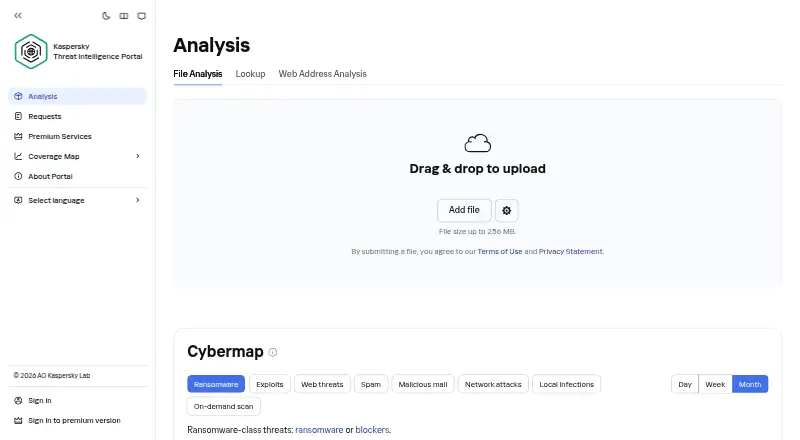
What Kaspersky Threat Intelligence Portal is
Kaspersky Threat Intelligence Portal is a cloud investigation workspace for security teams working with cyberthreat intelligence. It supports indicator enrichment, malware analysis, threat actor and campaign tracking, and incident response. Threat Lookup connects related threats in Kaspersky's knowledge base, while Threat Analysis examines suspicious files using multiple analysis layers. AI features summarize information for triage and investigation; KIRA also supports OSINT search and relationship tracing. Actor profiles link updated tactics, techniques, procedures, campaigns and indicators when related Kaspersky reports are published. Remote MCP connects compatible assistants such as Claude and ChatGPT to portal data. Users can look up IP addresses, file hashes, domains and web addresses, and registered users can submit web addresses to a sandbox for a page-activity report. The REST API supports web-address lookups with an API token and file submissions for sandbox analysis, up to a documented maximum of 256 MB. Listed connectors include Maltego, MISP, Splunk Enterprise Security, IBM QRadar and Elastic SIEM. Free access includes limited suspicious-file and URL executions; some report sections may lack data, and full reports require demo access.
Who it suits
Kaspersky presents the portal for SOC teams, threat analysts and threat hunters, including incident response and threat-hunting use cases.
What it does well
- Supports indicator enrichment and incident response
- AI features summarize threat information and trace relationships
- REST API supports web-address lookups and file submissions
- Connectors include Maltego, MISP and Splunk Enterprise Security
What to know first
- Free access limits suspicious-file and URL executions
- Some report sections may have no data
- Full reports require demo access
- Submitted samples must not be confidential or commercially sensitive
Limits
Free access includes a limited number of suspicious-file and URL executions in Kaspersky Cloud Sandbox. General access provides general information about submitted objects, while some report sections may contain no data and full reports require demo access.
Plans
| Plan | Billed and limits | Price |
|---|---|---|
| Free access | Free access to curated features · Limited features · limited number of suspicious files and URLs for Cloud Sandbox | Free |
As opentip.kaspersky.com lists them, read 8 Oct 2026. The maker's own page has the final word.
Getting started
- Visit the Threat Intelligence Portal website.
- Register for general access to use its available threat intelligence features.
- Submit an API token for REST API web address lookups.
- Use the portal to look up indicators or submit files and URLs for analysis.
- Request trial access by submitting contact information and selecting the demo request option.
- Connect compatible assistants through Remote MCP or use a listed connector.
Overview
Kaspersky Threat Intelligence Portal is a cloud-based investigation workspace for security teams. It suits SOC teams, threat analysts, and threat hunters who need to enrich indicators and examine suspicious files or URLs. Its strongest case is a broad set of investigation tools with Kaspersky intelligence; the free tier is constrained, and its sample terms rule out sensitive submissions.
Key features
Threat Lookup lets analysts check IP addresses, file hashes, domains, and web addresses against Kaspersky’s threat knowledge base and explore links between related threats. That makes it useful for validating and prioritizing alerts, though general access may show only partial information rather than a full report.
Threat Analysis combines static, dynamic, and behavioral file analysis with cloud reputation to identify threats, including previously unknown ones. Registered users can submit URLs to a sandbox and inspect page activity, such as downloads and JavaScript, without opening the page in their own browser. The limited number of free file and URL executions makes this better for occasional triage than a high-volume workflow.
The workspace supports IOC enrichment, malware analysis, incident response, and tracking threat actors and campaigns. AI features add summaries and OSINT search: KIRA can trace relationships between queried objects and produce a human-readable verdict. Actor profiles connect updated tactics, techniques, and procedures, campaigns, and indicators when related Kaspersky reports are published. These features help analysts move from a single indicator toward broader context, but the profiles depend on related Kaspersky reports.
Remote MCP support connects compatible assistants such as Claude and ChatGPT to Portal data. A REST API supports web-address lookups using an API token and file submissions for sandbox analysis, returning a basic report; the documented maximum file size is 256 MB. Out-of-the-box connectors include Maltego, MISP, Splunk Enterprise Security, IBM QRadar, and Elastic SIEM. This range can suit teams embedding intelligence checks in established workflows, while the file API’s basic report should not be mistaken for full report access.
Pricing
The portal uses a freemium model. Free access costs nothing and includes curated features, with limited features and a limited number of suspicious file and URL executions in Kaspersky Cloud Sandbox. It is a practical starting point for occasional checks, not a dependable allowance for sustained analysis. Full reports require demo access, which users can request by submitting contact information and selecting the demo request option; trial access is available by request.
General access provides information about submitted objects, but some report sections may have no data. Its terms also restrict use to non-commercial malware detection and prevention. Submitted samples must not be confidential or commercially sensitive, and Kaspersky’s terms grant rights to use, store, edit, reproduce, distribute, and delete their contents. That is a material limitation for organizations handling customer files, proprietary samples, or other sensitive evidence.
Platforms
The portal is available on the web and through an API, with cloud deployment. Indicator enrichment, STIX/TAXII support, and report management broaden its fit for teams connecting threat intelligence to existing operations.
Who it's for
This is a good fit for SOC teams and threat analysts who need a shared place for indicator lookup, file and URL analysis, and incident response. Threat hunters may value the actor and campaign context and AI-assisted relationship tracing. It is a poor fit for teams that need unrestricted full reports on general access or cannot submit samples under the stated terms.
Pros and cons
Pros
- Combines indicator lookup, file and URL analysis, and investigation workflows in one cloud workspace.
- AI summaries, OSINT search, and relationship tracing can help analysts triage and connect indicators to broader context.
- API access and named SIEM and intelligence connectors give teams options for integrating portal data.
- Free access provides a way to make limited checks without a paid plan.
Cons
- Free sandbox executions are limited, restricting its usefulness for repeated or high-volume analysis.
- General access may omit report sections, while full reports require demo access.
- Sample terms prohibit confidential or commercially sensitive submissions and limit use to non-commercial malware detection and prevention.
Alternatives
Consider Pulse Intelligence if you want a free, open-source self-hosted option across web, desktop, and API platforms; its listed setup requires Node.js 20.9+, PostgreSQL 17, and a Redis-compatible server. OpenAEV may suit teams seeking on-premise attack simulation and tabletop exercises in a free Community Edition with community support. Choose IBM X-Force Exchange for a free portal tier if limited access without X-Force API access meets your needs. IntelOwl is a free, open-source self-hosted alternative. MISP is free open-source software under AGPL, with a yearly support contract also offered. ThreatForge offers a free AGPL-3.0-or-later Community Edition and a 90-day Enterprise trial. Threat Intelligence Platform may fit users who can work within a credit-based free plan: 100 credits after sign-up, with web analysis at 10 credits per request and API requests at 1–3 credits each. Security Vision TIP is a paid option with individual pricing calculated via sales. Browse Threat Intelligence Platforms for more choices.
Verdict
Kaspersky Threat Intelligence Portal is a strong choice for SOC teams and analysts who want lookup, sandbox analysis, AI-assisted investigation, and integrations in one workspace. Its limited free executions and broad rights over submitted samples are the main reasons to look elsewhere, especially for sensitive or sustained analysis.
Verdict
The portal combines lookup, file and URL analysis, investigation features and integrations for security teams. Free access is limited, and its general-access terms restrict the types and use of submitted samples.
Questions
Is Kaspersky Threat Intelligence Portal free?
Kaspersky offers a free version with access to curated threat intelligence. Registered users receive a limited number of suspicious-file and URL executions in Cloud Sandbox.
How can a team request trial access?
Users can submit contact information and select the demo request option to request trial access.
Which platforms are supported?
The portal lists web and API access and is deployed in the cloud.
What can the REST API do?
It supports web address lookups with an API token and file submissions for sandbox analysis. The documented maximum file size is 256 MB.
Which security tools can it connect to?
Listed connectors include Maltego, MISP, Splunk Enterprise Security, IBM QRadar and Elastic SIEM. Remote MCP also connects compatible assistants such as Claude and ChatGPT.
What are the sample submission terms?
Submitted samples must not be confidential or commercially sensitive. The general access terms grant Kaspersky rights to use, store, edit, reproduce, distribute and delete sample contents.
Facts from Kaspersky Threat Intelligence Portal's own pages
- Access limits
- General access provides general information about submitted objects, while some report sections may have no data and full reports require demo access. · opentip.kaspersky.com, 8 Oct 2026
- Actor profiles
- AI-powered actor profiles link updated TTPs, campaigns, and technical indicators when related Kaspersky reports are published. · kaspersky.com, 8 Oct 2026
- AI connectivity
- Remote MCP support lets users connect compatible AI assistants such as Claude and ChatGPT to Portal data. · kaspersky.com, 8 Oct 2026
- AI features
- KIRA provides AI summarization and OSINT search, and can automatically trace relationships between searched objects and produce a human-readable verdict. · kaspersky.com, 8 Oct 2026
- AI integrations
- Remote MCP support connects the portal to compatible assistants such as Claude and ChatGPT. · kaspersky.com, 8 Oct 2026
- AI summaries
- AI automation turns threat information into concise, actionable intelligence to help analysts triage and investigate. · kaspersky.com, 8 Oct 2026
- API
- The portal provides a REST API for web address lookups using an API token. · opentip.kaspersky.com, 8 Oct 2026
- Company
- Kaspersky is a global cybersecurity and digital privacy company founded in 1997. · kaspersky.com, 8 Oct 2026
- File analysis
- File analysis uses dynamic, static, and behavioral analysis technologies and a global cloud reputation system to detect threats. · opentip.kaspersky.com, 8 Oct 2026
- File analysis API
- The API can submit a file for sandbox analysis and return a basic report; the documented maximum file size is 256 MB. · opentip.kaspersky.com, 8 Oct 2026
- Founded
- 1997 · opentip.kaspersky.com, 28 Sept 2026
- Free access
- Kaspersky describes a free version of the Threat Intelligence Portal that provides access to trusted threat intelligence. · kaspersky.com, 8 Oct 2026
- Free access limits
- The free version provides registered users a limited number of suspicious file and URL executions in Kaspersky Cloud Sandbox. · kaspersky.com, 8 Oct 2026
- Indicator lookup
- Users can look up IP addresses, file hashes, domains, and web addresses to validate and prioritize alerts and incidents. · opentip.kaspersky.com, 8 Oct 2026
- Integrations
- Kaspersky lists out-of-the-box connectors including Maltego, MISP, Splunk Enterprise Security, IBM QRadar, and Elastic SIEM. · usa.kaspersky.com, 8 Oct 2026
- Intended users
- Kaspersky presents the portal for SOC teams, threat analysts, and threat hunters. · kaspersky.com, 8 Oct 2026
- Investigations
- It supports IOC enrichment, malware analysis, threat actor and campaign tracking, and incident response. · kaspersky.com, 8 Oct 2026
- Purpose
- The portal is a centralized investigation workspace that gives security teams access to current cyberthreat intelligence. · kaspersky.com, 8 Oct 2026
- Submission terms
- The general access terms say submitted samples must not be confidential or commercially sensitive and restrict use to non-commercial malware detection and prevention. · opentip.kaspersky.com, 8 Oct 2026
- Terms and sample handling
- The General Access terms say submitted samples must not be confidential or commercially sensitive and grant Kaspersky rights to use, store, edit, reproduce, distribute, and delete their contents. · opentip.kaspersky.com, 8 Oct 2026
- Threat analysis
- Threat Analysis provides multi-layered analysis of suspicious files to detect previously unknown threats. · kaspersky.com, 8 Oct 2026
- Threat Lookup
- Threat Lookup provides access to Kaspersky's cyberthreat knowledge base and connections between related threats. · kaspersky.com, 8 Oct 2026
- Trial access
- Users can request trial access by submitting contact information and selecting the demo request option. · opentip.kaspersky.com, 8 Oct 2026
- URL sandbox
- Registered users can submit web addresses to a URL Sandbox and receive a report on page activity, including downloads and JavaScript, without opening the page in their own browser. · opentip.kaspersky.com, 8 Oct 2026
Where Kaspersky Threat Intelligence Portal stands on Freedom251
- Threat Intelligence Platforms#5 of 32