Freedom251 › Disk Benchmark Software
Storage Benchmark Kit
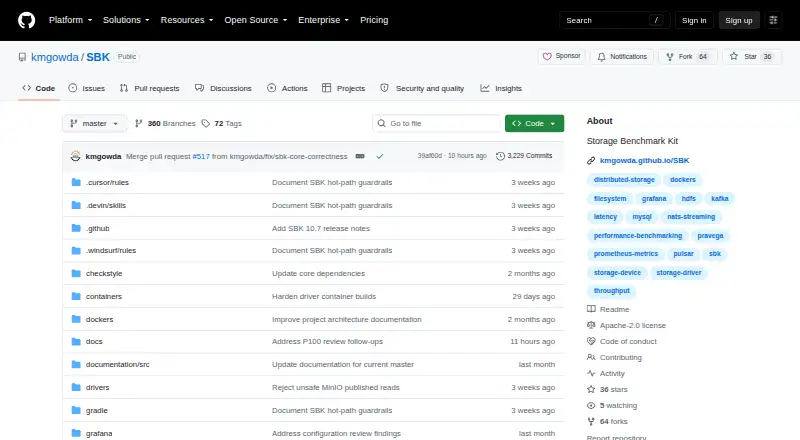
What Storage Benchmark Kit is
Storage Benchmark Kit (SBK) is a Java framework for measuring storage throughput and latency with a shared workload engine. Drivers cover object stores, message systems, databases, file systems, caches and local queues. The harness controls concurrency, duration, rate, payloads, timestamps and reporting, and can send results to the console, CSV, a local web console, Prometheus or gRPC. PrometheusLogger exposes metrics, while SBK Dashboard supports Grafana and persistent time-series history. For distributed benchmarks, SBK-GEM launches SBK on remote hosts over SSH and aggregates measurements through an embedded SBM instance. YAML tools load arguments for single-node and distributed runs. SBK is free under Apache License 2.0 and requires JDK 25; its wrapper can download a pinned OpenJDK 25 release and verify its SHA-256 checksum. Automatic JDK setup supports Linux and macOS x64/AArch64 and Windows x64. The Local Web Console uses unauthenticated, unencrypted plain HTTP.
Who it suits
SBK suits developers and operators who need configurable storage benchmarks, retained metrics or distributed runs. Its documentation also addresses building storage drivers and running benchmark workflows.
What it does well
- Drivers span six types of storage backends.
- Workload settings include concurrency and payloads.
- Distributed runs launch over SSH.
- Apache License 2.0; no paid plans listed.
What to know first
- Requires JDK 25.
- Local Web Console has no authentication or TLS.
- Three drivers are not enabled in the aggregate build.
Limits
SBK requires JDK 25. Automatic JDK installation supports Linux and macOS on x64 or AArch64, and Windows on x64. ChromaDB, HaloDB, and Ignite are present in the source tree but are not enabled in the aggregate build.
Plans
| Plan | Billed and limits | Price |
|---|---|---|
| Apache License 2.0 | Open-source license · no paid plans listed | Free |
As github.com lists them, read 9 Oct 2026. The maker's own page has the final word.
Getting started
- Visit the SBK GitHub project.
- Use Linux or macOS on x64 or AArch64, or Windows on x64, for automatic JDK installation.
- Run SBK with JDK 25; its wrapper can download a pinned OpenJDK 25 release and verify its checksum.
- Configure a single-node run with SBK-YAL or a distributed run with SBK-GEM-YAL.
- Send results to a supported output such as CSV, Prometheus, or gRPC.
Storage Benchmark Kit (SBK) is a Java framework for engineers who need repeatable throughput and latency measurements across many storage backends. It is strongest for teams building their own benchmark workflows, retaining metrics, or coordinating runs across hosts; it is less suitable as a quick, desktop-only disk speed checker.
Its breadth and configurable workload engine make it a capable open-source foundation, provided your environment can run JDK 25 and you protect the unsecured local console.
Overview
SBK applies one workload engine to object stores, message systems, databases, file systems, caches, and local queues. That common approach helps teams compare unlike systems with consistent controls instead of maintaining a separate utility for each backend. The coverage is not universal in a ready-to-build form: ChromaDB, HaloDB, and Ignite are in the source tree but disabled in the aggregate build.
The project is Apache License 2.0 software, with bug reports and feature requests handled through GitHub Issues and usage or design questions through GitHub Discussions. It is therefore a sensible choice for organizations comfortable operating and adapting open-source tooling rather than expecting a commercial support desk.
Key features
The harness exposes controls for concurrency, duration, rate, payloads, timestamps, and reporting. Those knobs let an engineer model sustained, rate-limited, or payload-sensitive workloads and make runs reproducible. They also add setup responsibility: meaningful results depend on choosing parameters that represent the system being evaluated.
Output can go to the console or CSV, or through a local web console, Prometheus, and gRPC. PrometheusLogger makes benchmark measurements consumable by Prometheus, while SBK Dashboard supports Grafana dashboards and persistent time-series history. The combination suits teams that need to compare runs over time, not just read a one-off terminal result.
For distributed work, SBK-GEM copies and starts SBK on remote hosts over SSH and aggregates measurements with an embedded SBM instance. SBK-YAL loads single-node arguments from YML; SBK-GEM-YAL does the same for distributed arguments. These components provide a path from a local experiment to coordinated multi-host measurement without abandoning the same workload model.
SBK requires JDK 25. Its wrapper can fetch a pinned OpenJDK 25 release and verify its SHA-256 checksum, reducing installation friction and version drift. Automatic installation covers Linux x64/AArch64, macOS x64/AArch64, and Windows x64. The Local Web Console uses plain HTTP with neither authentication nor TLS, so it belongs only on a trusted benchmark network or behind an SSH tunnel.
Pricing
Apache License 2.0 — free. SBK is open-source software with no paid plans listed. That makes it appropriate for broad internal use without seat fees or usage quotas, but your team takes on deployment, configuration, and operational support itself. There is no commercial tier to provide a supported alternative to the JDK and network-security requirements.
Platforms
SBK provides an API and command-line interface for self-hosted use on Linux, macOS, and Windows. Automatic JDK setup supports Linux x64 and AArch64, macOS x64 and AArch64, and Windows x64. This is a practical cross-platform base for engineering teams, while the self-hosted model means you must manage hosts, SSH access, and benchmark-network isolation.
Who it's for
Choose SBK if you are comparing storage technologies, developing storage drivers, preserving benchmark history, or running coordinated measurements across remote machines. Its workload and reporting controls fit performance engineers and infrastructure teams that need repeatability and integration with existing Prometheus/Grafana monitoring.
Look elsewhere if you want a minimal graphical disk test, a turnkey hosted service, or a console secured by default. SBK's JDK 25 runtime, source-level breadth, and plain-HTTP web interface require more engineering discipline than a small desktop utility.
Pros and cons
Pros
- One harness for varied backends: object stores, messaging, databases, file systems, caches, and queues can be assessed with shared workload concepts.
- Detailed workload control: concurrency, rates, durations, payloads, timestamps, and latency/throughput reporting support tailored scenarios.
- Strong reporting path: CSV, Prometheus, gRPC, Grafana dashboards, and persistent time-series history support both immediate analysis and trend tracking.
- Distributed option: SBK-GEM uses SSH to launch remote workers and aggregate measurements.
- No license charge: Apache 2.0 licensing removes paid-plan and seat constraints.
Cons
- JDK 25 dependency: environments standardized on older Java versions must accommodate a newer runtime.
- Console security gap: plain HTTP without authentication or TLS requires a trusted network or SSH tunnel.
- Uneven backend availability: ChromaDB, HaloDB, and Ignite are not enabled in the aggregate build.
- Self-service operation: support flows through GitHub rather than a paid support plan.
Alternatives
For a focused disk benchmark, fio is a free Linux, macOS, and Windows option under GNU GPLv2. Choose it when you want a dedicated disk-testing tool rather than SBK's multi-backend framework and distributed harness.
AJA System Test is a free macOS and Windows utility; its Lite edition is suited to straightforward standalone testing, while the full version adds PCIe bandwidth testing.
simple-disk-benchmark is a free, MIT-licensed command-line tool for Linux, macOS, and Windows, a better fit when a small CLI is all you need.
Parkdale offers a free download for Android, macOS, and Windows, making it preferable when mobile coverage or a simpler desktop workflow matters.
AmorphousDiskMark is a free Mac-only choice; AS SSD Benchmark is free Windows freeware. DaVinci Resolve and Buddi serve different software categories rather than storage benchmarking.
For a broader starting point, browse the Disk Benchmark Software list.
Verdict
Storage Benchmark Kit is a strong choice for engineers who need configurable, scriptable storage measurements with Prometheus/Grafana retention and an upgrade path to distributed runs. Choose it for that breadth and control. Look elsewhere for a quick desktop disk check, or if requiring JDK 25 and securing a plain-HTTP console would outweigh the value of its open, extensible framework.
Verdict
SBK provides configurable single-node and distributed benchmark workflows with several reporting options. Plan around its JDK 25 requirement and keep the plain-HTTP console on a trusted network or behind an SSH tunnel.
Questions
How much does SBK cost?
The Apache License 2.0 plan is free.
Which platforms are supported?
The supported platforms are Linux x64/AArch64, macOS x64/AArch64, and Windows x64.
What does SBK measure?
It measures storage system throughput and latency using a common workload engine.
Does it support Prometheus or Grafana?
PrometheusLogger exposes metrics for Prometheus, and SBK Dashboard supports Grafana dashboards and persistent time-series history.
Is SBK open source?
Yes. SBK is licensed under the Apache License 2.0.
What security limit applies to the Local Web Console?
It uses plain HTTP without authentication or TLS. The project advises exposing it only on a trusted benchmark network or through an SSH tunnel.
Facts from Storage Benchmark Kit's own pages
- Backend coverage
- Its drivers cover object stores, message systems, databases, file systems, caches, and local queues. · kmgowda.github.io, 9 Oct 2026
- Configuration
- SBK-YAL loads single-node SBK arguments from YML, while SBK-GEM-YAL loads distributed SBK-GEM arguments from YML. · kmgowda.github.io, 9 Oct 2026
- Distributed execution
- SBK-GEM copies and launches SBK on remote hosts over SSH and runs an embedded SBM instance to aggregate measurements. · kmgowda.github.io, 9 Oct 2026
- Integrations
- PrometheusLogger exposes metrics for Prometheus, and SBK Dashboard supports Grafana dashboards and persistent time-series history. · kmgowda.github.io, 9 Oct 2026
- Intended users
- The documentation provides workflows for running benchmarks, building storage drivers, retaining metrics, and executing distributed benchmarks. · kmgowda.github.io, 9 Oct 2026
- License
- SBK is licensed under the Apache License 2.0. · github.com, 9 Oct 2026
- Metrics
- SBK includes console, CSV, local web console, Prometheus, and gRPC output options. · kmgowda.github.io, 9 Oct 2026
- Notable availability limit
- ChromaDB, HaloDB, and Ignite are in the source tree but are not enabled in the aggregate build. · kmgowda.github.io, 9 Oct 2026
- Operating systems
- Automatic JDK installation supports Linux x64/AArch64, macOS x64/AArch64, and Windows x64. · kmgowda.github.io, 9 Oct 2026
- Purpose
- SBK is a Java framework for measuring storage system throughput and latency with a common workload engine. · kmgowda.github.io, 9 Oct 2026
- Runtime requirement
- SBK requires JDK 25; its wrapper can download a pinned OpenJDK 25 release and verify its SHA-256 checksum. · kmgowda.github.io, 9 Oct 2026
- Security
- The Local Web Console uses plain HTTP without authentication or TLS, and the project advises exposing it only on a trusted benchmark network or through an SSH tunnel. · kmgowda.github.io, 9 Oct 2026
- Support
- The project directs bug reports and feature requests to GitHub Issues and usage or design questions to GitHub Discussions. · kmgowda.github.io, 9 Oct 2026
- Workload controls
- The harness controls concurrency, duration, rate, payloads, timestamps, and reporting. · kmgowda.github.io, 9 Oct 2026
Where Storage Benchmark Kit stands on Freedom251
- Disk Benchmark Software#16 of 29