Freedom251 › PC Benchmark Software
dperf
by dperf
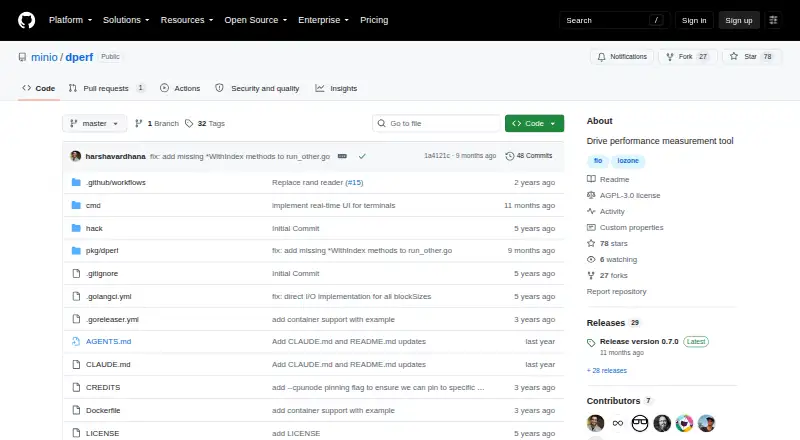
What dperf is
dperf is a free Linux command-line utility for benchmarking drives and locating storage bottlenecks or performance outliers. It benchmarks multiple drives at once and ranks them by throughput. Measurements use O_DIRECT to bypass the operating system page cache. Users can configure block size, file size and concurrent I/O operations per drive. Results include read and write throughput; verbose mode adds per-drive statistics alongside aggregate totals.
The utility supports sequential tests, but does not measure random I/O, IOPS or latency. Its README describes using Kubernetes Jobs, CronJobs or DaemonSets for storage validation, and automated performance checks in CI/CD pipelines. Temporary disk space must equal the file size multiplied by the I/O operations per drive, for each drive. dperf requires Linux, a kernel with O_DIRECT support, a filesystem supporting direct I/O and write access to target directories. Prebuilt Linux binaries are listed for amd64, arm64, ppc64le and s390x. It is released under GNU Affero General Public License v3.0; support is directed to GitHub Issues, with MinIO Sales listed for enterprise support.
Who it suits
dperf may suit Linux administrators and storage teams comparing throughput across multiple drives. Its documented Kubernetes deployment and CI/CD examples may also fit storage validation workflows.
What it does well
- Benchmarks multiple drives simultaneously.
- Ranks drives by throughput.
- Configurable block size, file size and concurrent operations.
- Verbose mode reports per-drive statistics and aggregate totals.
- Prebuilt binaries listed for four architectures.
What to know first
- Does not support random I/O tests.
- Does not measure IOPS or latency.
- Requires Linux and direct I/O support.
- Needs temporary space based on file size and I/O operations.
Limits
dperf reports read and write throughput for sequential tests; it does not measure random I/O, IOPS, or latency. Temporary disk space must equal the file size multiplied by I/O operations per drive, for each drive.
Plans
| Plan | Billed and limits | Price |
|---|---|---|
| dperf | AGPL-3.0 licensed; Linux drive benchmarking | Free |
As github.com lists them, read 7 Oct 2026. The maker's own page has the final word.
Getting started
- Open the dperf project at https://github.com/minio/dperf.
- Use Linux with a kernel and filesystem that support direct I/O.
- Select a prebuilt binary for amd64, arm64, ppc64le, or s390x, or use the project for self-hosted deployment.
- Ensure the target directories are writable and have the documented temporary disk space available.
- Configure block size, file size, and concurrent I/O operations per drive, then run the benchmark.
Verdict
dperf focuses on sequential read and write throughput across drives, with per-drive and aggregate reporting. It is not a fit when random I/O, IOPS or latency measurements are required.
Questions
Does dperf cost anything?
No. The project is free and released under the GNU Affero General Public License v3.0.
What platforms does dperf support?
It requires Linux. Prebuilt binaries are listed for amd64, arm64, ppc64le, and s390x.
What measurements does it provide?
It reports read and write throughput for sequential tests. It does not measure random I/O, IOPS, or latency.
Can dperf be used with Kubernetes?
Yes. The README describes deployment as Kubernetes Jobs, CronJobs, or DaemonSets for storage validation.
What does dperf require to run?
It requires Linux, a kernel with O_DIRECT support, a filesystem supporting direct I/O, and write access to target directories.
Where can I get support?
The README directs users to GitHub Issues and lists MinIO Sales as the contact for enterprise support.
Facts from dperf's own pages
- Architectures
- Prebuilt Linux binaries are listed for amd64, arm64, ppc64le, and s390x. · github.com, 7 Oct 2026
- Direct I/O
- It uses O_DIRECT to bypass the operating system page cache for drive performance measurements. · github.com, 7 Oct 2026
- Founded
- 2014 · github.com, 28 Sept 2026
- Free plan
- Yes · github.com, 20 Sept 2026
- Headquarters
- Redwood City, California, United States · github.com, 28 Sept 2026
- Integrations
- The README provides Kubernetes deployment examples and describes automated storage performance checks in CI/CD pipelines. · github.com, 7 Oct 2026
- Kubernetes
- The README describes deploying dperf as Kubernetes Jobs, CronJobs, or DaemonSets for storage validation. · github.com, 7 Oct 2026
- License
- The project is released under the GNU Affero General Public License v3.0. · github.com, 7 Oct 2026
- Output
- It reports read and write throughput, with verbose mode showing per-drive statistics alongside aggregate totals. · github.com, 7 Oct 2026
- Parallel benchmarks
- It benchmarks multiple drives simultaneously and ranks them by throughput. · github.com, 7 Oct 2026
- Purpose
- dperf is a drive benchmarking utility for identifying storage bottlenecks and performance outliers across multiple drives. · github.com, 7 Oct 2026
- Support
- The README directs users to GitHub Issues and lists MinIO Sales as the contact for enterprise support. · github.com, 7 Oct 2026
- System requirements
- dperf requires Linux, a kernel with O_DIRECT support, a filesystem supporting direct I/O, and write access to target directories. · github.com, 7 Oct 2026
- Temporary storage
- The documented disk-space requirement is temporary space equal to filesize multiplied by ioperdrive for each drive. · github.com, 7 Oct 2026
- Workload settings
- Users can configure block size, file size, and concurrent I/O operations per drive. · github.com, 7 Oct 2026
Where dperf stands on Freedom251
- PC Benchmark Software#19 of 73
- Disk Benchmark Software#13 of 29
- PC benchmark tools#56 of 70