Freedom251 › Code Search Tools

sqry
What sqry is
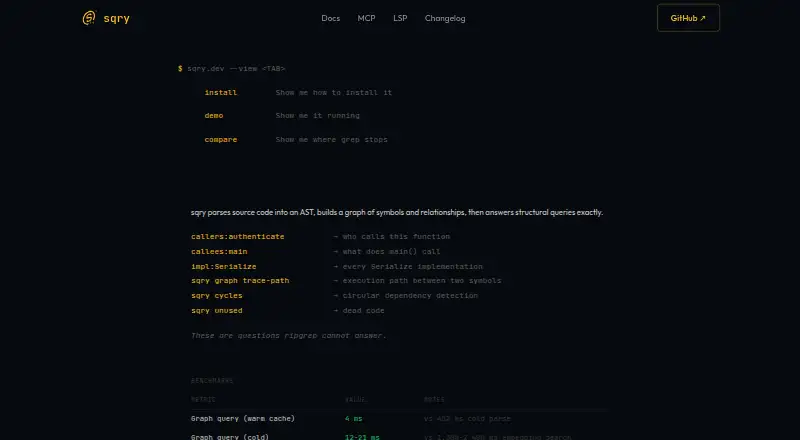
sqry is a free, open-source code analysis tool under the MIT license. It parses source into an abstract syntax tree and builds a graph of symbols and their relationships, making structural queries such as which functions call another possible. Its documented queries cover callers, callees, implementations, dependency cycles, and unused symbols. The project lists 37 language plugins: 28 provide full relation tracking, while nine extract symbols and imports. Users build an index before querying; it persists so later queries can load the cached graph snapshot. sqry runs locally on Linux, macOS, and Windows, and its maker says source code stays on the machine with no telemetry. An MCP server connects it to AI assistants including Claude, Codex, Gemini, Cursor, and Windsurf, exposing 39 tools in standalone mode or a curated 16 in daemon mode. An LSP server works with VS Code, Neovim, Helix, and LSP 3.17 clients. Windows builds require bundled MinGW runtime DLLs alongside executables; the release ZIP includes them.
Who it suits
sqry suits developers who want to query code structure locally or connect structural code information to AI assistants and editors. It supports codebases across 37 language plugins, with different levels of relation tracking.
What it does well
- Free and open source under the MIT license
- Runs locally with no telemetry
- Queries callers, implementations, cycles, and unused symbols
- Provides MCP and LSP servers
- Install scripts verify checksums by default
What to know first
- Users must build an index before querying
- Nine language plugins lack full relation tracking
- Windows executables require bundled MinGW runtime DLLs
Plans
| Plan | Billed and limits | Price |
|---|---|---|
| sqry | Open source · MIT license · runs locally | Free |
As sqry.dev lists them, read 30 Sept 2026. The maker's own page has the final word.
Getting started
- Visit https://sqry.dev/.
- Choose an installer for Linux, macOS, or Windows, or install with cargo.
- On Windows, keep the bundled MinGW runtime DLLs alongside the executables.
- Build an index for the codebase before running queries.
- Connect the MCP server or configure the LSP server with a supported editor or client.
sqry is a locally run structural code-search and navigation tool for developers who need relationships between symbols, not just matching text. It suits maintainers, security-conscious teams, and AI-assisted workflows that can accommodate an indexing step. Its broad plugin range and integrations are compelling, but language support varies in depth and quick searches are not its strongest use case.
Overview
sqry parses a codebase into an abstract syntax tree and a graph of symbols and relationships. That model supports questions such as which functions call another function, where implementations exist, which dependencies form cycles, and which symbols appear unused. Regex search and code navigation are also included, so it can cover both structural investigation and conventional searching.
Use begins by building an index. The resulting graph snapshot persists, allowing later queries to load cached data rather than rebuilding every time. This is a sensible workflow for ongoing repository work, but it adds setup and waiting before a first query and makes sqry less attractive for a one-off text lookup.
sqry is open source under the MIT license, self-hosted, and processed locally. Verivus Pty Ltd says source code never leaves the machine and the product has no telemetry. The project also describes cargo-vet and cargo-deny checks for dependency licensing and CVEs on every commit.
Key features
Structural analysis and plugins
Documented graph commands cover callers, callees, implementations, dependency cycles, and unused symbols. The 37 language plugins are not interchangeable: 28 provide full relation tracking, while nine provide symbol extraction and import tracking. That distinction is important for polyglot teams; a listed language may support indexing and basic discovery without supporting every relationship query.
AI and editor connections
An MCP server connects sqry to Claude, Codex, Gemini, Cursor, and Windsurf. The standalone server exposes 39 tools, while daemon mode narrows that to a curated 16. The full server favors assistants that need broad control; daemon mode is a more restrained fit when a smaller surface is preferable.
The LSP server works with VS Code, Neovim, Helix, and any LSP 3.17 client. This puts symbol-aware navigation in established editor workflows instead of requiring a separate interface. A GitHub Action is described for checking dead code, cycles, and duplicates on every pull request, although the project does not currently publish a public composite action; CI setup therefore relies on its install script and CLI commands.
Security and distribution
Public releases include checksums and Sigstore DSSE attestation metadata, and installation scripts verify checksums by default. Installers are provided for macOS, Linux, and Windows, with cargo installation on all three. Windows users must keep the bundled MinGW runtime DLLs alongside the executables; the release ZIP includes them.
Pricing
sqry costs free under its single “sqry” plan. It is open source, MIT licensed, and runs locally, with no paid tier, trial period, seat charge, or renewal term. That makes it straightforward for individual developers and teams to deploy without a service budget. The trade-off is that support and operation remain part of a self-hosted workflow, and there is no hosted plan to remove that responsibility.
Platforms
sqry runs on Linux, macOS, and Windows. Editor support extends through its LSP implementation to VS Code, Neovim, Helix, and other LSP 3.17 clients. AI use is available through MCP-compatible integrations named by the project.
Who it's for
Choose sqry when you need local, relationship-aware analysis across a sizeable or unfamiliar codebase, especially if privacy rules prohibit uploading source. It is particularly suitable for maintainers tracing call chains, reviewing architectural dependencies, or exposing dead code through CI, and for teams that already use MCP assistants or LSP editors.
It is a weaker fit for instant searches where indexing overhead is unwelcome, or for a language that falls into the nine-plugin extraction-only group. Confirm the plugin's relation coverage before making it central to a polyglot workflow.
Pros and cons
- Pros: Structural callers, callees, implementations, cycles, and unused-symbol queries go beyond plain text search.
- Pros: Local, telemetry-free processing and MIT licensing keep source under your control and avoid recurring fees.
- Pros: MCP and LSP integrations connect the same graph to major AI assistants and common editors.
- Pros: Checksums, Sigstore attestations, and default installer verification strengthen release handling.
- Cons: Every project needs an index before querying, adding a deliberate setup step.
- Cons: Nine of 37 plugins lack full relation tracking, so language coverage must be checked feature by feature.
- Cons: Windows deployment requires the accompanying MinGW runtime DLLs.
- Cons: CI currently uses scripts and CLI commands rather than a published composite action.
Alternatives
Browse Code Search Tools for a wider shortlist. Pick Chromium instead if you need a free, open-source browser spanning desktop, mobile, and extension platforms. ast-grep is the better comparison for free structural matching across API, extension, desktop, web, and Windows environments. Choose Code Search when a freemium community plan with unlimited users, repository-wide find-and-replace, CLI, MCP, and SCIP intelligence is more useful than sqry's local graph workflow. GNU GLOBAL offers free software under the GNU GPL for Linux, macOS, self-hosted, and Windows use. OpenGrok is a free, open-source CDDL project with web and self-hosted options. Shebe provides local code search under Apache-2.0. Chatterbox TTS is an unrelated free MIT-licensed open-source model project. LXR Cross Referencer is a free, self-installed web code cross-referencer.
Verdict
sqry is a strong choice for developers who want private, local structural queries integrated with editors, AI assistants, and pull-request checks. Its main reason to choose it is the combination of graph-based analysis and zero-cost MIT deployment. Look elsewhere if your workflow demands immediate text search, a hosted service, or complete relationship support for a language served only by sqry's extraction-focused plugins.
Verdict
sqry offers local structural queries across a broad set of language plugins, along with AI and editor integrations. Check the plugin coverage for your languages and account for its index-building step before querying.
Questions
How much does sqry cost?
The sqry plan is free. It is open source under the MIT license.
Which operating systems does it support?
sqry supports Linux, macOS, and Windows. Installers are listed for those platforms, and cargo installation is available for all platforms.
Which languages does sqry support?
The project lists 37 language plugins. Twenty-eight support full relation tracking; nine provide symbol extraction and import tracking.
Does sqry send source code to a server?
The maker says sqry runs on the user's machine, source code does not leave the machine, and the tool has no telemetry.
Which AI assistants and editors can connect to sqry?
Its MCP server supports assistants including Claude, Codex, Gemini, Cursor, and Windsurf. The LSP server works with VS Code, Neovim, Helix, and any LSP 3.17 client.
Does sqry provide a GitHub Action?
The home page lists a GitHub Action for checking dead code, cycles, and duplicates on pull requests. The documentation describes using the install script and CLI in GitHub Actions and says sqry does not currently publish a public composite action.
Facts from sqry's own pages
- AI integrations
- Its MCP server supports Claude, Codex, Gemini, Cursor, and Windsurf; the standalone server exposes 38 tools, while daemon mode exposes a curated subset of 16. · sqry.dev, 30 Sept 2026
- CI
- The documentation describes using sqry's install script and CLI commands in GitHub Actions and says it does not currently publish a public composite action. · sqry.dev, 30 Sept 2026
- CI integration
- The home page lists a GitHub Action for checking dead code, cycles, and duplicates on every pull request. · sqry.dev, 30 Sept 2026
- Company
- The site identifies Verivus Pty Ltd as the maker and says sqry is built by Verivus. · sqry.dev, 30 Sept 2026
- Dependency auditing
- The project says it audits dependencies with cargo-vet and uses cargo-deny for license policy and CVE checks on every commit. · sqry.dev, 30 Sept 2026
- Editor integrations
- sqry provides an LSP server that works with VS Code, Neovim, Helix, and any LSP 3.17 client. · sqry.dev, 30 Sept 2026
- Index requirement
- Users build an index before querying, and the index persists so later queries can load the cached graph snapshot. · sqry.dev, 30 Sept 2026
- Installation
- The quick start lists installers for macOS, Linux, and Windows, plus cargo installation for all platforms. · sqry.dev, 30 Sept 2026
- Languages
- sqry lists 37 language plugins; 28 support full relation tracking and nine provide symbol extraction and import tracking. · sqry.dev, 30 Sept 2026
- Language support
- sqry has 37 language plugins: 28 provide full relation support and nine provide symbol and import extraction. · sqry.dev, 30 Sept 2026
- License and price
- sqry is open source under the MIT license and runs locally. · sqry.dev, 30 Sept 2026
- Local processing
- The product says it runs entirely on the user's machine, with no source code leaving the machine and no telemetry. · sqry.dev, 30 Sept 2026
- Maker
- The site identifies Verivus Pty Ltd as the maker of sqry. · sqry.dev, 30 Sept 2026
- MCP tools
- The standalone MCP server exposes 39 tools, while daemon mode provides a curated subset of 16 tools. · sqry.dev, 30 Sept 2026
- Privacy
- The maker says no source code leaves your machine and sqry has no telemetry. · sqry.dev, 30 Sept 2026
- Product
- sqry parses source code into an abstract syntax tree, builds a graph of symbols and relationships, and answers structural code queries. · sqry.dev, 30 Sept 2026
- Purpose
- sqry parses source code into an abstract syntax tree and symbol graph to answer structural code queries such as who calls a function. · sqry.dev, 30 Sept 2026
- Query features
- Its documented queries and graph commands cover callers, callees, implementations, dependency cycles, and unused symbols. · sqry.dev, 30 Sept 2026
- Security
- Public releases include checksums and Sigstore DSSE attestation metadata, and the installation scripts verify checksums by default. · sqry.dev, 30 Sept 2026
- Windows requirement
- The Windows build requires bundled MinGW runtime DLLs alongside the executables; the release ZIP includes them. · sqry.dev, 30 Sept 2026
Where sqry stands on Freedom251
- Code Search Tools#20 of 42