Freedom251 › Text-to-speech tools

Chatterbox TTS
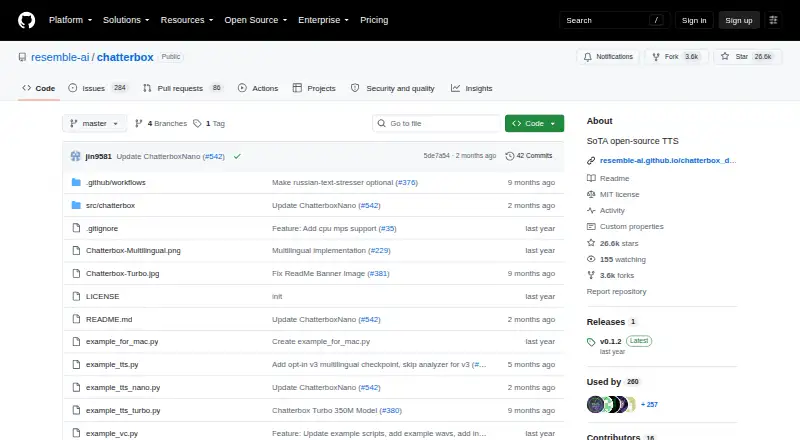
What Chatterbox TTS is
Chatterbox TTS is a family of open-source text-to-speech models from Resemble AI. The project lists Turbo, Nano, Multilingual V3, and dedicated single-language models. Turbo supports tags such as [sigh], [gasp], [cough], and [laugh] to prompt vocal reactions; Nano is intended for on-device or CPU inference where memory and latency budgets are tight. The README lists 23 supported languages for Multilingual and provides pip and source installation instructions. It describes development with Python 3.11 on Debian 11, with CUDA, CPU, and MPS device options. Chatterbox supports voice cloning, audio input, batch processing, voice isolation, and WAV export. Generated audio files include Resemble AI's PerTh watermark. The repository is MIT licensed, and the models are free for research and development. Resemble says it has stopped offering voice generation as a commercial product. The README invites users to join the project's Discord community.
Who it suits
It may suit developers building voice agents or exploring open-source speech generation. Turbo is described for low-latency voice agents, while Nano is aimed at on-device or CPU inference with tight memory and latency budgets.
What it does well
- MIT-licensed models are free for research and development
- Multilingual model lists 23 supported languages
- Turbo accepts tags for vocal reactions
- Voice cloning and WAV export are supported
- CUDA, CPU, and MPS device options are listed
What to know first
- Generated audio includes a PerTh watermark
- Resemble no longer offers voice generation commercially
- The README describes development with Python 3.11 on Debian 11
Limits
The models are free for research and development under the MIT license. Every generated audio file includes the PerTh watermark, and Resemble says it has stopped offering voice generation as a commercial product.
Plans
| Plan | Billed and limits | Price |
|---|---|---|
| Chatterbox open-source models | Free to use under the MIT license · Open-source models for research and development | Free |
| Voice AI Research (Chatterbox) | Open models · free to build on · no commercial hosted voice service | Free |
As github.com lists them, read 8 Oct 2026. The maker's own page has the final word.
Getting started
- Open the Chatterbox project website.
- Choose a listed model, such as Turbo, Nano, or Multilingual V3.
- Install with pip or follow the instructions to install from source.
- Use a listed device option: CUDA, CPU, or MPS.
- Join the project’s Discord community for support.
Chatterbox TTS is an open-source family of text-to-speech models for developers and researchers running their own software stack. It is best suited to teams that need voice cloning, multilingual output, or a model they can tune to local hardware. The cost is attractive for experimentation, but watermarking and the product’s changed commercial status make it a poor default for a customer-facing voice service.
Overview
Chatterbox is a collection rather than a hosted editor: the project provides Turbo, Nano, Multilingual V3, and dedicated single-language models. You install it with pip or from source, using Python 3.11 in the documented Debian 11 development and test setup. CUDA, CPU, and Apple MPS device paths are shown, so the practical experience depends on your environment and ability to manage a Python runtime.
The repository uses the MIT license, and Resemble AI describes the models as free for research and development. Resemble also says it has stopped offering voice generation as a commercial product. Every generated file contains the company’s PerTh watermark, which is a material consideration for published audio even when the model itself costs nothing.
Key features
Workload-specific models
Turbo is positioned for low-latency voice agents, making it the logical starting point for interactive applications where response time matters. Nano targets on-device or CPU inference when memory and latency budgets are tight, giving developers a more realistic option for constrained deployments. Multilingual V3 supports 23 languages, while dedicated single-language models let a project choose a narrower model instead of treating every language as the same workload.
Expressive synthesis and cloning
Turbo accepts paralinguistic tags including [sigh], [gasp], [cough], and [laugh]. Those controls are useful when plain text is not enough to convey a character’s reaction. Voice cloning is supported, and audio can be supplied as an input; generated audio exports in WAV. Batch processing suits queued production or research runs better than a polished, live authoring workflow.
Local control, with a visible trade-off
Self-hosting keeps model execution in an environment you control and avoids a per-character subscription. The trade-off is operational: installation, device selection, and ongoing runtime management are your responsibility. The PerTh mark is embedded in every output, so local execution does not produce unmarked audio.
Pricing
| Plan | Price | What it includes |
|---|---|---|
| Chatterbox open-source models | free | Free to use under the MIT license; open-source models for research and development |
There is no paid tier, seat schedule, usage quota, or trial-renewal cycle to compare. That makes Chatterbox unusually straightforward for prototypes and academic work. It does not, however, turn the models into a commercial hosted service: Resemble’s stated withdrawal from commercial voice generation and the mandatory watermark should be resolved before committing to a revenue-generating product.
Platforms
Chatterbox supports Linux, macOS, and self-hosted deployments. The documented device choices cover CUDA, CPU, and MPS, while the stated test environment is Debian 11 with Python 3.11. The project invites users to join its Discord community for support. Resemble AI’s Trust Center reports ISO/IEC 27001:2022 certification and a SOC 2 Type II examination, useful context for organizations assessing the maker, although those assurances do not remove the work of securing your own deployment.
Who it's for
Choose Chatterbox if you are a developer, researcher, or voice-agent builder comfortable installing models and managing hardware. It is particularly well matched to low-latency prototypes, CPU- or device-constrained experiments, multilingual applications, and voice-cloning research where a zero software price matters. Look elsewhere if you need a hosted workflow, unwatermarked deliverables, or a commercial voice-generation vendor with an active product offering.
Pros and cons
- Pros: MIT-licensed models cost nothing, making repeated research and development runs accessible.
- Pros: Turbo, Nano, Multilingual V3, and single-language models let teams trade language coverage, latency, and hardware demands.
- Pros: Voice cloning, expressive reaction tags, WAV export, and CUDA/CPU/MPS paths cover useful developer scenarios.
- Cons: Every generated file carries a PerTh watermark, limiting suitability for polished public or client work.
- Cons: Installation and runtime operation are self-managed; the documented environment assumes Python 3.11 and a compatible local setup.
- Cons: Resemble AI no longer offers voice generation as a commercial product, weakening the case for production dependence.
Alternatives
Fish Audio is a better fit when you want hosted, cross-platform access and a defined free allowance of 8,000 credits per month, up to seven minutes of generation, and 500 characters per generation.
Kokoro TTS suits users seeking another free self-hosted model, with 82 million parameters and Apache-licensed weights.
Speechify is the more appropriate choice for a consumer-facing app spanning Android, iOS, web, Windows, and macOS, with a free tier of 10 voices and a 1.5x maximum speed.
Typecast is aimed at creators who prefer a project-based web and mobile workflow, including a free tier with three projects and 3,000 lifetime credits.
Cartesia Sonic is an alternative for API and web deployments with a free allowance of 20,000 credits per month.
Google Cloud Text-to-Speech is preferable when you want a metered cloud API; standard voices are billed at US$0.000004 per character, with 0 to 4 million characters free.
LOVO AI offers a creator-oriented freemium service with five projects on its free plan.
Murf AI is another hosted creator option; its free plan allows 10 projects and 10 minutes of generation but no downloads.
Verdict
Chatterbox TTS is a strong choice for technical users who want free, MIT-licensed models they can run locally, especially for voice-agent prototypes, multilingual research, and constrained devices. Choose it for model flexibility and zero software cost. Choose another service when production audio must be unwatermarked, hosted, or backed by an active commercial voice-generation offering.
Verdict
Chatterbox offers several open-source model choices, with documented installation paths and device options. Generated files carry a PerTh watermark, and Resemble says its voice generation is no longer a commercial product.
Questions
How much does Chatterbox TTS cost?
The listed plan, Chatterbox open-source models, is free.
Can it be used commercially?
Commercial use is listed as yes, while Resemble says it has stopped offering voice generation as a commercial product and its models remain open and free for research and development.
Which platforms are listed?
Linux, macOS, and self-hosted environments.
Is Chatterbox TTS open source?
Yes. The project repository is MIT licensed.
What audio format can it export?
WAV. Generated audio files include Resemble AI’s PerTh watermark.
What languages does it support?
The Multilingual model lists 23 supported languages.
Facts from Chatterbox TTS's own pages
- Commercial use
- Yes · github.com, 20 Sept 2026
- Company founding
- Resemble says Zohaib Ahmed and Saqib Muhammad started the company in 2019. · resemble.ai, 21 Oct 2026
- Company headquarters
- LinkedIn lists Resemble AI headquarters in Santa Clara, California, with 11–50 employees. · linkedin.com, 21 Oct 2026
- Company ownership and funding
- Crunchbase describes Resemble AI as a private, for-profit company with five funding rounds and founders Zohaib Ahmed and Saqib Muhammad, while funding amounts are obscured. · crunchbase.com, 21 Oct 2026
- Controls
- The Python interface exposes generation controls including exaggeration, CFG weight, temperature and random seed. · raw.githubusercontent.com, 21 Oct 2026
- Current availability
- Resemble says it has stopped offering voice generation as a commercial product and that its voice models remain open and free for research and development. · resemble.ai, 8 Oct 2026
- Documentation depth
- The repository includes model selection tables, Python examples, language identifiers, watermark extraction code, tuning guidance and evaluation links. · raw.githubusercontent.com, 21 Oct 2026
- Export formats
- WAV · github.com, 20 Sept 2026
- Expressive speech
- Turbo supports paralinguistic tags such as [sigh], [gasp], [cough], and [laugh] to prompt vocal reactions. · resemble.ai, 8 Oct 2026
- Founded
- 2019 · github.com, 28 Sept 2026
- Free plan
- Yes · github.com, 20 Sept 2026
- Hallucination reduction
- The V3 description says it reduces unwanted continuation, repetition and off-prompt speech compared with earlier multilingual versions. · raw.githubusercontent.com, 21 Oct 2026
- Installation
- The project can be installed with pip as chatterbox-tts or from a cloned repository in editable mode. · ondalabs.app, 21 Oct 2026
- Integration
- NVIDIA provides a Chatterbox TTS plugin for ACE for Games with CUDA, Vulkan and Windows D3D12 backends. · docs.nvidia.com, 21 Oct 2026
- Intended users
- The README describes Turbo for low-latency voice agents and Nano for on-device or CPU inference when memory and latency budgets are tight. · github.com, 8 Oct 2026
- Languages
- The README lists 23 supported languages for Chatterbox Multilingual. · github.com, 8 Oct 2026
- Latest model
- The repository identifies Chatterbox Multilingual V3 as its newest general-purpose multilingual model. · raw.githubusercontent.com, 21 Oct 2026
- License
- The code and model listing identify the project as MIT licensed, permitting modification and redistribution subject to the license notice. · github.com, 21 Oct 2026
- Limit: commercial availability
- Resemble’s current product notice says voice generation is no longer offered as a commercial product, although the models remain open and free for research and development. · resemble.ai, 21 Oct 2026
- Limit: comparative performance evidence
- An independent review reports that Resemble’s blind test favored Chatterbox, but an Artificial Analysis snapshot ranked Chatterbox below ElevenLabs’ leading model. · ondalabs.app, 21 Oct 2026
- Limit: service reliability and billing
- Trustpilot complaints repeatedly mention failed or cut-off audio, slow or absent support, unexpected charges, credit problems and service outages; these reviews concern Resemble’s former hosted service rather than the self-hosted model. · trustpilot.com, 21 Oct 2026
- Limit: watermark removability
- An independent review notes that MIT licensing allows modified software, so users can technically remove the watermark by changing the code. · ondalabs.app, 21 Oct 2026
- Maker legal name
- Resemble AI, Inc. is the company name shown in the maker’s privacy-policy contact information. · resemble.ai, 21 Oct 2026
- Memory requirement
- NVIDIA documents approximately 2.3 GB VRAM for Turbo-only inference and 3.5 GB for multilingual TTS-only inference in its plugin. · docs.nvidia.com, 21 Oct 2026
Where Chatterbox TTS stands on Freedom251
- Text-to-speech tools#2 of 232
- Text-to-Speech Software#2 of 223
- Image Upscaling Software#2 of 99
- AI Voice Generators#1 of 33
- Voice Cloning Software#1 of 25
- Game Voice Generators#2 of 45
- AI Voice Cloning Software#2 of 29