Freedom251 › Text-to-Speech Software

Cartesia Sonic
What Cartesia Sonic is
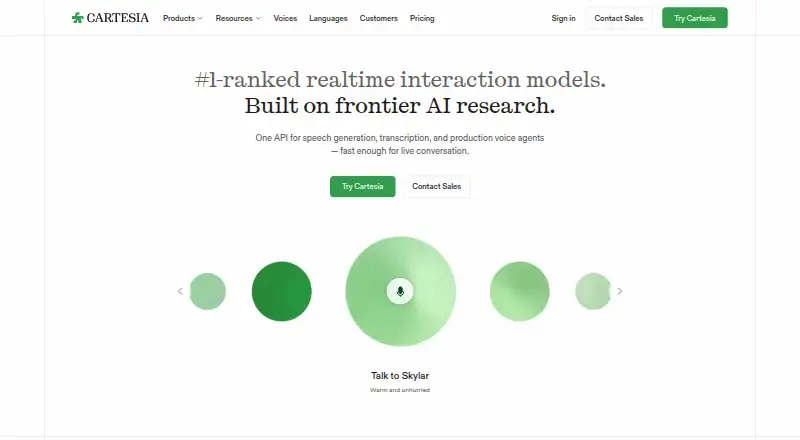
Cartesia Sonic is a text-to-speech model for real-time voice applications, available through the web and an API. Cartesia says its latency is below 90 milliseconds and it supports 44 languages. The model can interpret emotional subtext and add nonverbal expressions, including laughter, to transcripts. It can also localize audio into other languages while retaining the emotion, tone, and speaker identity. Custom pronunciation dictionaries let users set how proper nouns and domain-specific terms are spoken.
For voice agents, Managed Agents combine Ink-2 speech-to-text, a selected LLM, and Sonic-3.6 text-to-speech, with turn-taking and interruption handling. Agents can use numbers provisioned by Cartesia, imported Twilio numbers, or a carrier connection over SIP. Cartesia lists HIPAA compliance, SOC 2 Type 2, GDPR, and PCI. It says Sonic can be deployed on-premise, in a customer VPC on AWS, GCP, or Azure, or through OEM licensing. Plans start with Free at 20K monthly credits and two concurrent text-to-speech requests; paid plans begin at $5/mo. The company is headquartered in San Francisco, California, and was founded in 2023.
Who it suits
Cartesia Sonic suits developers building real-time voice applications who need speech synthesis, multiple languages, or controls for emotion and pronunciation. Teams building voice agents can use Managed Agents with a selected LLM and supported phone or SIP connections.
What it does well
- Below 90ms latency for real-time voice applications
- Supports 44 languages and audio localization
- Custom dictionaries control proper-noun and domain-term pronunciation
- Managed Agents handle turn-taking and interruptions
- Deployment options include on-premise and customer cloud VPCs
What to know first
- Free plan provides 20K monthly credits
- Free plan allows two concurrent text-to-speech requests
- API and web are the listed platforms
Limits
Free includes 20K credits per month and two concurrent Sonic text-to-speech requests. Pro costs $5/mo and includes 100K credits per month and three concurrent requests. The listed Enterprise plan uses custom credits and agent usage.
Plans
| Plan | Billed and limits | Price |
|---|---|---|
| Pro | $5/mo · 100K credits / month · $5 prepaid agents / month · Commercial use license · Instant voice cloning | $5 a month |
| Startup | $49/mo · 1.25M credits / month · $49 prepaid agents / month · Pro voice cloning · Organizations | $49 a month |
| Scale | $299/mo · 8M credits / month · $299 prepaid agents / month · Priority support · High concurrency limits | $299 a month |
| Free | $0/mo · 20K credits / month · $1 prepaid agents / month · Text to Speech · Speech to Text | Free |
| Enterprise | Custom · Custom credits & agent usage · Volume pricing · Custom concurrency limits · DPAs and BAAs · Shared Slack channel · SSO · Security questionnaires | On request |
As cartesia.ai lists them, read 1 Oct 2026. The maker's own page has the final word.
Getting started
- Open Cartesia’s website at https://www.cartesia.ai/
- Choose web access or use the API
- Start with the Free plan or select a paid plan
- For voice agents, configure Managed Agents with a chosen LLM and a Cartesia number, Twilio number, or SIP carrier connection
Cartesia Sonic is text-to-speech software for real-time voice applications, with API and web access. It is best suited to developers and teams building conversational products that need responsive, expressive speech. Its main trade-off is usage-based capacity: the free tier is limited, while higher monthly credit allowances cost more.
Overview
Sub-90ms latency makes Sonic a candidate for interactive speech, where delays can disrupt a conversation. Support for 44 languages, emotion-aware delivery, localization, and pronunciation dictionaries also make it more adaptable than a basic voice-rendering tool. The free plan is a useful starting point, but its 20K monthly credits and two concurrent text-to-speech requests constrain larger or busier workloads.
Key features
- Expressive speech: Sonic interprets emotional subtext and can add non-verbal expressions such as laughter. That is useful for conversational and character-led voices, but less suited to projects that require uniformly neutral delivery.
- Localization: It can render an audio clip in another language while retaining emotion, tone, and speaker identity. This supports multilingual adaptation without discarding the original performance’s character.
- Pronunciation control: Custom dictionaries let users specify how proper nouns and domain terms should be spoken, a practical safeguard for branded or specialist vocabulary.
- Voice agents: Managed Agents combine Ink-2 speech-to-text, a chosen LLM, and Sonic-3.6 text-to-speech, with turn-taking and interruption handling. Teams can use Cartesia-provisioned numbers, import Twilio numbers, or connect a carrier over SIP.
- Deployment and security: Sonic can be deployed on-premise, in a customer VPC on AWS, GCP, or Azure, or through OEM licensing. Cartesia lists HIPAA compliance, SOC 2 Type 2, GDPR, and PCI, making these options relevant to organizations with deployment or compliance requirements.
- Help: Cartesia’s documentation directs users to Discord to reach the team and community. That offers a support channel, though it may not suit organizations that need a different support arrangement.
Pricing
Sonic uses a freemium model. The free plan costs nothing, billed monthly, and includes 20K credits per month, $1 prepaid agents per month, and two concurrent text-to-speech requests. It works for trying the service or keeping a small workload within a fixed allowance; the credit and concurrency ceilings limit sustained or simultaneous use.
Pro costs $5 a month, billed $5/mo. It includes 100K credits per month, $5 prepaid agents per month, commercial use, instant voice cloning, and three concurrent requests. It is the lowest paid tier and fits commercial projects that need more capacity than Free, though it remains capped at 100K monthly credits.
Startup costs $49 a month, billed $49/mo, for 1.25M credits per month and $49 prepaid agents per month. It adds Pro voice cloning and Organizations. The larger allowance suits teams with higher usage or organizational needs; it costs substantially more than Pro.
Scale costs $299 a month, billed $299/mo, and includes 8M credits per month, $299 prepaid agents per month, priority support, and high concurrency limits. It is aimed at heavier workloads that need more simultaneous capacity and a priority support option, rather than small projects.
Enterprise has custom pricing and custom credits and agent usage. It is the option for organizations that need a tailored allowance rather than one of the fixed monthly tiers.
Platforms
Sonic is available through an API and on the web. API access suits integration into voice products; web access provides another way to work with the service. Commercial use is included on Pro and above. Voice cloning is available, with instant cloning on Pro and Pro voice cloning on Startup.
Who it's for
Sonic is a strong fit for developers building low-latency voice interfaces, teams localizing spoken content while preserving a speaker’s delivery, and organizations that need pronunciation controls or managed voice agents. Its deployment choices and listed compliance credentials may also matter to enterprises with specific infrastructure requirements. It is a weaker fit for low-volume users who need more than the free cap, or for buyers seeking a broad desktop and mobile app selection rather than API or web access.
Pros and cons
- Pros
- Sub-90ms latency and interruption-aware managed agents support responsive conversational use.
- 44 languages, expressive delivery, and localization that preserves speaker identity serve multilingual voice products.
- Pronunciation dictionaries help control names and domain vocabulary.
- On-premise, customer-VPC, and OEM deployment options offer flexibility beyond a hosted API.
- Cons
- The free plan is limited to 20K monthly credits and two concurrent requests.
- Capacity rises by plan, so sustained high usage requires a higher monthly commitment.
- The documented support route is Discord, which may not match every team’s preferred support channel.
- Access is through API and web, not a listed desktop or mobile platform.
Alternatives
- Fish Audio is worth considering for users who want API access alongside Linux, macOS, self-hosted, web, or Windows platforms; its free tier includes 8,000 monthly credits, up to seven minutes of generation, and up to 500 characters per generation.
- Kokoro TTS is a free alternative for users who prioritize an Apache-licensed, open-weight model and broad platform availability across API, desktop, web, and self-hosted options.
- Speechify may suit readers looking for a product spanning Android, iOS, desktop, web, and API, with a free tier of 10 voices and a 1.5x maximum speed.
- Typecast is another freemium choice, with a free plan capped at three projects and 3,000 lifetime credits and a free trial.
- Chatterbox TTS is a free option for users who want open-source models under the MIT license and can work with Linux, macOS, or self-hosted software.
- Google Cloud Text-to-Speech may fit teams already looking for a cloud API with a free allowance: its Standard voices plan charges US$0.000004 per character (US$4 per 1 million characters), with 0 to 4 million characters free.
- LOVO AI offers a free plan with limited features and five projects, plus Pro+ with 20 voice-generation hours per month and unlimited projects.
- Murf AI is an alternative for users who want Windows access; its free plan allows 10 projects and 10 minutes of voice generation, with one editor and no downloads.
For category browsing, see AI Voice Generators, Game Voice Generators, and Text-to-Speech Software.
Verdict
Choose Cartesia Sonic if you are building a real-time voice product and need low latency, multilingual localization, pronunciation control, or managed agents. Its expressive features and deployment options make it more than a basic speech generator, but the free tier is narrow and meaningful capacity costs climb quickly. For light use, limited budgets, or a preference for desktop and mobile apps, one of the alternatives may be a better fit.
Verdict
Choose Cartesia Sonic for real-time text-to-speech with multilingual localization, pronunciation controls, and voice-agent options. The Free plan provides 20K monthly credits; higher usage starts at $5/mo, while Enterprise pricing is custom.
Questions
Is there a free plan?
Yes. Free includes 20K credits per month and two concurrent Sonic text-to-speech requests.
How much do paid plans cost?
Pro is $5/mo, Startup is $49/mo, and Scale is $299/mo. Enterprise pricing is custom.
Which platforms are supported?
Cartesia lists API and web access.
Can Sonic be used commercially?
The Pro plan includes a commercial use license. Commercial use is also listed as available.
Can it clone voices?
Voice cloning is listed. Pro includes instant voice cloning, and Startup includes Pro voice cloning.
Where can Sonic be deployed?
Cartesia says it can be deployed on-premise, in a customer VPC on AWS, GCP, or Azure, or through OEM licensing.
Facts from Cartesia Sonic's own pages
- API access
- Yes · cartesia.ai, 20 Sept 2026
- Commercial use
- Yes · cartesia.ai, 20 Sept 2026
- Concurrency
- The Free plan lists two concurrent Sonic text-to-speech requests, while Pro lists three. · cartesia.ai, 1 Oct 2026
- Deployment
- Cartesia says Sonic can be deployed on-premise, in a customer VPC on AWS, GCP, or Azure, or through OEM licensing. · cartesia.ai, 1 Oct 2026
- Emotion
- Sonic interprets emotional subtext and can insert non-verbal expressions such as laughter into transcripts. · cartesia.ai, 1 Oct 2026
- Free plan
- Yes · cartesia.ai, 20 Sept 2026
- Headquarters
- San Francisco, California, United States · cartesia.ai, 28 Sept 2026
- Integrations
- Managed Agents can use Cartesia-provisioned numbers, import Twilio numbers, or connect a carrier over SIP. · cartesia.ai, 1 Oct 2026
- Languages
- Sonic supports 44 languages. · cartesia.ai, 1 Oct 2026
- Latency
- Sonic has sub-90ms latency. · cartesia.ai, 1 Oct 2026
- Localization
- Sonic can localize an audio clip into other languages while carrying over emotion, tone, and speaker identity. · cartesia.ai, 1 Oct 2026
- Platforms
- web,api · cartesia.ai, 20 Sept 2026
- Product
- Sonic is a text-to-speech model for real-time voice applications. · cartesia.ai, 1 Oct 2026
- Pronunciation
- Custom pronunciation dictionaries let users specify pronunciations for proper nouns and domain terms. · cartesia.ai, 1 Oct 2026
- Security
- Cartesia lists HIPAA compliance, SOC 2 Type 2, GDPR, and PCI on the Sonic page. · cartesia.ai, 1 Oct 2026
- Paid from
- 5 · cartesia.ai, 20 Sept 2026
- Support
- Cartesia's documentation directs users to Discord to chat with the Cartesia team and community for help. · docs.cartesia.ai, 1 Oct 2026
- Voice agents
- Managed Agents combine Ink-2 speech-to-text, a chosen LLM, and Sonic-3.6 text-to-speech with turn-taking and interruption handling. · cartesia.ai, 1 Oct 2026
- Voice cloning
- Instant voice cloning can use 10 seconds of audio, while Pro Voice Clone training uses 30 minutes or more from one speaker. · cartesia.ai, 1 Oct 2026
Where Cartesia Sonic stands on Freedom251
- Text-to-Speech Software#40 of 223
- Text-to-speech tools#47 of 232
- Voice Ai Tools#6 of 28
- AI Voice Generators#8 of 33
- Game Voice Generators#13 of 45