Freedom251 › Integration Platform as a Service Software

Skyvia
by Skyvia
What Skyvia is
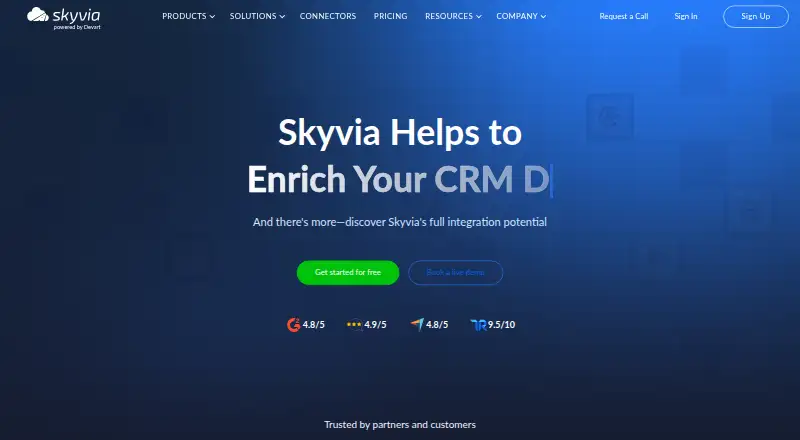
Skyvia is a web service for integrating, backing up, accessing, and managing cloud data. It supports ETL, ELT, Reverse ETL, import, export, replication, and synchronization across cloud apps, databases, storage, data warehouses, spreadsheets, and BI tools. Skyvia advertises more than 200 ready-to-use connectors and also supports custom REST and GraphQL connectors. Its products cover Data Integration, Automation, Backup, Query, and Connect, with separate plans. Users can build visual workflows with triggers, actions, and logic, apply SQL transformations, and capture changes through real-time CDC and incremental updates. Skyvia can create web API and MCP endpoints for live data access; Skyvia Connect can publish data through OData and SQL endpoints. The service is accessed through a browser, while a Windows Agent provides a gateway to local databases behind a firewall. The free integration plan allows 10k records per month and two scheduled integrations. Registered accounts receive 14-day trials for all products. The listed plans include Backup Standard at $7 a month and Data Integration Basic at $79 a month.
Who it suits
Skyvia suits teams that need to connect cloud applications, databases, or local databases and build data workflows. Its separate products cover integration, automation, backup, query, and connection needs.
What it does well
- Advertises more than 200 ready-to-use connectors.
- Supports custom REST and GraphQL connectors.
- Free integration plan includes two scheduled integrations.
- Windows Agent connects to local databases behind a firewall.
What to know first
- Free integration plan allows 10k records per month.
- Free plan allows two scheduled integrations.
- Products have separate pricing plans.
Limits
The free integration plan allows 10k records per month, two scheduled integrations, once-a-day scheduling, and 30-day schedule expiration. The listed Data Integration Basic plan is $79 a month and allows five scheduled integrations with once-a-day scheduling.
Plans
| Plan | Billed and limits | Price |
|---|---|---|
| Free | billed monthly · 10k records per month · 2 scheduled integrations · Once-a-day scheduling · 30-day schedule expiration | Free |
| Basic | billed monthly · 5 scheduled integrations · Once-a-day scheduling · Unlimited source/target connections · Unlimited users | $99 a month |
| Standard | billed monthly · 50 scheduled integrations · Hourly scheduling · Unlimited source/target connections · Unlimited users | $199 a month |
| Professional | billed monthly · Unlimited scheduled integrations · Once-a-minute scheduling · Unlimited source/target connections · Unlimited users | $499 a month |
| Enterprise | Unlimited record volume · Dedicated virtual machine | On request |
| Enterprise | Unlimited record volume · Dedicated virtual machine | On request |
| Data Integration Standard | $199 $159/mo.; Save $480/yr · once-an-hour scheduling · 50 scheduled integrations · basic scenarios · advanced mapping | $159 a month |
| Data Integration Professional | $499 $399/mo.; Save $1200/yr · once-a-minute scheduling · unlimited scheduled integrations · advanced scenarios · advanced mapping | $399 a month |
The first 8 of 18 plans, as skyvia.com lists them, read 21 Sept 2026. The maker's own page has the final word. Every plan
Getting started
- Visit https://skyvia.com/.
- Register an account to receive 14-day product trials.
- Open Skyvia in a web browser, or use the Windows Agent for access to local databases behind a firewall.
- Start with the Free plan or choose a product plan.
- Configure an integration using a ready-to-use connector or a custom REST or GraphQL connector.
Skyvia is a browser-based service for moving and managing data across cloud applications, databases, and analytics tools. It suits teams that need integration alongside backup or live data access, especially when some sources remain behind a firewall. Its breadth is useful, but separate product plans and integration quotas make careful plan selection essential.
Overview
Skyvia combines data integration, automation, backup, query, and data access in one service. Data Integration supports ETL, ELT, Reverse ETL, imports, exports, replication, and synchronization across cloud apps, databases, storage, data warehouses, spreadsheets, and BI tools. More than 200 prebuilt connectors and custom REST and GraphQL connectors give teams a broad starting point for connecting systems.
The service runs in a web browser, while a Windows Agent provides a secure gateway to local databases behind a firewall. That hybrid approach is a practical fit for organizations combining cloud and on-premises data. Skyvia says it encrypts private data at rest with AES 256-bit encryption and uses TLS in transit; it also states that it is SOC 2 certified, HIPAA-ready, PCI DSS-compliant, and GDPR-compliant.
Key features
Integration and transformation
Scheduled and real-time synchronization, including change data capture and incremental updates, can help keep connected datasets current. SQL transformations let users clean and enrich data, analyze it, and calculate metrics. The range of methods and connectors is a strength for teams working across varied systems, though the integration plans impose different scheduling and volume limits.
Automation and access
Automation uses visual workflows assembled from triggers, actions, and logic components. Skyvia Connect can publish data through OData and SQL endpoints, while web API and MCP endpoints support live data access. These options extend the service beyond moving data, but readers seeking only one of these capabilities should compare the separate product plans before committing.
Backup
Backup supports automatic daily backups and manual backups on demand. Its plans include data search, backup comparison, automatic cleaning, and unlimited snapshot storage, with the Standard plan capped at 20 GB and Professional at 200 GB. Those storage limits make the plan choice consequential for larger backup sets.
Pricing
Skyvia is freemium, with a free plan and 14-day trials for all products after account registration. Annual billing is advertised as 20% off. The listed plan prices below use the stated monthly terms; backup and Data Integration prices are shown with discounted monthly billing and annual savings.
| Plan | Price | What it includes and who it suits |
|---|---|---|
| Free | free | 10k records per month, two scheduled integrations, once-a-day scheduling, and 30-day schedule expiration. A sensible way to evaluate light workloads, but the record and schedule caps rule it out for sustained, higher-volume use. |
| Basic | $99 a month | Five scheduled integrations, once-a-day scheduling, unlimited source/target connections, and unlimited users. It suits small workloads that need more than the free plan's two schedules, but not frequent refreshes. |
| Standard | $199 a month | Fifty scheduled integrations, hourly scheduling, unlimited connections, and unlimited users. The step up is justified when hourly runs or a larger workflow count matter. |
| Professional | $499 a month | Unlimited scheduled integrations, once-a-minute scheduling, unlimited connections, and unlimited users. It is aimed at teams needing frequent runs and many schedules, but the price is substantial. |
| Enterprise | Custom pricing | Unlimited record volume, a dedicated virtual machine, priority support, and onboarding consultations. This is the integration option for organizations with high volumes and support needs. |
| Data Integration Basic | $79 a month, billed $99 $79/mo.; Save $240/yr | Once-a-day scheduling, five scheduled integrations, basic scenarios, and simple mapping. It is a lower-cost entry to Data Integration, with less schedule capacity and functionality than higher tiers. |
| Backup Standard | $7 a month, billed $9 $7/mo.; Save $24/yr | 20 GB storage plus unlimited snapshot storage, search, comparison, automatic cleaning, and automatic backups. Best for modest backup needs; the storage cap is the key constraint. |
| Backup Professional | $79 a month, billed $99 $79/mo.; Save $240/yr | 200 GB storage with the same listed backup capabilities. It suits larger backup sets, though the tenfold storage increase comes with a much higher monthly price. |
Integration plans list unlimited users, so seat counts are not the pricing pressure there; scheduled integrations, run frequency, and record volume matter more. The products have separate plans, so a low Backup starting price does not describe the cost of using the wider service.
Platforms
Skyvia supports API, web, and Windows. The cloud service is browser-accessible, and the Windows Agent connects local databases behind a firewall. Its Azure-hosted, multi-tenant fault-tolerant architecture supports the cloud service; the Windows gateway is the important bridge for on-premises sources.
Who it's for
Skyvia is a strong fit for teams that need to connect multiple cloud services or combine those sources with local databases, and for organizations that also want automation, backup, or API-based access. It is less suitable for a small, fixed integration workload that fits a simpler free tool, or for buyers who need a single product with straightforward all-in pricing.
Pros and cons
- Pros: More than 200 prebuilt connectors plus custom REST and GraphQL support help cover mixed data environments.
- Pros: The Windows Agent offers a route to local databases behind a firewall without giving up browser-based access to the cloud service.
- Pros: Integration plans allow unlimited users, avoiding per-seat limits as teams grow.
- Pros: Daily and manual backup options, search, comparison, and automatic cleaning add useful data-protection tools.
- Cons: The free integration plan is capped at 10k records per month and two scheduled integrations, limiting its usefulness beyond evaluation or small workloads.
- Cons: Paid integration tiers become much more expensive as scheduling frequency and workflow count rise.
- Cons: Separate pricing plans for five products make the total cost harder to judge when a team needs capabilities from several products.
- Cons: Backup storage is limited to 20 GB on Standard and 200 GB on Professional, which may constrain larger datasets.
Alternatives
For a different approach to data integration, compare ETL Software, CRM Data Migration Software, and Integration Platform as a Service Software.
- Apache Beam is worth considering for readers who want a free, open-source programming model and are comfortable with execution costs depending on the runner and infrastructure.
- Apache NiFi is a free-to-download option under the Apache License, Version 2.0, with no commercial plan or usage limits stated on its official pages.
- Apache Hop is an open-source alternative for teams able to work with a self-hosted platform; release 2.19.0 requires Java 21.
- Apache Spark is a free, open-source distributed data analytics engine, available through downloads, PyPI, Maven Central, and Docker.
- EasyMorph has a free desktop plan billed forever, but its restrictions include 20 actions per project and 20 loop iterations per project.
- Keboola offers a free plan with 120 compute minutes in the first month and 60 minutes per month afterward; additional compute costs $0.14 per minute.
- Ab Initio Data Platform uses custom pricing and requires a free proof of concept before software purchase.
- CloverDX is a paid alternative with a calculator for annual estimates and pricing available by contacting the vendor.
Verdict
Choose Skyvia if your team needs a broad connector-based integration service that can also reach local databases, automate workflows, protect data, or expose live access endpoints. Its mix of integration methods and adjacent tools is the central advantage. Look elsewhere if your workloads fit a simpler free option, or if you want one transparent plan rather than separate products and rising costs for more frequent or numerous integrations.
Verdict
Skyvia offers data integration alongside automation, backup, query, and access tools, including a Windows gateway for local databases. Check the free integration limits and the separate product plans when choosing a fit.
Questions
Does Skyvia have a free plan?
Yes. The Free plan costs nothing and includes 10k records per month and two scheduled integrations.
How much do paid Skyvia plans cost?
Listed prices include Backup Standard at $7 a month and Data Integration Basic at $79 a month. Integration plans also include Basic at $99 a month, Standard at $199 a month, and Professional at $499 a month.
Is there a free trial?
Yes. Skyvia provides 14-day trials for all products when an account is registered.
Which platforms does Skyvia support?
The listed platforms are API, web, and Windows. Skyvia is accessed through a browser, and a Windows Agent provides a gateway to local databases behind a firewall.
What data sources can it connect to?
Skyvia supports cloud apps, databases, storage, data warehouses, spreadsheets, and BI tools. It advertises more than 200 ready-to-use connectors and supports custom REST and GraphQL connectors.
Does Skyvia offer on-premises integration?
Yes. On-premises integration is listed as a solution, and the Windows Agent provides access to local databases behind a firewall.
Facts from Skyvia's own pages
- Priority support
- The Enterprise integration plan includes priority support and onboarding consultations. · skyvia.com, 28 Sept 2026
- Annual discount
- Annual billing is advertised as 20% off. · skyvia.com, 28 Sept 2026
- API access
- Skyvia Connect can publish data through OData and SQL endpoints, and the platform exposes web API use cases. · skyvia.com, 28 Sept 2026
- Web API endpoints
- Skyvia can create web API and MCP endpoints for live data access. · skyvia.com, 28 Sept 2026
- API management
- Yes · skyvia.com, 21 Sept 2026
- Backup options
- Backup includes automatic daily backups and anytime manual backups. · skyvia.com, 28 Sept 2026
- Cloud access
- Skyvia is 100% cloud-based and requires only a web browser for access. · skyvia.com, 28 Sept 2026
- Cloud data service
- Skyvia integrates, backs up, accesses, and manages cloud data in one service. · skyvia.com, 28 Sept 2026
- Customer base
- Skyvia reports more than 2,000 loyal customers and 400 trusted partners. · skyvia.com, 28 Sept 2026
- Records processed
- Skyvia reports processing 30 billion records per month. · skyvia.com, 28 Sept 2026
- Company scale
- Skyvia's About page reports 10 billion records processed per month, 20 terabytes backed up and 2,000+ loyal customers. · skyvia.com, 28 Sept 2026
- Compliance
- Skyvia states that it is SOC 2 certified, HIPAA-ready, PCI DSS-compliant and GDPR-compliant. · skyvia.com, 28 Sept 2026
- Available connectors
- The homepage advertises more than 200 ready-to-use connectors. · skyvia.com, 28 Sept 2026
- Connectors
- Skyvia lists 200+ prebuilt connectors and supports custom REST and GraphQL connectors. · skyvia.com, 28 Sept 2026
- SQL transformations
- Users can clean, enrich, analyze, and compute metrics with SQL transformations. · skyvia.com, 28 Sept 2026
- Deployment model
- hybrid · skyvia.com, 21 Sept 2026
- Founded
- 1997 · skyvia.com, 28 Sept 2026
- Free access
- Users can get started for free. · skyvia.com, 28 Sept 2026
- Free integration limits
- The free integration plan allows 10k records per month and two scheduled integrations. · skyvia.com, 28 Sept 2026
- Free plan
- Yes · skyvia.com, 21 Sept 2026
- Hosting
- Skyvia is hosted in Microsoft Azure and uses a multi-tenant fault-tolerant cloud architecture. · skyvia.com, 28 Sept 2026
- Integration methods
- The platform supports ETL, ELT, Reverse ETL, import, export, replication and synchronization workflows. · docs.skyvia.com, 28 Sept 2026
- Supported platforms
- Skyvia supports cloud apps, databases, storages, data warehouses, spreadsheets, and BI tools. · skyvia.com, 28 Sept 2026
- On-premises connectors
- Yes · skyvia.com, 21 Sept 2026
Where Skyvia stands on Freedom251
- Integration Platform as a Service Software#10 of 113
- Integration Software#8 of 28
- ETL Software#9 of 28
- Business Automation#8 of 23
- CRM Data Migration Software#15 of 41
- Data Integration#12 of 26