Freedom251 › C and C++ Static Analysis Tools

Semgrep Code
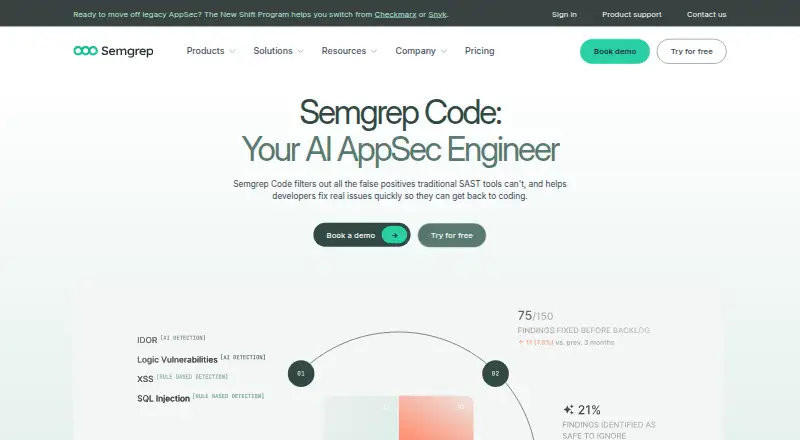
What Semgrep Code is
Semgrep Code is a static application security testing product that scans source code for vulnerabilities and helps developers address findings. Its detection combines deterministic analysis for issues such as cross-site scripting and SQL injection with AI analysis for more complex problems, including insecure direct object references and business logic flaws. Pull requests can include tailored, step-by-step remediation instructions. The product supports 35+ programming languages and integrates with source-control and CI tools including GitHub, GitLab, Bitbucket, Jenkins, CircleCI, Azure, and Buildkite. Extensions are listed for VS Code and IntelliJ, with Slack, email, and webhooks available for notifications. The Free Edition includes Code and Supply Chain, allows scans of up to 10 repositories, and permits a maximum of 10 contributors. Teams supports up to 500 private repositories; Enterprise has no repository or contributor limit. Local or fully CI-based scans keep source code in the user's environment, while opting into AI processing sends part of a file containing a finding to a model. Free Edition is available; Teams is listed at $30/month/contributor.
Who it suits
Semgrep Code suits development teams that want to scan source code for security issues and include remediation guidance in pull requests. Its free repository and contributor limits may fit smaller teams, while Teams and Enterprise list larger limits.
What it does well
- Supports 35+ programming languages.
- Provides remediation instructions in pull requests.
- Integrates with source-control and CI tools.
- Free Edition allows up to 10 repositories.
- Local and fully CI-based scans keep code in the user's environment.
What to know first
- Free Edition allows a maximum of 10 contributors.
- Teams is limited to 500 private repositories.
- AI processing sends part of a finding's file to a model.
Limits
The Free Edition supports up to 10 repositories and a maximum of 10 contributors, with 60 AI credits. Teams — Code supports up to 500 private repositories and 20 AI credits per developer per month. Enterprise has no repository or contributor limit and includes 50 AI credits per developer per month.
Plans
| Plan | Billed and limits | Price |
|---|---|---|
| Free Edition | per contributor · 10 repositories · 10 contributors · GitHub/GitLab authentication · 60 AI credits/month · Code and Supply Chain | Free |
| Teams Secrets | per contributor · 20 AI credits/developer/month · SSO · one-click CI/CD · award-winning support | $15 a month |
| Teams — Code | $30/month/contributor · Code (SAST) · 20 AI credits per developer per month · 500 private repositories maximum | $30 a month |
| Teams Code | per contributor · 20 AI credits/developer/month · SSO · one-click CI/CD · award-winning support | $30 a month |
| Teams Supply Chain | per contributor · 20 AI credits/developer/month · SSO · one-click CI/CD · award-winning support | $30 a month |
| Enterprise | On-premises SCM · custom CI/CD integrations · dedicated infrastructure option · unlimited repositories and contributors · dedicated account manager | On request |
As semgrep.dev lists them, read 15 Oct 2026. The maker's own page has the final word.
Getting started
- Visit https://semgrep.dev/products/semgrep-code/.
- Choose the Free Edition, Teams — Code, or Enterprise plan.
- Connect a listed source-control or CI tool, or use the VS Code or IntelliJ extension.
- Run scans in pull requests, CI/CD, pre-commit workflows, or an IDE.
- Keep scans local or fully CI-based, or opt into AI processing.
Overview
Semgrep Code is a source-code security scanner for development teams that want vulnerability checks embedded in pull requests and CI. It suits teams that need both rule-based detection and analysis of harder-to-classify flaws; its strongest case is broad workflow coverage, while its repository and contributor caps make plan choice consequential.
Key features
Detection and triage
Semgrep combines deterministic SAST checks for familiar issues such as XSS and SQL injection with AI analysis aimed at complex flaws such as IDOR and business logic vulnerabilities. That mix can cover more than pattern matching alone, though teams should weigh AI processing against their code-handling requirements. Semgrep says Multimodal can reduce findings requiring triage by 20% on activation and improve as it learns from triage decisions; that is a stated potential, not a result every team should assume.
Support for 35+ languages and custom security rules gives teams room to scan varied codebases and express organization-specific checks. Pull-request, CI/CD, and pre-commit scanning put checks into several points of the development process, rather than limiting review to a separate security workflow.
Remediation and workflow
Findings in pull requests come with tailored, step-by-step remediation instructions, which can help developers act without handing every issue off to a separate security team. IDE extensions for VS Code and IntelliJ, plus Slack, email, and webhook notifications, extend that workflow. Integrations include GitHub, GitLab, Bitbucket, Jenkins, CircleCI, Azure, and Buildkite.
For local or fully CI-based scans, source code stays on the user's computer or CI environment. Opting into AI processing sends part of a file containing a finding to a model, a distinction security-conscious teams should account for before enabling it. Semgrep's trust portal describes a SOC 2 Type II report and a full-scope third-party penetration test covering the Semgrep AppSec Platform, including Code.
Pricing
The Free Edition costs nothing (billed Free) and includes Code and Supply Chain, up to 10 repositories, a maximum of 10 contributors, and 60 AI credits. Community-based support makes this a practical starting point for small projects, but the contributor and repository ceilings limit its fit for expanding teams.
Teams — Code costs $30 a month (billed $30/month/contributor). It includes Code (SAST), 20 AI credits per developer per month, and up to 500 private repositories. This is the paid fit for teams that need room beyond the free caps, but its per-contributor price makes headcount part of the cost decision. Teams support is described as award-winning.
Enterprise has custom pricing, no repository or contributor limit, 50 AI credits per developer per month, a dedicated account manager, and tailored onboarding. It is the natural choice for organizations that need uncapped scale and dedicated support; smaller teams may not need those provisions. The published paid-from figure is 15 /user/mo, while the Teams plan price is $30/month/contributor.
Semgrep offers cloud deployment, with local and CI-based scan options. Its platform coverage includes Linux, macOS, and Windows, as well as web, API, extension, and self-hosted access.
Who it's for
Semgrep Code is best suited to development and security teams that want configurable SAST across pull requests, CI, and IDE workflows, especially when they value guided remediation and detection spanning both known patterns and more complex flaws. The Free Edition suits a small contributor group evaluating or scanning a limited set of repositories. Teams fits broader private-repository use; Enterprise fits organizations whose scale or support needs exceed those caps.
Teams focused on source-code security should also note the broader platform capabilities: IaC and container scanning, policy as code, remediation workflows, SBOM management, and automated fixes.
Pros and cons
- Pros: Deterministic and AI-assisted detection addresses both established vulnerability patterns and complex flaws.
- Pros: Pull-request guidance, IDE extensions, and CI integrations bring findings closer to developer work.
- Pros: Free access includes both Code and Supply Chain, with 60 AI credits.
- Cons: Free use is capped at 10 repositories and 10 contributors, so growing teams must move plans.
- Cons: Teams costs $30/month/contributor, making the bill scale with team size.
- Cons: AI processing sends part of a file containing a finding to a model, which may not suit every code-handling policy.
Alternatives
Snyk Open Source is worth considering when the priority is open-source dependency analysis: its free plan covers five projects and access to Snyk Open Source (SCA), while Semgrep Code centers on source-code SAST.
PVS-Studio is an alternative for teams seeking a cross-platform static analyzer with a free trial; its Team plan is aimed at fewer than 10 developers and includes one supported platform.
MobSF is a free alternative with web, Windows, macOS, and Linux platforms. Joern is a free alternative for teams considering a Linux, macOS, or Windows option. NaiveSystems Analyze is a freemium alternative across Windows, macOS, and Linux.
Bandit, Bearer, and Flawfinder are free alternatives; Bandit and Bearer list Linux and macOS, while Flawfinder lists Windows, macOS, and Linux.
Browse more options in SAST Tools, Static Application Security Testing Software, Secrets Scanning Software, Static Analysis Tools, DevSecOps Platforms, and C and C++ Static Analysis Tools.
Verdict
Choose Semgrep Code if your team wants configurable, multi-language SAST woven into pull requests and CI, with remediation guidance and an AI-assisted route to more complex findings. Its clearest drawback is the combination of contributor-based paid pricing and tight free-tier caps; teams with very small budgets or strict limits on sending finding-related code to a model should look elsewhere.
Verdict
Semgrep Code pairs static analysis with AI analysis and remediation guidance for findings. The Free Edition has repository and contributor caps; paid options include Teams at $30/month/contributor and an Enterprise plan with no repository or contributor limit.
Questions
Is there a free plan?
Yes. Free Edition includes Code and Supply Chain, scans up to 10 repositories, allows up to 10 contributors, and includes 60 AI credits.
How much does Teams — Code cost?
The listed plan is $30 a month, billed at $30/month/contributor.
What platforms and integrations are available?
Platforms include API, extensions, Linux, macOS, self-hosted, web, and Windows. Listed integrations include GitHub, GitLab, Bitbucket, Jenkins, CircleCI, Azure, and Buildkite; VS Code and IntelliJ extensions are also listed.
Does Semgrep Code support many programming languages?
The pricing comparison lists support for 35+ programming languages.
Does scanning send source code to a model?
Local or fully CI-based scans keep source code on the user's computer or CI environment. If AI processing is enabled, part of a file containing a finding is sent to a model.
Who makes Semgrep Code?
Semgrep Code is a product of Semgrep. The company is listed as founded in 2017 and headquartered in San Francisco, California, United States.
Facts from Semgrep Code's own pages
- API
- The pricing comparison lists a REST API for Teams and Enterprise plans, and the product page describes connecting the API to security dashboards or alerting tools. · semgrep.dev, 15 Oct 2026
- Authentication
- Semgrep Platform supports OpenID Connect/OAuth2 and SAML 2.0 single sign-on, with GitHub, GitLab and Azure AD options listed. · semgrep.dev, 15 Oct 2026
- CLI and formats
- The CLI provides scan and CI commands and can emit SARIF, JSON, JUnit and GitLab report formats; autofix is marked experimental. · docs.semgrep.dev, 15 Oct 2026
- Code handling
- For local or fully CI-based scans, Semgrep says source code stays on the user's computer or CI environment; opting into AI processing sends part of a file containing a finding to a model. · semgrep.dev, 30 Sept 2026
- Community Edition
- Community Edition provides more than 30 languages and 3,000-plus customizable community rules and runs on macOS, Windows and Linux. · semgrep.dev, 15 Oct 2026
- Company founding and headquarters
- Semgrep was founded in 2017 and is headquartered in San Francisco. · linkedin.com, 15 Oct 2026
- Company identity
- The legal entity is Semgrep, Inc., formerly known as r2c. · crunchbase.com, 15 Oct 2026
- Company size
- LinkedIn lists Semgrep as a privately held company with 201–500 employees. · linkedin.com, 15 Oct 2026
- Compliance
- Semgrep's trust portal describes a SOC 2 Type II report and a full-scope third-party penetration test covering the Semgrep AppSec Platform, including Semgrep Code. · trust.semgrep.dev, 30 Sept 2026
- Cross-file analysis
- Semgrep Code Pro Engine performs cross-file and cross-function analysis to improve true-positive coverage, while Community Edition intentionally remains single-file. · docs.semgrep.dev, 15 Oct 2026
- Custom rules
- Rules use a source-code-like syntax, and teams can create and manage private or custom rules. · semgrep.dev, 15 Oct 2026
- Detection
- Its multimodal detection combines deterministic SAST for issues such as XSS and SQL injection with AI analysis for complex flaws such as IDOR and business logic vulnerabilities. · semgrep.dev, 30 Sept 2026
- Developer extension
- The Visual Studio Code extension scans files on open or change, shows inline findings, supports autofix and covers more than 30 languages. · marketplace.visualstudio.com, 15 Oct 2026
- Developer remediation
- The product places tailored, step-by-step remediation guidance in pull requests and can generate code-fix snippets. · semgrep.dev, 15 Oct 2026
- Developer workflow
- The integrations page lists VS Code and IntelliJ IDE extensions, and Slack, email, and webhooks for notifications. · semgrep.dev, 30 Sept 2026
- Documentation depth
- Documentation covers scanning, rule writing, CLI commands, APIs, integrations, billing, support and release notes, with community Slack and GitHub issue support. · docs.semgrep.dev, 15 Oct 2026
- Founded
- 2017 · semgrep.dev, 28 Sept 2026
- Free tier limits
- The Free Edition includes Code and Supply Chain, allows scanning up to 10 repositories, and has a maximum of 10 contributors. · semgrep.dev, 30 Sept 2026
- Funding
- A February 5, 2025 announcement reported a $100 million Series D and total funding of $204 million. · prnewswire.com, 15 Oct 2026
- Headquarters
- San Francisco, California, United States · semgrep.dev, 23 Sept 2026
- Installation
- Official installation paths include Homebrew on macOS, pip on Windows and Linux, and a semgrep/semgrep Docker image on Linux. · semgrep.dev, 15 Oct 2026
- Integrations
- Supported workflow connections include GitHub, GitLab, Bitbucket, Jenkins, CircleCI, Azure, Buildkite, HackerOne, Slack, email, webhooks, VS Code and IntelliJ. · semgrep.dev, 15 Oct 2026
- Languages
- Semgrep lists support for more than 30 programming languages and frameworks for SAST and nine for SCA. · semgrep.dev, 15 Oct 2026
- Limit: G2 reliability
- A G2 reviewer reported bugs, crashes and frequent problems during pull-request scans. · aws.amazon.com, 15 Oct 2026
Where Semgrep Code stands on Freedom251
- C and C++ Static Analysis Tools#1 of 25
- Static Application Security Testing Sast#3 of 24
- Static Application Security Testing Software#4 of 25
- SAST Tools#5 of 26