Freedom251 › C and C++ Static Analysis Tools
Clang Static Analyzer
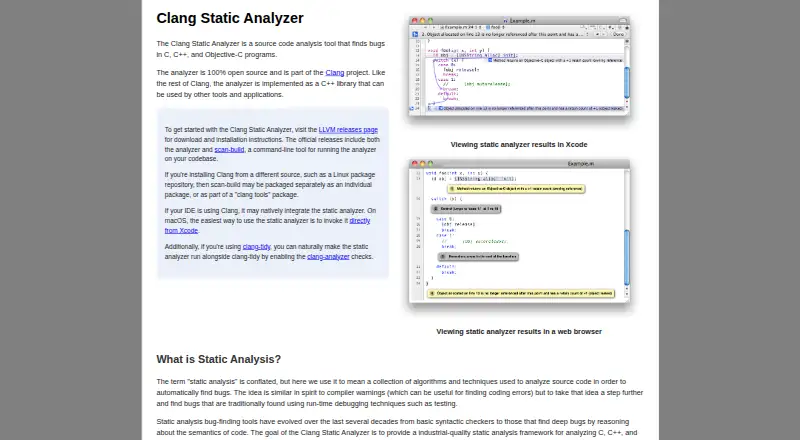
What Clang Static Analyzer is
Clang Static Analyzer is a free, open-source tool in the Clang project for finding bugs in C, C++, and Objective-C programs. It uses symbolic execution to analyze paths across function calls, and is designed to detect particular bug types rather than every possible problem. Its implementation is also a reusable C++ library for other tools and applications. Official releases include scan-build, a command-line tool for running analysis on a codebase. On macOS, the analyzer can be invoked from Xcode; it can also run alongside clang-tidy when clang-analyzer checks are enabled. Clang-based IDEs may integrate it directly, and its documentation offers guidance for scan-build and CodeChecker. The tool supports Linux, macOS, and Windows, and is self-hosted. Static analysis can take much longer than compilation, and some algorithms have exponential worst-case time. Results may include false positives, with frequency varying by check. LLVM releases use the Apache-2.0 with LLVM-exception license; LLVM also provides signed source packages and git tags for verification.
Who it suits
It suits developers working with C, C++, or Objective-C who want static analysis within a Clang-based workflow. It can also suit tool builders needing a reusable C++ analysis library.
What it does well
- Free and open source
- Supports C, C++, and Objective-C
- Includes scan-build for command-line analysis
- Can run alongside clang-tidy
- Clang-based IDEs may integrate it natively
What to know first
- Analysis can take longer than compilation
- Some algorithms have exponential worst-case time
- May report false positives
- Detects only bugs it was engineered to find
Plans
| Plan | Billed and limits | Price |
|---|---|---|
| Clang Static Analyzer | 100% open source · analyzes C, C++ and Objective-C | Free |
As clang-analyzer.llvm.org lists them, read 2 Oct 2026. The maker's own page has the final word.
Getting started
- Visit https://clang-analyzer.llvm.org/.
- Use an official release and its scan-build command-line tool to analyze a codebase.
- On macOS, invoke the analyzer from Xcode.
- Enable clang-analyzer checks to run it alongside clang-tidy.
- Use a Clang-based IDE integration when available.
Overview
Clang Static Analyzer is a free, open-source bug-finding tool for C, C++ and Objective-C. It suits developers already working with Clang or Xcode who want analysis in a local workflow. Its path-aware analysis and integration options are useful, but slower runs, false positives and a deliberately bounded detection scope mean it works best alongside testing and code review.
The analyzer uses symbolic execution to follow program paths and examines behavior across function boundaries. That context can expose defects that statement-by-statement checks miss. It is also built as a reusable C++ library, allowing other tools and applications to use the analysis engine.
Deployment is self-hosted. Analysis may take substantially longer than compilation, and some algorithms have exponential worst-case time. Findings can include valid code, with false-positive frequency varying by check, so teams need a review process for warnings.
Key features
- Path-sensitive, inter-procedural analysis: Symbolic execution tracks paths and interactions across functions, giving developers more context than isolated statement checks.
- scan-build command line: Official releases include a command-line runner for analyzing a codebase, a practical fit for scripted or local build workflows.
- Xcode integration: On macOS, invoking the analyzer from Xcode is the simplest route, making it particularly suitable for Apple-platform developers using that IDE.
- clang-tidy compatibility: Analyzer checks can run alongside clang-tidy, consolidating two Clang-based checking workflows.
- IDE and library integration: Clang-based IDEs may provide native integration, while the reusable C++ library supports embedding in other tools and applications.
- Additional command-line guidance: Documentation covers scan-build and CodeChecker usage, giving teams more than one command-line-oriented workflow.
- Security analysis and custom rules: The analyzer is marked for security analysis and custom rules, useful when standard checks need to be extended.
- Open development: Users can report false positives, request features and submit patches. LLVM also provides release announcements through a Discourse forum and mailing-list category.
Pricing
Clang Static Analyzer costs free under its single “Clang Static Analyzer” plan. The plan is 100% open source and analyzes C, C++ and Objective-C. There is no paid tier or free trial to evaluate, so organizations get the complete published offering without seat fees or usage quotas. The trade-off is operational: teams must run and maintain the analyzer themselves, and budget for the review time caused by slower analysis and occasional false positives.
Current LLVM releases use the Apache-2.0 with LLVM-exception license. LLVM says source packages and git tags are signed by release managers and supplies GnuPG keys for verification, a useful assurance for teams that verify release artifacts.
Platforms
Official platform coverage includes Linux, macOS and Windows. macOS users have the clearest documented IDE path through Xcode. On other systems, scan-build and other command-line workflows are the practical choices; Clang-based IDEs may also integrate the analyzer natively.
Who it's for
This is a strong fit for C, C++ or Objective-C teams that want free, self-hosted analysis and already use Clang tooling, Xcode or clang-tidy. It also suits organizations that need an embeddable C++ analysis library or want to contribute checks and fixes upstream.
It is less suitable as a sole quality gate for teams that need broad bug coverage, predictable runtime or findings that require little triage. Its engineered check set cannot cover every defect, and long or worst-case exponential analyses can challenge large build pipelines.
Pros and cons
Pros
- Fully free and open source: There are no published license charges, making broad local adoption practical.
- Context-aware analysis: Path and inter-procedural reasoning can identify issues hidden from simpler checks.
- Flexible integration: scan-build, Xcode, clang-tidy, IDE support and a reusable library cover different development setups.
- Verifiable releases and community contribution: Signed artifacts, public support channels and patch submission help teams operate and improve the tool.
Cons
- Runtime overhead: Analysis can be much slower than compilation, with exponential worst-case behavior for some algorithms.
- False positives: Correct code may be flagged, and the rate differs by check, increasing triage work.
- Bounded detection: It finds only bug classes for which checks have been engineered, so coverage is not comprehensive.
- Self-hosted responsibility: Teams handle execution and integration rather than using a managed analysis service.
Alternatives
For a broader directory of options, see C and C++ Static Analysis Tools and Static Analysis Tools.
- CBMC is another free, cross-platform command-line tool for C and C++ under the BSD 4-clause license.
- Infer is a free, self-hosted option with downloadable binary, source-build and Docker delivery for supported languages.
- MATLAB Grader fits users who already have a MATLAB license under maintenance; LMS integration requires a qualifying academic license.
- Qodana is preferable when a freemium, hosted or self-hosted platform with a 30-day detailed history and team-oriented contributor billing is a better fit.
- Semgrep Code suits teams wanting a paid product with a free edition covering code and supply chain for up to 10 repositories and 10 contributors.
- CPAchecker is a free Apache 2.0-licensed alternative for Linux, macOS, Windows and self-hosted deployments.
- Flawfinder is free GPL-2.0+ open-source software for its supported platforms.
- Parasoft SOAtest is the alternative to consider when tailored, quote-based commercial pricing and a free trial are acceptable.
Verdict
Choose Clang Static Analyzer if you develop C, C++ or Objective-C and want a no-cost, self-hosted analyzer that fits Clang, Xcode, clang-tidy or custom tooling. Its main advantage is context-aware analysis without license fees. Look elsewhere if you need comprehensive defect coverage, consistently fast analysis or a managed service with less warning triage.
Verdict
Clang Static Analyzer offers free, self-hosted analysis for three languages, with command-line and potential IDE integration. Its limited detection scope, runtime, and possible false positives matter when interpreting results.
Questions
How much does Clang Static Analyzer cost?
The listed plan is free. The analyzer is 100% open source.
Which programming languages does it analyze?
It analyzes C, C++ and Objective-C programs.
Which platforms does it support?
It runs on Linux, macOS and Windows.
Is it open source?
Yes. It is part of the Clang project. Current LLVM releases are distributed under the Apache-2.0 license with the LLVM exception.
How can I run it?
Official releases include scan-build, a command-line tool. On macOS it can be invoked from Xcode, and it can also run alongside clang-tidy.
What are its analysis limitations?
It can only detect bugs it was engineered to find. Analysis may be slower than compilation, some algorithms have exponential worst-case time, and checks can produce false positives.
Facts from Clang Static Analyzer's own pages
- Additional tooling
- The documentation provides command-line usage guidance for scan-build and CodeChecker. · clang.llvm.org, 2 Oct 2026
- Analysis method
- It implements path-sensitive, inter-procedural analysis based on symbolic execution. · clang.llvm.org, 2 Oct 2026
- clang-tidy integration
- The analyzer can run alongside clang-tidy by enabling clang-analyzer checks. · clang.llvm.org, 2 Oct 2026
- Command line
- Official releases include scan-build, a command-line tool for running the analyzer on a codebase. · clang.llvm.org, 2 Oct 2026
- Community support
- LLVM provides a Discourse forum and mailing-list announcement category for release notifications. · releases.llvm.org, 2 Oct 2026
- Contributions
- Users can report false positives, file feature requests or contribute patches. · clang.llvm.org, 2 Oct 2026
- False positives
- The analyzer can falsely flag bugs in code that behaves correctly, with frequency varying by check. · clang.llvm.org, 2 Oct 2026
- IDE integration
- An IDE using Clang may natively integrate the static analyzer. · clang.llvm.org, 2 Oct 2026
- Library
- The analyzer is implemented as a reusable C++ library for other tools and applications. · clang.llvm.org, 2 Oct 2026
- License
- Current LLVM releases are distributed under the Apache-2.0 with LLVM-exception license. · releases.llvm.org, 2 Oct 2026
- Open source
- The analyzer is 100% open source and part of the Clang project. · clang.llvm.org, 2 Oct 2026
- Performance limitation
- Static analysis can be much slower than compilation and some algorithms require exponential time in the worst case. · clang.llvm.org, 2 Oct 2026
- Purpose
- Clang Static Analyzer finds bugs in C, C++ and Objective-C programs. · clang.llvm.org, 2 Oct 2026
- Release verification
- LLVM says source packages and git tags are signed by release managers and provides GnuPG keys for verification. · releases.llvm.org, 2 Oct 2026
- Scope limitation
- The analyzer can only find bugs it has been specifically engineered to find. · clang.llvm.org, 2 Oct 2026
- Xcode integration
- On macOS, the easiest way to use the analyzer is to invoke it directly from Xcode. · clang.llvm.org, 2 Oct 2026
Where Clang Static Analyzer stands on Freedom251
- C and C++ Static Analysis Tools#3 of 25
- Static Analysis Tools#6 of 38