Bandit
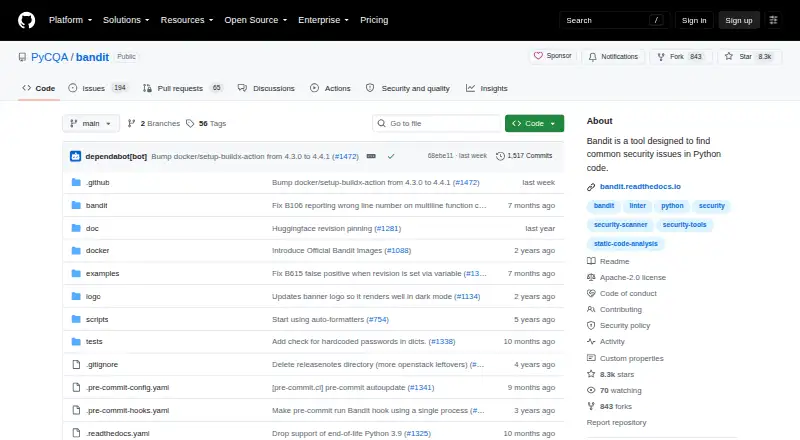
What Bandit is
Bandit is a free security linter for Python code. It builds an abstract syntax tree from source files and runs plugins against the tree's nodes to identify common security issues, then generates a report. The project recommends installing it from PyPI with pip. Optional installation extras add TOML support, the bandit-baseline command-line tool, and SARIF output formatting. A JSON baseline report can be used to set aside known findings considered non-issues. Bandit supports pre-commit hooks, and listed integrations include Visual Studio Code, Sublime Text, Vim and Neovim, Emacs, GitHub Actions, Jenkins, Ruff, and Flake8. It is available for Linux and macOS and can be used in self-hosted environments. The project publishes container images for amd64, arm64, armv7, and armv8; it says each image is signed with Sigstore Cosign and provides a way to verify its origin. The library is licensed under Apache License 2.0. Support links include a GitHub issue tracker and a Discord community. Vulnerability reports should be submitted through GitHub's private reporting, with reporters also asked to inform Tidelift security.
Who it suits
Bandit suits Python developers and teams who want to scan source code for common security issues. Its documented integrations and pre-commit hook support fit workflows using editors or CI tools.
What it does well
- Free under Apache License 2.0.
- Scans Python code and generates reports.
- JSON baseline can exclude known non-issues.
- Pre-commit, editor, and CI integrations listed.
- Container images cover four architectures.
What to know first
- Targets Python code only.
- Documentation recommends installation with pip.
- No free trial is listed.
Plans
| Plan | Billed and limits | Price |
|---|---|---|
| Bandit | Free software · Apache License 2.0 | Free |
| Free | Free software · open-source Python security linter · self-hosted CLI/container use | Free |
As github.com lists them, read 5 Oct 2026. The maker's own page has the final word.
Getting started
- Open the Bandit project website on GitHub.
- Install Bandit from PyPI using pip, as the documentation recommends.
- Choose any optional installation extras needed for TOML support, bandit-baseline, or SARIF output.
- Configure Bandit as a pre-commit hook or use one of its listed integrations.
- Scan Python files and review the generated report.
Bandit is a free security linter for Python source code. It suits developers and teams that want security checks embedded in editors, commits, or CI without adopting a hosted platform. The tradeoff is focus: Bandit addresses Python code rather than broad, multi-language application security.
Overview
Bandit parses Python into an abstract syntax tree (AST), applies security plugins to the resulting nodes, and produces a report after scanning files. That design keeps analysis close to the source and makes the tool appropriate for code-review gates and developer feedback. It is less suitable when you need runtime monitoring, dependency coverage, or a single scanner spanning several programming languages.
The project is open source under the Apache License 2.0. Installation comes from PyPI, with pip recommended in the documentation, so teams can add it to an existing Python toolchain rather than adopt a separate service.
Key features
Focused scanning and baselines
Bandit’s plugin-based AST analysis is aimed at common security issues in Python. Teams can create custom security rules when the built-in checks do not match internal coding standards. A JSON baseline can suppress findings already judged to be non-issues, which is useful when introducing scanning to an established repository; it manages accepted noise but does not expand detection coverage.
Output and workflow integration
Optional installation extras provide TOML support, the bandit-baseline command-line interface, and SARIF output formatting. SARIF can make results easier to consume in compatible security workflows, while the baseline utility simplifies ongoing suppression management.
Editor integrations cover Visual Studio Code, Sublime Text, Vim and Neovim, and Emacs. CI options include GitHub Actions and Jenkins, with additional integrations for Ruff and Flake8. Configuring Bandit as a repository pre-commit hook catches issues before changes reach a remote branch, making it practical for teams that prefer fast local feedback.
Container distribution
A published image on ghcr.io supports amd64, arm64, armv7, and armv8 architectures. Each image is signed with Sigstore Cosign, and the project provides a command to verify its source of origin. That is a useful supply-chain control for teams standardising scanner execution in containers.
For maintenance and security communication, the project points users to its GitHub issue tracker and Bandit Discord community. Vulnerability reports go through GitHub’s private vulnerability reporting, with a request to inform Tidelift security as well.
Pricing
Bandit — free (Free software; Apache License 2.0). There is no free trial because the software is free, and no paid tier or seat allowance is described. This suits individual Python developers, open-source projects, and organisations that can run and maintain their own tooling. The cost advantage comes with operational responsibility: Bandit is a scanner you install and integrate, not a managed security service.
Platforms
Bandit runs on Linux and macOS and is available as self-hosted software. Its PyPI distribution, pip installation path, editor and CI integrations, and multi-architecture container image support local and pipeline deployment. Windows is not among the supported platforms stated for this entry.
Who it's for
Choose Bandit if your primary target is Python source and you want a focused SAST check in an IDE, pre-commit workflow, or CI/CD pipeline. It is particularly well suited to teams that need custom rules or a baseline to control accepted findings, and to organisations that require self-hosted execution.
Look elsewhere if your estate spans many languages, if dependency or live-application analysis is central, or if you want a vendor-managed platform with usage plans and service features.
Pros and cons
Pros
- Free and Apache-licensed: there is no subscription cost or trial expiry, making broad internal deployment straightforward.
- Python-specific AST analysis: plugins target common Python security issues directly in source code.
- Workflow breadth: editor, pre-commit, GitHub Actions, Jenkins, Ruff, and Flake8 integrations support different development habits.
- Baseline and custom rules: teams can reduce recurring noise and adapt checks to internal requirements.
- Verified containers: signed images across four listed architectures support controlled self-hosted execution.
Cons
- Narrow language scope: Python source is the stated target, so polyglot estates need additional tooling.
- Self-managed operation: installation, integration, and result handling remain the team’s responsibility.
- Baseline is suppressive, not expansive: it keeps known findings quiet but does not add new detection categories.
Alternatives
Semgrep Code is the better choice for teams needing a broader platform across API, extension, Linux, macOS, self-hosted, web, and Windows deployments, with a free edition capped at 10 repositories, 10 contributors, and 60 AI credits.
Snyk Open Source fits teams prioritising open-source dependency analysis and a hosted option; its free plan covers five projects, while the Team plan costs $25 a month for up to 10 developers.
MobSF is a free GPL-3.0 framework for broader mobile-security workflows, with a Professional plan priced at $2,999.99 a year.
Flawfinder is another free, self-hosted code scanner, aimed at a different analysis focus and supporting Windows as well as Linux and macOS.
NaiveSystems Analyze offers a freemium alternative with some open-source components, including an on-premises analysis runner.
NodeJsScan is a free, open-source, self-hosted option for Node.js projects, available through Docker or local setup.
Bearer provides a free open SAST CLI for Linux and macOS without stated numeric limits.
Brakeman is a free vulnerability scanner for Ruby on Rails applications, with free non-commercial use noted by its GitHub README.
For broader comparisons, see SAST Tools and Static Application Security Testing Software.
Verdict
Bandit is the right choice for Python-focused teams that want a free, self-hosted security gate with editor, pre-commit, and CI integration, plus baselines and custom rules. Choose it for practical source-level Python checks; look elsewhere when you need multi-language coverage, dependency analysis, or a managed application-security platform.
Verdict
Bandit focuses on Python security linting, with options for baselines, formatted output, and integration into development workflows. Its project documentation also provides support links and a private vulnerability-reporting route.
Questions
How much does Bandit cost?
Bandit is free software. Its listed plan is free.
Is Bandit open source?
The documentation identifies the Bandit library license as Apache License 2.0.
Which platforms does Bandit support?
The listed platforms are Linux, macOS, and self-hosted environments.
What does Bandit analyze?
Bandit scans Python source code, building an abstract syntax tree and running plugins against its nodes to find common security issues.
What integrations are listed?
The documentation lists Visual Studio Code, Sublime Text, Vim/Neovim, Emacs, GitHub Actions, Jenkins, Ruff, and Flake8.
Where can users get support?
The documentation links to the GitHub issue tracker and a Bandit Discord community.
Facts from Bandit's own pages
- Baseline
- A JSON baseline report can be used to ignore known findings considered non-issues. · bandit.readthedocs.io, 5 Oct 2026
- Baselines
- Bandit can compare a scan with a JSON baseline report to suppress known findings. · bandit.readthedocs.io, 21 Oct 2026
- Community listing rating
- HelloGitHub shows 0 ratings for the PyCQA/bandit repository. · hellogithub.com, 21 Oct 2026
- Configuration
- Configuration files can select or skip tests, change plugin settings, exclude paths, and define profiles. · bandit.readthedocs.io, 21 Oct 2026
- Container
- Official container images are published on ghcr.io for amd64, arm64, armv7, and armv8. · github.com, 21 Oct 2026
- Documentation depth
- The documentation site includes getting started, configuration, integrations, plugin references, formatter references, CI/CD guidance, FAQs, and API modules. · bandit.readthedocs.io, 21 Oct 2026
- Formatter extensibility
- Report formatters are themselves plugins and additional formatter entry points can be registered through setuptools or pbr. · ericwbbandit.readthedocs.io, 21 Oct 2026
- GitHub Action
- The official GitHub Action supports Python version, profile, tests, skips, severity, confidence, exclusions, baseline, ini, and target inputs. · github.com, 21 Oct 2026
- Image verification
- The project says every container image is signed with Sigstore Cosign and provides a command to verify its source of origin. · github.com, 5 Oct 2026
- Installation
- The documented primary installation method is pip, with optional extras for TOML, baseline, and SARIF support. · bandit.readthedocs.io, 21 Oct 2026
- Integrations
- Official integration documentation lists VS Code, Sublime Text, Vim/Neovim, Emacs, GitHub Actions, Jenkins, Ruff, and Flake8. · ericwbbandit.readthedocs.io, 21 Oct 2026
- Intended use
- The project describes Bandit as a security linter for Python code. · github.com, 5 Oct 2026
- License
- The project is distributed under the Apache License 2.0. · github.com, 21 Oct 2026
- Limit: no platform governance
- Independent guidance describes Bandit as a local CLI without centralized dashboards, policy management, or cross-project reporting. · zairalabs.ai, 21 Oct 2026
- Limit: Python-only scope
- Independent reviews identify the Python-only, source-pattern focus as a limitation for polyglot repositories. · gitnux.org, 21 Oct 2026
- Limit: shallow analysis
- Independent guidance says Bandit cannot follow dynamic behavior or provide deep interprocedural dataflow analysis. · zairalabs.ai, 21 Oct 2026
- Maker structure
- PyCQA expands to Python Code Quality Authority and is described by its own documentation as a loose organization of project maintainers. · meta.pycqa.org, 21 Oct 2026
- Operating systems
- PyPI classifies the package for macOS and POSIX/Linux environments. · pypi.org, 21 Oct 2026
- Plugin extensibility
- Third-party test plugins are registered through bandit.plugins entry points and receive a context object and AST node. · zairalabs.ai, 21 Oct 2026
- Praise: CI output
- GitNux highlights CI-friendly output formats that can feed automated reporting and dashboards. · gitnux.org, 21 Oct 2026
- Praise: configurable rules
- GitNux praises the plugin-based engine, configurable filtering, and ability to add or tailor checks. · gitnux.org, 21 Oct 2026
- Pre-commit
- The project documents a pre-commit hook configuration using the PyCQA/bandit repository. · bandit.readthedocs.io, 21 Oct 2026
- Project origin
- Bandit began in the OpenStack Security Project and was later moved to PyCQA. · github.com, 21 Oct 2026
- Purpose
- Bandit scans Python code to find common security issues by building an AST and running plugins against its nodes. · github.com, 5 Oct 2026
Where Bandit stands on Freedom251
- SAST Tools#1 of 26
- Static Application Security Testing Software#1 of 25