Freedom251 › Autonomous Networks

Selector
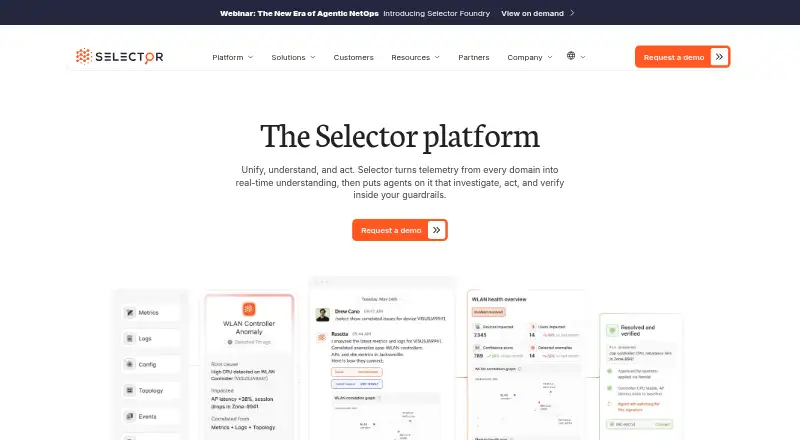
What Selector is
Selector brings telemetry from network, cloud, infrastructure, and application systems together to help teams investigate incidents and respond. It connects to more than 300 sources and collects metrics, logs, configurations, and flows without agents. The platform correlates events, metrics, and logs, using baselines, rules, and machine learning to identify anomalies and build a live knowledge graph. It links incidents across infrastructure, applications, and services with explainable root-cause insights. Rosetta lets teams ask operational questions in plain language, while Foundry coordinates specialist agents to investigate, act, and verify within user-defined guardrails. Agents can be governed in a Git repository under existing role-based access controls, and actions await approval. Selector supports MCP and A2A connections and the customer’s choice of LLM. It is Kubernetes-native, with on-premises, customer-cloud, and SaaS deployment options. Pricing is on request. The contact page invites visitors to try it for free but does not specify duration or self-serve access.
Who it suits
Selector names network operations teams, network architects, executive leaders, application developers, and site reliability engineers as intended users. It suits teams that need to connect operational telemetry with incident investigation and governed agent workflows.
What it does well
- Collects telemetry from 300+ sources without agents
- Links incidents across infrastructure, apps, and services
- Plain-language operational questions through Rosetta
- Agent actions wait for approval
- On-premises, customer-cloud, or SaaS deployment
What to know first
- Pricing is available on request
- Free access terms are unspecified
Getting started
- Open https://www.selector.ai/platform/.
- Contact sales to discuss pricing and the free access invitation.
- Select an on-premises, customer cloud, or SaaS deployment.
- Connect telemetry sources and integrations relevant to your operations.
- Set user-defined guardrails and approval requirements for Foundry agent actions.
Overview
Selector brings network, cloud, infrastructure, and application telemetry into one operations platform, with incident analysis and governed response workflows. It is best suited to organizations managing complex, cross-domain environments. Its breadth is a strong reason to consider it; custom pricing and approval-gated actions may not suit teams seeking a simple, self-serve tool.
Key features
Telemetry and incident analysis
Selector collects metrics, logs, configurations, and flows from more than 300 telemetry sources without agents. It correlates events, metrics, and logs using baselines, rules, and machine learning, then builds a live knowledge graph to connect incidents across infrastructure, applications, and services. That can give operations teams a shared route from anomaly detection to explainable root-cause insights instead of forcing each domain to be investigated in isolation.
The integrations page describes more than 500 integrations across network, infrastructure, containers, and apps, including IP Fabric, LogicMonitor, Moogsoft, and SQL databases. The breadth is relevant to organizations with mixed environments, although teams should confirm that their required systems are covered.
Natural-language investigation and agents
Rosetta lets teams ask operational questions in plain language and returns explainable answers grounded in operational context. Foundry orchestrates specialist agents to investigate, act, and verify. Together, they connect incident context with response workflows, but automation remains deliberately controlled: agents run within user-defined guardrails, actions wait for approval, and activity leaves an auditable trail.
Foundry agents can be built and governed in a Git repository under existing role-based access controls. Selector also supports connecting tools over MCP and A2A and running on the customer’s choice of LLM. These controls and extension points suit organizations that need to govern how agents work; they add less value to teams that want unattended remediation without an approval step.
Pricing
Selector is a paid platform with custom pricing. The contact page invites visitors to try it for free and directs them to contact sales, but does not state a trial duration or describe a self-serve free plan. That route may let interested teams explore access, but buyers should clarify whether the free access is a trial, what it includes, and what follows before committing.
Selector does not publish plan tiers, prices, seat allowances, quotas, or renewal terms. Teams comparing budgets will need a sales conversation to establish scope and cost.
Platforms
Selector supports API, Linux, self-hosted, and web platforms. It is Kubernetes-native and can be deployed on-premises, in a customer cloud, or as SaaS, giving organizations a choice of deployment environment rather than requiring one hosting model.
Who it's for
Selector names network operations teams, network architects, executive leadership, application developers, and site reliability engineers among its intended users. It is most compelling where these groups need to connect telemetry across domains and coordinate incident response. Organizations that need a self-serve price, clearly defined free-plan limits, or actions executed without approval should look elsewhere.
Pros and cons
- Pros: Agentless collection across more than 300 telemetry sources and more than 500 integrations supports broad, cross-domain visibility.
- Pros: Correlation, a live knowledge graph, and explainable root-cause insights connect detection with investigation.
- Pros: User guardrails, role-based access controls, Git-based governance, approval gates, and audit trails give teams control over agent actions.
- Cons: Custom pricing and sales-directed free access make it harder to assess cost or start independently.
- Cons: Approval before execution limits how far teams can automate action without human review.
Alternatives
For a broader comparison, browse AIOps Platforms.
- NetAI may fit teams that want a free Core platform for 1–10 devices and a published paid option.
- Saneops may suit teams seeking a free, self-hosted or web option with a 1,000-alert monthly allowance.
- BMC Helix AIOps is another paid option, with custom pricing and API, Linux, web, and Windows platforms.
- Digitate ignio AIOps may suit buyers interested in per-event IT Event Management or per-assist Document Assist pricing.
- Dell APEX AIOps Incident Management is another paid option with pricing stated in the customer quote.
- Keep may suit teams seeking a freemium option with a published Growth plan that specifies alert, workflow, integration, user, and retention limits.
- Vitria VIA AIOps is another paid option.
- BigPanda may suit buyers looking for tiered credits with a stated one- to three-year commitment and a shared credit pool.
Verdict
Choose Selector if your organization needs broad telemetry correlation, explainable cross-domain incident analysis, and agent workflows governed by existing controls. Its combination of context and guarded orchestration is the main reason to shortlist it. Look elsewhere if public pricing, a clearly defined self-serve free tier, or execution without approval is essential.
Verdict
Selector combines broad telemetry correlation and explainable incident analysis with agent workflows that remain subject to user guardrails and approval. Teams considering it will need to ask about pricing and clarify the terms of free access.
Questions
How much does Selector cost?
Pricing is on request.
Can I try Selector for free?
The contact page invites visitors to try Selector for free and directs them to contact sales. It does not state a trial duration or self-serve free plan.
Which deployment options are available?
Selector describes deployment as Kubernetes-native and available on-premises, in a customer cloud, or as SaaS.
What telemetry does Selector collect?
It collects metrics, logs, configurations, and flows from more than 300 sources without agents.
What integrations does Selector support?
Its integrations span network, infrastructure, containers, and apps, with examples including IP Fabric, LogicMonitor, Moogsoft, and SQL databases.
How are Foundry agents governed?
Teams can govern agents in a Git repository under existing role-based access controls. Agents operate within user-defined guardrails, leave an auditable trail, and wait for approval before executing actions.
Facts from Selector's own pages
- Agent governance
- Foundry supports building and governing agents in a Git repository under existing role-based access controls, and actions wait for approval before execution. · selector.ai, 2 Oct 2026
- Agentic operations
- Foundry orchestrates specialist agents that investigate, act, and verify within user-defined guardrails. · selector.ai, 2 Oct 2026
- Agent orchestration
- Foundry turns correlated context into agents, while Rosetta interprets intent and orchestrates specialist agents over MCP and A2A. · selector.ai, 3 Oct 2026
- Company
- Selector Software, Inc. lists its headquarters in Santa Clara, California. · selector.ai, 3 Oct 2026
- Correlation
- Selector correlates events, metrics, and logs, applies baselines, rules, and machine learning to detect anomalies, and builds a live knowledge graph. · selector.ai, 3 Oct 2026
- Correlation and anomaly detection
- Selector correlates events, metrics, and logs, applies baselines, rules, and machine learning to detect anomalies, and builds a live knowledge graph. · selector.ai, 2 Oct 2026
- Deployment
- Selector describes deployment as Kubernetes-native and available on-premises, in a customer cloud, or as SaaS. · selector.ai, 3 Oct 2026
- Extensibility
- The platform supports connecting tools over MCP and A2A and running on the customer’s choice of LLM. · selector.ai, 2 Oct 2026
- Founded
- Selector says it was founded in 2019. · selector.ai, 3 Oct 2026
- Free access
- Selector’s contact page invites visitors to try Selector for free and directs them to contact sales; it does not state trial duration or a self-serve free plan. · selector.ai, 2 Oct 2026
- Governance
- Foundry agents operate within user-set guardrails, leave an auditable trail, and do not execute actions until approved. · selector.ai, 3 Oct 2026
- Headquarters
- Selector Software, Inc. lists its headquarters in Santa Clara, California. · selector.ai, 2 Oct 2026
- Integrations
- Selector’s integrations page describes 500+ integrations and lists categories including alerting, APM, ITSM, logs, metrics, public cloud, and network devices. · selector.ai, 3 Oct 2026
- Intended users
- Selector names network operations, network architects, executive leadership, application developers, and site reliability engineers as audiences. · selector.ai, 3 Oct 2026
- Natural language
- Rosetta lets teams ask questions in plain language and get explainable answers using operational context. · selector.ai, 2 Oct 2026
- Purpose
- Selector unifies telemetry across domains and uses agents to investigate, act, and verify within configured guardrails. · selector.ai, 3 Oct 2026
- Root cause analysis
- Selector links incidents across infrastructure, apps, and services and delivers root cause analysis to Slack, Teams, or ITSM tools. · selector.ai, 3 Oct 2026
- Support
- The company lists [email protected] and links to its support portal. · selector.ai, 3 Oct 2026
- Target users
- The platform lists network operations teams, network architects, executives, application developers, and site reliability engineers among its intended users. · selector.ai, 2 Oct 2026
- Telemetry ingestion
- The platform connects to 300+ telemetry sources across network, cloud, and edge, collecting metrics, logs, configs, and flows without agents. · selector.ai, 3 Oct 2026
Where Selector stands on Freedom251
- Autonomous Networks#3 of 17
- AIOps Platforms#5 of 19