
Keep
What Keep is
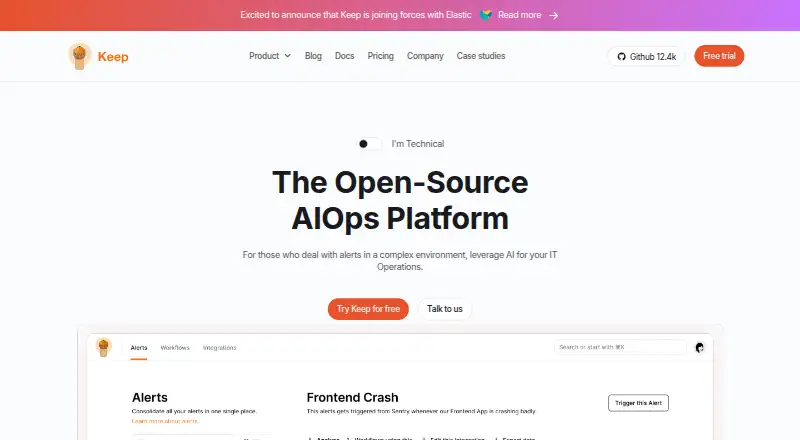
Keep is an open-source alert management and AIOps platform for organizing alerts, automating workflows, and reducing noise. Its alert workspace supports querying, slicing, data analysis, and rule-based grouping. A YAML-based workflow engine with a UI can query MySQL, enrich alerts, update Jira tickets, and run Python scripts. Keep lists more than 110 providers, with bidirectional integrations across monitoring, incident response, ticketing, source control, change management, and CMDB systems. It can be self-hosted or used as a managed cloud service; self-hosting options include local and Kubernetes deployments using Helm or Docker Compose. Enterprise offers managed on-premises or cloud deployment and alert correlation informed by past incidents and a knowledge base. Growth costs $199 a month and includes 200 deduplicated alerts monthly, unlimited ingested alerts, 100 workflows, 20 integrations, 10 users, and 14 days of data retention. Startup is listed for personal or non-commercial projects, with five workflows, one integration, and one user. Support ranges from community-based on Startup to 24/7 on Enterprise.
Who it suits
Keep suits teams that need to consolidate alerts and automate work across monitoring, ticketing, and related systems. Its listed plans cover small or personal projects through enterprise deployments, though Startup and Growth have explicit limits.
What it does well
- Alert workspace supports querying and rule-based grouping
- Workflow engine can enrich alerts and update Jira tickets
- Lists more than 110 providers
- Can be self-hosted or used as managed cloud
- Enterprise includes alert correlation and 24/7 support
What to know first
- Startup is limited to five workflows
- Startup includes one integration and one user
- Growth includes 200 deduplicated alerts per month
- Growth retains data for 14 days
Plans
| Plan | Billed and limits | Price |
|---|---|---|
| Growth | 200 deduplicated alerts / month · Unlimited ingested alerts · 100 workflows · 20 integrations · 10 users · 2 Weeks Data Retention | $199 a month |
| Startup | 5 workflows · 1 integration · 1 user · For personal or non-commercial projects | On request |
| Enterprise + AI | Unlimited workflows · Unlimited integrations · Unlimited users · 99.99% SLA · 24/7 Support · Managed On-Prem or Cloud Deployment | On request |
As keephq.dev lists them, read 30 Sept 2026. The maker's own page has the final word.
Keep is an open-source platform for controlling operational alerts and automating the work that follows them. It fits teams that need one coordination layer across monitoring and service tools, especially those comfortable self-hosting or moving to Enterprise for scale. The main choice is whether the lower tiers’ user, integration, workflow and retention ceilings match your operation.
Overview
Keep centralizes alert querying, slicing and analysis, then applies rule-based grouping to reduce duplicate or distracting notifications. Deduplication, routing, enrichment and suppression rules help direct incidents to the right response instead of leaving operators to sort an undifferentiated stream.
It is also an automation layer. The YAML workflow engine has a user interface and can query MySQL, enrich an alert, update Jira tickets or execute Python scripts. That combination is well suited to teams that want repeatable remediation and ticket handling rather than another read-only alert dashboard.
Keep lists more than 110 providers, with bidirectional integrations spanning monitoring, incident response, ticketing, source control, change management and CMDB systems. This breadth can connect a mixed operations stack, although Startup and Growth sharply restrict how much of that breadth you can use.
Key features
Alert control
Grouping, deduplication, routing and suppression address the common problem of noisy, repeated alerts. Growth allows unlimited ingested alerts but counts only 200 deduplicated alerts per month, so teams with many distinct incidents may reach the allowance even when ingestion itself is unrestricted.
Workflow automation
Visual access to YAML workflows lowers the barrier to automating database lookups, enrichment, Jira updates and Python actions. It is a strong fit for operations teams with established procedures; teams wanting only basic notification forwarding may not need this level of orchestration.
AIOps and deployment
Enterprise + AI adds alert correlation based on past incidents and a knowledge base. Keep can run locally or on Kubernetes through Helm or Docker Compose, with deployments provisioned as code, or operate as a managed cloud service. Enterprise adds managed on-premises or cloud deployment, 99.99% SLA and 24/7 support.
Pricing
Startup
Startup has custom pricing and is aimed at personal or non-commercial projects. It permits five workflows, one integration and one user, with community-based support. Those limits make it suitable for a small proof of concept, but restrictive for a shared production operation.
Growth
Growth costs $199 a month. It includes 200 deduplicated alerts per month, unlimited ingested alerts, 100 workflows, 20 integrations, 10 users and two weeks of data retention, plus dedicated Slack support. It is the practical tier for a small operations group that can stay within the alert allowance; ten users and twenty integrations can still constrain a growing service organization, and fourteen days of retention limits historical analysis.
Enterprise + AI
Enterprise + AI uses custom pricing and removes the listed workflow, integration and user limits. It adds AIOps correlation, a 99.99% SLA, 24/7 support and managed on-premises or cloud deployment. This is the appropriate route for large, distributed teams or organizations with deployment and service-level requirements.
A free plan and free trial are available, making Startup a low-risk way to assess the workflow model before committing. Keep’s privacy policy identifies Google Cloud Platform in Iowa, United States as a personal-information storage location and describes reasonable technical, organizational and security measures; organizations with residency requirements should account for that location.
Platforms
Keep is offered through an API and web interface, and can be self-hosted. Local, Docker Compose and Kubernetes-with-Helm deployment paths suit teams that want infrastructure control, while managed cloud avoids maintaining the platform.
Who it's for
Keep is a strong match for teams managing Prometheus-style alerts that need enrichment and routing, and for enterprises connecting many operational systems or synchronizing ServiceNow tickets. It is less suitable when you need many users, integrations or long retention at a modest price, unless Enterprise economics are acceptable.
Pros and cons
Pros
- Broad connectivity: More than 110 bidirectional providers can bridge monitoring, ticketing, source control and CMDB tools.
- Actionable automation: MySQL queries, Jira updates, enrichment and Python execution turn alert rules into operational workflows.
- Flexible deployment: Self-hosting, managed cloud and Enterprise managed on-premises cover different infrastructure policies.
- Noise controls: Deduplication, grouping and suppression help focus response on meaningful incidents.
Cons
- Strict entry-tier caps: Startup allows one user and integration; Growth allows ten users and twenty integrations.
- Limited Growth history: Two weeks of retention can be inadequate for trend analysis or post-incident review.
- Deduplicated-alert ceiling: Growth’s 200-per-month allowance may become the binding limit for busy teams despite unlimited ingestion.
- Advanced AIOps is Enterprise-only: Correlation and the broadest capacity require custom pricing.
Alternatives
Choose NetAI when a free core platform for 1–10 devices and support across API, Linux, Windows and self-hosted environments is the priority; its Core Enterprise plan is $5.99 a month.
Saneops is a better fit for a free, self-hosted or web option with a 1,000-alert-per-month tier and no credit card requirement.
Pick BMC Helix AIOps when you need a paid enterprise product across API, Linux, web and Windows and are prepared to contact sales.
Digitate ignio AIOps suits buyers wanting event-based pricing, including $0.10 per event for IT Event Management with noise suppression and AI correlation.
Consider Selector for a paid platform available through API, Linux, self-hosted and web deployments.
Dell APEX AIOps Incident Management is an alternative when subscription terms are handled through a customer quote.
Vitria VIA AIOps offers paid API, self-hosted and web deployment.
BigPanda is aimed at buyers comfortable with value-based subscription pricing and one- to three-year commitments.
For broader discovery, browse AIOps Platforms and Alert Management Software.
Verdict
Choose Keep if you need open-source alert coordination, substantial integrations and workflows that can take action across your toolchain. Look elsewhere if Growth’s 200 deduplicated alerts, 10-user limit or 14-day retention do not fit, or if you want advanced AIOps without moving to a custom-priced Enterprise plan.
Verdict
Keep pairs alert organization with workflow automation and a broad set of listed integrations. Growth costs $199 a month; prospective users should weigh its alert and retention limits against their needs.
Facts from Keep's own pages
- AI features
- The Enterprise plan includes AIOps alert correlation; the homepage describes correlation using past incidents and a knowledge base. · keephq.dev, 30 Sept 2026
- Alert management
- Keep provides a single pane of glass for alerts, with querying, slicing, data analysis, and rule-based grouping. · keephq.dev, 30 Sept 2026
- Company
- The company says it is remote-first and headquartered in Tel Aviv, Israel. · keephq.dev, 30 Sept 2026
- Deployment
- Keep can be self-hosted or used as a managed cloud service; Enterprise offers managed on-premises or cloud deployment. · keephq.dev, 30 Sept 2026
- Headquarters
- Tel Aviv, Israel · keephq.dev, 28 Sept 2026
- Integrations
- Keep lists 110+ providers and describes bidirectional integrations across monitoring, incident response, ticketing, source control, change management, and CMDB systems. · keephq.dev, 30 Sept 2026
- Intended users
- Keep describes the product as serving teams from small teams managing Prometheus alerts to enterprises connecting many tools and syncing ServiceNow tickets. · docs.keephq.dev, 30 Sept 2026
- Plan limits
- Startup is limited to 5 workflows, 1 integration, and 1 user; Growth is limited to 100 workflows, 20 integrations, and 10 users. · keephq.dev, 30 Sept 2026
- Privacy and security
- Keep's privacy policy says it maintains reasonable technical, organizational, and security measures, and identifies Google Cloud Platform in Iowa, United States as a personal-information storage location. · keephq.dev, 30 Sept 2026
- Product
- Keep is an open-source alert management and AIOps platform for alerting, automation, and noise reduction. · docs.keephq.dev, 30 Sept 2026
- Self-hosting options
- The documentation says Keep can be started locally or on Kubernetes using Helm or Docker Compose, and deployments can be provisioned as code. · docs.keephq.dev, 30 Sept 2026
- Support
- Startup includes community-based support, Growth includes dedicated Slack support, and Enterprise includes 24/7 support. · keephq.dev, 30 Sept 2026
- Workflow automation
- Its YAML-based workflow engine has a UI and can query MySQL, enrich alerts, update Jira tickets, and execute Python scripts. · keephq.dev, 30 Sept 2026
Where Keep stands on Freedom251
- AIOps Platforms#2 of 19
- Alert Management Software#6 of 36