Freedom251 › Error Monitoring Software
Sankofa Catch
What Sankofa Catch is
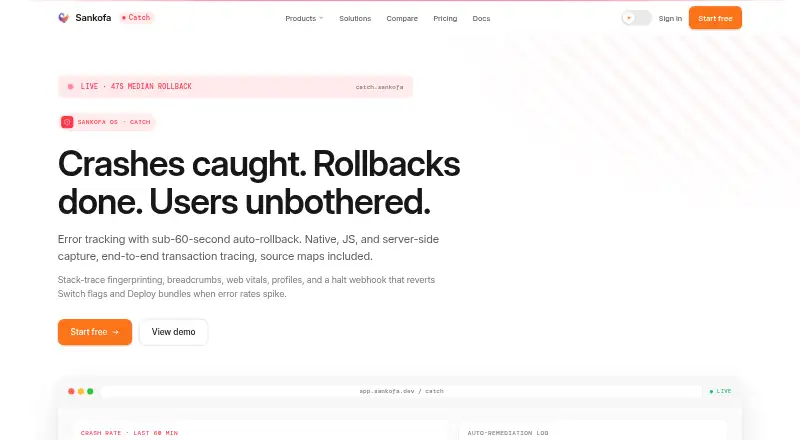
Sankofa Catch provides error tracking and performance monitoring, capturing uncaught exceptions, unhandled rejections, native crashes, ANRs, breadcrumbs, transactions, web vitals, and server profiling data. Official SDKs support Web, Flutter, React Native, Android, iOS, Node, Go, Java, and Python. Catch groups events using exception type, normalized stack trace, and message, with custom fingerprints also available. It supports JavaScript source maps, iOS dSYM bundles, Android ProGuard or R8 mappings, Android NDK symbols, and Flutter symbols. Alerts can trigger webhooks, Slack messages, or PagerDuty pages. When error rates cross a configured threshold, Catch can send a halt webhook to Switch and trigger Deploy to revert an eligible React Native OTA bundle. The SDKs provide a beforeSend hook for modifying or dropping events before transmission; replay PII is masked at capture. Catch has a free plan and paid plans from $9 a month. It can run on customer infrastructure, with air-gapped operation available on Enterprise.
Who it suits
Catch suits software teams monitoring errors and performance across supported platforms, from indie makers and side projects to scale-ups. Teams can choose cloud or self-hosted deployment; air-gapped operation is available on Enterprise.
What it does well
- Official SDKs cover web, mobile, and server languages.
- Supports multiple platform-specific symbol and source-map formats.
- Alerts can reach webhooks, Slack, or PagerDuty.
- Self-hosting is available on customer infrastructure.
- Free plan includes 5,000 errors per month.
What to know first
- Hobby has no email support.
- Free event retention is 30 days.
- Paid plans start at $9 a month.
- Air-gapped operation is limited to Enterprise.
Limits
Free includes 5,000 errors and 10,000 performance events monthly, 500 profiles, 500 replay views monthly, 30-day event retention, three-day replay retention, one project, three seats, and a live environment. Starter costs $9/month and includes 25,000 errors, 50,000 performance events, two projects, five seats, and 60-day retention.
Plans
| Plan | Billed and limits | Price |
|---|---|---|
| Free | $0/ month · 5k errors + 10k performance events/month · 500 profiles · 500 replay views · 30-day event retention · 3-day replay retention · 1 project · 3 seats · live environment · all 8 SDKs | Free |
| Booster pack | $10 / 30 days · +25k error events for the current month · does not extend retention | $10, paid once |
| Pro | $24/ month · 75k errors + 200k performance events/month · 5k profiles · 1k replay views · 90-day retention · 5 projects · unlimited seats · auto-halt and auto-rollback · Plan auto-ticket · distributed tracing · network and database query tracking · 3 webhooks | $24 a month |
| Growth | $60/ month · 400k errors + 1M performance events/month · 25k profiles · 3k replay views · 365-day retention · unlimited projects and environments · conditional rollback rules · PagerDuty · per-environment permissions · 25 webhooks · JSON audit-log export | $60 a month |
| Starter | $9/ month · 25k errors + 50k performance events/month · 2k profiles · 750 replay views · 60-day retention · 2 projects · 5 seats · live + staging · custom fingerprints · email and Slack alerts · 1 webhook | $9 a month |
| Enterprise | Custom · Custom event volume and retention · legal hold · SAML 2.0 SSO · SCIM 2.0 · field-level PII redaction · DLP · SIEM export on request · dedicated infrastructure · region pinning · 99.95% SLA | On request |
As sankofa.dev lists them, read 15 Oct 2026. The maker's own page has the final word.
Getting started
- Open the Catch website.
- Choose the Free plan or a paid plan.
- Select a supported platform and use its official SDK.
- Configure event capture and, if needed, custom fingerprints.
- Set up alerts or a supported halt and rollback integration.
Sankofa Catch is an application error-tracking and performance-monitoring service for teams working across web, mobile, and server platforms. It suits indie developers through larger engineering teams, especially React Native teams that can use its OTA rollback workflow. Its appeal is the breadth of captured signals and release safeguards; quotas and retention vary enough by plan to make workload a key part of the choice.
Overview
Catch captures uncaught exceptions, unhandled rejections, native crashes, ANRs, breadcrumbs, transactions, web vitals, and server profiling data. Errors are grouped by exception type, normalized stack trace, and message, with custom fingerprints for teams that need to tune grouping.
Alerts can trigger webhooks, Slack messages, or PagerDuty pages. A configured Plan integration can create a ticket when a halt occurs. Catch can also send a halt webhook to Switch and trigger Deploy to revert an eligible React Native OTA bundle when error rates cross a configured threshold. That makes the rollback path useful for teams on this release workflow, but not a general safeguard for every deployment type.
Key features
- Wide application coverage: Official SDKs support Web, Flutter, React Native, Android, iOS, Node, Go, Java, and Python. That breadth can give a mixed client-and-server team one monitoring service across its stack.
- Source maps and symbols: Catch supports JavaScript source maps, iOS dSYM bundles, Android ProGuard or R8 mappings, Android NDK symbols, and Flutter symbols. These help teams connect captured failures to application code across supported platforms.
- Release controls: Threshold-triggered rollback for eligible React Native OTA bundles can shorten the path from rising errors to release recovery, provided the team uses the Switch and Deploy workflow.
- Privacy and security controls: SDKs provide a beforeSend hook to modify or drop events before transmission, and replay PII is masked at capture. Catch says data is encrypted in transit with TLS 1.3 and at rest with AES-256-GCM, with server-side keys kept behind the customer's KMS.
- Deployment choice: Catch can run on customer infrastructure using the same binary; air-gapped operation is available on Enterprise. This gives infrastructure-sensitive teams an option, though the air-gapped deployment requires the highest tier.
Pricing
Free is billed at $0/ month and includes 5k errors and 10k performance events per month, 500 profiles, 500 replay views per month, 30-day event retention, 3-day replay retention, one project, three seats, and a live environment. It fits indie makers, side projects, and evaluation, but the single project and short replay retention can constrain ongoing team use.
Starter costs $9 a month, billed $9/ month. It raises the monthly allowances to 25k errors, 50k performance events, 2k profiles, and 750 replay views, with 60-day retention, two projects, five seats, and live plus staging environments. It is aimed at indie SaaS teams that need a staging environment and more room than Free, while the five-seat cap limits larger groups.
Booster pack costs $10, paid once, billed $10 / 30 days, and adds 25k error events to the current month without extending retention. It can address a temporary error-volume spike, but it does not increase performance-event capacity or preserve data longer.
Pro costs $24 a month, billed $24/ month. It includes 75k errors, 200k performance events, 5k profiles, 1k replay views monthly, 90-day retention, five projects, unlimited seats, and three webhooks. Funded startups can use the larger quotas and remove the seat ceiling, though project and webhook limits remain.
Growth costs $60 a month, billed $60/ month. It provides 400k errors, 1M performance events, 25k profiles, 3k replay views monthly, 365-day retention, unlimited projects and environments, and 25 webhooks. Those allowances suit scale-ups that need longer history and room for many projects; the price is substantially above the entry tier.
Enterprise has custom pricing and includes custom event volume and retention, SAML 2.0 SSO, SCIM 2.0, dedicated infrastructure, and a 99.95% SLA. It is the tier for organizations that need those identity, infrastructure, or service commitments. Catch labels GDPR-ready operations as operational and SOC 2 Type II as in progress with a Q4 2026 target.
Support also changes by tier: Hobby has no email support, email support begins with Pro, and Slack Connect is available on Growth and Enterprise. Teams that depend on direct support should factor that threshold into the cost of moving beyond Starter.
Platforms
Catch supports Android, iOS, Linux, macOS, Windows, web, API, and self-hosted deployment. Its SDK list spans web, mobile, and server languages, while the self-hosting option suits teams that want to run the service on their own infrastructure.
Who it's for
Catch is a strong fit for teams that want error and performance data across several application types, with alert routing and a clear rollback option for eligible React Native OTA releases. Free gives small projects a low-commitment start, Starter targets indie SaaS, Pro is positioned for funded startups, and Growth has the quotas and project flexibility for scale-ups. Teams with workloads beyond the listed quotas, or requirements such as SSO, dedicated infrastructure, or air-gapped operation, should consider Enterprise.
It is a weaker fit for teams that need generous replay retention on the free tier, unlimited projects before Growth, or email support before Pro. The rollback benefit also depends on using the specified Switch and Deploy path.
Pros and cons
- Pro: Captures a broad set of errors and performance signals, including native crashes, ANRs, web vitals, and server profiling data.
- Pro: Source-map and symbol support covers major web, iOS, Android, and Flutter debugging needs.
- Pro: Multiple alert destinations and a threshold-based React Native OTA rollback path connect monitoring to response.
- Pro: Self-hosting is supported, with air-gapped operation offered on Enterprise.
- Con: Free limits teams to one project, three seats, and three days of replay retention.
- Con: Starter remains capped at five seats and two projects, while unlimited projects arrive only with Growth.
- Con: Email support starts at Pro, and Slack Connect starts at Growth.
- Con: Automatic rollback applies to eligible React Native OTA bundles through the Switch and Deploy workflow, so teams on other deployment paths cannot rely on that feature.
Alternatives
For a broader comparison, see Error Monitoring Software. Consider Backtrace if its free Developer plan's single-developer allowance of up to 25k monthly errors and one-month retention better suits an individual project. BugSnag is another freemium option with a free tier for one user and 7.5K events plus 1M spans per month.
Airbrake offers a free developer tier and a Dev + errors plan at $17 a month billed annually for 25,000 errors, one user, and one team. Embrace User Session Insights is worth comparing for session-focused needs; its free plan allows up to 1 million sessions per year, five users, and three days of event data retention.
Firebase Cloud Messaging is a no-cost option if the requirement is Firebase Cloud Messaging. Rollbar is another freemium error-monitoring alternative. Measure may suit teams that prioritize open-source software; it says its source code is publicly available on GitHub. AppSignal has a free plan with 30K requests, 1GB logging, five-day retention, and unlimited users, teams, applications, and dashboards.
Verdict
Choose Sankofa Catch if your team needs cross-platform error and performance monitoring, useful source-map coverage, and a path from elevated error rates to rollback for eligible React Native OTA releases. Its lower tiers offer a practical entry point, while Pro and Growth raise quotas, retention, and team capacity. Look elsewhere if your needs depend on broader replay retention at no cost, early email support, or rollback outside the supported deployment workflow.
Verdict
Catch combines error capture, performance monitoring, alerting, and configurable rollback workflows. The free plan has a 5,000-error monthly allowance, while listed paid plans begin at $9 a month.
Questions
Is Sankofa Catch free?
Yes. Free is billed at $0 per month and includes 5,000 errors and 10,000 performance events monthly.
How much do paid plans cost?
Starter is $9 per month, Pro is $24 per month, and Growth is $60 per month. Enterprise pricing is custom.
Which platforms and SDKs are supported?
Catch lists Android, iOS, Linux, macOS, web, Windows, API, and self-hosted platforms. Official SDKs cover Web, Flutter, React Native, Android, iOS, Node, Go, Java, and Python.
Can Catch be self-hosted?
Yes. Sankofa says Catch can run on customer infrastructure using the same binary. Air-gapped operation is available on Enterprise.
What integrations are available?
Alerts can trigger webhooks, Slack messages, or PagerDuty pages. A configured Plan integration can create a ticket when a halt occurs.
What support comes with each plan?
Hobby has no email support. Email support is available from Pro, and Slack Connect is available on Growth and Enterprise.
Facts from Sankofa Catch's own pages
- Access controls
- SAML 2.0 or OIDC SSO, project/team/resource RBAC and audit logs are documented, with SSO listed for Growth and Enterprise. · sankofa.dev, 15 Oct 2026
- Alert routing
- Alerts can be routed to the team owning the affected file instead of a shared firehose channel. · sankofa.dev, 15 Oct 2026
- API
- The REST API uses https://api.sankofa.dev, x-api-key authentication for ingestion and bearer JWTs for dashboard or management calls. · docs.sankofa.dev, 15 Oct 2026
- Audience
- The Catch pricing page describes Free for indie makers, side projects, and evaluation, Starter for indie SaaS, Pro for funded startups, and Growth for scale-ups. · sankofa.dev, 7 Oct 2026
- Automatic rollback
- When a spike crosses a threshold, Catch can tell Deploy to revert to the last known-good release. · sankofa.dev, 15 Oct 2026
- Capture
- Catch captures uncaught exceptions, unhandled rejections, native crashes, ANRs, breadcrumbs, transactions, web vitals, and server profiling data. · docs.sankofa.dev, 7 Oct 2026
- Catch endpoints
- The API reference lists event, transaction, vital and profile ingestion endpoints plus issue reads and symbol uploads under /api/v1/catch. · docs.sankofa.dev, 15 Oct 2026
- Company history
- The About timeline says foundations began in 2023, the Catch-Switch-Deploy bond shipped in 2024, Vision launched in 2025 and enterprise features arrived in 2026. · sankofa.dev, 15 Oct 2026
- Compliance
- The security page labels GDPR-ready operations as operational and SOC 2 Type II as in progress with a Q4 2026 target. · sankofa.dev, 7 Oct 2026
- Compliance status
- GDPR-ready operations are described as implemented; SOC 2 Type II is in progress with a Q4 2026 target, and ISO 27001 is on the 2027 roadmap. · sankofa.dev, 15 Oct 2026
- Crash grouping
- Catch fingerprints events using exception type, normalized stack trace, and exception message, and permits custom fingerprints. · docs.sankofa.dev, 7 Oct 2026
- Crash-to-deploy linkage
- Each crash can be associated with the deploy and feature flag that introduced it. · sankofa.dev, 15 Oct 2026
- Data residency
- Projects can be pinned to EU, US or AF regions, while Enterprise can run on customer infrastructure. · sankofa.dev, 15 Oct 2026
- Documentation depth
- The docs cover quickstarts, concepts, product guides, SDK guides for nine ecosystems and a REST API reference. · docs.sankofa.dev, 15 Oct 2026
- Flutter auto-rollback
- The Flutter SDK disables a patch after two launch crashes within 30 seconds and restores the last known-good patch. · pub.dev, 15 Oct 2026
- Flutter native capture
- The Flutter package says it captures Dart errors, iOS exceptions and POSIX signals, Android uncaught JVM errors and ANRs. · pub.dev, 15 Oct 2026
- Flutter package
- pub.dev lists sankofa_flutter version 0.2.10 for Android and iOS, bundling Catch with analytics, flags, config, surveys, replay and Deploy. · pub.dev, 15 Oct 2026
- Flutter replay controls
- The Flutter SDK documents masking sensitive widgets and suppressing replay around external textures such as maps and videos. · pub.dev, 15 Oct 2026
- Go requirements
- The Go SDK documentation requires Go 1.22 or newer and a module-aware project with go.mod. · docs.sankofa.dev, 15 Oct 2026
- Integrations
- The documented integrations are Sankofa Switch, Deploy, Plan, Slack, PagerDuty and generic webhooks. · sankofa.dev, 15 Oct 2026
- Issue grouping
- Catch groups same-shaped errors into an event timeline and ranks them by impact. · sankofa.dev, 15 Oct 2026
- Java limitation
- The Java SDK does not currently provide a Spring Boot starter or Sankofa-specific annotations. · docs.sankofa.dev, 15 Oct 2026
- Licence inconsistency
- The documentation overview calls Sankofa a closed-source SaaS with open-source SDKs, while the About and Terms pages describe an open-core platform, creating an unresolved licensing ambiguity. · docs.sankofa.dev, 15 Oct 2026
- Licence statement
- The About page says the ingestion engine, analytics surface, flag evaluator and SDKs are open source, while the enterprise layer is separate. · sankofa.dev, 15 Oct 2026
Where Sankofa Catch stands on Freedom251
- Error Monitoring Software#14 of 30