Freedom251 › Error Monitoring Software

Logister
What Logister is
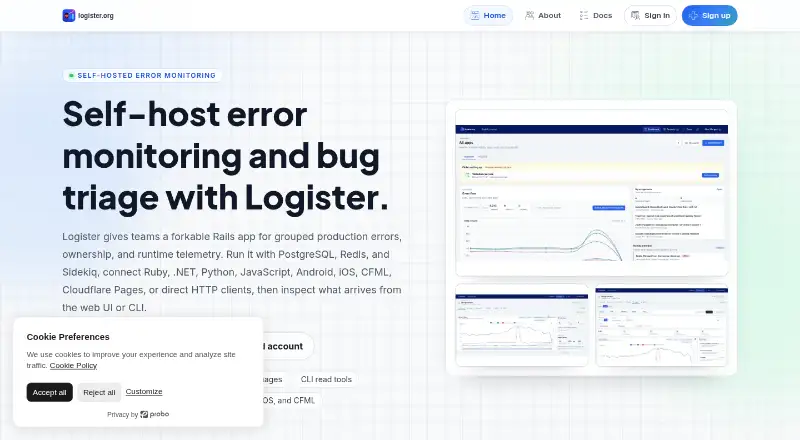
Logister is a self-hosted error-monitoring and bug-triage dashboard for teams that want to operate the software themselves. It collects errors, logs, metrics, transactions, spans, and check-ins, then groups recurring failures into issues that teams can assign and track as unresolved, resolved, ignored, or archived. Issue details can bring together request context, stack traces, occurrence history, and related logs for investigation.
Project Insights lets teams filter telemetry by time, environment, release, and custom attributes. Transaction cards summarize recent traffic with volume, throughput, P50 and P95 latency, error rate, and Apdex. Documented integrations cover Ruby, .NET, Python, JavaScript and TypeScript, Android, iOS, Cloudflare Pages, CFML, and direct HTTP. The ingestion API accepts JSON payloads with project tokens, and the CLI reads project telemetry using user-scoped access tokens.
Logister is open source under the MIT license, with versioned Docker images published through GitHub Container Registry and Docker Hub. The self-hosted plan is free. Its production baseline uses a Rails web process, PostgreSQL, Redis, and a Sidekiq worker. An optional hosted app is also described, while self-hosting is the primary product path.
Who it suits
Logister suits teams that want to monitor application telemetry and manage recurring errors in software they host themselves. It is especially relevant to teams using its documented language, platform, and direct HTTP integrations, and able to run the required Rails, PostgreSQL, Redis, and Sidekiq services.
What it does well
- Collects errors, logs, metrics, transactions, spans, and check-ins.
- Groups recurring failures into assignable issues with four workflow states.
- Issue details can include request context, stack traces, history, and logs.
- Insights filters cover time, environment, release, and custom attributes.
- Transaction cards report latency percentiles, error rate, and Apdex.
- MIT-licensed source and versioned Docker images are available.
What to know first
- Production self-hosting requires Rails, PostgreSQL, Redis, and Sidekiq.
- ClickHouse, S3-compatible storage, SMTP, and Turnstile require optional services when used.
Limits
The free self-hosted plan is an open-source, forkable Rails app, and its documented production baseline requires Rails, PostgreSQL, Redis, and Sidekiq. ClickHouse, S3-compatible archive storage, SMTP, and Cloudflare Turnstile are optional services for self-hosted installs.
Plans
| Plan | Billed and limits | Price |
|---|---|---|
| Self-hosted | Open-source, forkable Rails app; requires Rails web, Sidekiq, PostgreSQL, and Redis | Free |
As logister.org lists them, read 4 Oct 2026. The maker's own page has the final word.
Getting started
- Visit https://logister.org/ to review the project and documentation.
- Choose the free self-hosted plan at no cost.
- Prepare a Rails web process, PostgreSQL, Redis, and a Sidekiq worker.
- Use the published Docker images or the project source for a self-hosted deployment.
- Keep secrets in a provider secret store and put HTTPS in front of the app before public exposure.
- Connect telemetry through a documented integration or send project-token JSON to the ingestion API.
Verdict
Choose Logister if your team wants an open-source dashboard for telemetry review and error triage that it can self-host. Its free plan costs nothing, but the production baseline requires a Rails process, PostgreSQL, Redis, and Sidekiq. Teams looking for a hosted-first path should note that the hosted app is described as optional.
Questions
How much does Logister cost?
The Self-hosted plan is free.
Is Logister open source?
Yes. The project describes its source as MIT-licensed and forkable.
Which platforms does it support?
Its listed platforms are API, self-hosted, and web.
What does it collect?
It ingests errors, logs, metrics, transactions, spans, and check-ins.
What does self-hosting require?
The documented production baseline is a Rails web process, PostgreSQL, Redis, and a Sidekiq worker.
Can I use a hosted version?
The maker describes a hosted app as optional; the primary product path is open-source and self-hosted.
Facts from Logister's own pages
- API and CLI
- The ingestion API accepts project-token JSON payloads, and the CLI uses user-scoped access tokens to read project telemetry. · logister.org, 4 Oct 2026
- Hosted option
- The maker describes the hosted app as optional; the primary product path is open-source and self-hosted. · logister.org, 4 Oct 2026
- Insights
- Project Insights supports time, environment, release, and custom-attribute filters for reviewing telemetry. · logister.org, 4 Oct 2026
- Integrations
- Documented integrations include Ruby, .NET, Python, JavaScript and TypeScript, Android, iOS, Cloudflare Pages, CFML, and direct HTTP. · logister.org, 4 Oct 2026
- Investigation
- Issue details can include request context, stack traces, occurrence history, and related logs. · logister.org, 4 Oct 2026
- Issue triage
- Repeated failures are grouped into issues that can be assigned and moved through unresolved, resolved, ignored, and archived states. · logister.org, 4 Oct 2026
- Optional services
- ClickHouse, S3-compatible archive storage, SMTP, and Cloudflare Turnstile are optional services for self-hosted installs. · logister.org, 4 Oct 2026
- Performance
- Transaction cards show volume, throughput, P50 and P95 latency, error rate, and Apdex for recent traffic. · logister.org, 4 Oct 2026
- Product
- Logister is an open-source, forkable error-monitoring and bug-triage dashboard for teams that want to run it themselves. · logister.org, 4 Oct 2026
- Security operations
- The self-hosting guide advises keeping secrets in a provider secret store and putting HTTPS in front of the app before exposing it publicly. · logister.org, 4 Oct 2026
- Self-hosting requirements
- The documented production baseline is a Rails web process, PostgreSQL, Redis, and a Sidekiq worker. · logister.org, 4 Oct 2026
- Source and releases
- The project describes its source as MIT-licensed and publishes versioned Docker images through GitHub Container Registry and Docker Hub. · logister.org, 4 Oct 2026
- Support
- The documentation includes troubleshooting guidance for ingestion, rate limits, Sidekiq, email, ClickHouse, and archive exports. · logister.org, 4 Oct 2026
- Telemetry
- It ingests errors, logs, metrics, transactions, spans, and check-ins. · logister.org, 4 Oct 2026
Where Logister stands on Freedom251
- Error Monitoring Software#12 of 30