Freedom251 › No-code app builders
Saltcorn
What Saltcorn is
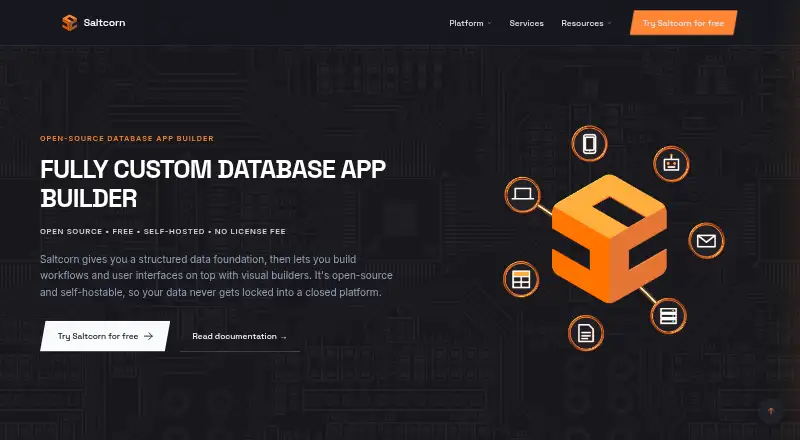
Saltcorn is an open-source database app builder for creating custom applications, workflows, and user interfaces. Its visual drag-and-drop builders let users create relational tables, forms, dashboards, portals, and workflows. Saltcorn runs on PostgreSQL or SQLite and includes a JSON REST API for other systems to read and write data. Plugins can add data types, views, and themes; the plugin store lists extensions including Apple Pay, CalDAV, CAPTCHA, charts, and AI agents. Applications can be packaged for iOS and Android, with offline use through a local SQLite database and later synchronization. Documented deployment options include Docker, Kubernetes, npm, marketplace templates, desktop use, and air-gapped self-hosting. Self-hosted instances make no telemetry calls, and the maker says Saltcorn can run fully offline behind a firewall. The MIT-licensed platform has no licence fee or per-seat cost. Free shared evaluation hosting has weak tenant isolation and no availability or security guarantee, so it is not intended for production or real data. Access roles include public, staff, user, and admin, but cannot express department-specific rules.
Who it suits
Saltcorn suits developers, power users, agencies, companies, enterprises, and local governments building custom apps or workflows. Its self-hosted and offline options may suit users who want to run applications behind a firewall.
What it does well
- Visual builders create tables, forms, and workflows
- Runs on PostgreSQL or SQLite
- Includes a JSON REST API
- Supports offline mobile use with later synchronization
What to know first
- Evaluation hosting is not intended for production or real data
- Evaluation hosting has weak tenant isolation
- Roles cannot express department-specific access rules
Limits
The free shared evaluation hosting has weak tenant isolation and no availability or security guarantee, and is not intended for production or real data. The free open-source platform has no licence fee or per-seat cost; paid deployment options include DigitalOcean marketplace deployment from ~$6/mo and managed hosting from about $16/month.
Plans
| Plan | Billed and limits | Price |
|---|---|---|
| Saltcorn open-source platform | MIT-licensed · no per-seat fee · self-hosted | Free |
| Saltcorn free evaluation hosting | Shared instance · evaluation only · no availability or security guarantee · weak tenant isolation | Free |
| Managed hosting via Elestio | From about $16/month · Dedicated VM · managed installation, TLS/SSL, encryption, backups, monitoring and updates | $16 a month |
| DigitalOcean marketplace deployment | From ~$6/mo · One-click droplet · database included | $6 a month |
As saltcorn.com lists them, read 5 Oct 2026. The maker's own page has the final word.
Getting started
- Visit the Saltcorn website.
- Choose the open-source platform for self-hosting, or select a hosting deployment option.
- Deploy using Docker, Kubernetes, npm or a marketplace template.
- Create relational tables, then build forms, dashboards, portals or workflows.
Overview
Saltcorn is a visual platform for building database-backed apps, interfaces and workflows. It is strongest for power users and developers who want to shape operational software around their own data and control where it runs. Its breadth is compelling, but teams need to account for deployment and access-control limits.
Key features
Drag-and-drop builders cover relational tables, forms, dashboards, portals and workflows. That combination suits internal databases, approval and compliance tools, customer or staff portals, reservations, payments and legacy replacements. It can bring an organization's data and processes into one app, though the builders do not remove the work of designing and operating that app.
Saltcorn runs on PostgreSQL or SQLite and provides a JSON REST API for other systems to read and write data. Plugins can add data types, views and themes, with examples including Apple Pay, CalDAV, CAPTCHA, charts and AI agents. This extensibility is useful when an app needs capabilities beyond the core builders. Its role model is less flexible for complex organizations: public, staff, user and admin roles are ordered, but cannot express department-specific access rules.
Apps can be packaged for iOS and Android, and offline use is supported through local SQLite storage with later synchronization. Deployment options include Docker, Kubernetes, npm, marketplace templates, desktop use and air-gapped self-hosting. Self-hosted instances make no telemetry calls, and Saltcorn can run fully offline behind a firewall—useful for organizations with strict infrastructure or privacy requirements, provided they can manage their deployment.
Pricing
The MIT-licensed open-source platform costs nothing, with no licence fee or per-seat cost, and is self-hosted. It is the natural choice for technically capable individuals or organizations that want control and can provide their own operating environment.
Saltcorn's shared evaluation hosting also costs nothing, but is for evaluation only. It has weak tenant isolation and no availability or security guarantee, so it should not hold production applications or real data.
For a low-cost self-managed deployment, the DigitalOcean marketplace option starts at $6 a month and includes a one-click droplet with database included. Managed hosting via Elestio starts at $16 a month and includes a dedicated VM, managed installation, TLS/SSL, encryption, backups, monitoring and updates. The latter costs more but shifts routine hosting work to a managed service; neither changes the platform's no-per-seat licensing.
Saltcorn Collective offers application building, support, training and platform enhancements, and aims to respond to enquiries within two working days. This may suit teams seeking help beyond the software, though the service terms and pricing are not provided here.
Platforms
Saltcorn supports Android, iOS, Linux, macOS, Windows and web, as well as API access and self-hosting. Its deployment range is a strength for teams that need options from marketplace installs to offline environments; those options also make infrastructure choices part of the decision.
Who it's for
Saltcorn is a good fit for individual power users, developers, agencies, growing companies, enterprises and local government that need custom database apps and can manage hosting themselves or pay for managed hosting. It is a weaker fit for organizations whose permissions must vary by department, or for teams that need production-safe shared hosting without taking on deployment responsibility.
Pros and cons
- Pros: Visual builders cover data, interfaces and workflows in one MIT-licensed platform with no per-seat cost.
- Pros: PostgreSQL or SQLite, a JSON REST API, plugins and mobile offline synchronization give teams several ways to connect and extend apps.
- Pros: Self-hosting and air-gapped operation support deployment and privacy control.
- Cons: The shared free evaluation instance is explicitly unsuitable for production data and carries no availability or security guarantee.
- Cons: Ordered roles cannot handle department-specific access rules, which may rule out Saltcorn for organizations with granular permission needs.
- Cons: Self-hosting offers control but requires deployment and operations capacity; managed hosting adds a monthly cost.
Alternatives
For teams comparing database and app-building tools, see No-Code Database Software, No-Code Development Platforms and No-code app builders.
Lark is worth comparing if a team needs a free plan with 20 users, 100 GB of storage, 18 months of message history and 1,000 monthly automations. Matrify offers a free standard license for up to 300 records and three users, a more bounded option for a small dataset. Ninox has a free plan capped at five users, 100 MB, 5,000 records and 1,000 API calls per month. Airtable may suit teams that prefer its freemium offering; its Team plan is $20 a month billed annually, with 50,000 records per base and 100,000 API calls per workspace per month.
Grist is another freemium option, with a free plan that allows unlimited documents and up to 5,000 records per document. Memento Database offers a free plan with 100 MB cloud storage, three libraries and unlimited entries. Stackby has a free plan with five editors, 50 read-only users, 20 stacks and up to 1,500 rows per stack. NocoBase is a self-hosted alternative whose free Community Edition includes unlimited applications, users and data volume, with NocoBase branding and community support.
Verdict
Choose Saltcorn if you want to build relational, workflow-driven apps with visual tools, avoid per-seat licensing and retain control over deployment. Its combination of extensibility, APIs and offline options is the main reason to choose it. Look elsewhere if department-specific permissions are essential, or if you need production-grade hosting without taking responsibility for the deployment.
Verdict
Saltcorn offers visual app building, relational data, workflows, and deployment flexibility in a MIT-licensed platform with no licence fee or per-seat cost. Treat its free shared evaluation hosting as non-production; it lacks availability and security guarantees.
Questions
Is Saltcorn free?
The open-source platform is free under the MIT licence, with no per-seat fee. Shared evaluation hosting is also free, with evaluation-only limits.
Can I host Saltcorn myself?
Yes. The maker documents self-hosting through Docker, Kubernetes and npm, as well as marketplace templates and air-gapped self-hosting.
Which databases does Saltcorn use?
Saltcorn runs on PostgreSQL or SQLite.
Does Saltcorn provide an API?
Yes. It includes a JSON REST API that other systems can use to read and write data.
Can Saltcorn apps work offline on phones?
Applications can be packaged for iOS and Android. Offline use is supported through a local SQLite database with later synchronization.
Who makes Saltcorn?
Saltcorn Collective Ltd identifies itself as the platform's original developer. The company says it is UK-based and works internationally.
Facts from Saltcorn's own pages
- Access control
- Saltcorn uses ordered public, staff, user and admin roles to control access, but its documented role system cannot express department-specific access rules. · wiki.saltcorn.com, 5 Oct 2026
- Company
- Saltcorn Collective Ltd says it is UK-based and works internationally; the site identifies it as the platform's original developer. · saltcorn.com, 5 Oct 2026
- Core capabilities
- Users can create relational tables and build forms, dashboards, portals and workflows with visual drag-and-drop builders. · saltcorn.com, 5 Oct 2026
- Data and API
- Saltcorn runs on PostgreSQL or SQLite and includes a JSON REST API for other systems to read and write data. · saltcorn.com, 5 Oct 2026
- Deployment
- The maker documents Docker, Kubernetes, npm, marketplace templates, desktop use and air-gapped self-hosting. · saltcorn.com, 5 Oct 2026
- Evaluation limit
- The free shared evaluation hosting has no availability or security guarantee, weak tenant isolation and is not intended for production or real data. · saltcorn.com, 5 Oct 2026
- Free plan
- Yes · saltcorn.com, 22 Sept 2026
- Integrations
- The plugin store includes extensions such as Apple Pay, CalDAV, CAPTCHA, charts and AI agents, while plugins can add data types, views and themes. · store.saltcorn.com, 5 Oct 2026
- Intended users
- The maker describes Saltcorn for individual power users and developers, agencies, growing companies, enterprises and local government. · saltcorn.com, 5 Oct 2026
- Licence
- Saltcorn has been MIT-licensed since 2020, and the maker states that the platform has no licence fee or per-seat cost. · saltcorn.com, 5 Oct 2026
- Mobile
- Saltcorn can package applications for iOS and Android, with offline use supported through a local SQLite database and later synchronization. · saltcorn.com, 5 Oct 2026
- Purpose
- Saltcorn is an open-source database app builder for creating custom apps, workflows and user interfaces with visual builders. · saltcorn.com, 5 Oct 2026
- Security and privacy
- Self-hosted instances make no telemetry calls, and the maker says Saltcorn can run fully offline behind a firewall. · saltcorn.com, 5 Oct 2026
- Support
- Saltcorn Collective offers application build, support, training and platform enhancement services, and says it aims to respond to enquiries within two working days. · saltcorn.com, 5 Oct 2026
- Use cases
- The maker lists operational tools, approval and compliance apps, internal databases, customer and staff portals, reservations, payments and legacy replacements. · saltcorn.com, 5 Oct 2026
Where Saltcorn stands on Freedom251
- No-code app builders#49 of 177
- No Code Platform#11 of 29
- No-Code Database Software#19 of 40
- No-Code Development Platforms#19 of 36