Freedom251 › DHCP Management Software
SagaOS Kea Pilot
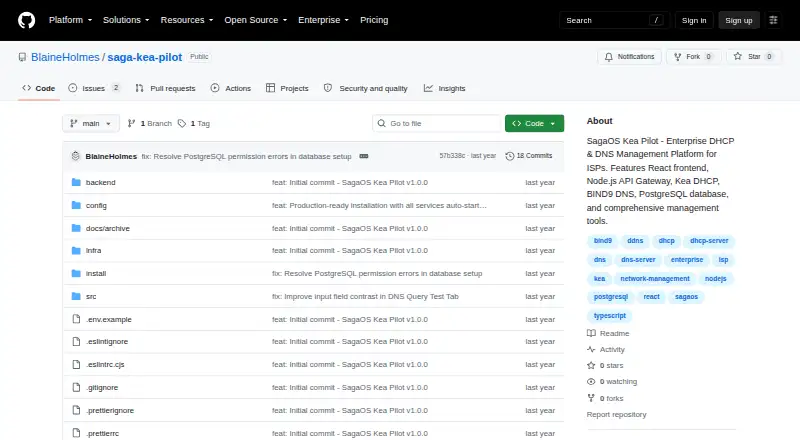
What SagaOS Kea Pilot is
SagaOS Kea Pilot is a free, open-source web management platform for Kea DHCP, BIND9 DNS, and Dynamic DNS, intended for ISP and enterprise network operations. It manages DHCPv4 and DHCPv6 subnets, pools, reservations, leases, options, and Kea high availability. DNS features include BIND9 zones and records, RFC2136 updates, and synchronization with DHCP lease events. A live health dashboard, service status tracking, performance metrics, WebSocket updates, audit logs, and analytics cover monitoring. The project also lists multi-tenant data isolation, granular role-based access control, and REST API endpoints for DHCP and DNS operations. Configuration tools include backup, restore, versioning, and rollback. Deployment is documented for Linux and Docker, with Ubuntu 20.04+, CentOS 8+, RHEL 8+, and Debian 11+ listed as supported operating systems. Minimum requirements are 2 CPU cores, 4 GB RAM, and 20 GB SSD; BIND9 is optional in the minimal installation. The software is MIT licensed, with no paid tiers or usage limits stated. The README documents admin/admin as the default login and says it must be changed for production.
Who it suits
Kea Pilot is intended for ISP and enterprise network operations teams managing DHCP and DNS. It suits administrators comfortable with Linux or Docker deployment and the listed system requirements.
What it does well
- Manages DHCPv4, DHCPv6, and Kea high availability.
- Supports BIND9 zones and DHCP lease synchronization.
- Includes audit logging and performance monitoring.
- MIT licensed with no paid tiers stated.
- Offers backup, restore, versioning, and rollback.
What to know first
- Requires at least 2 CPU cores, 4 GB RAM, and 20 GB SSD.
- Default login is admin/admin and must be changed for production.
- BIND9 is optional only in the minimal installation.
Limits
The MIT-licensed software is free, with no paid tiers or usage limits stated. Its minimum system requirements are 2 CPU cores, 4 GB RAM, and 20 GB SSD; higher resources are recommended for production.
Plans
| Plan | Billed and limits | Price |
|---|---|---|
| MIT-licensed software | No paid tiers or usage limits stated | Free |
As github.com lists them, read 30 Sept 2026. The maker's own page has the final word.
Getting started
- Open the project website on GitHub.
- Choose a Linux installation or Docker deployment.
- Use a supported operating system: Ubuntu 20.04+, CentOS 8+, RHEL 8+, or Debian 11+.
- Provide at least 2 CPU cores, 4 GB RAM, and 20 GB SSD storage.
- Sign in with the documented initial admin/admin credentials, then change them for production.
SagaOS Kea Pilot is a self-hosted web console for operating Kea DHCP and BIND9 DNS. It is best suited to ISP and enterprise teams that want those services, monitoring, and configuration controls together. Its MIT licence makes commercial use possible without a software fee, but teams must run the infrastructure and secure the initial login before production.
Overview
Kea Pilot brings address allocation, name-service administration, and operational oversight into one platform. That combination is most useful for network teams already running Kea; it is less compelling for organizations seeking a hosted service or a general-purpose IP address management product. Multi-tenant isolation and granular role permissions help when multiple teams or customers share the environment.
Deployment is on Linux or Docker, with Kea, PostgreSQL, and Nginx in the documented stack. BIND9 can be omitted from the minimal installation, though DNS management and DHCP-linked DDNS depend on it. The minimum footprint is 2 CPU cores, 4 GB RAM, and 20 GB SSD, with higher resources recommended for production. The initial admin/admin login must be changed before production use.
Key features
DHCP and DNS administration
DHCPv4 and DHCPv6 management includes subnets, pools, host reservations, leases, options, and Kea high availability. This makes the platform relevant to operators who need both protocol versions and failover controls in the same workflow. BIND9 zone and record management, RFC2136 updates, and synchronization of DNS with DHCP lease events connect address assignment with name resolution. If a team only needs basic IPv4 DHCP on a local Windows service, this broader Linux-oriented scope may be unnecessary.
Monitoring, access, and recovery
A live health dashboard, WebSocket updates, service status, performance metrics, audit logs, and analytics provide operational visibility beyond configuration alone. Role-based access control, user management, and tenant data isolation support shared administration. Backup, restore, versioning, and rollback give operators a way to recover configuration changes. The project also lists CSRF protection, input validation, secure sessions, SQL injection and XSS protections, and rate limiting; TOTP and hardware-token multi-factor authentication are described as enterprise features.
API and integrations
REST endpoints cover DHCP and DNS operations, while WebSocket events support live updates. This is useful for teams integrating management workflows with other systems, though the platform's value depends on operating the associated services and database rather than merely consuming a hosted API.
Pricing
The MIT-licensed software plan costs nothing. It permits commercial use, modification, and distribution, and no paid tiers or usage limits are stated. That is a strong fit for teams able to deploy and maintain the stack themselves; the trade-off is that software cost does not remove the hardware, administration, or production-security requirements. The software is provided without warranty. Commercial support is available for enterprise deployments and custom integrations.
Platforms
Kea Pilot is available as a web interface and API for self-hosted Linux deployments. Documented operating systems are Ubuntu 20.04+, CentOS 8+, RHEL 8+, and Debian 11+, with Docker deployment also supported. It is not presented as a Windows-hosted or managed cloud service. Support channels include GitHub Issues, documentation, and community discussions.
Who it's for
Choose Kea Pilot if your ISP or enterprise network team already operates Kea and wants DHCPv4/v6, BIND9 DNS, DDNS synchronization, monitoring, permissions, and configuration recovery in one self-hosted system. Its multi-tenant controls are especially relevant to shared environments. Look elsewhere if you need a hosted product, a small-footprint local DHCP utility, or a deployment that does not meet the stated minimum system requirements.
Pros and cons
- Pros: DHCPv4/v6, reservations, high availability, DNS management, and lease-linked DDNS cover a broad network-services workflow.
- Pros: Monitoring, audit logging, tenant isolation, granular roles, and configuration rollback address operational oversight and recovery needs.
- Pros: MIT licensing allows commercial use and modification without a software charge.
- Cons: Self-hosting requires at least 2 CPU cores, 4 GB RAM, and 20 GB SSD, with more recommended for production.
- Cons: The documented admin/admin initial credentials require immediate replacement for production, adding a security step before deployment.
- Cons: BIND9, PostgreSQL, and Nginx add operational components for teams that only need DHCP management.
Alternatives
Compare DHCP Management Software if you want to survey the category before choosing a self-hosted platform.
- Subnetly is worth considering when you want a freemium option with a monthly free tier capped at 256 IPAM addresses, 10 subnets, 2 DHCP pools, and one private and one public DNS zone.
- ISC Stork is another free, self-hosted option for Linux, macOS, or web environments; professional support is also offered at custom pricing.
- FluxDHCP may suit teams seeking free, self-hosted Linux DHCP software under an AGPL-3.0 licence.
- teemIP is an alternative for teams wanting a freemium IPAM platform with a free Community plan and community support.
- DacatDHCP is a permanently free Windows option for local IPv4 DHCP service.
- Danbyte is a free, self-hosted Linux option with all features included and no seat licence or enterprise tier.
- Jen Kea DHCP Management Console is a free self-hosted Kea console for Ubuntu 22.04/24.04 or Docker, requiring MySQL or MariaDB.
- OpenIPAM is a free open-source option with browser-only or self-hosted-backend use.
Verdict
Kea Pilot is a strong fit for ISP and enterprise operators who want one self-hosted control plane for Kea DHCP, BIND9 DNS, monitoring, and configuration recovery. Its breadth and permissive MIT licence are the main reasons to choose it; the infrastructure burden and required credential hardening are the main reasons to look elsewhere.
Verdict
Kea Pilot combines DHCP and DNS administration with monitoring, access controls, and configuration recovery tools. Production users should replace the documented default credentials and meet the stated system requirements.
Questions
How much does SagaOS Kea Pilot cost?
The software is free and MIT licensed. No paid tiers or usage limits are stated.
Which platforms does it support?
It is listed for API, Linux, self-hosted, and web use. Documented operating systems include Ubuntu 20.04+, CentOS 8+, RHEL 8+, and Debian 11+.
Does it support DHCPv6 and reservations?
Yes. It manages DHCPv4 and DHCPv6, including host reservations, and supports DHCP failover and Kea high availability.
Does it manage DNS as well as DHCP?
Yes. It manages BIND9 zones and records, supports RFC2136 updates, and synchronizes DNS with DHCP lease events. BIND9 is optional in the minimal installation.
Is the software open source?
Yes. The repository states that it is MIT licensed, allowing commercial use, modification, and distribution. The software is provided without warranty.
What are the default credentials?
The README documents admin/admin as the initial login and says it must be changed for production.
Facts from SagaOS Kea Pilot's own pages
- Access control
- It lists multi-tenant support, data isolation, and role-based access control with granular permissions. · github.com, 30 Sept 2026
- Access controls
- It lists multi-tenant data isolation and role-based access control with granular permissions and user management. · github.com, 30 Sept 2026
- API
- It provides REST API endpoints for DHCP and DNS operations and WebSocket events for live updates. · github.com, 30 Sept 2026
- Authentication
- The README says the project supports TOTP and hardware-token multi-factor authentication as an enterprise feature. · github.com, 30 Sept 2026
- Authentication caveat
- The documented initial credentials are admin/admin, and the README says to change them for production. · github.com, 30 Sept 2026
- Configuration
- Configuration tools include backup, restore, versioning, and rollback. · github.com, 30 Sept 2026
- Deployment
- The project documents Linux installation and Docker deployment, and lists Ubuntu 20.04+, CentOS 8+, RHEL 8+, and Debian 11+ as supported operating systems. · github.com, 30 Sept 2026
- DHCP
- It supports DHCPv4 and DHCPv6 management, including subnets, address pools, host reservations, leases, DHCP options, and Kea high availability. · github.com, 30 Sept 2026
- DNS
- It provides BIND9 zone and record management, RFC2136 dynamic updates, and DDNS synchronization with DHCP lease events. · github.com, 30 Sept 2026
- Initial credentials
- The README documents admin/admin as the default login and says it must be changed for production. · github.com, 30 Sept 2026
- Integrations
- The documented stack includes Kea DHCP, BIND9, PostgreSQL, Docker, and Nginx; BIND9 is optional in the minimal installation. · github.com, 30 Sept 2026
- License
- The repository states that the software is MIT licensed and permits commercial use, modification, and distribution; it also provides the software without warranty. · github.com, 30 Sept 2026
- Monitoring
- The project lists a live health dashboard, WebSocket updates, service status tracking, performance metrics, audit logging, and analytics. · github.com, 30 Sept 2026
- Purpose
- The project describes itself as a web management platform for Kea DHCP, BIND9 DNS, and Dynamic DNS, aimed at ISP and enterprise network operations. · github.com, 30 Sept 2026
- Requirements
- The listed minimum system requirements include 2 CPU cores, 4 GB RAM, and 20 GB SSD storage. · github.com, 30 Sept 2026
- Security
- Listed security measures include CSRF protection, input validation, secure sessions, SQL injection prevention, XSS protections, rate limiting, and audit logging. · github.com, 30 Sept 2026
- Support
- The README directs users to GitHub Issues, its documentation and community discussions, and says commercial support is available for enterprise deployments and custom integrations. · github.com, 30 Sept 2026
- System requirements
- The README specifies at least 2 CPU cores, 4 GB RAM, and 20 GB SSD, with higher recommendations for production. · github.com, 30 Sept 2026
Where SagaOS Kea Pilot stands on Freedom251
- DHCP Management Software#7 of 25