Freedom251 › DHCP Management Software
FluxDHCP
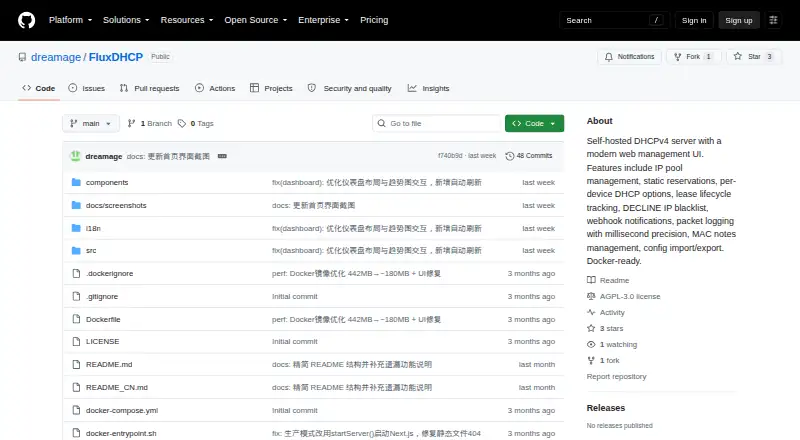
What FluxDHCP is
FluxDHCP is a free, self-hosted DHCPv4 server managed through a web interface. It supports the listed RFC 2131 message types, including discovery, offers, requests, acknowledgments, and releases. Address pools can define subnet ranges, gateways, DNS servers, netmasks, and lease durations, with sequential or random allocation and overlap detection. Administrators can set static MAC-to-IP reservations and device-specific DHCP option overrides. Lease tracking covers offered, bound, released, and expired states, with automatic cleanup of expired records. Its packet logger records transaction details, direction, raw options, client information, and millisecond timestamps. Webhooks send DHCP events to external services through HTTP POST or GET, using templates and custom headers. Configuration can be exported or imported as JSON, and imported changes are hot-reloaded. The project is licensed under AGPL-3.0 and supports English and Chinese, dark mode, and a responsive mobile-friendly interface. It requires Node.js 20 or later; Docker Compose is recommended, and manual installation is documented.
Who it suits
FluxDHCP suits administrators who want to run and manage a DHCPv4 server themselves, with configurable pools, reservations, logging, and webhooks. It is not a DHCPv6 option.
What it does well
- Supports configurable pools and overlap detection
- Offers static MAC-to-IP reservations
- Tracks lease states with automatic expiry cleanup
- Sends events through configurable webhooks
- JSON configuration imports trigger hot-reloads
What to know first
- Does not support DHCPv6
- Requires Node.js 20 or later
- Binding UDP port 67 requires root or administrator privileges
- Self-hosted deployment is required
Limits
FluxDHCP supports DHCPv4 and does not support DHCPv6. Binding UDP port 67 requires root or administrator privileges.
Plans
| Plan | Billed and limits | Price |
|---|---|---|
| FluxDHCP | AGPL-3.0 licensed; self-hosted | Free |
As github.com lists them, read 4 Oct 2026. The maker's own page has the final word.
Getting started
- Open the FluxDHCP GitHub project.
- Use the recommended Docker Compose deployment, or follow the documented manual installation route with Node.js and npm.
- Run it with Node.js 20 or later.
- Run with root or administrator privileges to bind UDP port 67.
- Use the web management UI to configure address pools, reservations, and DHCP options.
Overview
FluxDHCP is a self-hosted DHCPv4 server with a browser-based management interface, suited to administrators who want to run address assignment on infrastructure they control. Its pool, reservation and monitoring tools make it a focused option for IPv4 networks; networks requiring DHCPv6 should look elsewhere.
Key features
Pool configuration covers subnet ranges, gateways, DNS servers, netmasks and lease durations, with sequential or random allocation. Overlap detection can help catch conflicting pool definitions before they cause address-assignment problems. Static MAC-to-IP reservations and per-device option overrides suit networks that need particular clients to retain an address or receive different DHCP settings.
Lease tracking distinguishes OFFERED, BOUND, RELEASED and EXPIRED states and automatically clears expired leases. The packet logger captures transactions with millisecond timestamps, direction, packet details, raw options and client information, giving administrators useful context when tracing DHCP activity. Webhooks can forward DHCP events to external services over HTTP POST or GET, with template variables and custom headers to shape those notifications.
FluxDHCP supports DHCPv4 message types including DISCOVER, OFFER, REQUEST, ACK, NAK, RELEASE, DECLINE and INFORM, and describes itself as RFC 2131 compliant. It does not support DHCPv6, which rules it out for environments that need both protocol versions. Configuration can be exported to and imported from JSON, with imported changes hot-reloaded. The project also lists Origin-header validation for API mutations, SSRF-protected webhook URLs and IP-format validation.
The interface offers English and Chinese localization, dark mode and a responsive mobile-friendly layout. Deployment is self-hosted: the recommended approach is Docker Compose, with manual installation also documented using Node.js and npm. The stack uses Node.js 20 or later and SQLite via better-sqlite3. Binding UDP port 67 requires root or administrator privileges, an operational constraint to account for when choosing how to run it.
Pricing
FluxDHCP is free: its AGPL-3.0-licensed self-hosted plan costs nothing. The project says use, modification and distribution are free subject to the license terms. There are no paid tiers described, so this is a straightforward fit for users comfortable deploying and maintaining their own server rather than paying for a hosted service.
Platforms
FluxDHCP is listed for Linux, self-hosted use and the web. The web interface is the management surface, while the server runs on Node.js 20 or later. Its documented Docker Compose and manual Node.js/npm deployment paths both require attention to the elevated privilege needed to bind UDP port 67.
Who it's for
FluxDHCP is best for administrators who need a focused, self-hosted DHCPv4 service with address pools, reservations, lease visibility and event notifications. It is less suitable for networks requiring DHCPv6, or for operators who cannot accommodate a Node.js 20+ runtime and privileged port binding.
Pros and cons
Pros
- Useful pool controls: allocation strategies, overlap detection and per-pool lease settings help administrators manage IPv4 address assignment.
- Operational visibility: lease states and packet records with millisecond timestamps provide detail for following DHCP activity.
- Flexible event handling: webhooks support both POST and GET, custom headers and template variables.
- Free, self-hosted licensing: the AGPL-3.0 release permits use, modification and distribution subject to its terms.
Cons
- IPv4 only: the lack of DHCPv6 makes it unsuitable where IPv6 address assignment is required.
- Privileged networking: binding UDP port 67 requires root or administrator privileges.
- Runtime prerequisite: deployment requires Node.js 20 or later.
Alternatives
For a broader DHCP software comparison, see DHCP Management Software.
- Subnetly is worth considering when an IPAM service with a published free monthly tier better fits: its Free plan costs nothing, with limits including 256 IPAM addresses, 10 subnets and 2 DHCP pools.
- ISC Stork is another free, self-hosted option for Linux, macOS and web environments; professional support is also offered at custom pricing.
- SagaOS Kea Pilot is a free, MIT-licensed alternative for Linux and self-hosted use.
- teemIP may suit teams looking for an open-source community plan, offered free forever at 0.00 EUR.
- DacatDHCP is a free Windows option for IPv4 DHCP service.
- Danbyte is a free, self-hosted alternative whose plan includes all features and has no seat license or license expiry.
- Jen Kea DHCP Management Console is a free self-hosted choice for users running ISC Kea with MySQL or MariaDB on Ubuntu 22.04/24.04 or Docker.
- OpenIPAM offers a free open-source option with browser-only or self-hosted-backend deployment.
Verdict
Choose FluxDHCP if you want a free, self-hosted DHCPv4 server with reservations, useful pool controls and detailed event visibility. Its focused IPv4 scope is the central trade-off: look elsewhere if DHCPv6 is required, or if running Node.js and binding a privileged port do not suit your deployment.
Verdict
FluxDHCP offers DHCPv4 pool, reservation, lease, and event-management features for self-hosting. Check the runtime and elevated port-binding requirement before deployment.
Questions
Is FluxDHCP free?
Yes. It is free, self-hosted software licensed under AGPL-3.0; use, modification, and distribution are free subject to the license terms.
Does FluxDHCP support DHCPv6?
No. The project lists DHCPv6 support as unavailable; it supports DHCPv4.
What does FluxDHCP need to run?
The documented runtime is Node.js 20 or later, with SQLite via better-sqlite3. Binding UDP port 67 requires root or administrator privileges.
How can FluxDHCP be deployed?
The README recommends Docker Compose and also documents manual installation with Node.js and npm.
What language and interface options does it have?
The interface supports English and Chinese localization, dark mode, and a responsive mobile-friendly layout.
What license does FluxDHCP use?
It is licensed under AGPL-3.0. The README says use, modification, and distribution are free subject to the license terms.
Facts from FluxDHCP's own pages
- Address pools
- Pools support subnet ranges, gateway, DNS servers, netmask, lease times, overlap detection, and sequential or random allocation. · github.com, 4 Oct 2026
- Configuration
- Configuration can be exported to and imported from JSON, and changes are hot-reloaded after import. · github.com, 4 Oct 2026
- Deployment
- The README recommends Docker Compose and also documents manual installation with Node.js and npm. · github.com, 4 Oct 2026
- DHCP protocol
- It supports DHCPv4 operations including DISCOVER, OFFER, REQUEST, ACK, NAK, RELEASE, DECLINE, and INFORM, and describes itself as RFC 2131 compliant. · github.com, 4 Oct 2026
- IP pools
- Pools support subnet ranges, gateways, DNS servers, netmasks, per-pool lease times, overlap detection, and sequential or random allocation. · github.com, 4 Oct 2026
- Lease tracking
- Lease states include OFFERED, BOUND, RELEASED, and EXPIRED, with automatic expiry cleanup. · github.com, 4 Oct 2026
- License
- The project is licensed under AGPL-3.0, and the README says use, modification, and distribution are free subject to the license terms. · github.com, 4 Oct 2026
- Localization and interface
- The interface supports English and Chinese localization, dark mode, and a responsive mobile-friendly layout. · github.com, 4 Oct 2026
- Logging
- The packet logger records DHCP transactions with millisecond timestamps, packet details, and translated option codes. · github.com, 4 Oct 2026
- Monitoring
- The packet logger records DHCP transactions with millisecond timestamps, direction, raw options, and client details. · github.com, 4 Oct 2026
- Notifications
- Webhooks can send DHCP events to external services using HTTP POST or GET, template variables, and custom headers. · github.com, 4 Oct 2026
- Operational requirement
- Binding UDP port 67 requires root or administrator privileges. · github.com, 4 Oct 2026
- Product
- FluxDHCP is a lightweight, self-hosted DHCPv4 server with a web management UI. · github.com, 4 Oct 2026
- Protocol
- It supports DHCPv4 and lists RFC 2131 message types including DISCOVER, OFFER, REQUEST, ACK, NAK, RELEASE, DECLINE, and INFORM. · github.com, 4 Oct 2026
- Purpose
- FluxDHCP is a lightweight, self-hosted DHCPv4 server with a web management UI. · github.com, 4 Oct 2026
- Requirements
- The listed runtime is Node.js 20 or later, and binding UDP port 67 requires root or administrator privileges. · github.com, 4 Oct 2026
- Reservations and options
- It supports static MAC-to-IP reservations and per-device DHCP option overrides. · github.com, 4 Oct 2026
- Runtime and database
- The documented stack uses Node.js 20 or later and SQLite via better-sqlite3. · github.com, 4 Oct 2026
- Security
- The project lists Origin header validation for API mutations, SSRF-protected webhook URLs, and IP format validation. · github.com, 4 Oct 2026
- Webhooks
- Webhook notifications can send DHCP events to external services via HTTP POST or GET with template variables and custom headers. · github.com, 4 Oct 2026
Where FluxDHCP stands on Freedom251
- DHCP Management Software#5 of 25