Freedom251 › IP Address Management Software

Danbyte
What Danbyte is
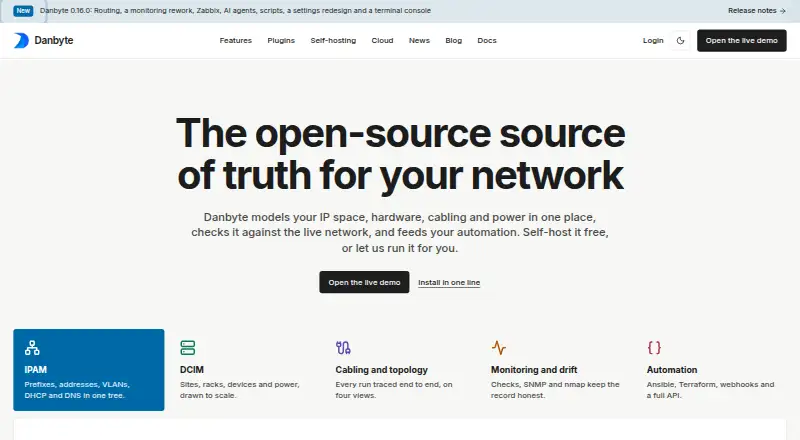
Danbyte is an open-source platform for managing IP address space, data-center infrastructure and network configuration as a shared source of truth. Its IPAM tools calculate prefix containment, free space and utilization by VRF, and also cover VLANs, DHCP ranges, DNS zones and route targets. For physical infrastructure, it models racks, device faceplates, ports, power and cabling, with topology views, fibre tracing, floor plans, circuits, VPN tunnels and wireless SSIDs. Proxmox VE and VMware vCenter imports bring in virtual machines and related infrastructure, with drift reconciliation. Active checks, SNMP and nmap discovery help compare observed infrastructure with its modeled state. Automation options include Ansible and Terraform inventories, Jinja templates, drift runners, signed webhooks and scoped APIs. Danbyte can run on Linux and be fully air-gapped on user hardware, without telemetry or an expiring license. Its free plans include all features and have no seat license. The Linux quick installer requires PostgreSQL 15+ and Redis.
Who it suits
Danbyte suits network and data-center teams that need to track address space, racks, cabling, virtualization and configuration changes. It is a fit for organizations seeking a self-hosted or air-gapped deployment with automation integrations.
What it does well
- Free and open source with all features included.
- No seat license or license expiry.
- Can run fully air-gapped on user hardware.
- Tracks IP space, racks, cabling and virtual infrastructure.
- Includes Ansible and Terraform inventory options.
What to know first
- Linux quick installer requires PostgreSQL 15+ and Redis.
- Danbyte Cloud has no listed price and is coming soon.
- Deployment is on-premises/self-hosted.
Plans
| Plan | Billed and limits | Price |
|---|---|---|
| Free and open source | all features · no seat licence · no enterprise tier · no licence expiry · self-hosted | Free |
| Self-hosted Danbyte | forever · all features · no seat licence · no enterprise tier · no licence expiry | Free |
| Danbyte Cloud | Coming soon · private instance · managed updates, backups, uptime and TLS · export anytime | On request |
As danbyte.net lists them, read 15 Oct 2026. The maker's own page has the final word.
Getting started
- Open the Danbyte website or use the live demo, which creates a private tenant without signup or a card.
- For a deployment, use the Linux quick installer on Linux.
- Provide PostgreSQL 15+ and Redis for the installation.
- Choose self-hosted deployment; it can run fully air-gapped on your hardware.
Overview
Danbyte is an open-source platform for managing IP space, data-center assets and network records in one system. It is best suited to infrastructure teams that want discovery and automation alongside their inventory. Its wide scope is useful, but it comes with the responsibility of running a self-hosted service and its database dependencies.
Key features
IPAM covers prefix containment, free space and utilization by VRF, plus VLANs, DHCP ranges, DNS zones and route targets. This is a stronger fit for teams that need address management connected to broader network operations than for those seeking only a simple allocation register.
For DCIM, Danbyte models rack elevations, device faceplates, ports, power, virtual chassis and device catalogs. Its topology tools add end-to-end cable tracing, fibre-strand tracing, four topology views, floor plans, circuits, VPN tunnels and wireless SSIDs. The breadth can consolidate physical and logical infrastructure records, though teams that need only rack inventory may find the wider network scope unnecessary.
Proxmox VE and VMware vCenter imports cover virtual machines, disks, virtual switches, VLANs and ESXi hosts, with drift reconciliation. Active checks, SNMP and nmap discovery maintain an observed layer and a drift inbox. These features help teams compare recorded infrastructure with discovered state rather than treating the inventory as a manual snapshot.
Automation includes native Ansible and Terraform inventory, Jinja export templates, configuration contexts, drift runners, signed webhooks and scoped APIs. Integrations also include Slack, Microsoft Teams, PagerDuty, LDAP/AD and WinRM. That makes Danbyte relevant to teams connecting infrastructure records to established operations and automation workflows.
Security controls include authenticated APIs by default, scoped API tokens, TLS-secure cookies, HSTS, CSP, security headers and SSRF protections. It can run air-gapped on the user's hardware without telemetry, phone-home behavior or an expiring license, which suits organizations that require local control. The trade-off is operational: the Linux quick installer bundles Python, Node and dependencies but still requires PostgreSQL 15+ and Redis.
A private live-demo tenant is available without signup or a payment card, and is automatically deleted after 30 minutes. The website states that it uses no tracking cookies, third-party trackers or cross-site profiling.
Pricing
Danbyte is free and open source. The Free and open source plan costs nothing and includes all features, no seat license, no enterprise tier, no license expiry and self-hosted deployment. The Self-hosted Danbyte plan is also free, billed forever, with all features and no seat license, enterprise tier or license expiry. Both are suitable for teams willing to operate the software themselves; neither imposes a per-seat charge.
Danbyte Cloud is marked as coming soon, with custom pricing. Its planned private instance includes managed updates, backups, uptime and TLS, with export anytime. Teams seeking a managed service cannot choose it yet.
Platforms
Danbyte supports API, Linux, self-hosted and web use. The installer targets Linux, and deployment is on-premises. It supports rack management, power monitoring, cooling monitoring, and space and capacity planning.
Who it's for
Danbyte is a strong candidate for infrastructure teams that want IPAM, DCIM, topology, discovery and automation tied together, particularly where self-hosting or air-gapped operation matters. It is less suitable for teams that cannot provision PostgreSQL and Redis or that want a managed cloud service now.
Pros and cons
- Pros: Broad coverage brings IPAM, physical and virtual infrastructure, topology and automation into one platform.
- Pros: Free self-hosted plans have no seat license or expiry, making the full feature set usable without per-seat licensing.
- Pros: Air-gapped operation and no telemetry support organizations seeking to keep the software and its data on their own hardware.
- Cons: PostgreSQL 15+ and Redis are required, adding services to provision and maintain alongside the Linux application.
- Cons: The cloud plan is not yet available, so teams wanting managed updates, backups and uptime must wait.
Alternatives
For a different approach to data-center management, Global Site Management has a free GSMpowerlite version intended for smaller data centers and pilot programs, plus a free trial. ColdAisle is another free, self-hosted option under the MIT license. openDCIM is a free web-based application under GPL v3.
Brightlayer DCIM is a paid option purchased through an Eaton reseller. CenterOS Capacity Management offers paid private-cloud and SaaS plans with custom pricing. EkkoSense is a paid web service with annual SaaS licensing. Hyperview offers a 30-day free trial with all features and no credit card required, followed by paid pricing per asset per year. Nlyte is a paid option with custom pricing.
Browse data center infrastructure management software, IT documentation software, network documentation software, DHCP management software or IP address management software to compare tools by category.
Verdict
Choose Danbyte if your infrastructure team wants a broad, free source of truth that connects IPAM, DCIM, discovery and automation, and can run it on its own Linux systems. Its strongest advantage is the combination of extensive coverage and unrestricted self-hosted licensing. Look elsewhere if you need managed cloud service today or cannot take on PostgreSQL and Redis operations.
Verdict
Danbyte combines IPAM, DCIM, discovery and automation in a free, self-hosted platform. Its breadth may suit infrastructure teams, but installation requires PostgreSQL and Redis, and the cloud service is not yet available.
Questions
How much does Danbyte cost?
The Free and open source and Self-hosted Danbyte plans are listed as free. Both include all features, with no seat license or license expiry.
Is Danbyte open source?
Yes. Danbyte is described as an open-source platform, and its Free and open source plan is listed as free.
Which platforms does Danbyte support?
The listed platforms are API, Linux, self-hosted and web. The quick installer targets Linux.
Can Danbyte run without an internet connection?
Danbyte can run fully air-gapped on the user's hardware. The self-hosted software sends no telemetry.
What does the Linux installer require?
The quick installer bundles Python, Node and dependencies. It requires PostgreSQL 15+ and Redis.
Is Danbyte Cloud available?
Danbyte Cloud is listed as coming soon. Its plan description includes a private instance, managed updates, backups, uptime and TLS, with export anytime.
Facts from Danbyte's own pages
- Alert integrations
- Alert routing includes Slack, Microsoft Teams, Discord, PagerDuty and email. · danbyte.net, 15 Oct 2026
- API security
- API tokens can be read-only, are tenant scoped, and requests are enforced by server-side RBAC. · docs.danbyte.net, 15 Oct 2026
- Automation
- Danbyte provides native Ansible and Terraform inventory, Jinja export templates, configuration contexts, drift runners, signed webhooks and scoped APIs. · danbyte.net, 30 Sept 2026
- Automation integrations
- Danbyte supplies native Ansible and Terraform inventories, Jinja templates, configuration-drift workflows and signed webhooks. · danbyte.net, 15 Oct 2026
- Containers
- A production Docker/Podman compose stack is provided in addition to the one-line installer. · github.com, 15 Oct 2026
- DCIM
- It models racks, devices, interfaces, faceplates, cabling, power panels, feeds and outlets. · danbyte.net, 15 Oct 2026
- Demo
- A browser demo requires no signup or card and automatically deletes its private tenant after 30 minutes. · danbyte.net, 15 Oct 2026
- Deployment
- Self-hosting uses Linux with PostgreSQL 15 or newer and Redis; Python, Node and other dependencies are bundled and offline operation is supported. · github.com, 15 Oct 2026
- Discovery
- Monitoring supports ping, TCP, HTTP and other checks, SNMP observed-versus-intended data, nmap sweeps and drift reconciliation. · danbyte.net, 15 Oct 2026
- Documentation
- The documentation covers installation, features, data model, API, architecture, permissions and NetBox migration. · docs.danbyte.net, 15 Oct 2026
- Installation
- The quick installer targets Linux and bundles Python, Node and dependencies, while requiring PostgreSQL 15+ and Redis. · docs.danbyte.net, 30 Sept 2026
- Integrations
- Listed integrations include Ansible, Terraform, Slack, Microsoft Teams, PagerDuty, Proxmox, VMware vCenter, SNMP, nmap, LDAP/AD and WinRM. · danbyte.net, 30 Sept 2026
- IPAM
- It manages prefixes, addresses, VLANs, DHCP scopes, DNS zones, VRFs, route targets and utilization maps. · danbyte.net, 15 Oct 2026
- Licence
- The repository is licensed under Apache License 2.0, permitting commercial use, modification and redistribution under that licence. · github.com, 15 Oct 2026
- Limit: cloud availability
- The feature page says the feature-identical Danbyte Cloud offering will open later, so the published offering is self-hosted software. · danbyte.net, 15 Oct 2026
- Limit: early maturity
- The project author described Danbyte as newly in public preview and requested feedback from real infrastructure users. · reddit.com, 15 Oct 2026
- Limit: operational burden
- Self-hosting requires administrators to provide Linux, PostgreSQL and Redis and operate the installation themselves. · github.com, 15 Oct 2026
- MCP access
- An optional Model Context Protocol endpoint supports Claude Desktop, Claude Code, Cursor and VS Code, with read-only mode or administrator-enabled writes. · docs.danbyte.net, 15 Oct 2026
- Monitoring
- Danbyte uses active checks plus SNMP and nmap discovery to maintain an observed layer and a drift inbox. · danbyte.net, 30 Sept 2026
- Notable news: version 0.16.0
- The homepage listed version 0.16.0 additions including routing, monitoring changes, Zabbix, AI agents, scripts, MCP and a terminal console. · danbyte.net, 15 Oct 2026
- Notable news: version 0.17.0
- The homepage announced release 0.17.0 with SLAs, topology diagrams, 3D racks and cabinets, MAC tracking, map capacity and safer upgrades. · danbyte.net, 15 Oct 2026
- Planning
- Planning tools provide Kanban boards, tasks, scheduling calendars, planned changes, maintenance windows and outage silencing. · danbyte.net, 15 Oct 2026
- Praise: breadth
- A Reddit commenter highlighted the combination of IPAM, hardware, cabling, power, floor plans, camera placement, fibre tracing and discovery. · reddit.com, 15 Oct 2026
- Praise: deployment freedom
- The same Reddit post praised self-hosting, air-gapped operation, free availability and multi-tenant separation. · reddit.com, 15 Oct 2026
Where Danbyte stands on Freedom251
- IP Address Management Software#1 of 43
- Network Documentation Software#1 of 27
- DHCP Management Software#1 of 25
- Data Center Infrastructure Management Software#1 of 24
- IT Documentation Software#2 of 20