Freedom251 › Travel Itinerary Apps
IPplan
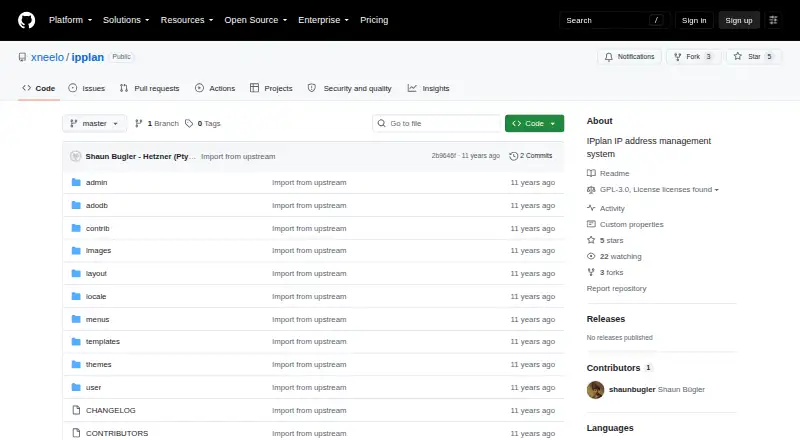
What IPplan is
IPplan is a free, self-hosted web application for managing and tracking IP address space. It can handle one or more networks and customer records, including overlapping address space. Administrators can find available space, split or join networks, search records, review statistics and keep an audit log that records contents before and after changes. Network definitions can be imported from routing tables, tab-delimited files or NMAP XML. For DNS administration, it supports forward and reverse zones, imports existing zones through zone transfer and exports zone data as XML. Multiple administrators can have group-based access profiles and authority boundaries for address space, including read-only groups. Authentication can use IPplan’s own scheme or an external Apache authentication module, including LDAP-based schemes and SiteMinder. Templates allow custom circuit, host-configuration and asset fields, while triggers can call user-defined functions on events. An external poller can scan subnets for active addresses, and configured SNMP support can read router routing tables. Installation requires a web server, PHP and a database; documented options include MySQL, PostgreSQL, Oracle and Microsoft SQL Server.
Who it suits
IPplan suits services companies managing customer IP records and address plans, as well as ISPs assigning address blocks to customers. It is intended for teams able to provide the required web server, PHP and database.
What it does well
- Manages multiple networks and overlapping address space.
- Imports network definitions from three listed formats.
- Includes DNS zone management and XML export.
- Audit log records contents before and after changes.
What to know first
- Requires a web server, PHP and a database.
- Non-MySQL databases may need workarounds.
- Sybase is listed as untested.
Limits
IPplan is free under the GPL. When using a database other than MySQL, some functionality requires workarounds and may be less optimal; Sybase is listed as untested.
Plans
| Plan | Billed and limits | Price |
|---|---|---|
| IPplan | Free (GPL) · self-hosted web application | Free |
As github.com lists them, read 4 Oct 2026. The maker's own page has the final word.
Getting started
- Open the IPplan project website on GitHub.
- Prepare a web server and PHP environment.
- Choose a database; documented working options include MySQL, PostgreSQL, Oracle, and Microsoft SQL Server.
- Deploy IPplan as a self-hosted web application.
- Set up administrators and group-based access profiles for address-space authority.
IPplan is a free, self-hosted web application for organizing IP address space, DNS records, and administrator access. It is particularly well suited to service companies tracking customer networks and ISPs allocating address blocks. The trade-off is operational: running it requires your own web, PHP, and database stack, and non-MySQL databases can reduce functionality or require workarounds.
Overview
IPplan combines IP address management with subnet planning, DNS data management, DHCP management, and audit history in one multilingual interface. It can represent single or multiple networks and customers, including overlapping address space, so it fits providers whose records do not map neatly to one internal network.
Because deployment is self-hosted, the free price does not remove infrastructure responsibility. You supply the web server, PHP runtime, and database, then maintain that environment. Apache is the preferred web server in the documentation; Apache on Windows is supported, and PHP under IIS is described as supported within the platform limitations.
Key features
Address administration goes beyond a simple inventory. Administrators can locate unused ranges, split or join networks, search records, and review statistics. The audit log stores the contents before and after a change, giving teams a concrete way to trace edits and investigate mistakes.
Network definitions can be imported from routing tables, tab-delimited files, or NMAP XML. That variety is useful when an existing inventory lives in different operational systems. An external poller can scan subnets for active addresses and collect usage statistics, while configured SNMP support can read routing tables from routers. Both monitoring functions depend on setting up the external components and network access they require.
DNS support covers forward and reverse zones. IPplan can bring existing zones in through zone transfer and export zone data as XML for processing elsewhere. It therefore works as a DNS data record alongside IPAM, but the export capability is not the same as promising automatic DNS service provisioning.
Access controls are suitable for delegated administration. Multiple administrators can receive group-based profiles and authority boundaries over address space, including read-only groups. Authentication can use IPplan’s internal method or an external Apache authentication module, including LDAP-based schemes and SiteMinder. Templates add custom circuit, host-configuration, and asset fields, and triggers can call user-defined functions when user events occur. Those extension points are valuable when standard records do not match a provider’s workflow, but they place customization work on the deploying organization.
Pricing
The IPplan plan costs nothing and is a Free (GPL) self-hosted web application. There are no published seat quotas, usage caps, trial period, or renewal charges. The practical cost is the server, database, administration, and any customization needed to operate it.
This is a strong fit for organizations that can run open-source software and want broad IPAM and DNS coverage without per-user billing. It is less suitable if you want a hosted service, vendor-managed upgrades, or a packaged support commitment.
Platforms
IPplan runs as a web application on Linux and Windows environments and is self-hosted. Apache is preferred, Apache on Windows works, and PHP under IIS is described as supported. The documented database choices are MySQL, PostgreSQL, Oracle, and Microsoft SQL Server; deployments away from MySQL may need workarounds and can be less optimal, while Sybase is untested.
Who it's for
Choose IPplan when a service company needs customer-by-customer address records, or when an ISP assigns and tracks address blocks across customers. It also suits network teams that need delegated read-only access, change history, imports from existing network sources, and DNS zone records in the same system.
Look elsewhere if your priority is a hosted, low-maintenance product or if your team cannot support PHP, database, web-server, and integration configuration. Database compatibility deserves particular attention before committing to a non-MySQL deployment.
Pros and cons
Pros
- Broad IPAM scope: overlapping networks, subnet operations, search, statistics, and free-space discovery cover real allocation work.
- Useful auditability: before-and-after change records help reconstruct who changed network data and what changed.
- Flexible integration: routing-table, tab-delimited, and NMAP XML imports, plus zone transfer and XML export, support varied existing workflows.
- Delegated control: group profiles, address-space boundaries, read-only groups, and LDAP-compatible external authentication support larger teams.
- Extensible records: templates and event triggers can adapt the application to custom asset and circuit data.
Cons
- Self-hosting burden: you must provide and maintain the web server, PHP, database, and external poller or SNMP configuration.
- Database caveat: non-MySQL options may need workarounds and deliver less optimal functionality; Sybase is untested.
Alternatives
IP Address Management Software is the broader category to compare when you want to survey multiple IPAM products.
ManageEngine OpUtils is a better match when you want a freemium product with a free tier limited to one Class C subnet and one switch, basic scanning, or a paid Professional plan on request.
Subnetly suits teams seeking a hosted-style freemium option with a free monthly allowance of 256 IPAM addresses, 10 subnets, two DHCP pools, and separate private and public DNS zones.
Tidal LightMesh is worth choosing when one user can work within a free limit of fewer than 1,000 IPs, with unlimited subnets and basic IPAM, or when a $35 a month Pro plan is preferable.
GestióIP is an alternative free IPAM package with an optional configuration-management module priced at $400 a year for up to 50 devices.
.NET is an open-source option for environments capped at 1,000 nodes on its free plan.
Azure IPAM fits Azure-focused deployments wanting an open-source project, while budgeting separately for Azure infrastructure and hosting.
NIPAP is another free, open-source IPAM system under the MIT license.
OpenNetAdmin is a free open-source IPAM system with no paid plans or stated usage limits.
Travel Itinerary Apps is unrelated to IP address management and is not a substitute for IPplan.
Verdict
IPplan is a strong choice for technically capable service providers and ISPs that need comprehensive, auditable IP and DNS records with no license fee. Choose it for its overlapping-network support, import and export paths, delegated access, and extensibility; look elsewhere for managed hosting, simpler deployment, or guaranteed parity across non-MySQL databases.
Verdict
IPplan covers IP address administration, DNS data and access controls in a free self-hosted application. Database choice matters: documentation notes workarounds and less optimal functionality for some non-MySQL options.
Questions
How much does IPplan cost?
The listed plan is free: free.
Is IPplan self-hosted?
Yes. It is a self-hosted web application and requires a web server, PHP, and a database.
Which databases are documented as working?
MySQL, PostgreSQL, Oracle, and Microsoft SQL Server are listed as working databases.
Can IPplan manage DNS data?
Yes. It supports forward and reverse DNS zones, zone-transfer imports, and XML exports of zone data.
Does IPplan keep an audit history?
Yes. Its audit log records contents before and after changes.
Who is IPplan intended for?
Its documentation describes services companies managing customer IP records and address plans, and ISPs assigning address blocks to customers.
Facts from IPplan's own pages
- Access control
- Multiple administrators can have group-based access profiles and address-space authority boundaries, including read-only groups. · github.com, 4 Oct 2026
- Authentication
- Authentication can use IPplan’s internal scheme or an external Apache authentication module, including LDAP-based schemes and SiteMinder. · github.com, 4 Oct 2026
- Customization
- Templates can add custom circuit, host-configuration, and asset fields; triggers can call user-defined functions on user events. · github.com, 4 Oct 2026
- Deployment requirements
- IPplan requires a web server, PHP, and a database; the documentation lists MySQL, PostgreSQL, Oracle, and Microsoft SQL Server as working databases. · github.com, 4 Oct 2026
- DNS
- It supports forward and reverse DNS zones, imports existing zones by zone transfer, and exports zone data as XML for external processing. · github.com, 4 Oct 2026
- Imports
- It can import network definitions from routing tables, tab-delimited files, and NMAP XML. · github.com, 4 Oct 2026
- Intended users
- The documentation describes use by services companies managing customer IP records and address plans, and by ISPs assigning address blocks to customers. · github.com, 4 Oct 2026
- IP features
- Features include finding free address space, splitting and joining networks, searching, statistics, and an audit log that records contents before and after changes. · github.com, 4 Oct 2026
- Monitoring
- An external poller can scan subnets for active addresses to gather usage statistics, and SNMP support can read routing tables from routers when configured. · github.com, 4 Oct 2026
- Network management
- It manages single or multiple networks and customers, including overlapping address space. · github.com, 4 Oct 2026
- Notable limitation
- When using a database other than MySQL, some functionality requires workarounds and may be less optimal, and Sybase is listed as untested. · github.com, 4 Oct 2026
- Platform notes
- The documentation prefers Apache and says Apache on Windows works; it also describes PHP under IIS as supported in its limitations section. · github.com, 4 Oct 2026
- Purpose
- IPplan is a free, multilingual web-based IP address management and tracking tool for administering IP address space. · github.com, 4 Oct 2026
- Security and compliance
- The project documentation describes authentication and group-based access controls but does not state security certifications or compliance attestations. · github.com, 4 Oct 2026
- Support
- The project documentation invites bug reports and forum contributions and provides [email protected] for feedback. · github.com, 4 Oct 2026
Where IPplan stands on Freedom251
- Travel Itinerary Apps#5 of 45
- IP Address Management Software#7 of 43