Freedom251 › IP Address Management Software
NIPAP
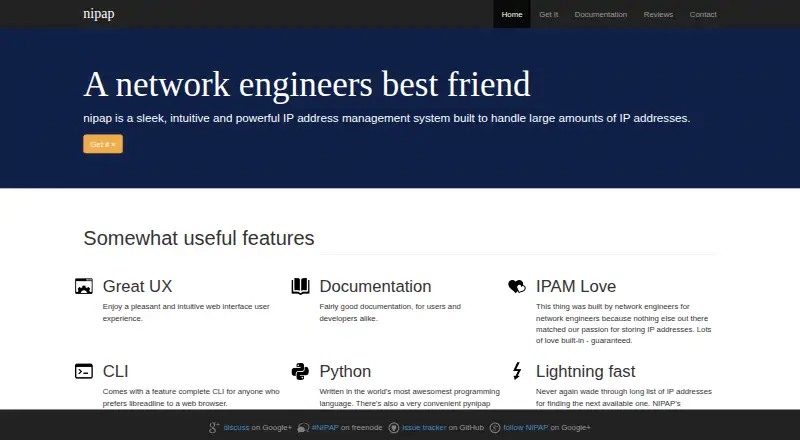
What NIPAP is
NIPAP is a free, open-source IP address management system designed for large address inventories. It provides a web interface and a feature-complete command-line tool, and can allocate the next available address automatically. Search supports IP prefix operators and regular expressions. NIPAP supports IPv6 with feature parity with IPv4 and is designed for native VRF support. It also offers subnet planning, integrated statistics, and audit history. Address data is stored and indexed in PostgreSQL using the ip4r module. The backend communicates through an XML-RPC API, and the project lists Python and Java client libraries. NIPAP is self-hosted and released under the MIT license at no cost. Debian and Debian derivatives are officially supported; other Unix-like systems may run it with manual dependency installation. Installation requires configuring authentication accounts for the backend and web interface. The maker describes user documentation as limited and directs users to GitHub issues for bugs, feature requests, and other issues.
Who it suits
NIPAP suits network engineers and organizations managing large address inventories who can deploy and maintain a self-hosted system. It may fit teams needing IPv6, VRF, and API support.
What it does well
- Automatically allocates the next available address.
- IPv6 support has feature parity with IPv4.
- Supports VRFs natively.
- Includes subnet planning, statistics, and audit history.
- Open source under the MIT license.
What to know first
- User documentation is described as limited.
- Debian and its derivatives are the only officially supported systems.
- Other Unix-like systems may need manual dependency installation.
- Installation requires configuring authentication accounts.
Plans
| Plan | Billed and limits | Price |
|---|---|---|
| NIPAP | Open source · MIT license | Free |
As spritelink.github.io lists them, read 7 Oct 2026. The maker's own page has the final word.
Getting started
- Visit the NIPAP website
- Plan for a self-hosted deployment on Debian or a Debian derivative
- Install NIPAP and configure authentication accounts for the backend and web interface
- Use the web interface or command-line tool to manage IP addresses
Verdict
NIPAP offers address management features for substantial inventories, including IPv6, VRFs, and automatic allocation. Teams should account for self-hosted deployment and the limited user documentation.
Questions
How much does NIPAP cost?
The NIPAP plan is free.
Is NIPAP open source?
Yes. NIPAP is open source under the MIT license.
Which platforms does NIPAP support?
Its listed platforms are API, Linux, self-hosted, and web. Debian and Debian derivatives are officially supported; other Unix-like systems may run it with manual dependency installation.
Does NIPAP support IPv6 and VRFs?
Yes. IPv6 has feature parity with IPv4, and NIPAP supports VRFs natively.
What integrations are available?
The maker lists an XML-RPC API, a Python library called pynipap, a Java client library, and a web interface that communicates with the backend through the API.
Where can users get support?
The maker directs users to GitHub issues for bugs, feature requests, and other issues.
Facts from NIPAP's own pages
- Address allocation
- NIPAP can automatically allocate the next available address. · spritelink.github.io, 7 Oct 2026
- Audience
- The maker describes NIPAP as built by network engineers for network engineers. · spritelink.github.io, 7 Oct 2026
- Command line
- NIPAP includes a feature-complete CLI. · spritelink.github.io, 7 Oct 2026
- Database
- NIPAP stores data in PostgreSQL and uses the ip4r module for ternary lookups. · spritelink.github.io, 7 Oct 2026
- Deployment
- The maker officially supports Debian and Debian derivatives; it says NIPAP should also run on Unix-like systems with manual dependency installation. · spritelink.github.io, 7 Oct 2026
- Documentation
- The maker describes its user documentation as rather limited and links to separate user and developer documentation. · spritelink.github.io, 7 Oct 2026
- Documentation limit
- The maker describes its user documentation as rather limited. · spritelink.github.io, 7 Oct 2026
- Integrations
- The maker lists Python and Java client libraries and a web interface that communicates with the backend through an XML-RPC API. · spritelink.github.io, 7 Oct 2026
- IPv6
- NIPAP supports IPv6 with feature parity with IPv4. · spritelink.github.io, 7 Oct 2026
- Libraries
- The maker lists a Python library called pynipap and a Java client library. · spritelink.github.io, 7 Oct 2026
- License
- NIPAP is open source under the MIT license. · spritelink.github.io, 7 Oct 2026
- Platforms
- The installation guide says NIPAP is officially supported on Debian and Debian derivatives and should run on Unix-like systems with manual dependency installation. · spritelink.github.io, 7 Oct 2026
- Product
- NIPAP is an IP address management system built to handle large amounts of IP addresses. · spritelink.github.io, 7 Oct 2026
- Purpose
- NIPAP is an IP address management system built to handle large amounts of IP addresses. · spritelink.github.io, 7 Oct 2026
- Search
- Its search supports IP prefix operators and regular expressions. · spritelink.github.io, 7 Oct 2026
- Security
- The installation guide describes configuring authentication accounts for the backend and web interface. · spritelink.github.io, 7 Oct 2026
- Statistics
- NIPAP includes integrated statistics. · spritelink.github.io, 7 Oct 2026
- Storage
- NIPAP uses PostgreSQL and the ip4r module to store and index IP addresses. · spritelink.github.io, 7 Oct 2026
- Support
- The maker directs users to GitHub issues for bugs, feature requests, and other issues. · spritelink.github.io, 7 Oct 2026
- VRF
- NIPAP supports VRFs and is designed for them from the ground up. · spritelink.github.io, 7 Oct 2026
- VRFs
- NIPAP is designed to support VRFs natively. · spritelink.github.io, 7 Oct 2026
- Web interface
- NIPAP provides a web interface for managing IP addresses. · spritelink.github.io, 7 Oct 2026
Where NIPAP stands on Freedom251
- IP Address Management Software#9 of 43
- Ipam Tool#6 of 18