Freedom251 › IP Address Management Software
Subnetly
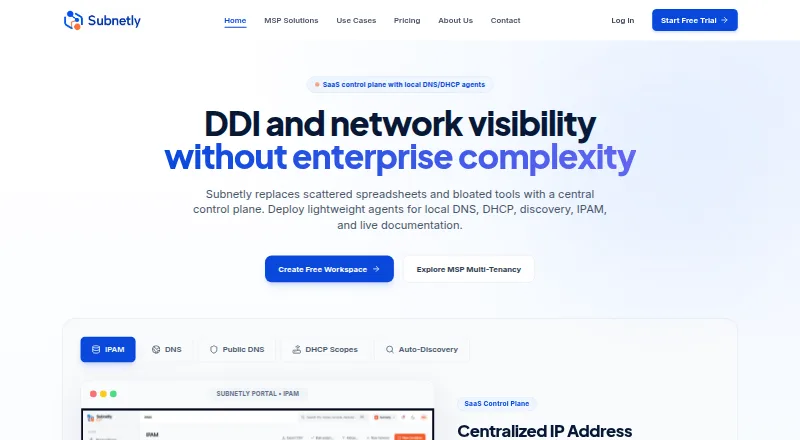
What Subnetly is
Subnetly is a SaaS DDI platform for managing DNS, DHCP, IP addresses, network discovery, and network visibility. Its dashboard tracks IP use and ownership, identifies conflicts and orphaned addresses, and supports QBR data export. Local agents handle authoritative DNS zones and DHCP scopes while the SaaS console coordinates records and configurations. Agents scan active segments with ARP, SNMP, and ICMP to build a hardware asset registry. Subnetly says its AI insights can flag capacity risks, IP conflicts, orphaned addresses, and configuration gaps. Deployment options include Docker, Kubernetes/Helm, Windows Server, and a Linux daemon. The maker says agents connect outward over HTTPS or TLS without open inbound ports or VPN tunnels. REST APIs and monitoring webhooks support automation, with access varying by paid tier. MSP controls include customer and site separation, technician roles, and customer-ready audit records. A free plan is available; Starter costs $49 a month. Starter and Pro include 14-day trials, and Business includes a 21-day trial; trial signup requires no credit card. The company describes its intended users as SMBs and MSPs.
Who it suits
Subnetly suits SMBs and managed service providers that need DNS, DHCP, IP address management, and network discovery. Its customer separation and technician controls are relevant to MSPs managing multiple clients.
What it does well
- Tracks IP utilization and ownership.
- Agents discover assets using ARP, SNMP, and ICMP.
- Provides REST APIs and monitoring webhooks.
- Trial signup requires no credit card.
What to know first
- Free plan is limited to 256 IPAM addresses.
- API and webhook access varies by paid tier.
- Privacy policy says absolute security cannot be guaranteed.
Limits
The free plan includes 256 IPAM addresses, 10 subnets, two DHCP pools, one site, one agent, one user, and seven-day history retention. Starter and Pro trials last 14 days; the Business trial lasts 21 days.
Plans
| Plan | Billed and limits | Price |
|---|---|---|
| Free | Billed monthly; free is always free · 256 IPAM addresses · 10 subnets · 2 DHCP pools · 1 private DNS zone · 1 public DNS zone · 100 DNS records · 1 site · 1 agent · 1 user · 10 AI Advisor messages/month · 1 AI documentation generation/month · 7-day history retention | Free |
| Pro | Billed monthly; 14-day trial · 10,000 IPAM addresses · 500 subnets · 100 DHCP pools · 25 private DNS zones · 10 public DNS zones · 10,000 DNS records · 10 sites · 10 agents · 10 users · 500 AI Advisor messages/month · 50 AI documentation generations/month · 180-day history retention · API access · Webhooks · Role-based access control | $149 a month |
| MSP Starter | Billed monthly; 14-day trial · 5 customer tenants · 10,000 IPAM addresses · 500 subnets · 100 DHCP pools · 25 private DNS zones · 10 public DNS zones · 10,000 DNS records · 15 sites · 15 agents · 3 MSP technician users · 5 client users · MSP dashboard · Customer switcher · Customer health dashboard | $199 a month |
| Business | Billed monthly; 21-day trial · 50,000 IPAM addresses · 2,500 subnets · 500 DHCP pools · 100 private DNS zones · 50 public DNS zones · 50,000 DNS records · 50 sites · 50 agents · 25 users · 2,500 AI Advisor messages/month · 250 AI documentation generations/month · 1-year history retention · API access · Webhooks · RBAC · Audit export · Priority support | $399 a month |
| Starter | Billed monthly; 14-day trial · 2,500 IPAM addresses · 100 subnets · 25 DHCP pools · 5 private DNS zones · 3 public DNS zones · 1,000 DNS records · 3 sites · 3 agents · 3 users · 100 AI Advisor messages/month · 10 AI documentation generations/month · 30-day history retention · Email support | $49 a month |
| MSP Growth | Billed monthly; 14-day trial · 25 customer tenants · 50,000 IPAM addresses · 2,500 subnets · 500 DHCP pools · 100 private DNS zones · 50 public DNS zones · 50,000 DNS records · 75 sites · 75 agents · 10 MSP technician users · 25 client users · MSP dashboard · Customer switcher · Customer health dashboard · White-label branding · API access · Webhooks · Audit export | $499 a month |
| MSP Scale | Billed monthly; 21-day trial · 75 customer tenants · 200,000 IPAM addresses · 10,000 subnets · 2,000 DHCP pools · 500 private DNS zones · 150 public DNS zones · 200,000 DNS records · 250 sites · 250 agents · 25 MSP technician users · 100 client users · MSP dashboard · Customer switcher · Customer health dashboard · White-label branding · Client portal · Advanced RBAC · Audit export · Premium support | $999 a month |
| MSP Enterprise | Contract billing · 75+ customer tenants · Custom IPAM, DNS, DHCP, site and agent limits · SSO/SAML options · SCIM options · Custom retention · Dedicated onboarding · Premium support · Private deployment options | On request |
The first 8 of 9 plans, as subnetly.com lists them, read 14 Oct 2026. The maker's own page has the final word. Every plan
Getting started
- Open subnetly.com and choose the free plan or a paid plan.
- Use the free plan or sign up for a Starter, Pro, or Business trial; trial signup requires no credit card.
- Choose a listed deployment option: Docker, Kubernetes/Helm, Windows Server, or Linux daemon.
- Deploy local agents to support DNS, DHCP, and network discovery.
- Use the SaaS console to coordinate records and configurations.
Overview
Subnetly is a hybrid DDI platform that combines IP address management with DNS, DHCP, network discovery and visibility. It is best suited to SMB network teams and MSPs managing multiple customer environments. Its broad scope is a strength, but the free tier is tightly capped and larger operations will need a paid or custom plan.
Key features
IP address management and visibility
The dashboard tracks IP use and ownership, flags conflicts and orphan addresses, and supports QBR data exports. That makes it useful not just for keeping an address inventory, but also for spotting allocation issues and preparing network reviews. AI insights target capacity risks and configuration gaps; teams that prefer to make those judgments themselves may place less value on that layer.
DNS, DHCP and discovery
Local agents handle authoritative DNS zones and DHCP scopes, while the SaaS console coordinates records and configurations. Agents scan active segments with ARP, SNMP and ICMP to build a hardware asset registry. Keeping these functions together should suit teams seeking a shared view across DDI and discovered assets; organizations that need only basic IPAM may find the platform broader than necessary.
Deployment and integrations
Deployment options include Docker, Kubernetes/Helm, Windows Server and Linux daemons. Agents communicate outbound over HTTPS or TLS, without open inbound ports or VPN tunnels, which can be a practical fit for networks where inbound access is undesirable. REST APIs and monitoring webhooks support automation with scripts and third-party tools, though access varies by paid tier.
For MSPs, customer and site separation, technician roles and customer-ready audit records address the need to keep client environments and operational records distinct. Subnetly's privacy policy describes safeguards that may include encryption in transit, access controls, tenant isolation, audit logging, monitoring and secure secret handling; it also cautions that no transmission or storage method is completely secure.
Pricing
Subnetly has a free plan and monthly paid plans. Starter and Pro include 14-day trials, while Business has a 21-day trial; signup requires no credit card.
- Free — free, billed monthly: 256 IPAM addresses, 10 subnets, two DHCP pools, one private and one public DNS zone, 100 DNS records, one site, one agent and one user. It also includes 10 AI Advisor messages and one AI documentation generation per month, with seven-day history retention. This is suitable for a small evaluation or very limited deployment, but the single-user, single-site caps leave little room for a growing team.
- Starter — $49 a month, billed monthly: 2,500 IPAM addresses, 100 subnets, 25 DHCP pools, five private and three public DNS zones, 1,000 DNS records, three sites, agents and users, 100 AI Advisor messages and 10 documentation generations monthly, and 30-day history retention. Email support is included. This is the entry paid tier for a small team that needs more than the free caps allow.
- Pro — $149 a month, billed monthly: 10,000 IPAM addresses, 500 subnets, 100 DHCP pools, 25 private and 10 public DNS zones, 10,000 DNS records, 10 sites, agents and users, 500 AI Advisor messages and 50 documentation generations monthly, with 180-day history retention. It suits teams needing more scale and longer history than Starter provides.
- MSP Starter — $199 a month, billed monthly: Five customer tenants, 10,000 IPAM addresses, 500 subnets, 100 DHCP pools, 25 private and 10 public DNS zones, 10,000 DNS records, 15 sites and agents, three MSP technician users and five client users. It includes 500 AI Advisor messages and 50 documentation generations monthly. The tenant and role structure makes this more appropriate than Pro for a small provider managing several clients.
- Business — $399 a month, billed monthly: 50,000 IPAM addresses, 2,500 subnets, 500 DHCP pools, 100 private and 50 public DNS zones, 50,000 DNS records, 50 sites and agents, 25 users, 2,500 AI Advisor messages and 250 documentation generations monthly, with one-year history retention. Priority support and a 21-day trial are included. It fits larger in-house operations that need expanded capacity and longer audit history.
- MSP Growth — $499 a month, billed monthly: 25 customer tenants, 50,000 IPAM addresses, 2,500 subnets, 500 DHCP pools, 100 private and 50 public DNS zones, 50,000 DNS records, 75 sites and agents, 10 MSP technician users and 25 client users. It includes 2,500 AI Advisor messages and 250 documentation generations monthly. This is the step up for MSPs whose tenant or technician needs exceed MSP Starter.
- MSP Scale — $999 a month, billed monthly: 75 customer tenants, 200,000 IPAM addresses, 10,000 subnets, 2,000 DHCP pools, 500 private and 150 public DNS zones, 200,000 DNS records, 250 sites and agents, 25 MSP technician users and 100 client users. It is aimed at providers needing substantially more customer and infrastructure capacity than MSP Growth, with premium support.
- Enterprise and MSP Enterprise — custom pricing: Enterprise offers custom limits, SSO/SAML options, custom retention, migration assistance, premium support and private deployment options. MSP Enterprise adds support for 75+ customer tenants, custom IPAM, DNS, DHCP, site and agent limits, SCIM options and dedicated onboarding. These plans are for organizations whose scale or deployment needs exceed the fixed tiers.
Platforms
Subnetly supports API, iOS, Linux, web and Windows. Its hybrid deployment options span containerized deployments, Kubernetes/Helm, Windows Server and Linux daemons, so teams can place agents in their network environment while coordinating through the SaaS console.
Who it's for
Subnetly is aimed at SMBs and MSPs, particularly administrators responsible for address allocation, DNS and DHCP configuration, and network asset oversight. Its multi-tenant MSP plans are the clearest fit for service providers; a smaller in-house team can start with Free or Starter. It is less compelling for buyers who need only a basic address inventory or want extensive capacity without moving beyond a small plan.
Pros and cons
- Pros: IPAM, DNS, DHCP and active-segment discovery are brought into one platform, which can reduce the need to reconcile separate network inventories.
- Pros: Outbound-only agent communication avoids open inbound ports and VPN tunnels, a useful deployment characteristic for managed networks.
- Pros: MSP tiers define customer tenants, technician seats and client users, making their capacity easier to assess against a provider's client base.
- Cons: The free plan's one user, one site and one agent cap it at small-scale use, even though it includes several core functions.
- Cons: Several paid plans impose distinct quotas on addresses, sites, agents, users and AI usage, so buyers must match multiple limits rather than price alone.
- Cons: Enterprise and MSP Enterprise require custom pricing, which makes those tiers harder to compare directly with the fixed monthly plans.
Alternatives
For a wider category comparison, see IP Address Management Software and DHCP Management Software.
- Tidal LightMesh is worth considering for a lower-cost starting point: its free plan allows one user and fewer than 1,000 IPs with unlimited subnets and DHCP discovery, while Pro is $35 a month.
- GestióIP may suit buyers seeking free IPAM software or a configuration-management module priced per year.
- teemIP is an option for teams that want a free community offering with open-source code.
- Danbyte is worth comparing for buyers seeking free, self-hosted software with all features included and no seat license.
- Obelinf may suit buyers looking for a freemium option on API and web platforms.
- phpIPAM is a free, self-hosted IP address management option for teams that do not need Subnetly's combined DDI scope.
- SpatiumDDI is another free option for buyers comparing DDI software.
- Infoblox Cloud Network Automation uses token-based licensing; consider it if that licensing model fits your purchasing approach.
Verdict
Subnetly is a strong fit for SMB network administrators and MSPs who want IPAM, DNS, DHCP and discovery under one roof, with outbound-only agents and dedicated multi-tenant tiers as notable advantages. Choose it when that joined-up scope and its capacity tiers match your environment; look elsewhere if a basic IPAM tool or a more open-ended free deployment is enough.
Verdict
Subnetly combines DDI management, discovery, and visibility, with a free plan and paid plans from $49 a month. Compare the plan limits and tier-dependent automation access with your network and customer needs.
Questions
Is Subnetly free?
Yes. The Free plan costs nothing and includes 256 IPAM addresses, 10 subnets, two DHCP pools, one site, one agent, and one user.
What do paid plans cost?
Paid plans start at $49 a month. Starter is $49 a month; Pro is 149.00 USD, MSP Starter is 199.00 USD, Business is 399.00 USD, MSP Growth is 499.00 USD, and MSP Scale is $999 a month. Enterprise and MSP Enterprise use contract billing.
Is there a free trial?
Starter and Pro include 14-day trials, and Business includes a 21-day trial. Trial signup requires no credit card.
Which deployment options are available?
Subnetly lists Docker, Kubernetes/Helm, Windows Server, and Linux daemon deployment options. Its platforms also include API, iOS, Linux, web, and Windows.
Does Subnetly support MSP workflows?
Yes. MSP features include customer and site separation, technician role controls, and customer-ready audit records.
Does Subnetly provide API access?
It describes REST APIs and monitoring webhooks for third-party automation tools and scripts. Access varies by paid tier.
Facts from Subnetly's own pages
- Agent communication
- The documented container uses outbound HTTPS only and has an approximately 12 MB binary footprint. · subnetly.com, 14 Oct 2026
- Agent network access
- Subnetly says local agents communicate outbound over HTTPS or TLS without open inbound ports or VPN tunnels. · subnetly.com, 29 Sept 2026
- AI features
- Subnetly says its AI insights flag capacity risks, orphaned addresses, IP conflicts, and configuration gaps. · subnetly.com, 29 Sept 2026
- AI insights
- AI-assisted features identify capacity risks, orphan addresses, IP conflicts and configuration gaps. · subnetly.com, 14 Oct 2026
- API and webhooks
- REST API access and webhooks are listed on Pro, Business and MSP Growth plans, with availability dependent on tier. · subnetly.com, 14 Oct 2026
- Company background
- Subnetly says it was founded in 2026 by veteran systems and network administrators and is intended for SMBs and MSPs. · subnetly.com, 29 Sept 2026
- Company legal name
- The privacy policy identifies the company as Subnetly, Inc. · subnetly.com, 14 Oct 2026
- Data collection limit
- Subnetly says it does not intentionally collect packet payloads, private keys, passwords or unrelated end-user content. · subnetly.com, 14 Oct 2026
- Deployment
- The maker lists Docker, Kubernetes/Helm, Windows Server, and Linux daemon deployment options. · subnetly.com, 29 Sept 2026
- DHCP
- The platform centralizes DHCP scopes, lease pools and reservations across environments. · subnetly.com, 14 Oct 2026
- Discovery
- Agents scan active segments with ARP, SNMP and ICMP to build a hardware asset registry. · subnetly.com, 14 Oct 2026
- DNS
- Local agents provide authoritative DNS zones while the SaaS console coordinates records. · subnetly.com, 14 Oct 2026
- DNS and DHCP
- Local agents support authoritative DNS zones and DHCP scopes while the SaaS console coordinates records and configurations. · subnetly.com, 29 Sept 2026
- Docker installation
- The homepage supplies a Docker image and run command using an agent registration key and subnet scan variable. · subnetly.com, 14 Oct 2026
- Documentation exports
- The use-case page says users can export CSV reports or provide view-only technician access. · subnetly.com, 14 Oct 2026
- Founded
- The about page says Subnetly was founded in 2026 by veteran systems and network administrators. · subnetly.com, 14 Oct 2026
- HQ
- No headquarters location is stated on the opened official pages. · subnetly.com, 14 Oct 2026
- Independent engagement
- PeerPush shows 3 upvotes and 2 follows for the Subnetly listing. · peerpush.com, 14 Oct 2026
- Independent launch
- PeerPush dates its Subnetly listing to August 4, 2026 and marks it as a just-launched product. · peerpush.com, 14 Oct 2026
- Independent listing
- PeerPush describes Subnetly as a hybrid SaaS DDI product for SMBs and MSPs managing DNS, DHCP and IPAM. · peerpush.com, 14 Oct 2026
- Independent platforms
- PeerPush lists Web, Mobile and API as Subnetly platforms. · peerpush.com, 14 Oct 2026
- Integrations and extensibility
- Subnetly describes REST APIs and monitoring webhooks for third-party automation tools and scripts; paid plan access varies by tier. · subnetly.com, 29 Sept 2026
- IPAM
- Its dashboard tracks utilization and ownership, flags conflicts and orphan addresses, and exports data for reporting. · subnetly.com, 14 Oct 2026
- Kubernetes
- Subnetly lists Kubernetes and Helm daemonset deployment for monitoring container network interfaces. · subnetly.com, 14 Oct 2026
Where Subnetly stands on Freedom251
- IP Address Management Software#14 of 43
- DHCP Management Software#9 of 25