Freedom251 › IT Capacity Management Software
CenterOS Capacity Management
What CenterOS Capacity Management is
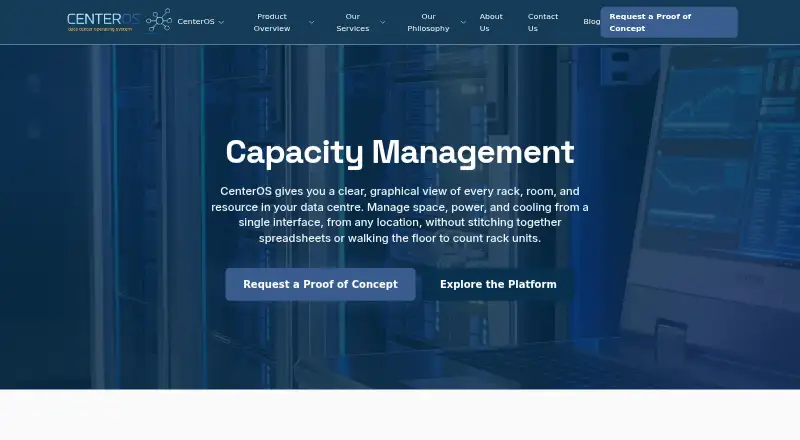
CenterOS Capacity Management is a data center capacity platform for managing racks, rooms, and resources across power, cooling, space, weight, connectivity, and compute. Teams can also define custom capacity dimensions. Rack elevations help users inspect equipment layouts and model planned installations, moves, or decommissioning before work begins. Equipment templates can populate vendor details such as power draw, heat output, weight, dimensions, and rack space when adding assets. The platform lists SNMP, Modbus, BACnet, MQTT, IPMI, and Prometheus among its monitoring protocols, and imports estate data from spreadsheets, NetBox, Ralph, or legacy DCIM systems. Deployment options include multi-tenant SaaS, dedicated private cloud, and sovereign on-premises operation, including air-gapped environments. The maker says sovereign deployments keep AI inference within the customer's boundary. CenterOS AI can answer plain-English questions, plan capacity, and correlate incidents; human approval is required for agent proposals. Entities have field-level audit trails, with state changes recorded as replayable events. The company was established in 2006 and is headquartered in Auckland, New Zealand. Pricing is available on request.
Who it suits
The SaaS option is described as suitable for colocation operators, MSPs, and enterprise teams modernizing from spreadsheets. The private cloud and sovereign on-premises choices may suit organizations that need dedicated deployment or on-premises operation, including air-gapped environments.
What it does well
- Tracks power, cooling, space, weight, connectivity, and compute.
- Models planned rack installations, moves, and decommissioning.
- Imports data from spreadsheets, NetBox, Ralph, and legacy DCIM systems.
- Offers SaaS, dedicated private cloud, and sovereign on-premises deployment.
- Lists six monitoring protocols, including SNMP and Prometheus.
- Records field-level audit trails and replayable state changes.
What to know first
- Pricing is available on request.
- All three listed plans are billed as contact us.
Plans
| Plan | Billed and limits | Price |
|---|---|---|
| Private Cloud | Contact us · Dedicated single-tenant deployment · Contractual SLAs | On request |
| SaaS | Contact us · Multi-tenant cloud · CenterOS AI included | On request |
| Sovereign On-Premises | Contact us · On-premises, including air-gapped · AI runs on your own GPUs | On request |
As centeros.com lists them, read 7 Oct 2026. The maker's own page has the final word.
Getting started
- Visit https://centeros.com/product-overview/capacity-management/.
- Choose between SaaS, dedicated private cloud, and sovereign on-premises deployment.
- Contact CenterOS to discuss pricing and the selected plan.
- Import estate data from spreadsheets, NetBox, Ralph, or a legacy DCIM system.
- Add assets using equipment templates and review rack elevations.
CenterOS Capacity Management is a multi-environment platform for modelling data-center capacity and planning infrastructure changes. It suits colocation operators, managed service providers, and enterprise teams with complex estates and strict placement constraints. Its broad resource model and deployment flexibility are strong reasons to consider it; custom pricing means buyers must have a requirements conversation before committing.
Overview
CenterOS presents racks, rooms, and resources graphically, combining space, power, and cooling in one operational view. It also tracks weight, connectivity, and compute, while allowing custom capacity dimensions. That breadth is valuable when a project can fail because of several constraints at once, rather than rack space alone.
The platform joins capacity planning with monitoring and forecasting. CenterOS names SNMP, Modbus, BACnet, MQTT, IPMI, and Prometheus support, giving teams multiple ways to bring telemetry into planning workflows. It can import estate information from spreadsheets, NetBox, Ralph, and legacy DCIM systems, which should reduce the burden of moving an established inventory into the system.
Key features
Physical change planning
- Rack elevations: Inspect current rack layouts and model installations, moves, or decommissioning before work starts. This is a practical advantage for operators coordinating physical work, not merely recording assets.
- Equipment templates: Vendor specifications such as power draw, heat output, weight, dimensions, and rack space can populate new assets. Templates make planning more consistent and expose likely capacity conflicts earlier.
- Multi-dimensional capacity: Power, cooling, space, weight, connectivity, and compute are tracked together, with custom dimensions for site-specific rules. Teams with unusually strict engineering or compliance constraints will get more value than those needing only a basic utilization list.
Automation and control
- AI assistance: CenterOS AI answers plain-English questions, plans capacity, and correlates incidents. Human approval is required for agent proposals, an important safeguard for change-controlled environments, although organizations still need to decide whether AI belongs inside their governance model.
- Auditability: Field-level audit trails and replayable event records support investigation and accountability when state changes need to be reconstructed.
- Data-boundary options: Sovereign on-premises deployment can run AI inference on customer-owned GPUs, including in air-gapped environments. That is a material distinction for organizations that cannot send operational data to a shared cloud.
Pricing
All three plans use custom pricing, so budget comparisons require a direct proposal.
| Plan | What it includes | Best fit |
|---|---|---|
| SaaS | Multi-tenant cloud with CenterOS AI included | Colocation operators, MSPs, and enterprise teams modernizing spreadsheet-based processes |
| Private Cloud | Dedicated single-tenant deployment with contractual SLAs | Organizations wanting managed cloud isolation and formal service commitments |
| Sovereign On-Premises | On-premises deployment, including air-gapped operation; AI runs on your own GPUs | Regulated or security-sensitive teams requiring control within their own boundary |
The SaaS plan is the straightforward starting point if shared cloud operation is acceptable. Private Cloud gives up multi-tenant economics for dedicated tenancy and SLA terms. Sovereign On-Premises demands customer infrastructure and GPU responsibility, but is the appropriate trade-off where disconnected operation or local AI processing is mandatory.
Platforms
CenterOS supports web access, an API, and self-hosted operation. Its hybrid deployment model spans multi-tenant SaaS, dedicated private cloud, and sovereign on-premises installations, including air-gapped sites.
Who it's for
This is aimed at data-center operators managing many racks or facilities, MSPs and colocation providers serving multiple tenants, and enterprise infrastructure groups replacing spreadsheet-led planning. It is especially suitable when power, cooling, weight, connectivity, and compute must be evaluated together. A smaller team seeking a simple, low-cost capacity tracker may find this breadth and deployment choice unnecessary.
Pros and cons
- Pro: Six built-in capacity domains plus custom dimensions support detailed engineering decisions.
- Pro: Rack modelling, equipment templates, and imports from common inventory sources connect planning to real estate data.
- Pro: Air-gapped sovereign deployment and local AI inference address stringent data-boundary requirements.
- Pro: Human approval for AI proposals and replayable audit events strengthen operational control.
- Con: Every plan is custom-priced, making quick cost qualification difficult.
- Con: Sovereign deployment requires customer-owned GPUs for AI and the operational responsibility that comes with on-premises infrastructure.
Alternatives
For a no-additional-cost Google Cloud tool, choose Google Cloud Capacity Planner; its billable Google Cloud resources remain charged separately. Choose Infovista VistaPlan if broad desktop and mobile platform coverage matters more than CenterOS's stated deployment boundaries. IBM Capacity Management Analytics is the alternative for teams needing distributed-platform or z/OS editions. Choose Rocket EDX when a variable-usage or fixed-price subscription model is preferred. Algomox ITMox offers custom enterprise pricing. Globberry Capacity Management is another paid capacity-management option. Choose Hyperview if a 30-day, no-card trial and per-asset annual pricing are more useful. ITRS Capacity Planner is a paid option with mobile, desktop, web, and Windows support.
For broader comparisons, see IT Capacity Management Software and Data Center Infrastructure Management Software.
Verdict
Choose CenterOS Capacity Management when your organization must plan physical and digital capacity across multiple resource dimensions and deployment environments. Its strongest differentiators are rack-level modelling, broad telemetry and import support, and a sovereign option with local AI inference. Look elsewhere if you need transparent pricing, a lightweight tracker, or a free starting tier.
Verdict
CenterOS Capacity Management suits data center operators and enterprise teams that need to plan capacity across multiple resource dimensions and deployment environments. Consider another option if you need a listed price before contacting the maker; each listed plan is priced on request.
Questions
How is CenterOS Capacity Management priced?
Pricing is on request. The SaaS, Private Cloud, and Sovereign On-Premises plans are each billed as contact us.
What deployment plans are available?
The listed plans are SaaS, Private Cloud, and Sovereign On-Premises. The platform options include multi-tenant SaaS, dedicated private cloud, and on-premises deployment, including air-gapped operation.
Can it run in an air-gapped environment?
Sovereign on-premises deployment includes air-gapped operation. The maker says AI inference in sovereign deployments runs inside the customer's boundary.
What capacity areas does it track?
It tracks power, cooling, space, weight, connectivity, and compute, with custom dimensions also available.
Which monitoring protocols are listed?
The listed protocols include SNMP, Modbus, BACnet, MQTT, IPMI, and Prometheus.
Who makes CenterOS Capacity Management?
CenterOS, established in 2006, is headquartered in Auckland, New Zealand.
Facts from CenterOS Capacity Management's own pages
- AI approvals
- CenterOS AI can answer plain-English questions, plan capacity, and correlate incidents, with human approval required for agent proposals. · centeros.com, 7 Oct 2026
- Audit evidence
- The maker says entities have field-level audit trails and state changes are recorded as replayable events. · centeros.com, 7 Oct 2026
- Capacity dimensions
- The platform tracks capacity across power, cooling, space, weight, connectivity, and compute, with custom dimensions also available. · centeros.com, 7 Oct 2026
- Capacity view
- CenterOS provides a graphical view of data center racks, rooms, and resources for managing space, power, and cooling. · centeros.com, 7 Oct 2026
- Company history
- CenterOS says it was established in 2006 with support from the New Zealand Foundation for Research, Science and Technology. · centeros.com, 7 Oct 2026
- Data imports
- The platform can import estate data from spreadsheets, NetBox, Ralph, or legacy DCIM systems. · centeros.com, 7 Oct 2026
- Deployment choices
- CenterOS offers multi-tenant SaaS, dedicated private cloud, and sovereign on-premises deployment, including air-gapped operation. · centeros.com, 7 Oct 2026
- Equipment templates
- Equipment templates can populate vendor specifications such as power draw, heat output, weight, dimensions, and rack space when adding an asset. · centeros.com, 7 Oct 2026
- Founded
- 2006 · centeros.com, 28 Sept 2026
- Headquarters
- Auckland, New Zealand · centeros.com, 28 Sept 2026
- Intended users
- The maker describes its SaaS deployment as suitable for colocation operators, MSPs, and enterprise teams modernizing from spreadsheets. · centeros.com, 7 Oct 2026
- Monitoring protocols
- CenterOS lists SNMP, Modbus, BACnet, MQTT, IPMI, and Prometheus among its monitoring protocols. · centeros.com, 7 Oct 2026
- Rack planning
- Users can inspect rack elevations and model planned installations, moves, or decommissioning before work begins. · centeros.com, 7 Oct 2026
- Security boundary
- The maker says sovereign on-premises deployments run AI inference inside the customer's boundary, including in air-gapped environments. · centeros.com, 7 Oct 2026
- Support
- The maker offers optional 24×7 monitoring and hands-on training, and says most teams become self-sufficient after two days of training. · centeros.com, 7 Oct 2026