RubriqFlow
What RubriqFlow is
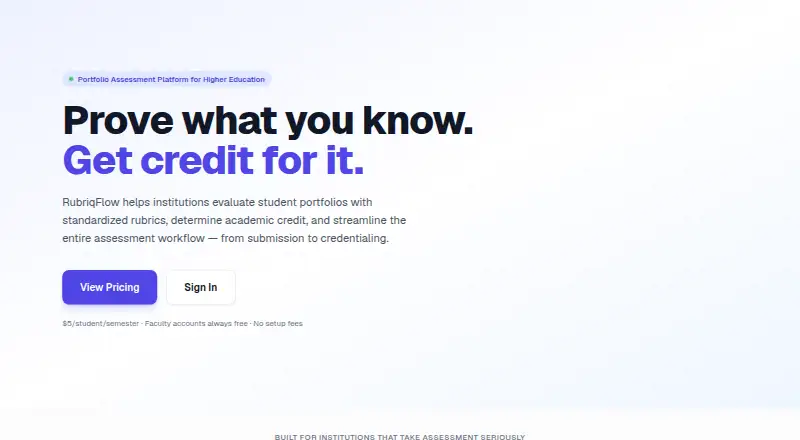
RubriqFlow is a web platform for higher education institutions evaluating student portfolios for academic credit. Students upload documents, artifacts, and evidence of prior learning for faculty review. Faculty score portfolios using weighted criteria and standardized levels; scores map to recommended credits, which faculty may override with a justification. The workflow covers submission through credentialing and maintains an audit trail for credit determinations. RubriqFlow supports institutional deployment with isolated organization data, department management, and centralized administration. It lists Student, Faculty, Org Admin, and Super Admin roles, and faculty can be assigned subjects to access relevant portfolios. The homepage states WCAG 2.1 AA verification and Section 508 support, and reports 33 of 33 tests passed in October 2025. FileDrop says it operates in compliance with FERPA and uses education records only to evaluate and award prior learning credit. It also says portfolio files are privately stored, browser connections use HTTPS with TLS, and downloads require authenticated authorization. Faculty and staff accounts are always free; student access is $5 a month, billed at $5/student/semester with no setup fees. Enterprise terms are custom.
Who it suits
RubriqFlow suits higher education institutions that assess prior learning portfolios for academic credit. Its role controls and department management may fit institutions coordinating review across faculty and administrators.
What it does well
- Faculty and staff accounts are always free
- Weighted criteria map scores to credit recommendations
- Faculty can override recommendations with justification
- Maintains an audit trail for credit decisions
- Student submissions cover documents and prior-learning evidence
What to know first
- Student access costs $5 a month
- Enterprise pricing is custom and not listed
Limits
Faculty and staff accounts are always free. Student access costs $5 per student per semester; enterprise pricing is custom.
Plans
| Plan | Billed and limits | Price |
|---|---|---|
| Faculty and staff accounts | Always free · Unlimited faculty and staff accounts | Free |
| Student access | $5/student/semester · Per student, per semester · no setup fees | $5 a month |
| Enterprise | Custom pricing · Custom pricing · SLA · dedicated support | On request |
As rubriqflow.com lists them, read 4 Oct 2026. The maker's own page has the final word.
Getting started
- Visit the RubriqFlow website.
- Create faculty and staff accounts under the always-free plan.
- Select student access at $5 per student per semester, or contact the provider about an enterprise agreement.
- Use the web platform to configure institutional roles and departments.
- Have students submit portfolio documents, artifacts, and prior learning evidence for faculty review.
RubriqFlow is a web-based system for colleges and universities that assess prior learning and award academic credit. It is best suited to institutions coordinating portfolio review across faculty and departments. Its strongest case is a traceable path from student evidence to credit recommendation; student fees are the main cost to weigh.
Overview
Students submit documents and other evidence of prior learning for faculty assessment. Faculty use weighted criteria and standardized scoring levels, with scores mapped to recommended credits. Reviewers can override a recommendation and explain why, while an audit trail records credit determinations. That connection between rubric scoring and credit decisions is useful for institutions formalizing prior-learning assessment, rather than teams that only need to grade ordinary assignments.
RubriqFlow describes a multi-tenant setup with separated organization data, department management, and centralized administration. Its roles cover students, faculty, organization administrators, and super administrators; faculty are assigned to subjects to access relevant portfolios. This structure supports institution-wide workflows, but is likely more elaborate than a small team needs for occasional rubric scoring.
Key features
Rubrics linked to credit
Weighted criteria and consistent scoring levels give faculty a common basis for evaluating portfolios. Automatic credit recommendations connect those scores to a decision, while justified overrides leave room for faculty judgment. The audit trail is a practical strength when an institution needs to account for how credit was determined.
Submission and administration
Students can submit portfolio documents, artifacts, and evidence for review. Department management and subject-based faculty access help organize that work across an institution, rather than treating each assessment as a standalone grading task.
Accessibility and data handling
The homepage states WCAG 2.1 AA verification and Section 508 support, and reports 33 of 33 tests passed in October 2025. FileDrop says it complies with FERPA and uses education records only to evaluate and award prior-learning credit. It says account data is deleted within 180 days after termination unless law requires longer retention. Browser connections use HTTPS with TLS, portfolio files are privately stored, and downloads require authenticated authorization.
Pricing
Faculty and staff accounts are free, billed as always free, with unlimited faculty and staff accounts. This removes a per-seat charge for reviewers, a meaningful advantage for institutions involving many faculty members.
Student access is $5 a month, billed at $5/student/semester, per student, per semester, with no setup fees. The semester basis makes enrollment volume central to the budget: schools should weigh the charge against the number of students using the process, rather than treating it as a flat institutional subscription.
Enterprise has custom pricing and includes an SLA and dedicated support. It is the fit for institutions seeking an enterprise agreement and direct support, but its cost will need to be assessed through a custom quote. The homepage offers volume discounts for schools with 2,500 or more students and institutions with 10,000 or more. There is no paid lower tier described between free staff accounts and per-student access.
Platforms
RubriqFlow is available on the web. That suits browser-based institutional workflows, but it is not a choice for teams seeking a listed native mobile app.
Who it's for
RubriqFlow is a strong fit for higher education institutions that assess prior learning at scale, need faculty to evaluate portfolios against consistent rubrics, and want credit recommendations and an audit trail in the same workflow. Schools with substantial student volumes may benefit from the stated volume discounts. It is a weaker fit for individual instructors seeking a simple assignment-grading rubric tool, or organizations that do not award academic credit for prior learning.
Pros and cons
- Pro: Scores map to credit recommendations, and justified faculty overrides preserve human judgment while documenting exceptions.
- Pro: Unlimited faculty and staff accounts are always free, reducing the cost of involving additional reviewers.
- Pro: Multi-tenant administration, department management, and subject-based access address institutional coordination needs.
- Con: Student access costs $5/student/semester, so total cost rises with the student population using the workflow.
- Con: The credit-assessment and administration focus may be excessive for small teams that only need to score coursework.
- Con: Enterprise pricing is custom, so institutions cannot compare that tier against a fixed published price.
Alternatives
For broader rubric and grading options, browse Rubric Software.
- Gradescope is worth considering for assignment grading across web and mobile: its free Basic plan includes dynamic rubrics, question-by-question grading, assignment statistics, regrade requests, and data export.
- GradeBoard is an option for teams whose needs fit a capped free allowance: its Free plan allows 10 learner submissions per month, limited rubric uploads, basic analytics, DOCX annotated downloads, 30-day data retention, and email support.
- OpenRubric may suit organizations seeking a self-hosted option; its Partner event plan provides one event at no cost in exchange for sponsor recognition and permission for an anonymized case study.
- Rubric Scorer is a mobile option for a single class with up to three rubrics on its free app plan.
- UniRubric may suit lecturers who want to try one marking job: its free plan includes one lifetime job, rubric-anchored output, approval before release, and PDF export.
- Pawtograder is a free self-hosted option for instructors evaluating with Pawtograder.
- Quick Rubric is a free web option for creating rubrics that remain publicly available, with reuse limited to non-commercial use.
- RubiStar is a free web option for educational use, though rubrics may be deleted if used personally or commercially.
Verdict
Choose RubriqFlow if your institution needs a coordinated, auditable process for reviewing prior-learning portfolios and turning rubric scores into credit recommendations. Free unlimited faculty accounts and the documented decision trail are compelling; the per-student semester charge and institution-focused workflow make it less suitable for small-scale assignment grading or buyers seeking a fixed, all-in price.
Verdict
RubriqFlow organizes portfolio review, credit recommendations, and credentialing for higher education. Faculty and staff accounts are free, while student access is billed per student per semester.
Questions
Does RubriqFlow have a free plan?
Faculty and staff accounts are listed as always free, with unlimited accounts. Student access costs $5 per student per semester.
What does student access cost?
It is $5 per student per semester, with no setup fees.
Which platform does RubriqFlow support?
RubriqFlow is listed as a web platform.
Who operates the service?
The privacy policy identifies Noctusoft, Inc. as the operator of FileDrop.
Does RubriqFlow support institutional and enterprise use?
It describes itself as a multi-tenant platform with separate organization data, department management, and centralized administration. Enterprise agreements have custom pricing, SLA, and dedicated support.
What accessibility support is stated?
The homepage states WCAG 2.1 AA verification and Section 508 support, and reports 33 of 33 tests passed in October 2025.
Facts from RubriqFlow's own pages
- Accessibility
- The homepage states WCAG 2.1 AA verification and Section 508 support; it reports 33 of 33 tests passed in October 2025. · rubriqflow.com, 4 Oct 2026
- Audit trail
- The product maintains a full audit trail for credit determination. · rubriqflow.com, 4 Oct 2026
- Company/operator
- The privacy policy identifies Noctusoft, Inc. as the operator of FileDrop. · filedrop.rubriqflow.com, 4 Oct 2026
- Credit recommendations
- Rubric scores map automatically to recommended credits, and faculty can override the recommendation with justification. · rubriqflow.com, 4 Oct 2026
- Data retention
- FileDrop says account data is deleted within 180 days after account termination, except where law requires longer retention. · filedrop.rubriqflow.com, 4 Oct 2026
- FERPA
- FileDrop states it operates in compliance with FERPA and uses education records exclusively to evaluate and award prior learning credit. · filedrop.rubriqflow.com, 4 Oct 2026
- Institutional deployment
- RubriqFlow describes itself as a multi-tenant platform for institutions, with isolated organization data, department management, and centralized administration. · rubriqflow.com, 4 Oct 2026
- Purpose
- RubriqFlow helps higher education institutions assess student portfolios with standardized rubrics, determine academic credit, and manage the workflow from submission to credentialing. · rubriqflow.com, 4 Oct 2026
- Roles and access
- The platform lists Student, Faculty, Org Admin, and Super Admin roles, with faculty assigned to subjects for access to relevant portfolios. · rubriqflow.com, 4 Oct 2026
- Rubric evaluation
- Faculty evaluate portfolios using weighted criteria and standardized scoring levels. · rubriqflow.com, 4 Oct 2026
- Scale pricing
- The homepage offers volume discounts for schools with 2,500 or more students and institutions with 10,000 or more. · rubriqflow.com, 4 Oct 2026
- Security
- FileDrop says browser connections use HTTPS with TLS, portfolio files are privately stored, and downloads require authenticated authorization. · filedrop.rubriqflow.com, 4 Oct 2026
- Submission workflow
- Students upload portfolio documents, artifacts, and evidence of prior learning for faculty review and credit determination. · rubriqflow.com, 4 Oct 2026
- Support
- The homepage offers enterprise agreements with dedicated support and links to a Help Center and Contact Us page. · rubriqflow.com, 4 Oct 2026
Where RubriqFlow stands on Freedom251
- Rubric Software#12 of 22