Pawtograder
What Pawtograder is
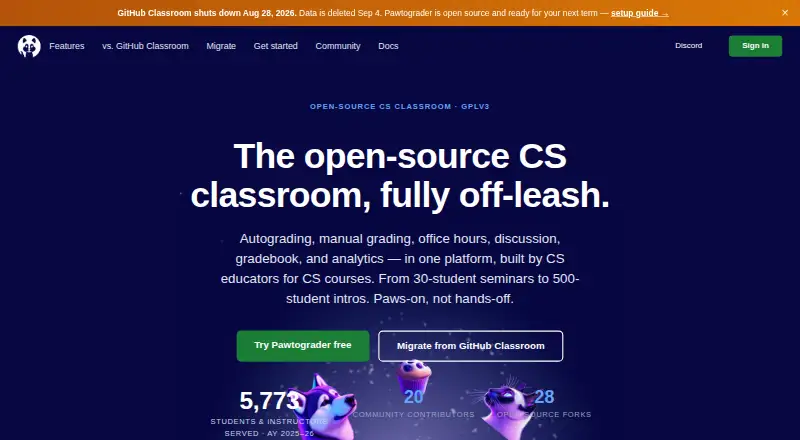
Pawtograder brings autograding, manual grading, office hours, discussion, a gradebook, and analytics together for computer science courses. Each commit can trigger tests through GitHub Actions, with individual test results shown in the grading interface. Rubrics support additive, deductive, and multi-level criteria, line-level annotations, and separate scoring for group members. The gradebook includes MathJS expression columns, drop-lowest calculations, CSV import, and a student what-if mode. Office hours queues support text, video, and screen sharing, and can show a student's linked submission and failing test. Discussion can surface threads related to known errors and allows public or staff-only posts. Calendar feeds and Discord mirroring cover course events; LTI 1.3 integrations with Canvas, Blackboard, Brightspace, and Moodle are roadmap items. Optional AI test hints and an MCP server are also listed. Pawtograder is GPLv3 open source and can run on its community instance or be self-hosted on Kubernetes using Helm charts. Self-hosting keeps data on institutional infrastructure, but requires GitHub Actions runners.
Who it suits
Pawtograder is designed for instructors, teaching assistants, and students in computer science courses. Self-hosting may suit institutions that want course data kept on their own infrastructure.
What it does well
- Commit-triggered tests show per-test results
- Rubrics support line annotations and group-member scoring
- Office hours support text, video, and screen sharing
- Open source under GPLv3
What to know first
- Requires institution-provided GitHub Actions runners
- Community instance is for evaluation; scale use requires contact
- One repository per assignment is assumed
Limits
The free community instance is for instructor evaluation; ongoing use at scale requires contacting the project. GitHub Actions runners are required, and the current repository model assumes one repository per assignment.
Plans
| Plan | Billed and limits | Price |
|---|---|---|
| Community instance | Free for instructors evaluating Pawtograder; talk to us about ongoing use at scale. · Evaluation use; ongoing use at scale requires contacting the project | Free |
As pawtograder.com lists them, read 7 Oct 2026. The maker's own page has the final word.
Getting started
- Visit https://pawtograder.com/.
- Choose the project-hosted community instance for evaluation or arrange self-hosting.
- For self-hosting, deploy on Kubernetes using Helm charts.
- Provide GitHub Actions runners, either GitHub-hosted or self-hosted.
- Use demo accounts by request if you want to explore the platform.
Pawtograder is an open-source course platform that joins automated code testing with grading and student-support work. It is best suited to computer-science instructors and teaching teams already organizing assignments in GitHub repositories. The strongest case is a unified workflow from failing test to feedback or help request; the main qualification is that your institution must supply GitHub Actions runners and accept its repository model.
Overview
Pawtograder combines autograding, manual grading, office-hours queues, discussion, a gradebook, and analytics in one course environment. Every commit can trigger tests through GitHub Actions, and the grading interface shows results for each test. That makes feedback more concrete for programming assignments and gives teaching staff a shared view of assessment and support rather than separate tools.
The project is GPLv3 open source. Instructors can use the project-hosted community instance or deploy it themselves on Kubernetes with Helm charts. Self-hosting keeps course data on institutional infrastructure and can suit FERPA, GDPR, and provincial data-residency requirements, but it also makes the institution responsible for deployment and operations. Pawtograder additionally requires GitHub Actions runners, either GitHub-hosted or self-hosted.
Key features
Rubrics support additive, deductive, and multi-level criteria, line-level annotations, and per-member scoring for group submissions. This is a useful combination for explaining code-specific decisions and separating individual contributions, though courses need to structure work around the platform's repository assumptions.
The gradebook supports MathJS expression columns, drop-lowest calculations, CSV import, and a student what-if mode. Those tools cover common course calculations and let students model outcomes before final grades. Office-hours queues handle text, video, and screen sharing, and can show a linked submission and failing test while staff help. Discussion can surface relevant threads for known errors and supports either public or staff-only posts.
Calendar feeds and Discord channel mirroring help connect course events to existing communication habits. LTI 1.3 connections for Canvas, Blackboard, Brightspace, and Moodle are described as roadmap items, so Pawtograder is not currently an LMS-integrated choice. An MCP server can provide a compatible AI client with context about an error, queue request, or discussion thread, while AI-generated test hints remain optional.
A significant constraint is the current repository model: each assignment assumes one repository. Multi-assignment repositories and assignments without repositories are identified as unbuilt requests, so courses using a different structure should look elsewhere.
Pricing
The Community instance costs 0.00 USD, billed Free, for instructors evaluating Pawtograder. It is suitable for evaluation, while ongoing use at scale requires contacting the project. No paid self-hosting or institutional-use price is stated, so larger deployments should expect custom pricing discussions rather than a published tier.
Platforms
Pawtograder runs as a web application and can be used through the project-hosted community instance or self-hosted on Kubernetes with Helm charts. Either route still depends on GitHub Actions runners, which the institution must provide or select.
Who it's for
It is aimed at instructors, teaching assistants, and students in computer-science courses where commits, tests, and repository-based assignments are central. Self-hosting is particularly relevant to institutions needing data to remain on their own infrastructure. It is a weaker fit for courses that require direct LMS workflows, avoid GitHub repositories, or cannot operate GitHub Actions runners. Discord community support and demo accounts by request give prospective teaching teams a way to assess the workflow before committing.
Pros and cons
Pros
- One workflow for code and support: per-test results, manual rubrics, office hours, discussion, and grade records are connected.
- Detailed assessment controls: line annotations, multi-level criteria, and per-member group scoring support programming feedback and team projects.
- Flexible deployment: the community instance is free for evaluation, while GPLv3 code and Kubernetes Helm charts enable institutional hosting.
- Useful grade calculations: MathJS expressions, drop-lowest rules, CSV import, and what-if mode cover practical course administration.
Cons
- Runner dependency: every institution must provide GitHub Actions runners, adding infrastructure and operational responsibility.
- Repository constraint: one repository per assignment does not suit multi-assignment repositories or repository-free assignments.
- No current LMS integration: LTI support for major LMS products is a roadmap item rather than a present workflow.
- Scale pricing is not self-serve: evaluation is free, but ongoing large-scale use requires contacting the project.
Alternatives
Choose Rubric Software when you want to compare rubric-focused products broadly rather than adopt a GitHub-centered course platform.
Gradescope is the better pick when you need Android, iOS, and web access, a free Basic tier, dynamic rubrics, question-by-question grading, assignment statistics, regrade requests, and data export.
GradeBoard suits a web workflow with a free plan capped at 10 learner submissions per month, limited rubric uploads, basic analytics, and 30-day data retention.
OpenRubric is an alternative for self-hosted, web-based rubric work with a free partner event rather than Pawtograder's course-wide workflow.
Rubric Scorer fits mobile-first users who need up to three rubrics for one class on its free app.
RubriqFlow is worth considering when unlimited faculty and staff accounts are more important and student access can be budgeted at $5 per student per semester.
UniRubric suits API and web users seeking one lifetime marking job on its free lecturer tier.
Quick Rubric is a free web option when publicly available rubrics and non-commercial reuse are acceptable.
RubiStar is a free web rubric tool for educational use, with rubrics subject to deletion if used personally or commercially.
Verdict
Pawtograder is a strong choice for computer-science teaching teams that want GitHub Actions tests, rich rubrics, grade calculations, and help queues in one open-source system. Choose it for the connection between a student's code and the people supporting that work, especially where self-hosting and data control matter. Look elsewhere if your assignments do not map to one repository each, your institution cannot provide runners, or direct LMS integration is essential.
Verdict
Pawtograder combines course grading and student support workflows, with community hosting or institutional self-hosting. Check the repository model and runner requirement against your course setup; ongoing use at scale requires contacting the project.
Questions
Is Pawtograder free?
The Community instance is listed as free. It is for instructors evaluating Pawtograder; ongoing use at scale requires contacting the project.
Is Pawtograder open source?
Yes. The platform is open source under the GPLv3 license.
Can an institution host Pawtograder itself?
Yes. Instructors can self-host on Kubernetes using Helm charts. The site says self-hosting keeps data on the institution's infrastructure.
Which platforms does Pawtograder support?
The listed platforms are self-hosted and web.
Does it integrate with learning management systems?
LTI 1.3 integrations with Canvas, Blackboard, Brightspace, and Moodle are described as roadmap items.
What does Pawtograder need for autograding?
The institution must provide GitHub Actions runners, either GitHub-hosted or self-hosted.
Facts from Pawtograder's own pages
- AI tools
- An MCP server provides context about a student's error, queue request, or discussion thread to MCP-compatible AI clients, and AI-generated test hints are optional. · pawtograder.com, 7 Oct 2026
- Audience and support
- The site describes Pawtograder as built for instructors, teaching assistants, and students, and offers Discord community support and demo accounts by request. · pawtograder.com, 7 Oct 2026
- Autograding
- Every commit can trigger tests through GitHub Actions, with per-test results shown in the grading interface. · pawtograder.com, 7 Oct 2026
- Data control
- The site says self-hosting keeps data on the institution's infrastructure and can fit FERPA, GDPR, and provincial data-residency requirements. · pawtograder.com, 7 Oct 2026
- Discussion
- The discussion board can surface relevant threads when students encounter known errors and supports public or staff-only posts. · pawtograder.com, 7 Oct 2026
- Gradebook
- The gradebook supports MathJS expression columns, drop-lowest calculations, CSV import, and a student what-if mode. · pawtograder.com, 7 Oct 2026
- Hosting
- Instructors can use the project-hosted community instance or self-host on Kubernetes using Helm charts. · pawtograder.com, 7 Oct 2026
- Integrations
- The site lists calendar feeds and Discord channel mirroring for course events; it describes LTI 1.3 integrations with Canvas, Blackboard, Brightspace, and Moodle as roadmap items. · pawtograder.com, 7 Oct 2026
- Known limit
- The current repository model assumes one repository per assignment; multi-assignment repositories and assignments without repositories are listed as unbuilt requests. · pawtograder.com, 7 Oct 2026
- License
- The platform is open source under the GPLv3 license, and the site links its code to github.com/pawtograder/platform. · pawtograder.com, 7 Oct 2026
- Office hours
- Office hours queues support text, video, and screen sharing, and can surface a student's linked submission and failing test. · pawtograder.com, 7 Oct 2026
- Purpose
- Pawtograder combines autograding, manual grading, office hours, discussion, a gradebook, and analytics for computer science courses. · pawtograder.com, 7 Oct 2026
- Rubrics
- Rubrics support additive, deductive, and multi-level criteria, line-level annotations, and per-member scoring for group submissions. · pawtograder.com, 7 Oct 2026
- Runtime requirement
- Pawtograder requires the institution to provide GitHub Actions runners, either GitHub-hosted or self-hosted. · pawtograder.com, 7 Oct 2026
Where Pawtograder stands on Freedom251
- Rubric Software#4 of 22