OpenRubric
What OpenRubric is
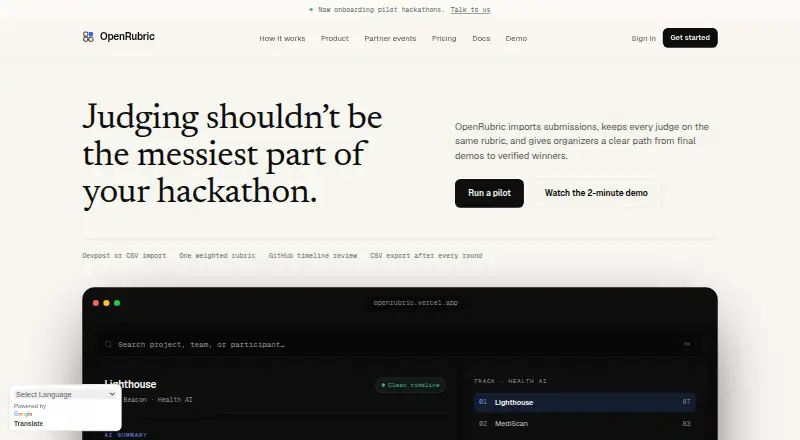
OpenRubric is a judging service for hackathons that helps organizers bring submissions together, set scoring criteria, coordinate judges, and produce event rankings. Projects can be imported from a public Devpost URL or CSV file, or entered manually. Organizers define weighted criteria and tracks; judges score each criterion, may add comments, and keep independent records. The service calculates winners by track and overall, with event data available for CSV export at any time. If configured with a GitHub token, it scans repository dates, commits, and contributors as timeline signals for organizers to review. People make the scoring and award decisions: OpenRubric does not judge projects, detect cheating, or automatically deduct points. AI can draft short project summaries for judges, and organizers can disable summaries without changing ranking calculations. A Partner event is listed as free for one event in kind. Managed events are billed at $50 to $100 per event; larger events are quoted before agreement. The service is onboarding pilot hackathons.
Who it suits
OpenRubric suits hackathon organizers and judges coordinating project reviews, scoring, and rankings. It may also suit organizers who want submission imports, GitHub timeline signals, and CSV export.
What it does well
- Imports projects from Devpost URLs, CSV files, or manual entry.
- Supports weighted criteria and separate judging tracks.
- Calculates track and overall winners.
- Exports event data to CSV at any time.
- AI summaries can be turned off without changing rankings.
What to know first
- Managed event pricing is $50 to $100 per event.
- GitHub timeline review requires a configured token.
- License does not permit redistribution or modification.
- No holistic rubrics or LMS integration.
Limits
The no-cost Partner event covers one event and is offered in exchange for sponsor recognition and permission for an anonymized case study. Managed events are billed at $50 to $100 per event, with larger events quoted before agreement.
Plans
| Plan | Billed and limits | Price |
|---|---|---|
| Partner event | first event · Event setup and rubric configuration · Devpost or CSV import · Judge onboarding · Live support · Rankings and CSV export · Sponsor recognition | Free |
| Managed event | per event · $50 to $100 per hackathon · AI credits · Rubric, tracks and judge assignments · GitHub timeline review · Email support · CSV backup · Larger events quoted | $50, paid once |
As openrubric.vercel.app lists them, read 15 Oct 2026. The maker's own page has the final word.
Getting started
- Visit the OpenRubric website.
- Choose a partner event or discuss a managed event.
- Import submissions from a public Devpost URL or CSV, or add projects manually.
- Set weighted criteria and tracks, then configure judge assignments.
- Optionally configure a GitHub token for repository timeline review.
- Onboard judges, conduct scoring, then export event results to CSV.
OpenRubric is a managed judging service for hackathon organizers coordinating project intake, judge scoring, and event results. It is best for events that need structured, track-based scoring while keeping award decisions with people. Its focused workflow is useful, but it is not a general grading platform.
Overview
Organizers can import projects from a public Devpost URL or CSV, or add them manually, then set up tracks and weighted scoring criteria. Judges score independently and may leave comments; OpenRubric calculates rankings by track and overall, with final scores and awards remaining human decisions. That makes it a coordination and ranking tool, not a cheating detector or automated judge.
GitHub review can surface repository dates, commits, and contributors as timeline signals when an organizer configures a token. Those signals are for people to review, not automatic point deductions. AI-generated summaries can give judges a short orientation to projects, and can be turned off without changing ranking calculations.
Key features
Scoring and event results
Weighted analytic criteria, tracks, independent records, and bulk scoring support the mechanics of judging multiple projects. Automatic rankings and CSV export reduce manual collation and make event data portable. The constraint is the scoring model: holistic rubrics are not supported, so events that judge primarily by one overall impression should look elsewhere.
Integrations and safeguards
Devpost and CSV imports cover two practical routes for bringing submissions into an event. GitHub review adds repository timeline context; Supabase handles hosted data and authentication, while AI model providers generate optional summaries. OpenRubric says row-level security isolates each judge's scores and that its server-only Supabase service key is not exposed to the browser. Hosted event data is retained while an account or event is active; the service says it does not sell data or use it for advertising.
There is no LMS integration or collaborative rubric authoring. The published license permits running an unmodified copy to evaluate the software or operate a bona fide judging event, but not redistribution or modification. That restriction matters for teams seeking to adapt or redistribute the code.
Pricing
| Plan | Price | What it includes | Best fit |
|---|---|---|---|
| Partner event | free | One event at no cost in exchange for sponsor recognition and permission for an anonymized case study; setup and rubric configuration, Devpost or CSV import, judge onboarding, live judging support, rankings, and CSV export. | A first event whose organizers can accept the recognition and case-study terms. |
| Managed event | Custom pricing; billed $50 to $100 per event | Flat fee per hackathon, with larger events quoted before agreement; AI credits, configured rubric, tracks and judge assignments, GitHub timeline review, email support, and CSV backup. | Organizers who want a managed event setup and support rather than the Partner event arrangement. |
The Partner plan is limited to one event and carries non-cash terms, while the managed option is charged per event rather than through a stated subscription. Managed events include email support before and during the event; pilot events include live support during judging. OpenRubric is onboarding pilot hackathons, so organizers looking for a standing, self-serve free tier should not assume the Partner offer is an ongoing allowance.
Platforms
OpenRubric is offered as a web service and as self-hosted software. Its license permits running an unmodified copy for evaluation or a bona fide judging event, but does not permit modifying or redistributing it.
Who it's for
OpenRubric is a strong fit for hackathon organizers who need a defined scoring process, multiple tracks, judge onboarding, and ranked results with CSV export. It also suits judges who want independent scoring records and optional project summaries. It is a weaker match for classroom workflows requiring LMS connections, collaborative rubric creation, or holistic scoring, and it will not replace human review of project integrity or award decisions.
Pros and cons
Pros
- Imports from Devpost, CSV, or manual entry, giving organizers more than one way to assemble submissions.
- Independent judge scoring, weighted criteria, tracks, bulk scoring, and automatic rankings support structured event judging without handing decisions to an algorithm.
- CSV export and backups help organizers retain event results outside the service.
- Optional AI summaries and GitHub timeline signals can add context without changing score calculations or automatically penalizing projects.
Cons
- No holistic rubrics, LMS integration, or collaborative authoring, limiting its usefulness beyond its hackathon workflow.
- The no-cost Partner event requires sponsor recognition and permission for an anonymized case study, and covers only one event.
- The license rules out redistribution and modification, constraining self-hosted adaptation.
- Hosted event data remains while the account or event is active, so teams should consider that retention condition when choosing a service.
Alternatives
For a broader set of rubric options, browse Rubric Software.
- Gradescope is a better option for assignment grading across Android, iOS, and web, with a free Basic plan that includes dynamic rubrics, question-by-question grading, statistics, regrade requests, and export.
- GradeBoard may suit educators looking for a web-based free tier with a monthly learner-submission allowance, AI model access, annotated DOCX downloads, analytics, and 30-day retention.
- Pawtograder is another self-hosted and web option, with a free community instance for instructors evaluating it; ongoing use at scale requires contacting its team.
- Rubric Scorer offers an Android and iOS app with a free allowance of up to three rubrics for one class.
- RubriqFlow has a free tier for unlimited faculty and staff accounts and student access priced at $5 a month per student per semester.
- UniRubric offers a free lecturer tier for one lifetime marking job, with rubric-anchored output, approval before release, and PDF export.
- Quick Rubric is a free web option for creating publicly available rubrics, with reuse in other projects limited to non-commercial use.
- RubiStar is a free web option for educational use, though rubrics may be deleted if used personally or commercially.
Verdict
Choose OpenRubric if you are organizing a hackathon and want submissions, independent judge scoring, track rankings, and event support in one focused workflow while keeping decisions human. The one no-cost Partner event can make it a practical starting point if its recognition and case-study terms suit your event. Look elsewhere if you need classroom integrations, holistic assessment, code you can modify or redistribute, or a continuing free plan without event-specific conditions.
Verdict
OpenRubric combines submission intake, judge scoring, and event rankings while leaving scores and awards to people. It offers one no-cost Partner event and paid managed events, with the published license limiting redistribution and modification.
Questions
Is OpenRubric free?
A Partner event is listed as free for one event, in kind. Managed events are billed at $50 to $100 per event, with larger events quoted before agreement.
What can I import?
Organizers can import submissions from a public Devpost URL or a CSV file, or add projects manually.
Does OpenRubric automatically score projects or detect cheating?
No. People make scores and award decisions, and the service does not automatically deduct points. GitHub review provides timeline signals for organizers to assess.
Can judges use AI summaries?
AI can draft short project summaries for judges. Organizers can disable the feature without changing ranking calculations.
What platforms does it support?
OpenRubric lists web and self-hosted platforms.
Can I redistribute or modify a copy?
The published license permits an unmodified copy for software evaluation or a bona fide judging event. It does not permit redistribution or modification.
Facts from OpenRubric's own pages
- AI rubric extraction
- The published project guide lists an AI feature that drafts rubric criteria from an uploaded rubric image. · github.com, 15 Oct 2026
- AI summaries
- The product can generate short project summaries for judges, and the summaries do not affect ranking calculations. · openrubric.vercel.app, 15 Oct 2026
- API
- The repository documents routes for hackathons, imports, submissions, scoring, rankings, GitHub scans, AI summaries and review-case resolution. · github.com, 15 Oct 2026
- API compatibility
- The AI summary endpoint accepts the OpenAI chat-completions format and can target OpenAI, Azure OpenAI, Together, Groq or local Ollama. · github.com, 15 Oct 2026
- Availability and audience
- OpenRubric says it is onboarding pilot hackathons and describes its service for hackathon organizers and judges. · openrubric.vercel.app, 2 Oct 2026
- CSV export
- Submissions, scores and rankings can be exported to CSV during judging or after results are calculated. · openrubric.vercel.app, 15 Oct 2026
- Data processors
- The privacy policy names Supabase, GitHub, an AI model provider and an SMTP or Gmail provider as service subprocessors. · openrubric.vercel.app, 15 Oct 2026
- Demo mode
- The application runs without environment variables in a demo mode containing a sample hackathon, five projects and three judges. · github.com, 15 Oct 2026
- Documentation depth
- The repository includes an end-to-end project guide, setup instructions, environment variables, API routes, scoring behavior and deployment guidance. · github.com, 15 Oct 2026
- GitHub review
- When configured with a GitHub token, OpenRubric scans repository dates, commits, and contributors for timeline signals that organizers review. · openrubric.vercel.app, 2 Oct 2026
- GitHub timeline review
- With a read-only GitHub token, the system checks repository creation, first and last commits, activity before or after the event and contributors. · openrubric.vercel.app, 15 Oct 2026
- Human decisions
- OpenRubric presents GitHub activity as review questions and never automatically deducts points or determines cheating. · openrubric.vercel.app, 15 Oct 2026
- Independent judge records
- Each judge has a separate score record and scores autosave without overwriting another judge's work. · openrubric.vercel.app, 15 Oct 2026
- Integrations
- Documented integrations include GitHub REST API, Devpost or CSV import, Supabase and an OpenAI-compatible AI provider. · github.com, 15 Oct 2026
- Legal update
- The privacy policy states it was last updated June 20, 2026. · openrubric.vercel.app, 15 Oct 2026
- Licence owner
- The license identifies Aadit Mehta as the sole owner and copyright holder in 2026. · github.com, 15 Oct 2026
- Licence status
- The GitHub README explicitly describes OpenRubric as proprietary software rather than open source. · github.com, 15 Oct 2026
- License limit
- The published license permits running an unmodified copy to evaluate the software or operate a bona fide judging event, but does not permit redistribution or modification. · openrubric.vercel.app, 2 Oct 2026
- Limit: Devpost API
- The documentation says Devpost has no stable public judging API, so OpenRubric imports only public metadata and falls back to CSV or manual links when automatic import fails. · github.com, 15 Oct 2026
- Limit: proprietary licensing
- The license forbids redistribution, modification, derivative works, hosting it as a service and competing products. · github.com, 15 Oct 2026
- Limit: young product
- The home page says OpenRubric is onboarding its first pilot hackathons and runs those events with the team present. · openrubric.vercel.app, 15 Oct 2026
- Privacy
- The hosted service says it does not sell data or use it for advertising and allows event exports and deletion requests by email. · openrubric.vercel.app, 15 Oct 2026
- Purpose
- OpenRubric is a managed judging service for hackathons that imports submissions, coordinates judging, reviews timelines, and produces rankings. · openrubric.vercel.app, 2 Oct 2026
- Rankings and export
- The service calculates winners per track and overall, and event data can be exported to CSV at any time. · openrubric.vercel.app, 2 Oct 2026
Where OpenRubric stands on Freedom251
- Rubric Software#2 of 22