Freedom251 › Alert Management Software
RightITnow ECM
What RightITnow ECM is
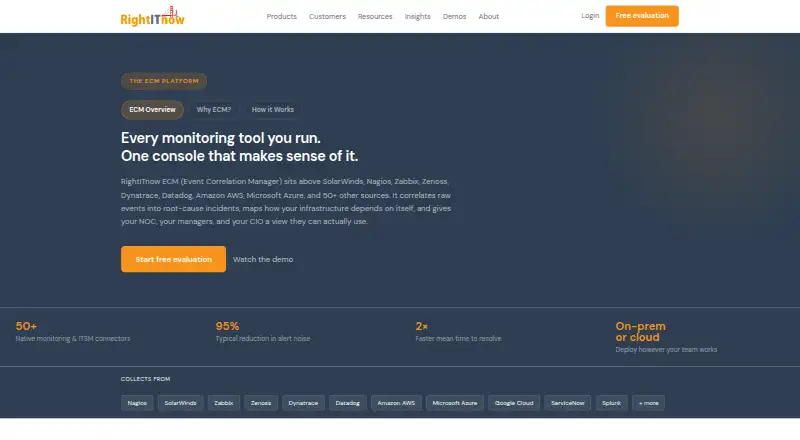
RightITnow ECM correlates events from monitoring tools into root-cause incidents and gives network operations teams and management a shared view. Configurable rules deduplicate, suppress, and group related alerts. Its live dependency graph uses discovered topology and a CMDB, highlighting critical paths to show causes and impact. Historical Trends tracks alert volume over 7-day, 30-day, 90-day, and one-year periods, with REST API export. The platform lists more than 50 connectors, including SolarWinds, Nagios, Zabbix, Dynatrace, Datadog, AWS, Azure, Google Cloud, and ServiceNow. Bidirectional ticket integration supports ServiceNow, Jira Software 9.x and Cloud, and BMC. Workflows can trigger remediation scripts, acknowledgements, or escalations when incidents are created or cleared. AI Incident Narrator produces plain-language summaries for NOC operators, IT managers, and CIOs. ECM is available as a cloud service or on premises, with dedicated nodes deployable across Azure, AWS, and Google Cloud. The iOS app lets on-call engineers receive and act on alerts. The free tier covers up to 100 managed entities; paid pricing is quote-based on entity count.
Who it suits
ECM may suit network operations teams and managers who need correlated incident views, monitoring integrations, and ticket workflows. Listed industries include financial services, MSPs and ISPs, government agencies, and IT consulting firms.
What it does well
- Configurable alert deduplication, suppression, and grouping
- Live dependency graph highlights critical paths
- More than 50 listed connectors
- Cloud and on-premises deployment options
What to know first
- Free tier is limited to 100 managed entities
- Paid pricing requires a quote
- iOS is the only listed mobile app
Limits
The Free tier supports up to 100 managed entities. Paid pricing is quote based on entity count, with no per-event licensing.
Plans
| Plan | Billed and limits | Price |
|---|---|---|
| Free tier | Up to 100 managed entities | Free |
| Paid plan | Quote based on entity count; no per-event licensing | On request |
As rightitnow.com lists them, read 8 Oct 2026. The maker's own page has the final word.
Getting started
- Visit the RightITnow products page.
- Choose the free tier, which supports up to 100 managed entities, or request a paid-plan quote based on entity count.
- Choose cloud service or on-premises deployment; dedicated nodes can be deployed across Azure, AWS, and Google Cloud.
- Connect monitoring tools using the listed connectors and configure alert correlation rules.
- On-call engineers can use the iOS app to receive alerts and acknowledge, escalate, or resolve incidents.
RightITnow ECM is an event-correlation and incident-management platform for teams that need to turn monitoring alerts into a shared operational picture. It is best suited to NOCs and IT operations groups managing complex dependencies across infrastructure and services. Its strongest case is the combination of correlation, topology, integrations, and response workflows; entity-based pricing and deployment choices should fit the team's environment.
Overview
ECM groups related monitoring events into root-cause incidents and gives operators and managers a common NOC view. Configurable deduplication, suppression, and grouping can reduce the noise responders face, while a live dependency graph links discovered topology and CMDB data to likely cause and impact. That makes ECM more compelling for teams with interconnected systems than for organizations seeking only a basic alert inbox.
Key features
Correlation and dependency context
Rules for deduplication and suppression help control repeated or irrelevant alerts, and grouping turns related events into incidents. ECM's dependency graph highlights critical paths, so responders can assess affected services alongside the initiating problem rather than treating alerts in isolation.
Integrations and response
More than 50 connectors include SolarWinds, Nagios, Zabbix, Zenoss, Dynatrace, Datadog, AWS, Azure, Google Cloud, and ServiceNow. Bidirectional ticket integration covers ServiceNow, Jira Software 9.x and Jira Software Cloud, and BMC. This breadth can suit teams that want incidents to flow into existing service-management tools, though connector count alone does not establish fit for any particular environment.
Automation workflows can run remediation scripts, send acknowledgements, or escalate when incidents are created or cleared. The iOS app lets on-call engineers receive alerts and acknowledge, escalate, or resolve incidents. AI Incident Narrator produces plain-language summaries for NOC operators, IT managers, and CIOs, helping different roles share an incident picture.
Analytics and anomaly analysis
Historical Trends tracks alert volume over 7-day, 30-day, 90-day, and one-year periods, with export through a REST API. Alerts can also be exported to Elasticsearch Cloud for real-time anomaly detection and analysis by severity, priority, and source. These options give operations teams ways to examine patterns beyond immediate incident response.
Pricing
ECM uses a freemium model, with a 45-day trial and custom pricing for paid use. The Free tier costs nothing and covers up to 100 managed entities. That cap makes it a defined-size entry point, not an unrestricted deployment; teams managing more entities will need a quote.
The paid plan is quote based on entity count and has no per-event licensing. Entity-based pricing may be easier to relate to managed infrastructure than event volume, but buyers should confirm the entity count and resulting quote against their environment. No seat quota or renewal term is established here, so neither should be assumed.
Platforms
ECM supports API, iOS, Linux, macOS, self-hosted, web, and Windows. It can run as a cloud service or on premises, and dedicated nodes can be deployed across Azure, AWS, and Google Cloud. The Alert Console is available in English, French, and Japanese. These options suit organizations with varied deployment requirements, while mobile incident response is specifically described for iOS.
Who it's for
ECM is a strong fit for NOCs and IT operations teams that need to correlate alerts across connected services, map dependencies, and coordinate incident response. Financial services, MSPs and ISPs, government agencies, and IT consulting firms are among the industries using it. Teams that need only basic alert routing, or cannot justify entity-based paid pricing, may prefer a narrower tool.
Pros and cons
- Pros: Configurable deduplication, suppression, and grouping can turn noisy monitoring events into more manageable incidents.
- Pros: A live topology graph with critical-path highlighting adds cause-and-impact context to response.
- Pros: More than 50 connectors, bidirectional ITSM integrations, and automated workflows connect incident handling to existing operations.
- Pros: Cloud and on-premises deployment, plus dedicated nodes across major cloud platforms, offer deployment flexibility.
- Cons: The free tier stops at 100 managed entities, which limits its reach for larger environments.
- Cons: Paid pricing depends on entity count and requires a quote, making cost harder to assess before sizing a deployment.
- Cons: The named mobile app is for iOS, which may not suit teams that require Android incident response.
Alternatives
Choose Grafana Cloud Application Observability if its always-free tier of 2,232 host hours fits the workload, or if its Pro plan's host-hour pricing and $19 monthly platform fee better match how you want to pay. Its listed platforms are Linux, macOS, web, and Windows.
Choose Wazuh if you want a free, open-source self-hosted option, or a listed Small plan starting at $571 a month. Its platforms include API, Linux, macOS, self-hosted, web, and Windows.
PagerDuty is an alternative for incident management.
Prometheus is an alternative for open-source monitoring and alerting.
TrueWatch Log Management is an alternative for log management.
AlertOps is an alternative for alert operations.
MISP is an alternative for security information sharing.
OpenNMS is an alternative for network management.
Verdict
RightITnow ECM is a sound choice for NOCs and IT operations teams that need alert correlation, dependency context, and incident workflows in one operational view. Its integrations and deployment range strengthen the case for complex environments. Look elsewhere if the 100-entity free cap is too small or a custom, entity-based quote does not fit your buying process.
Browse Alert Management Software for more options.
Verdict
ECM brings event correlation, topology, integrations, and incident workflows into a shared operations view. The free tier has a defined entity cap, while paid pricing depends on entity count.
Questions
What does RightITnow ECM cost?
The Free tier costs nothing and supports up to 100 managed entities. Paid pricing is quote based on entity count, with no per-event licensing.
Is there a free trial?
Yes. RightITnow lists a 45-day trial.
Where can ECM run?
ECM is available as a cloud service or for on-premises deployment. Dedicated nodes can also be deployed across Azure, AWS, and Google Cloud.
Which platforms does ECM support?
Listed platforms are API, iOS, Linux, macOS, self-hosted, web, and Windows.
Which ticketing integrations are supported?
ECM supports bidirectional ticket integration with ServiceNow, Jira Software 9.x and Jira Software Cloud, and BMC.
Who makes RightITnow ECM?
The facts give the maker’s founding date as January 2013 and headquarters as San Francisco, California, USA.
Facts from RightITnow ECM's own pages
- AI summaries
- AI Incident Narrator generates plain-language incident summaries for NOC operators, IT managers, and CIOs. · rightitnow.com, 8 Oct 2026
- Analytics
- Historical Trends tracks alert volume over 7-day, 30-day, 90-day, and one-year periods and can export through a REST API. · rightitnow.com, 8 Oct 2026
- Anomaly detection
- The product page says alerts can be exported to Elasticsearch Cloud for real-time anomaly detection and analysis of severity, priority, and source. · rightitnow.com, 8 Oct 2026
- Audience
- The company lists financial services, MSPs and ISPs, government agencies, and IT consulting firms among industries using ECM. · rightitnow.com, 8 Oct 2026
- Automation
- Automation workflows can trigger remediation scripts, acknowledgements, or escalations when incidents are created or cleared. · rightitnow.com, 8 Oct 2026
- Company history
- RightITnow says it was founded in January 2013. · rightitnow.com, 8 Oct 2026
- Deployment
- ECM is available as a cloud service or for on-premises deployment, with dedicated nodes also deployable across Azure, AWS, and Google Cloud. · rightitnow.com, 8 Oct 2026
- Event correlation
- It groups related alerts using configurable rules for deduplication, suppression, and grouping. · rightitnow.com, 8 Oct 2026
- Founded
- 2013 · rightitnow.com, 28 Sept 2026
- Headquarters
- San Francisco, California, USA · rightitnow.com, 28 Sept 2026
- Integrations
- The platform lists 50+ connectors, including SolarWinds, Nagios, Zabbix, Zenoss, Dynatrace, Datadog, AWS, Azure, Google Cloud, and ServiceNow. · rightitnow.com, 8 Oct 2026
- ITSM
- ECM supports bidirectional ticket integration with ServiceNow, Jira Software 9.x and Jira Software Cloud, and BMC. · rightitnow.com, 8 Oct 2026
- Language support
- The Alert Console is available in English, French, and Japanese. · rightitnow.com, 8 Oct 2026
- Mobile
- The ECM iOS app lets on-call engineers receive alerts and acknowledge, escalate, or resolve incidents. · rightitnow.com, 8 Oct 2026
- Purpose
- RightITnow ECM correlates events from monitoring tools into root-cause incidents and provides a shared NOC and management view. · rightitnow.com, 8 Oct 2026
- Topology
- ECM builds a live dependency graph from discovered topology and a CMDB, with critical-path highlighting for cause and impact. · rightitnow.com, 8 Oct 2026
Where RightITnow ECM stands on Freedom251
- Alert Management Software#10 of 36